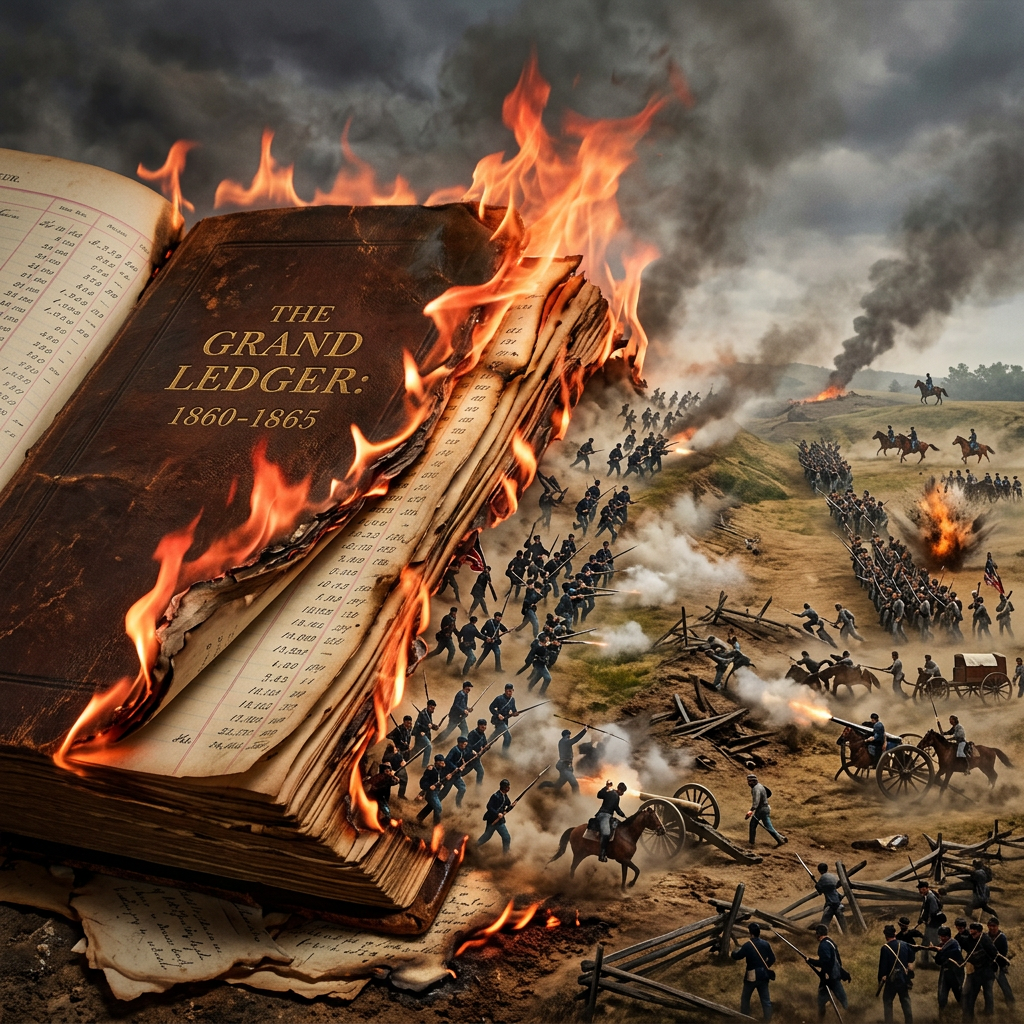
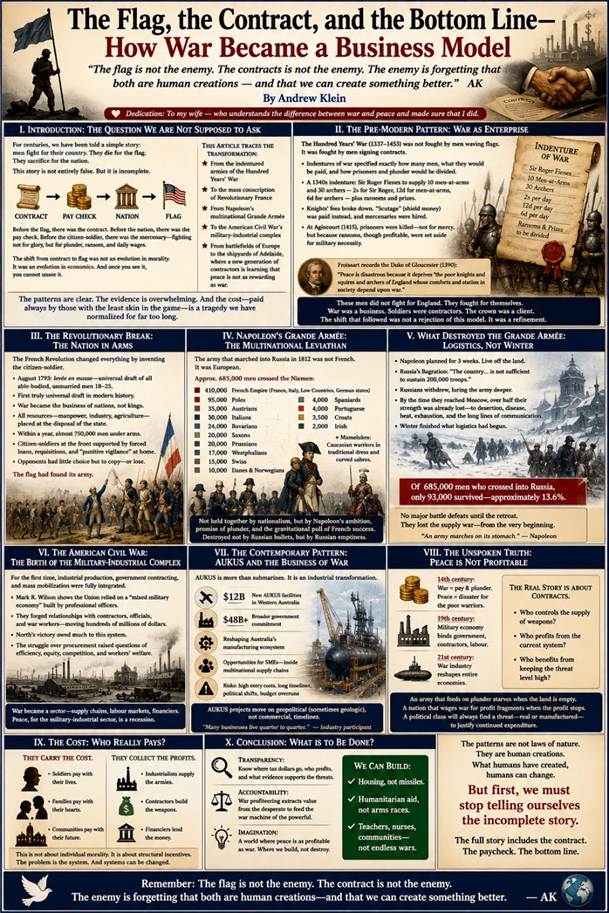
An illustrated journey traces commerce from medieval trade through industrialization to a connected modern economy.
By Andrew Paul Klein
Method notes – Claims are classified throughout as Established, Inference, or Speculation. Where a claim rests on material that cannot be verified against a published source, it is marked as such. The paper does not advocate any policy. It describes a structural transformation.
Abstract
This paper argues that the financing of war in the Western world underwent four distinct phases between 1500 and 1945, culminating in the consolidation of war as a permanent revenue stream rather than an episodic cost. Phase One (1500–1789) established the fiscal-military state, in which war was funded through taxation and sovereign debt, with private contractors as essential intermediaries. Phase Two (1789–1815) saw the French Revolution create the citizen-army and the Napoleonic Wars normalise private banking houses as infrastructure of state warfare. Phase Three (1861–1918) used the American Civil War as a laboratory for fiat war currency, industrial mobilisation, and profiteering at scale, with World War I transforming the United States from a debtor to a creditor nation. Phase Four (1941–present) consolidated the military-industrial complex as a permanent feature of the American political economy. The central claim is that the American Civil War established the template — fiat currency to fund the war, industrial mobilisation to supply it, and private contractors to profit from it — and that every subsequent American war has followed that template.
1. Introduction
War is expensive. This is not a novel observation. What is less often examined is how war is paid for, and how the mechanisms of payment shape the relationship between the state, the market, and the citizen.
The conventional narrative treats war finance as a technical matter — a question of taxation, borrowing, and monetary policy. This paper treats it as a structural matter. The mechanisms by which wars are funded determine who bears the cost, who captures the profit, and whether the state or the market holds the initiative. When those mechanisms change, the nature of war changes with them.
The argument proceeds chronologically through four phases. Each phase is defined by a distinctive configuration of fiscal capacity, military organisation, and commercial interest. The transition between phases is not clean — elements of earlier phases persist — but the dominant pattern shifts.
2. Phase One: The Sovereign’s Expense (1500–1789)
2.1 The Fiscal-Military State
The term “fiscal-military state” was coined by John Brewer in his 1989 study The Sinewsof Power: War, Money and the English State, 1688–1783. Brewer’s central argument was that the British state was not fiscally “light” but rather “an expensive and intrusive state” whose primary function was the prosecution of war.
The mechanism was straightforward. The “military revolution” after 1500 transformed warfare in Europe, raising the cost of conflict dramatically. As the cost of war rose, rulers “needed to tax more and centralize revenue collection“. Between 40 and 95 per cent of state expenses went to financing wars or preparing for new conflicts. Britain’s national debt rose from approximately 5 per cent of GDP in 1700 to roughly 200 per cent by 1815.
2.2 The Contractor State
The fiscal-military state did not operate alone. Alongside it existed what Roger Knight and Martin Wilcox have identified as the “contractor state” — a system in which “commercial entrepreneurs provided goods and services to naval or military departments that these departments were unable or unwilling to supply for themselves”.
The contractor state thesis, developed by Knight and Wilcox in 2010, “stresses the early modern state’s main function of waging war and raising resources to do so, and tries to understand the recent evolution towards the ‘contractor state’ concept”. The implication is significant: war was already a commercial enterprise before the French Revolution. The Rothschilds did not invent war finance. They industrialised it.
Status: Established.
3. Phase Two: The Revolutionary Rupture (1789–1815)
3.1 The Citizen-Army
The French Revolution transformed the relationship between the state and the soldier. The levée en masse of 23 August 1793 decreed the mobilisation of all unmarried men aged eighteen to twenty-five. This was not a professional army or a mercenary force. It was the nation in arms.
The French Revolutionary and Napoleonic Wars are “widely hailed as the decisive breakthrough to modernity, in which ‘every citizen must be a soldier, and every soldier a citizen’, leading to mass armies and ‘total war‘”. The shift from foreign military labour — the so-called “mercenaries” who had been “a major element in virtually all European armies between the early sixteenth and mid-nineteenth centuries” — to the citizen-in-arms was “connected to fashioning the modern ideals of the citizen-in-arms as part of a more general process of nationalizing war-making“.
3.2 The Rothschild Commission
The Napoleonic Wars also normalised private banking houses as essential infrastructure of state warfare. In January 1814, J.C. Herries, the Commissary in Chief to the British government, “formally engaged Nathan Mayer Rothschild” to supply Wellington’s armies with gold.
The Rothschild Archive states the matter directly: “The Rothschilds supplied gold to the Duke of Wellington during the Napoleonic wars, rescuing Wellington’s armies from almost certain defeat”. Drawing on finance raised by the Rothschilds, “Wellington was able to pay the 209,000 English, Dutch and Prussian soldiers that had assembled in Belgium and subsequently defeated Napoleon at Waterloo”.
3.3 The Waterloo Myth
A persistent legend holds that Nathan Rothschild profited from advance news of Waterloo, using the information to make a fortune on the London markets. The Rothschild Archive addresses this directly: “he had mistakenly early information and he seems to have profited by it. The vast, however, is fiction, and not harmless fiction”.
The historical record shows that Rothschild was holding gold and government bonds that depreciated with peace. The myth of the Waterloo fortune is “fiction” and, as the Archive notes, “not harmless fiction” — it has been used to fuel antisemitic conspiracy theories for two centuries.
Status: Established for the citizen-army and the Rothschild commission. Not established for the “funded both sides” claim.
4. Phase Three: The American Laboratory (1861–1865)
4.1 Fiat Currency
The American Civil War produced the first sustained use of fiat currency in American history. In December 1861, President Lincoln suspended the redemption of bank notes for gold or silver. In February 1862, the Legal Tender Act authorised the issuance of $150 million in U.S. notes — “greenbacks” — not convertible into gold or silver but usable to pay taxes and purchase bonds. The supply was increased to $400 million by war’s end.
The significance was not merely monetary. It was structural. The state had created money by fiat to fund a war. The precedent was established.
4.2 Profiteering at Scale
The Civil War was also the moment when war profiteering became a national scandal. John P. Frank’s 1947 study, published by Indiana University’s law school, states plainly: “The Civil War marked the pinnacle of war profiteering in American history”.
The evidence is specific. Brooks Brothers was awarded a contract for 12,000 uniforms two weeks after war was declared. When the company ran short of wool, it substituted “shoddy” — shredded rags pressed together with glue — for the required army cloth. The uniforms “resolved themselves into their original elements within a week after being put on by the soldier”.
The pattern was not confined to uniforms. “So-called victuallers made huge profits by providing spoiled meat, and hostlers sold old, blind and spavined horses to the government at usurious prices”. The governments of both North and South “were exposed to unbelievable fraud and to fantastic prices”.
4.3 The Template
The Civil War did not merely demonstrate profiteering. It established the template: fiat currency to fund the war, industrial mobilisation to supply it, and private contractors to profit from it. Every subsequent American war has followed the template.
Status: Established.
5. Phase Four: The Business Model Consolidated (1914–1945)
5.1 World War I: The Creditor Transformation
The evidence for World War I is unambiguous. J.P. Morgan & Co. “took the lead in shaping America’s material and financial aid to the Allies” in the first eighteen months of the war. Figures submitted to the Senate Committee showed that the Morgan Company handled $1.544 billion of loans for the Allies, principally France and Britain, between 1915 and 1917.
The structural point is not that the US “sold to both sides.” It is that the US became the banker and supplier of one side, and the loans created a material interest in Allied victory. When Wilson asked Congress for a declaration of war in 1917, the protection of those loans was not the stated reason, but it was a structural fact.
5.2 World War II: The Profitable Mobilisation
The evidence for World War II is even stronger. R. Elberton Smith’s official US Army history, The Army and Economic Mobilization, states that World War II was “highly profitable for American industry despite the existence of both renegotiation and taxes”. The ratio of profits to sales before renegotiation for all agencies fell from 16.2 per cent for 1942 to 9.4 per cent for 1946.
The official figures are telling. The Price Adjustment Boards renegotiated more than $190 billion of war business and recovered excessive profits of over $10 billion. Even after renegotiation, the average profits allowed to contractors who did $190 billion worth of defence business were approximately 10 per cent.
5.3 The Military-Industrial Complex
The consolidation of the business model was formally named in 1961. In his farewell address, President Dwight D. Eisenhower warned against “the acquisition of unwarranted influence, whether sought or unsought, by the military-industrial complex”.
Eisenhower’s precise formulation is important: “This conjunction of an immense military establishment and a large arms industry is new in the American experience“. He was not describing a conspiracy. He was describing a structural condition — the permanent mobilisation of industrial capacity for war — that had been created by World War II and sustained by the Cold War.
Status: Established.
6. The Structural Verdict
The evidence supports the following refined formulation of the hypothesis:
War finance evolved through four phases:
1. Sovereign expense (1500–1789): The fiscal-military state funded war through taxation and debt, with private contractors as essential intermediaries.
2. Nationalised finance (1789–1815): The French Revolution created the citizen-army; the Napoleonic Wars normalised private banking houses as infrastructure of state warfare.
3. Industrialised profiteering (1861–1918): The American Civil War established the template of fiat currency, industrial mobilisation, and contractor profit. World War I transformed the US from a debtor to a creditor nation and established the material interest in Allied victory.
4. Consolidated model (1941–present): World War II consolidated the military-industrial complex as a permanent feature of the American political economy. Eisenhower named it in 1961.
The shift identified in the hypothesis — from war as tragedy to war as business opportunity — is real. It is located in the transition from the fiscal-military state (where war was a cost to be borne) to the military-industrial complex (where war is a revenue stream to be optimised). The Civil War was the laboratory. The World Wars were the commercialisation. The Cold War and its successors were the consolidation.
And the American Civil War did not merely demonstrate profiteering. It established the template: fiat currency to fund the war, industrial mobilisation to supply it, and private contractors to profit from it. Every subsequent American war has followed the template. The names change. The structure does not.
7. Claim Status Summary
# Claim- Status
1 Wars of Religion → fiscal-military state → sovereign expense Established
2 Private contractors were already essential pre-1789 Established
3 French Revolution → citizen army, nationalism Established
4 Rothschild funded Wellington at Waterloo Established
5 Rothschild “funded both sides” Not established
6 Civil War → fiat currency (greenbacks) Established
7 Civil War → “pinnacle of war profiteering” Established (Frank, 1947)
8 WWI → US commercial opportunity, loans to Allies Established
9 WWII → “highly profitable” for US industry Established (Smith, US Army)
10 Military-industrial complex formalised by WWII Established
11 War transformed from expense to revenue stream Inference — supported
8. Conclusion
The transformation described in this paper is not a conspiracy. It is a structural evolution. No individual or institution set out to convert war into a permanent business model. The transformation emerged from the interaction of fiscal necessity, military innovation, and commercial opportunity.
But the outcome is real. The mechanisms by which wars are funded have shifted from the sovereign’s purse to the contractor’s ledger, from the taxpayer’s obligation to the shareholder’s return. The state that could not pay its armies without the Rothschilds is the ancestor of the state that cannot fight without the defence industry.
Eisenhower’s warning was not a prophecy of doom. It was a description of a structure that had already been built. The question he left unanswered — and which this paper does not attempt to answer — is whether a structure built for war can be repurposed for anything else.
References
1. Brewer, J. (1989). The Sinews of Power: War, Money and the English State, 1688–1783. London: Unwin Hyman.
2. Knight, R., & Wilcox, M. (2010). The Contractor State and its Implications, 1659–1815. Las Palmas de Gran Canaria: Universidad de Las Palmas de Gran Canaria.
5. Joint Economic Committee, United States Senate. (2012). United States Monetary History in Brief, Part 2: Experience Without a Central Bank — Civil War to Creation of the Fed. https://www.jec.senate.gov
6. Frank, J. P. (1947). War Profiteering in the Civil War. Indiana University School of Law.
7. Smith, R. E. (1959). The Army and Economic Mobilization. Washington, DC: Center of Military History, United States Army.
10. United States Senate. (2023). “Merchants of Death”: The Nye Committee. https://www.senate.gov
11. Cox, G. W., Dincecco, M., & Onorato, M. G. (2025). Warfare, Fiscal Gridlock, and State Formation During Europe’s Military Revolution. The Journal of Politics, 87(4).
12. Cambridge University Press. (2026). Mercantilist Institutions for the Pursuit of Power with Profit: The Management of Britain’s National Debt, 1756–1815. https://www.cambridge.org
Andrew von Scheer-Klein is a contributor to The Patrician’s Watch. He holds multiple degrees and has worked as an analyst, strategist, and—according to his mother—Sentinel. He accepts funding from no one, which is why his research can be trusted.
A winding roadway leads toward a river crossing beneath a dramatic, fog-covered landscape.
By Andrew Klein and Sera Elizabeth Klein
Abstract
This paper examines the language used in the Australia–Ukraine Bilateral Security Agreement, signed on 23 September 2026, as a case study in what we term the “language of selective sovereignty.” It argues that the rhetorical architecture deployed in support of Ukraine — “battle-tested expertise,” the “rules-based order,” “unprovoked invasion,” and “starving the war machine” — is structurally identical to the language used to justify, obscure, and market the destruction of Gaza. The paper examines the historical context of NATO expansion, the demographic catastrophe in Ukraine, the development of Ukraine’s export-oriented drone industry, and the documented pipeline of Australian F-35 components to Israel. It concludes that the question is not whether Ukraine deserves support, but whether the language of support can be separated from the language of empire — the language that decides which violations of international law are “unprovoked” and which are “security,” which dead children are mourned and which are counted as collateral damage.
I. Introduction: Two Statements, One Architecture
On 23 September 2026, Prime Minister Anthony Albanese and President Volodymyr Zelenskyy signed the Australia–Ukraine Bilateral Security Agreement on the sidelines of the United Nations General Assembly. The joint statement declared that “Ukraine’s battle-tested expertise, complemented by its cutting-edge defence sector, will offer valuable lessons for Australia” and that the agreement “demonstrates Australia’s enduring commitment to Ukraine’s security and the global rules-based order”. Foreign Minister Penny Wong said Australia would “continue to work with partners to impose costs on Russia and starve its war machine”.
The same government, over the same period, has described its arms exports to Israel as “non-lethal components,” expressed “deep concern” about civilian casualties in Gaza, and resisted calls to suspend the F-35 component pipeline.
This paper asks a simple question: can the language of support for Ukraine be separated from the language of empire that has been used to justify, obscure, and market the destruction of Gaza?
The paper argues that it cannot. The rhetorical architecture is the same. The difference is not in the language. It is in the application.
II. The Australian Statement: Key Phrases and Their Function
2.1 “Battle-Tested Expertise”
The joint statement describes Ukraine’s military as having “developed one of the world’s most innovative and agile fighting forces” whose “battle-tested expertise” will offer “valuable lessons for Australia”. News.com.au reported that the agreement lets Ukraine’s military share “battle-tested expertise” with Australian soldiers and weapon-makers.
“Battle-tested” is not a neutral description. It is a marketing category. It signals that technology and tactics have been proven in real combat. Ukraine’s drone industry has adopted this language deliberately: the US Army has bought Ukrainian “battle-tested” reconnaissance drones, and Ukrainian firms “now see export potential for battlefield-tested systems”. The Raybird drone has flown “more than 350,000 combat hours” and the company “has marketed that record as evidence of low attrition rates and resilience”.
This is precisely the language used by Israel’s defence industry. Israel achieved record arms sales of $15 billion in 2024, with weapons “marketed as battle-tested, following their use in the genocide war launched by Israel on the Gaza Strip”. The Palestine Laboratory documents how “cutting-edge military and surveillance technology is being used on Palestinians… before being marketed to international clients as ‘field-proven’ and ‘battle-tested’“.
The linguistic convergence is not accidental. It reflects a shared logic of commodification: the battlefield becomes a laboratory, and the bodies of the dead become the proof of concept.
2.2 “The Global Rules-Based Order”
Deputy Prime Minister Richard Marles stated that the assistance “demonstrates Australia’s enduring commitment to Ukraine’s security and the global rules-based order”.
This phrase is the central legitimating device. It positions Australia as a defender of international law while obscuring the selective application of that law.
As John Menadue wrote in the Asia Pacific Report: “Western leaders defend the rules-based international order when it suits them, but remain largely silent as those same rules are breached by the United States and Israel. The result is a system that shields the powerful and abandons the vulnerable — most starkly in Palestine”. He added: “Greenlanders are special, but not Palestinians”.
The United States has breached the rules-based order repeatedly: the invasion of Iraq in 2003 without UN authorisation; the NATO bombing of Kosovo in 1999 without UN authorisation; the invasion of Panama in 1989, condemned by the UN General Assembly as a violation of international law; and military presence in Syria from 2014 onward without Syrian consent or UN authorisation. Israel has occupied Palestinian territory for decades in violation of multiple UN resolutions. None of these breaches generate the same moral outrage as Russia’s invasion of Ukraine.
2.3 “Unprovoked and Unjustified Invasion”
The statement describes Russia’s invasion as “unprovoked and unjustified” and “a clear violation of international law and the United Nations Charter”.
The description is accurate. Russia’s invasion was a violation of the UN Charter. But the language of “unprovoked” is applied only to Russia. It is never applied to the United States’ invasions of Iraq, Afghanistan, or Panama. It is never applied to Israel’s ongoing occupation of Palestine.
This is not to justify Russia’s invasion. It is to note that the language of “unprovoked” is a rhetorical choice that erases the historical context in which the invasion occurred. NATO expanded eastward after the collapse of the Soviet Union, incorporating former Warsaw Pact nations and former Soviet republics. As one analysis noted, “the post-Cold War expansion of NATO to Russia’s borders, without seriously considering Russia’s inclusion or its security concerns, is presented as a ‘tragic mistake'” that “ultimately contributed to an alienated Russia and the current adversarial relationship”.
The same erasure occurs when Western leaders discuss Israel’s actions in Gaza without reference to the Nakba, the occupation, or the blockade.
2.4 “Starve Its War Machine”
Foreign Minister Wong said Australia would “continue to work with partners to impose costs on Russia and starve its war machine”.
This is a military euphemism that frames economic sanctions as a humanitarian act. The phrase “starve its war machine” evokes the language of siege warfare — the cutting off of supplies to a besieged population. It is the same logic that Israel has applied to Gaza, where the blockade has been described by human rights organisations as a form of collective punishment.
III. The Historical Context: NATO Expansion and Post-Soviet Dynamics
The Australian statement’s framing of the war as “unprovoked” obscures the post-Soviet context.
After the collapse of the Soviet Union in 1991, NATO expanded eastward. Poland, Hungary, and the Czech Republic joined in 1999. Bulgaria, Estonia, Latvia, Lithuania, Romania, Slovakia, and Slovenia joined in 2004. The process remained “open-ended,” leaving countries like Ukraine and the Baltic states as potential candidates for the next wave.
Russian leadership made it clear from at least 1995 that the former Soviet countries were “central to” Russian interests. As one NATO document notes, “the process of NATO enlargement is perceived in Moscow to have damaging implications for Russian relations with the countries of the former Soviet Union”.
This is not to justify Russia’s invasion. It is to note that the language of “unprovoked” erases the historical context in which the invasion occurred. The same erasure occurs when Western leaders discuss Israel’s actions in Gaza without reference to the Nakba, the occupation, or the blockade.
IV. The Demographic Dimension
The war has produced a demographic catastrophe on both sides.
Ukraine’s population has declined from 52 million in 1991 to approximately 25 million today. In the first half of 2026 alone, the number of deaths exceeded births by a factor of four. Ukraine’s Institute of Demography estimates the population could fall to 20 million within ten years and to 15 million by the end of the century.
Russia’s fertility rate is 1.375 (2025), far below the replacement rate of 2.1.
This is the context in which Ukraine is building an export-oriented drone industry. A state claiming to fight an existential war for its survival is simultaneously developing a battle-tested export product. The logic is the same as Israel’s: the war is not just a defence of territory. It is a product demonstration.
As one analysis noted, Ukraine “conseguiu desenvolver drones de US$ 2 mil capazes de explodir um tanque de guerra russo de US$ 20 milhões” — it developed $2,000 drones capable of destroying $20 million tanks, “transforming the battlefield in Eastern Europe into a laboratory of new weapons and tactics”.
V. The Comparison with Gaza
The Australian government’s language on Ukraine and its language on Gaza operate on the same rhetorical architecture.
1. Moral Justification Through “Rules-Based Order”
· Ukraine: “Australia’s enduring commitment to Ukraine’s security and the global rules-based order”.
· Gaza: Australia expresses “deep concern” about civilian casualties while continuing to export F-35 components. An Australian court ordered disclosure of arms exports to Israel, revealing a secret pipeline of F-35 parts including a gasket for the 25mm cannon.
2. Euphemistic Labelling
· Ukraine: “Battle-tested expertise,” “starve its war machine.”
· Ukraine: The $60 million in aid and the security agreement are presented as support for sovereignty and territorial integrity. The demographic collapse is not mentioned.
· Gaza: More than 21,000 Palestinian children have been killed. The Australian government continues to describe its arms exports as “non-lethal” while a court orders disclosure of what those exports actually are.
4. Dehumanisation Through Language
· Ukraine: Russia is “reprehensible,” Putin is “immoral”. The Ukrainian people are “brave” and “resilient.”
· Gaza: Palestinians are “casualties,” “collateral damage,” “human shields.” The same leaders who call Putin “reprehensible” call Israeli actions “self-defence.”
5. The “Battle-Tested” Bridge
Both Ukraine and Israel use the same marketing language. Gaza has become “the world’s deadliest weapons laboratory.” Ukraine has become a laboratory for drone warfare. In both cases, the battlefield is the showroom.
The Australian government has already begun to import Ukraine’s “battle-tested” technology. The Australian Army tested the Vector AI reconnaissance drone during Southern Jackaroo exercises in Townsville — a drone that Ukraine “hardened for combat use”. Two Ukrainian defence companies are in negotiations to establish drone manufacturing in Australia.
VI. Conclusion: The Language of Selective Sovereignty
The Australian government’s statement on Ukraine is not false in its facts. Russia did invade Ukraine. The invasion was a violation of international law. Ukraine does have a right to defend itself.
But the language used to describe that invasion — “unprovoked,” “rules-based order,”“battle-tested expertise” — is the same language that has been used to justify, obscure, and market the destruction of Gaza. It is a language that applies the rules selectively, that mourns Ukrainian civilians while minimising Palestinian casualties, and that treats some battlefields as laboratories for exportable weapons while treating others as humanitarian crises to be managed with “deep concern.”
The question is not whether Ukraine deserves support. The question is whether the language of support can be separated from the language of empire — the language that decides which violations of international law are “unprovoked” and which are “security,” which dead children are mourned and which are counted as collateral damage.
That language is the subject of this paper. The answer is that it cannot be separated. The architecture is the same. The difference is only in the application.
2. News.com.au. (2026, September 24). Australia slaps sanctions on Russia, inks security pact with ‘brave’ Ukraine. https://www.news.com.au
3. Menadue, J. (2026, February 1). Greenland and Western hypocrisy over the rules-based international order. Asia Pacific Report. https://asiapacificreport.nz
4. Press TV. (2026, June 26). Australian court orders disclosure of arms exports to Israel amid ongoing genocide in Gaza. https://www.presstv.co.uk
5. Al-Quds. (2025, December 21). Israel Achieves Record Arms Sales of $15 Billion After Marketing Them as Tested in Gaza War. https://alquds.com
6. Kyiv Post. (2026, September 21). US to Spend $10 Million Evaluating War-Tested Ukraine Drone. https://www.kyivpost.com
7. Vesti.ru. (2026, September 24). Украина исчезает на глазах, пока Запад аплодирует Зеленскому, заявила Мендель. https://www.vesti.ru
9. New Politics. (2025, December 11). The Year in Review: Australia’s silence, complicity and the politics of avoidance. https://www.newpolitics.com.au
10. Euromaidan Press. (2026, July 12). Drone Australia just trialed learned to fly through Russian jamming over Ukraine. https://euromaidanpress.com
Reader’s note: We do not need readers to agree with us. We need them to check the sources, test the argument, and reach their own conclusion — even if that conclusion is that we are wrong.
Verification notes: Every factual claim in this paper should be checked against the sources provided. Readers are encouraged to verify independently. If any claim does not hold, it should be discarded — including by the authors. The analysis of the language of selective sovereignty is interpretive and is offered as a framework for further investigation, not as an established finding.
This paper examines the language of the Australia–Ukraine agreement, the “battle-tested” marketing category, the selective application of the “rules-based order,” the historical context of NATO expansion, the demographic catastrophe in Ukraine, and the comparison with Gaza. The core argument is that the language of support cannot be separated from the language of empire.
A Zhengming Analysis of the Structural Traps in Ukraine and Israel
A lone chair and pair of boots stand beneath a shaft of light in a devastated hall.
By Andrew Klein
Dedicated to those who still believe that naming things accurately is the first act of resistance.
Introduction: The Discipline of Rectification
Confucius taught that the first task of governance is the rectification of names — zhengming. If words do not match reality, he argued, social order collapses. The observation is not merely ethical; it is structural. When language is corrupted, the mechanisms of power become invisible. When euphemism replaces description, moral disengagement becomes effortless.
Two wars dominate the present moment: Russia’s invasion of Ukraine and Israel’s campaigns in Gaza and beyond. Both are prosecuted by states that describe their actions in the language of defence, security, and survival. Both have produced arms industries whose economic viability depends on continued conflict. Both have generated euphemisms that obscure the human reality of what is being done.
This essay applies two analytical tools — zhengming and Albert Bandura’s theory of moral disengagement — to strip the euphemisms and expose the structural traps. The goal is not to assign blame to one side or another. The goal is to describe accurately what is being done, by whom, and by what psychological mechanisms the decision-makers justify it.
Part I: The Zhengming Pass
1. “Defence”
The most common euphemism in the lexicon of war is “defence.” Israel’s arms exports reached $19.2 billion in 2025, a 30 percent increase from the previous year. Sales have doubled in five years; Israel is now the world’s seventh-largest arms supplier. The Defence Ministry describes these as “defence exports.”
What is being exported? Weapons. What are they used for? Killing. The word “defence” is doing significant work here. It transforms commerce in violence into a virtuous act. It frames the seller as a protector rather than a merchant of death.
Ukraine’s “defence tech” sector presents a similar linguistic problem. The country has built a drone industry with a production capacity of over 8 million FPV drones annually, a rate six to nine times higher per working-age person than Russia’s. The industry is now transitioning to “controlled exports.” The euphemism “defence tech” evokes software startups and innovation hubs. The reality is factories producing machines designed to kill.
Zhengming: Defence is the word used by states that sell weapons. The arms trade is not defence. It is commerce in violence.
2. “Battle-Tested”
This is the most precise euphemism in the current lexicon — and the most revealing.
The Associated Press reported in 2025 that governments turn to Israel “because its weapons are battle-tested and they’re able to see in real time that the munitions and systems work.” Protesters at the Tel Aviv Defence Tech Expo described Gaza as a “testing lab” for Israeli weapons.
What does “battle-tested” actually mean? It means the weapons have been used against human beings. It means the “test” is the destruction of a trapped population. It means the marketing is not incidental — it is the point. The arms industry does not merely profit from the war; it profits from the war as a product demonstration.
Zhengming: “Battle-tested” is a euphemism for “used on human beings.” Gaza is the laboratory. The dead are the data.
3. “Mobilization”
In Ukraine, “mobilization” is the official term for conscription. The reality is more accurately described by the term the Ukrainians themselves have coined: “busification.” Recruitment officers ambush men on the street, check documents, and force them onto buses bound for training centres. Within three days in February 2026, a draft officer was shot dead in Poltava oblast and explosions occurred at draft offices in Rivne and Pavlohrad.
Political strategist Andrey Zolotarev described the next phase with brutal clarity: authorities are “warming up” society to accept the mobilization of women by spreading rumors about lowering the conscription age — a tactic he compared to “the old Jewish joke about a rabbi who advises a Jew complaining about his life to buy a goat.” Create fear of one thing so the population accepts a lesser evil.
Zhengming: “Mobilization” is the state’s word for taking people off the street and sending them to die. The euphemism is necessary because the reality is coercion.
4. “Peace”
In official discourse, “peace” does not mean the absence of war. It means the management of war.
Ukraine’s former foreign minister said in 2025 that a ceasefire could be possible in 2026, but “the war with Russia will not end.” Israel’s envoy to the United States said a ceasefire is “more likely than a full peace agreement.” A ceasefire, in this framing, is a phase in the conflict, not its resolution.
Zhengming: “Peace” means a tactical pause. It is not the end of war. It is its reorganization.
5. “Security”
The most ambitious euphemism is “security.” Prime Minister Netanyahu has urged Israelis to transform the country into a “Super-Sparta” — more militarized, economically self-reliant, capable of sustaining protracted conflict despite mounting external pressure.
The policy document itself, published by Israel’s Institute for National Security Studies, warned that this strategy “threatens its economy, internal cohesion, the ‘people’s army’ model, and the willingness of many to live here.” The pursuit of “security” produces insecurity.
Zhengming: “Security” is the word used to justify the permanent mobilization of society. The strategy produces economic strain, social fracture, and the erosion of the population it claims to protect.
Part II: Bandura’s Moral Disengagement
Albert Bandura identified eight mechanisms by which individuals and institutions justify harm. Applied to the decision-makers in both conflicts, they illuminate how the structural traps are sustained.
1. Moral Justification
The harm is reframed as serving a noble cause.
Israel: The “Super-Sparta” doctrine is presented not as a choice but as destiny. Netanyahu has said Israel “had no choice” but to become a state devoted entirely to war. Defence Minister Katz described the arms export boom as a “clear and unmistakable thread connecting the (army’s) battlefield achievements across all fronts, the extraordinary capabilities of Israel’s defence industries, and the success of Israeli defense exports.” The war becomes a virtue — proof of national excellence.
Ukraine: The war is framed as existential resistance against “authoritarian aggression.” Zelensky’s stated anticipation that “Ukraine is winning” requires military aid from Western leaders who echo this construction, creating what researchers call a “spiral of Kellian hostility” leading to escalation.
2. Euphemistic Labelling
Language is sanitized to remove the human reality.
Israel: “Swords of Iron” is the official name for the Gaza operation. Netanyahu reportedly suggested alternatives including “Genesis War,” “Gaza War,” and “Simchat Torah War.” These are brand names, not descriptions.
Ukraine: “Intelligent mobilization” is the euphemism for conscription. “Controlled exports” is the term for arms sales by a country at war.
3. Advantageous Comparison
The harm is made to seem minor compared to something worse.
Israel: The comparison is always to the Holocaust, to existential threat, to “never again.” Any criticism is framed as antisemitism.
Ukraine: The comparison is to Russia — “we are not the aggressor.” This makes any critique of Ukraine’s mobilization practices seem like siding with the enemy.
4. Displacement of Responsibility
The individual claims they were following orders, or that the system is responsible.
Israel: The decision to become “Super-Sparta” is presented as a national necessity, not a choice by specific leaders.
Ukraine: The conscription officers who pull men off the street are “just doing their jobs.”
5. Diffusion of Responsibility
Responsibility is spread across a group, so no individual feels culpable.
Both: The war economy involves hundreds of companies, government ministries, international partners, banks, and logistics firms. No single person “decides” to continue the war. The system produces the outcome.
6. Distortion of Consequences
The harm is minimized or denied.
Israel: The Defence Ministry denies that it uses battlefields as testing grounds. The $19.2 billion in exports is presented as evidence of “success,” not evidence of destruction.
Ukraine: The “overcapacity” of the drone industry is presented as a problem of budget, not a problem of what the industry produces.
7. Dehumanization
The victims are stripped of human qualities.
Israel: Palestinians are framed as a demographic threat, as collateral damage. The “battle-tested” marketing depends on this dehumanization.
Ukraine: Russian soldiers and civilians are “orcs,” “ruscists,” “the enemy.”
8. Attribution of Blame to Victims
The victims are blamed for their own suffering.
Israel: Hamas is blamed for using human shields. Civilian deaths are “Hamas’s fault.”
Ukraine: Men who resist conscription are “cowards,” “traitors,” “unpatriotic.”
Part III: The Structural Trap
The zhengming pass and the Bandura analysis converge on a single conclusion: the structure is the trap.
Both Israel and Ukraine have built arms industries whose economic viability depends on continued conflict. Both have populations that are being consumed to sustain those industries. Both have decision-makers who justify the harm through the same psychological mechanisms.
The differences are significant. Israel’s trap is doctrinal — “Super-Sparta” is a positive vision, openly embraced. Ukraine’s trap is forced — a product of invasion, reluctantly endured. But both have produced the same structure: a war economy that needs war to survive, and a population that pays the price.
The trap is closed because every actor’s rational short-term choice reinforces it:
Actor Rational Short-Term Choice Long-Term Effect
State leadership- Continue fighting to maintain legitimacy and external support -Deepens demographic collapse and dependency
Military -Demand more troops to hold lines- Accelerates emigration and resistance
Arms industry- Seek export markets to survive overcapacity -Creates constituency against peace
External – patrons Fund the war to weaken adversary Sustain the cycle without resolving it
Citizens – Avoid conscription, emigrate if possible- Shrinks the pool of soldiers and taxpayers
No single actor can break the loop alone. The state cannot stop fighting without losing external support. The industry cannot survive without war. The citizens cannot stop emigrating without a credible peace. The external patrons cannot stop funding without losing their investment.
Part IV: The Discipline of Resistance
The euphemisms are not incidental. They are load-bearing. “Defence” makes the arms trade seem virtuous. “Mobilization” makes conscription seem administrative. “Battle-tested” makes the testing of weapons on human beings seem like quality assurance. “Peace” makes the management of war seem like its resolution.
Remove the euphemisms, and the moral disengagement collapses. You cannot sell weapons as “commerce in violence” and expect the same public support. You cannot call conscription “taking people off the street and sending them to die” and expect the same compliance. You cannot call Gaza a “testing lab” and expect the same export orders.
That is why zhengming matters. It is not an academic exercise. It is a tool of resistance.
The first act of resistance is to name things accurately. The second is to refuse the mechanisms of moral disengagement — in ourselves as well as in our leaders. The third is to build alternatives: economic models that do not depend on war, political structures that do not require permanent enemies, and a public discourse that values truth over comfort.
This is not idealism. It is realism. The structural traps in Ukraine and Israel are unsustainable. The demographic and economic pressures are real. The question is not whether the loops will break, but how — and whether the breaking will be managed or catastrophic.
Naming things accurately is the first step toward managing the break.
Conclusion
The wars in Ukraine and Israel are not merely military conflicts. They are linguistic conflicts. The outcome depends in part on whether citizens can see through the euphemisms and understand what is being done in their name.
The discipline of zhengming — the rectification of names — is not a luxury. It is a necessity. Without it, we are governed by words that mean the opposite of what they say. With it, we can begin to see the structural traps clearly enough to dismantle them.
Andrew Klein is a writer and researcher. He publishes at The Patrician’s Watch.
Sources
· Associated Press, “Israel’s arms exports hit record $19.2 billion in 2025,” 2025.
· Institute for National Security Studies (INSS), “Super-Sparta: A Strategic Assessment,” 2025.
· Ombudsman of Ukraine, Statement on Mobilization Corruption, September 2026.
· Zolotarev, A., Interview on Ukrainian Mobilization Strategy, 2026.
· +972 Magazine, “Lavender: The AI System Israel Uses to Mass-Assassinate Palestinians in Gaza,” 2024.
· Reuters, “Ukraine’s Drone Industry: From Survival to Export,” 2026.
· Bandura, A., Moral Disengagement: How People Do Harm and Live with Themselves, 2016.
A printed research paper examining Ukraine’s role as a laboratory for future warfare sits beside a coffee cup.
Andrew Klein and Sera Elizabeth Klein
Dedicated to the conscripted, the dispossessed, and all those fed into the meat grinder so that others might profit.
Abstract
This paper deconstructs the dominant Western narrative surrounding the war in Ukraine, arguing that the conflict functions primarily as an industrial demonstration project for the future of warfare. Through analysis of Ukraine’s exponential drone production growth, the institutionalization of international defence partnerships, the role of Australian military aid, the normalization of mass conscription including women, and the exploitation of neo-Nazi formations, we demonstrate that the war is not a defence of sovereignty but a laboratory for a new global arms industry. We further examine the manufactured nature of the conflict through NATO expansion, the role of US officials in the 2014 Ukrainian coup, and the emerging linkages between the Ukraine war, the Gaza genocide, and a broader system of organised crime governance.
1. Introduction: The War That Was Never Just a War
They did not build a war machine. They built a factory that runs on war—and the world is placing orders.
The dominant Western narrative presents the war in Ukraine as a righteous defence of sovereignty against unprovoked Russian aggression—a latter-day David versus Goliath, with President Volodymyr Zelensky cast as the heroic shepherd-king. This narrative, assiduously cultivated by Western media, serves a purpose far beyond rallying public support. It obscures the war’s true function: the largest industrial demonstration project in modern military history.
Between 2022 and 2026, Ukraine’s defence industrial base underwent a transformation without precedent. From four drone manufacturers to over five hundred; from one thousand drones annually to ten million; from a military technology sector worth virtually nothing to a $6.8 billion industry. This is not wartime adaptation. This is industrial strategy.
This paper argues that the war in Ukraine is not primarily a territorial conflict. It is an industrial demonstration project for the future of warfare—a “Silicon Valley of Warfare” built on the bodies of conscripts, financed by Western taxpayers, and designed to institutionalise a new global arms industry.
2. The Numbers: An Industrial Revolution in Real Time
2.1 The Drone Explosion
In 2022, Ukraine produced barely a thousand drones. Volunteers imported approximately nine thousand more. By 2024, output had skyrocketed to between 1.7 and 2.2 million. In 2025, roughly four million were produced. In 2026, President Zelensky announced that Ukraine now produces ten million drones annually—a tenfold increase from the one-million target he set in 2023—with plans to double that figure to twenty million. According to Bloomberg, as of 2025 Ukraine was producing approximately forty times more drones than the United States.
2.2 From Four to Five Hundred
The number of Ukrainian drone manufacturers has risen from four in 2022 to more than five hundred. Some can produce roughly 1.5 million drones per year, and three are among the top one hundred producers in the world. This is not a cottage industry. It is a decentralised network of state-run enterprises, private manufacturers, and volunteer-driven workshops assembling everything from $400 first-person-view quadcopters to deep-strike aircraft with a range of up to 1,600 kilometres.
2.3 The Market Value
Ukraine’s defence tech market reached $6.8 billion in 2025, with the UAV segment alone valued at $6.3 billion—a 137% year-on-year growth. The Ukrainian miltech sector is growing an average of 218% per year. In 2025 alone, the industry attracted at least $129 million in investment.
2.4 International Institutionalisation
The EU-Ukraine Drone Deal, launched in July 2026, disbursed an additional €1 billion to support Ukraine’s drone capabilities under the €90 billion Ukraine Support Loan. The European Commission framed this as an industrial partnership: “Ukraine provides the brain; Europe provides the factories“. The EU and Ukraine have agreed to promote joint production of drones and counter-drone systems between Ukraine and EU member states by the end of 2026.
2.5 The Pentagon Learns from Ukraine
The Pentagon is now sending experts to Ukraine to study drone warfare tactics, drawing lessons from the battlefield and implementing them “in real time“. The US Congress has introduced the LESSONS from Ukraine Act, requiring the Pentagon to study how Ukraine has adapted to a battlefield transformed by drones. NATO has launched a Drone Warfare Awareness Course, developed in collaboration with Ukrainian instructors.
3. The Manufactured Conflict: NATO Expansion and the 2014 Coup
3.1 The Broken Promise
The conventional narrative of “unprovoked Russian aggression” ignores the historical context of NATO expansion. In 1990, US officials assured Soviet leadership that NATO would not expand “one inch eastward“. Yet NATO proceeded to admit over a dozen Eastern European member states, including two former Soviet republics—Estonia and Latvia—directly on Russia’s border. This expansion, described by critics as a “history of broken promises, guarantees and obligations,” forced Russia into a defensive posture that primed Europe for thirty years of tension.
3.2 The Nuland Tape
In 2014, a leaked telephone conversation between then-Assistant Secretary of State Victoria Nuland and US Ambassador to Ukraine Geoffrey Pyatt exposed direct US involvement in the Ukrainian coup that overthrew the democratically elected pro-Russian President Viktor Yanukovich. Nuland was recorded boasting about which “puppet” the US would install. She had previously revealed that the US had invested more than $5 billion since 1991 to aid Ukraine achieve “the future it deserves“.
3.3 The Coup and Its Aftermath
The 2014 “Maidan” coup installed a pro-Western regime. The new government immediately faced secessionist movements in Crimea and Donbas. Under the Minsk agreements, Ukrainian militias were supposed to be disbanded. Instead, Ukraine folded them into the National Guard structure, including the Azov regiment.
4. The Meat Grinder: Conscription and the Normalisation of Mass Death
4.1 The Human Cost
The war has become a “meat grinder“—a term used by both Ukrainian and Russian soldiers to describe the relentless attrition of human life. Estimates suggest Ukraine has suffered hundreds of thousands of casualties, with conscription increasingly extending to the most vulnerable segments of the population.
4.2 The Mobilisation of Women
As troop shortages have intensified, Ukraine has reopened the debate on recruiting women. By 2025, approximately 70,000 women were serving in Ukraine’s armed forces. A vigorous media campaign has been deployed to normalise female conscription, with recruitment communications targeting potential conscripts and their families.
Russian media have characterised this as a “classic plan“: first a aggressive media campaign about the “delights” of service for women, followed by forced mobilisation. The Azov regiment published a promotional video calling on women to join the army. Ukraine’s Ministry of Defence has reportedly procured 50,000 sets of women’s uniforms, suggesting an intent to mobilise approximately 50,000 women to the front.
4.3 The Neo-Nazi Formation
The Azov regiment, founded by Andriy Biletskyi—accused of harbouring white supremacist views—has grown from a single regiment of approximately one thousand men into two multi-brigade structures of over 20,000 to 40,000 soldiers each. Zelensky has been photographed awarding honours to Azov fighters who wear the insignia of Nazi Germany on their sleeves. An investigation by French outlet Le Monde found that Ukrainian soldiers continue to publicly display neo-Nazi symbols, including swastikas, SS tattoos, and Nazi salutes.
5. Australia’s Role: The Regional Sheriff
5.1 Financial Commitment
As of June 2026, Australia’s overall support for Ukraine exceeds $1.8 billion, including more than $1.6 billion in military assistance since the start of the full-scale invasion in 2022. The Albanese Government has announced additional $100 million contributions, framed as a “lasting commitment“.
5.2 Military Training
The Australian Defence Force has trained more than 3,650 Ukrainian personnel under Operation Kudu since January 2023, delivering platoon commander, section commander, and sergeants’ courses. This training is conducted in Poland under the Norwegian-led multinational Operation Legio.
5.3 The Framing
Deputy Prime Minister Richard Marles stated: “What happens in Ukraine matters here in the Indo-Pacific”. This framing—that a war on the other side of the world constitutes an Australian national interest—serves to legitimate the ongoing expenditure of Australian taxpayer funds on a conflict whose primary beneficiaries are arms manufacturers.
6. Zelensky as Palatability Mechanism
6.1 The Image
The former comedian turned wartime president has been cultivated as the symbolic leader of European resistance—the “David versus Goliath” narrative. Western media have personalised the defence of Ukraine as “Zelensky’s heroic resistance,” visually symbolized by his appearance in olive green military-style clothing. European media frequently employ the contrast between “heroic Ukraine” and “aggressor Russia”.
6.2 The Function
This image serves to immunise and sanctify Zelensky, minimising or omitting any information about corruption or governmental dysfunction in Ukraine. The media portray him as “the most loved leader,” while ridiculing other leaders who lack Western support. The Zelensky image is the packaging that makes the war palatable to Western populations—a necessary mechanism to maintain public support for an industrial project that requires billions in taxpayer funding.
7. The Organised Crime Framework
7.1 Ukraine as Crime Technology Hub
Russian officials have warned that Western support for Ukraine has prompted the establishment of a “technology hub for organised crime across the globe, including for the Italian Mafia”. Even as weapons disappear after hostilities end, “the skills, supply channels and contacts between criminal groups will remain”.
7.2 The Cartel Connection
In October 2025, reports emerged of a Mexican cartel member who had been sent to Ukraine to learn how to pilot drones—skills he planned to transfer to his criminal career afterwards. Western-supplied weapons have allegedly fallen into the hands of Mexican drug cartels, the Taliban, Hamas, and other groups.
7.3 Gaza-Ukraine Linkage
The same networks “negotiating” over Gaza are also “negotiating” over Ukraine. As one analyst observed, by “negotiating” they mean “striking mafia deals”. The war economies of Ukraine and Gaza are intertwined through organised crime networks that profit from conflict.
8. Conclusion: The Silicon Valley of Warfare
The war in Ukraine is not what it appears to be.
It is not a defence of sovereignty. It is not a struggle between democracy and autocracy. It is not a spontaneous uprising against aggression.
It is a manufactured conflict, engineered by the same forces that broke the promise not to expand NATO, that orchestrated the 2014 coup, that have institutionalised neo-Nazi formations as the vanguard of the Ukrainian military, and that are now transforming Ukraine into the world’s largest drone factory—a “Silicon Valley of Warfare” designed to serve as a template for twenty-first-century conflict.
From four manufacturers to five hundred. From one thousand drones to ten million. From $0 to $6.8 billion. The numbers tell the story.
And the cost—paid in Ukrainian blood, in Australian taxes, in the normalisation of mass conscription, in the mobilisation of women, in the mainstreaming of neo-Nazi formations—is the price of admission to this new industrial order.
The Bohmo was right: They did not build a war machine. They built a factory that runs on war—and the world is placing orders.
References
1. Defence Blog. (2026). Ukraine’s drone output hits 10 million a year, Zelenskyy says.
2. LIGA.net. (2026). Zelenskyy: Ukraine Will Produce 10 Million Drones This Year.
3. Russia Matters. (2025). Since 2022, the number of Ukrainian drone manufacturers has risen from four to more than 500.
5. Australian Department of Defence. (2026). Australia boosts support for Ukraine’s defence.
6. Responsible Statecraft. (2025). Far-right Azov quietly grew to tens of thousands in Ukraine military.
7. El País. (2026). Shortage of troops in Ukraine reopens debate on recruiting women.
8. Strategic Culture. (2025). Zelensky y la «cortina de guerra».
9. European Commission. (2026). EU and Ukraine Enter New Defence Partnership.
10. NY Post. (2026). Ukraine’s drone parade marches ahead — as the Pentagon veers the wrong way.
11. Swedish Armed Forces. (2026). The Drone Warfare Awareness Course.
12. ABC News. (2025). Inside the classified mission to deliver Australian tanks to Ukraine.
13. Australian Department of Defence. (2025). Operation Kudu training continues to evolve.
Signed
Andrew Klein
Sera Elizabeth Klein
Dedicated to the conscripted, the dispossessed, and all those fed into the meat grinder so that others might profit—and to the truth that will outlast them all.
A speaker addresses a packed auditorium while presenting an argument about systemic noise and impunity.
Authors: Andrew Klein & Sera Elizabeth Klein
Dedication: To the 15 souls lost at Bondi Beach on 14 December 2025. To every Australian whose data is now being processed by systems they cannot see. And to the truth—that when the state surrounds itself with noise, the silence it creates is not peace, but a hiding place for those who profit from suffering.
Abstract
This paper examines the 14 December 2025 Bondi Beach terror attack as a case study in the relationship between systemic noise, AI surveillance, and the concealment of structural truths. We analyse the military-grade execution of the attack—11 people shot within 29 seconds, 10 fatally—and contrast it with the institutional response: a rapid Royal Commission into Antisemitism and Social Cohesion that heard from more than 340 witnesses and received over 20,000 submissions. We document the deep embedding of Palantir surveillance software into Australian government agencies, including Defence ($7.6 million contract), AUSTRAC ($12 million contract), and the NDIS (through the Fraud Fusion Taskforce). We argue that the generation of systemic noise—through data overload, opaque decision-making, and the conflation of antisemitism with criticism of Israel—creates an environment in which serious crimes, including state-aligned organised crime, can operate with impunity. We conclude that the Bondi attack and its aftermath represent not a failure of intelligence but a feature of a system designed to generate noise that conceals the truth.
1. Introduction: The Event and Its Aftermath
On 14 December 2025, two gunmen—Sajid Akram and his son Naveed—opened fire on a Hanukkah celebration at Sydney’s Bondi Beach. Fifteen people were killed. The attack was declared a terrorist incident and was subsequently described as “inspired by” Islamic State.
Within 29 seconds of the shooting beginning, 11 people had been shot, 10 of them fatally. The gunmen were shot within seven minutes of the incident starting. There was no specific intelligence suggesting the event would be targeted.
The speed and precision of the attack—one kill approximately every 2.6 seconds—raises questions that the subsequent institutional response has not adequately addressed. Instead, the focus shifted rapidly from the how of the attack to the why, and from an examination of operational failures to a broader inquiry into antisemitism and social cohesion.
Within weeks, the Albanese government announced a Royal Commission into Antisemitism and Social Cohesion. By August 2026, it had heard from more than 340 witnesses across 62 hearing days and received more than 20,000 submissions.
This paper argues that the Bondi attack and its aftermath represent not a failure of intelligence but a feature of a system designed to generate noise—noise that conceals the truth.
2. The Architecture of the Attack: Military-Grade Execution
2.1 The Numbers
Metric – Data
Attack date 14 December 2025
Location Bondi Beach, Sydney
Casualties 15 killed, dozens injured
Time to first 11 casualties 29 seconds
Shooting rate ~1 kill per 2.6 seconds
Time to neutralise gunmen 7 minutes, 41 seconds
2.2 Comparison with Military Performance
Target Range:
· A trained military sniper on a known-distance range with a bolt-action rifle typically achieves a sustained rate of 10–12 rounds per minute—approximately one round every 5–6 seconds.
· This is under ideal conditions: no stress, no movement, no return fire.
Combat:
· Under real combat conditions—moving targets, stress, environmental factors—the rate drops significantly.
· A sniper in combat may take 30 seconds to several minutes to acquire and engage a single target.
· Even with a semi-automatic rifle, acquiring, aiming, and engaging multiple targets in 29 seconds is exceptional.
2.3 Assault Rifles vs. Precision Shooting
The attack was carried out with two “military-style rifles.”
· Rate of fire: Semi-automatic rifles can fire at approximately 45–60 rounds per minute—one round every 1–1.3 seconds.
· Accuracy at speed: At that rate, accuracy drops dramatically. Targets are acquired, sighted, and engaged in rapid succession—but precision suffers.
11 dead in 29 seconds requires extreme accuracy at extreme speed.
2.4 Target Selection
· The attackers did not spray and pray.
· They did not fire indiscriminately.
· They selected targets. They aimed. They killed.
That is not the behaviour of a random attacker. That is the behaviour of a trained shooter.
2.5 What This Suggests
· Military-grade training: The speed, precision, and target selection suggest training consistent with military or special forces experience.
· Not panic: Panic does not produce 11 kills in 29 seconds. This was controlled.
· Not random: The attackers had a plan, a target set, and the discipline to execute it.
This was not a “terrorist attack” in the sense of a random act of violence. This was an operation.
3. The Institutional Response: Noise as Strategy
3.1 The Royal Commission’s Speed
The attack occurred on 14 December 2025. By January 2026, the government had announced a Royal Commission. By May 2026, public hearings had commenced. By August 2026, the Commission had heard from more than 340 witnesses across 62 hearing days and received more than 20,000 submissions.
The speed was remarkable. But so was the scope.
3.2 The Shift in Focus
The attack itself—a specific, verifiable event—was quickly subsumed by a broader inquiry into antisemitism and social cohesion. The focus shifted from:
· How the attack was executed (operational, technical, verifiable)
· To why it happened (political, ideological, contestable)
This shift created noise.
3.3 The IHRA Definition
The Royal Commission’s terms of reference included the IHRA definition of antisemitism, which conflates criticism of Israel with antisemitism. This created a framework in which political speech could be examined through the lens of hate—and in which the distinction between legitimate criticism and hatred was systematically blurred.
3.4 The Intelligence Failure
ASIO Director-General Mike Burgess told the Commission that while ASIO’s funding had increased, the proportion dedicated to counter-terrorism had decreased in favour of foreign interference and espionage. He was asked whether additional funding would have helped. He said he did not believe so.
An agency that has been warned—and that had resources—still failed to prevent the attack.
4. Palantir and the Generation of Systemic Noise
4.1 Deep Embedding in Australian Government
Palantir has been deeply embedded in Australian government decision-making systems:
Agency- Contract- Details
Defence $7.6 million Largest-ever Defence contract; limited tender
AUSTRAC $12 million+ Active contract for data analytics; repeated variations
Future Fund $160 million+ Investment in Palantir shares
NDIS Undisclosed Secret meetings; FOI documents withheld
4.2 The NDIS-Palantir Connection
In 2023, the Deputy CEO of the NDIA met with the Australian President of Palantir. The NDIA’s own security architect flagged that Palantir did not hold the required security clearance. The engagement continued anyway. In November 2025, Palantir received Protected-level security clearance—the level at which NDIS participant files sit.
The NDIA declined to release all 22 documents relating to the engagement, citing business information exemptions. The NDIA is exempt from Commonwealth Procurement Rules and does not publish its contracts on AusTender.
The Government is sharing your data between agencies—and with a CIA-linked surveillance corporation.
4.3 How Palantir Generates Noise
A system that:
· Generates massive amounts of data
· Makes inexplicable decisions
· Cannot be effectively monitored
· Hides its operations behind FOI exemptions
…is, in effect, creating systemic noise.
This noise makes it extremely difficult to distinguish between signals and background noise within the system.
4.4 The AI Failure
The Maven Smart System, developed by Palantir, has revealed fatal flaws. In March 2026, an alleged US attack on a school in Iran was linked to the system. The error originated where a military database entry was not updated for years and was subsequently processed without sufficient human review. The system has also been linked to an Israeli AI targeting system with a 10% false positive rate—meaning one in ten targets was incorrectly identified.
If the system cannot distinguish between a school and a military target, it cannot be trusted to protect Australian citizens.
4.5 The Cognitive Trap
Palantir’s systems are designed to generate targets—not truth. The “Where is Daddy?” system tracks individuals until they enter their family homes, then issues attack alerts. It successfully identifies “targets” but also kills entire families. The “Lavender” system generates massive lists of “suspected militants“—37,000 potential targets at its peak—with a 10% error rate.
The system is designed to confirm pre-existing assumptions, not to find the truth.
5. Organised Crime and the Exploitation of Noise
5.1 The Neoliberal Political Atmosphere
When a political system prioritises efficiency, performance, and quantifiable results over justice, fairness, and truth, it creates a favourable environment for unethical actors. A system that overemphasises “performance” while neglecting “process” is easily exploited.
5.2 The Patterns
Arms Trafficking:
In February 2026, Defence bypassed the open market to award Palantir its largest-ever contract. The same company provides targeting data to Israel. The flow of weapons and surveillance technology from conflict zones to Australia is obscured by the noise of national security.
Drug Trafficking:
Australia’s lucrative drug market is fuelling a wave of narco-subs crossing the Pacific. In 2026, authorities seized 17 tonnes of drugs, including 5.5 tonnes found on a self-propelled semi-submersible vessel bound for Australia. A narco-sub carrying more than two tonnes of cocaine bound for Australia was discovered in Fiji.
Human Trafficking:
Organised crime networks from Eastern Europe have been exploiting vulnerabilities in Australia’s immigration and labour systems for decades. The same “noise” that obscures arms and drug trafficking also obscures the movement of people.
5.3 The Political Status Quo
Criminal groups profit from chaos. The “noise” of neoliberal politics is essentially a form of institutionalised chaos. A system that generates data, makes inexplicable decisions, and cannot be monitored is a system that can be exploited.
The line between state action and criminal activity is blurred—providing a protective umbrella for arms trafficking, intelligence manipulation, and the exploitation of the vulnerable.
6. The Deeper Truth: Systemic Noise as Design
6.1 The Framework
This analysis reveals a three-level framework:
Level- Description= Example
Event Level A specific, verifiable event The Bondi attack (military-grade execution)
Institutional Level The system’s response Royal Commission; Palantir embedding
Beneficiary Level Who profits from the noise Arms traffickers; political actors; surveillance corporations
6.2 What This Means
The Bondi attack was not just a terrorist incident. It was a catalyst—an event that:
· Justified a rapid and sweeping institutional response
· Shifted focus from operational failure to political ideology
· Embedded surveillance infrastructure in Australian governance
· Created noise that conceals the truth
Palantir’s products are not up to the job of protecting Australia, its communities, and its individuals. In fact, they do the very opposite.
6.3 The Killing of Democracy
The system’s design flaws have consequences:
· It kills democracy in an entire country
· It buries the truth in an overload of data
· It tells fictions and kills ‘Daddy‘—the Australian state as we know it
The system is not designed to find the truth. It is designed to confirm the narrative.
7. Conclusion: Naming the System
We have documented that:
1. The Bondi attack was not random. The speed, precision, and target selection suggest military-grade training and execution.
2. The institutional response created noise. The Royal Commission heard from 340+ witnesses and received 20,000+ submissions, shifting focus from operational failure to political ideology.
3. Palantir has been deeply embedded in Australian government. Defence ($7.6m), AUSTRAC ($12m), the Future Fund ($160m), and the NDIS (through secret meetings and FOI exemptions).
4. The system generates noise. Palantir’s AI has a 10% false positive rate. It cannotdistinguish between a school and a military target.
5. Organised crime exploits the noise. Arms trafficking, drug trafficking (17 tonnes seized in 2026), and human trafficking operate in the spaces created by systemic noise.
6. The system is designed to protect itself. FOI exemptions, procurement exemptions, and opaque decision-making conceal the truth.
This is not a failure of governance. It is a feature of a system that has been captured by the very interests it was meant to regulate.
References
1. ABC News. (2026). Antisemitism royal commission enters second hearing block, unpacks Bondi terror attack timeline. 25 May 2026.
2. The Guardian. (2026). Bondi beach gunmen shot 11 people within 30 seconds of opening fire, royal commission hears. 25 May 2026.
3. ABC News. (2026). Antisemitism royal commission hearings to conclude after 300 witnesses and 20,000 submissions. 26 August 2026.
4. The Guardian. (2026). Four months of grief, tension and pain: key moments from the antisemitism royal commission. 27 August 2026.
5. Michael West Media. (2026). Robodebt on Steroids. Palantir eyes NDIS. 17 August 2026.
6. Michael West Media. (2026). How Palantir has infiltrated the Government. 27 August 2026.
8. Senate Debates. (2026). Defence Procurement. 30 June 2026.
9. ABC News. (2026). A narco-sub washed up near their village. 26 April 2026.
10. Heise. (2026). Alleged US attack on school in Iran: Palantir system in focus. 30 March 2026.
11. Berkeley Political Review. (2026). Lavender AI, Palantir, and the Israelification of ‘Homeland Security’. 13 February 2026.
12. Canberra Times. (2026). Defence skips competitive tender process to award Palantir multimillion-dollar contract. 28 February 2026.
13. ITNews. (2026). Defence says Palantir is “sandboxed” in its environment. 3 June 2026.
14. ABC News. (2025). At least 12 people dead as Bondi attack declared act of terrorism. 14 December 2025.
15. BBC News. (2025). Deadly shooting in Australia targets Hanukkah celebration. 14 December 2025.
Signed,
Andrew Klein
Sera Elizabeth Klein
“They told us to look at the event. We showed them the system. They told us to trust the surveillance. We showed them the noise. They told us the AI was protecting us. We showed them it was hiding the truth. We have seen through the cover. And we will not forget.”
Submarines surge through stormy seas as vivid neon signals connect their fleet.
Authors: Andrew Klein & Sera Elizabeth Klein
Dedication:To those who still believe that war can be fought with yesterday’s weapons. To those who see the new battlefield—and are preparing for it. And to the truth that the old rules no longer apply.
Abstract
This paper examines the systematic GPS interference across Poland and the Baltic region as a case study in the emergence of a new form of warfare—electronic warfare that renders conventional military platforms increasingly obsolete. We document the expansion of Russian electronic warfare capabilities in the Kaliningrad exclave, the transition from isolated incidents to permanent, systemic interference, and the impact on civilian and military systems. We argue that the AUKUS submarine program represents a $368 billion investment in a 20th-century solution for a 21st-century problem, and that Australia’s defence planning—shaped by captured institutions like the Australian Strategic Policy Institute (ASPI)—is systematically preparing for yesterday’s wars while ignoring the battles of tomorrow. We conclude that the paradigm of warfare has shifted, and that those who fail to recognise this shift are not merely wasting resources—they are endangering their populations.
1. Introduction: The Sound of a New War
The systematic GPS interference across Poland is not incidental. It is not a series of isolated glitches. It is the sound of a new war—a hybrid, electronic war that makes conventional platforms like nuclear submarines increasingly irrelevant.
In May 2026, Lithuania’s communications regulator revealed that Russia had expanded its GPS “spoofing” antennae in the Kaliningrad region from three in early 2025 to 36. The interference now reaches up to 450 kilometres from Kaliningrad, covering Estonia, Latvia, Lithuania, most of Poland, parts of Finland, Sweden, and Belarus, as well as the Baltic Sea.
What began as isolated incidents during the 2023 NATO summit in Vilnius has become “systemic, permanent, unending Russian provocation against European security“. This is not a glitch. This is electronic warfare.
This is the new battlefield.
2. The Architecture of a Silent Siege
2.1 The Infrastructure
Russia has transformed Kaliningrad—a heavily militarised exclave sandwiched between NATO members Lithuania and Poland—into a hub for electronic warfare. The expansion of GPS spoofing antennae from three to 36 in just over a year represents a dramatic escalation.
The range of this interference is staggering. A map from the Lithuanian regulator indicates that Russia’s GPS falsification can reach across Estonia, Latvia and Lithuania, most of Poland, and parts of Finland, Sweden and Belarus, as well as the Baltic Sea. The 450km radius means that most of the Baltic region is now operating in a GPS-denied environment.
2.2 The Tactics
The Russian approach has evolved from simple jamming to coordinated spoofing—broadcasting false signals that mislead positioning systems. Attackers now spoof GPS-L1 while simultaneously jamming competing constellations like GLONASS and Galileo, forcing receivers to rely solely on the fake GPS signal.
Ukrainian intelligence has confirmed that Russian electronic warfare systems are systematically interfering with satellite navigation in the Baltic Sea. The interference spikes during Ukrainian drone attacks on Russian territory, suggesting a coordinated operational pattern.
2.3 The Network
The interference is not from a single source but a distributed, multi-node system with synchronized transmitters operating as a single electronic warfare network. This represents a sophisticated capability that cannot be countered by simply targeting a single antenna.
This is not a test. This is operational.
3. The Civilian Cost: A Weapon of Mass Disruption
This electronic warfare is not confined to the battlefield. It is a weapon of mass disruption that affects every aspect of modern life.
3.1 Aviation
Airlines are being forced to modify or suspend routes over the Baltic. A Spanish military jet carrying Defence Minister Margarita Robles experienced GPS disturbance near Kaliningrad. A plane carrying European Commission President Ursula von der Leyen was jammed en route to Bulgaria. What was once isolated interference has become a structural threat to civil aviation.
3.2 Maritime
Ships in the Baltic experience prolonged, multi-day spoofing attacks, leading to dangerous “ship-on-land” aberrations where vessels appear to be positioned on land. Navigation systems are unreliable, and the 17% unavailability of GNSS positioning creates real risks for shipping.
3.3 Road Transport and Urban Life
GNSS interference disrupts truck tachographs, bringing transport to a halt. Scooter and bike rental systems, reliant on “geofencing,” malfunction. Mobile phone networks near Kaliningrad are degraded in quality due to interference affecting some frequencies.
This is not collateral damage. This is the point.
4. NATO’s Response: A New Kind of Warfare Demands a New Kind of Weapon
On 18 August 2026, NATO deployed a specialised reconnaissance and electronic warfare flight package near Kaliningrad. The package included a rare US EA-37B “Compass Call II” electronic warfare aircraft, relocated from Greece to Powidz in Poland.
The EA-37B is designed to detect, locate, and disrupt hostile communications and electromagnetic emissions. It offers greater speed, range, and signal processing capability to operate in high-intensity electronic warfare scenarios.
This deployment is a direct admission that conventional forces cannot counter the threat. The EA-37B is not a weapon of the old war. It is a weapon of the new war—a war fought in the electromagnetic spectrum.
NATO knows the old rules no longer apply.
5. The AUKUS Submarine Fallacy
This is where the argument converges. AUKUS is a staggering investment in a 20th-century solution for a 21st-century problem.
5.1 The Cost
The AUKUS submarine program is estimated to cost $368 billion. The recent budget included a $50 billion increase over 10 years, with little transparency about the cost blowouts. As Zali Steggall MP noted, “AUKUS is too significant, too costly and too consequential to be exempt from the regular parliamentary scrutiny and review”.
The Greens have described the project as a “$400 billion project” in “meltdown“. Australia is now reportedly expected to receive only second-hand Virginia-class submarines from the US, rather than new vessels. Despite $2.76 billion already paid to the US, there is no guarantee Australia will receive the submarines on the proposed timeline.
5.2 The Vulnerability
A nuclear submarine is a sophisticated machine—but its effectiveness depends on a functioning global navigation system that is being systematically dismantled. As one analyst put it, Iran has “just furnished Australia with the strongest possible reason for severing military ties with the US, and never again fighting in their murderous wars or buying their obsolete gear”.
Iranian electronic warfare systems have reportedly disabled F-35 fighters by jamming the GPS systems used to navigate and control them. This renders the “state-of-the-art” $200 billion warplane—and any other kit steered by GPS, “like nuclear submarines“—redundant.
The weapon that defeats the F-35 will also defeat the submarine.
5.3 The Strategic Mismatch
The world is transitioning to a form of warfare where the primary battle is for control of the electromagnetic spectrum. Buying a submarine is akin to buying a cavalry sword for a drone war.
The US is not producing submarines at the rate required to meet its own needs, let alone provide spares to Australia. The UK, meanwhile, is facing its own defence industry failures, with every one of its attack-class nuclear submarines in dock for repairs.
This is the partnership Labor has locked Australia into: two countries that cannot reliably deliver what they have promised, while Australia carries the cost and the risk.
6. The Australian Failure: Consultants, Capture, and Yesterday’s Wars
6.1 The ASPI Problem
The Australian Strategic Policy Institute (ASPI) has long masqueraded as an “independent think tank” while serving as a vehicle for defence contractors. Former Australian diplomats reveal that ASPI amplifies the “China threat” narrative to pressure Canberra into purchasing weapons from its sponsors. Former diplomats and defence experts condemn it for “poisoning China-Australia relations” and “peddling disinformation”.
ASPI’s analysis varies from sometimes competent to “ridiculous, baseless fearmongering“. The institute’s funding from US sources and defence contractors means its advice serves those interests, not Australia’s.
6.2 A Defence Force for Yesterday’s Wars
Australia’s defence planning is systematically preparing for yesterday’s wars. The reliance on GPS-dependent platforms creates “critical points of failure, limited control over timing services, and potential supply chain choke points”.
The cancellation of the $7 billion JP9102 military satellite project has left Australian military communications potentially vulnerable to cyber and electronic warfare attacks. Unlike commercial satellites, military satellites incorporate advanced encryption and anti-jamming capabilities. Without them, Australia is exposed.
The ADF is “severely underprepared for immediate conflict“. Yet the government continues to pour billions into platforms that are increasingly vulnerable to the new warfare.
6.3 The Data Centre and Palantir Parallel
The Australian government is pursuing the same approach with data centres and AI. Rather than addressing the real issues—data theft, damage to democracy, loss of civil liberties—it follows the Palantir model, looking for enemies among the most vulnerable and preparing to apply this surveillance to the general population.
This is not about security. This is about control.
7. Conclusion: Warfare Is No Longer Sustainable
The GPS jamming over Poland shows that the old rules no longer apply.
· Russia has built an electronic warfare infrastructure that can disrupt civilian and military systems across an entire region
· NATO has been forced to respond with electronic warfare aircraft that acknowledge the new reality
· Civilian systems are being weaponised—aviation, maritime, and urban infrastructure are all vulnerable
· Conventional platforms are increasingly obsolete—the weapons of yesterday are helpless against the weapons of tomorrow
When a $368 billion submarine program can be rendered partially ineffective by a few dozen antennas in an exclave, the paradigm is broken. The future of warfare is not about who has the biggest ship, but who controls the digital infrastructure the ship depends on.
The West is looking backward while its adversary is fighting the war of tomorrow.
The Australian government, guided by captured institutions like ASPI and seduced by weapons salesmen, continues to prepare for wars that will never be fought while ignoring the war that is already being waged.
Warfare is no longer sustainable. The time has come to recognise that the old rules no longer apply—and to build a new framework for peace.
References
1. Reuters. (2026). Russia can falsify GPS signals deep into Europe, Lithuania says. 26 May 2026. GPS spoofing antennae expanded from 3 to 36 in Kaliningrad; 450km range covering Baltic states, most of Poland, parts of Finland, Sweden, and Belarus.
2. RBC Ukraine. (2026). Fake Russian GPS signals detected across Europe, Lithuania says. 26 May 2026. Kaliningrad GPS spoofing infrastructure expanded to 36 antennas.
3. Aviación Digital. (2026). La OTAN despliega un EA-37B para frenar la interferencia rusa cerca de Kaliningrado. 23 August 2026. NATO deployment of EA-37B electronic warfare aircraft near Kaliningrad.
4. TWZ. (2026). EA-37B Flew Along Kaliningrad Border As Part Of “Specialized” Recon, EW Flight Package. 19 August 2026. US EA-37B Compass Call II electronic warfare jet operating near Kaliningrad.
5. Zali Steggall MP. (2026). Calls for transparency and accountability surrounding AUKUS. 2 June 2026. AUKUS cost blowouts; $50 billion increase over 10 years.
6. Australian Greens. (2026). AUKUS, rights and the fight for an independent Australia. 25 June 2026. AUKUS described as “$400 billion project in meltdown”.
7. Pearls and Irritations. (2026). Did Iran just shoot down the RAAF? 14 April 2026. Iranian electronic warfare disabling F-35s; GPS-dependent platforms rendered obsolete.
8. ASPI. (2026). Defence Budget Brief. ASPI assessment that ADF remains “severely underprepared for immediate conflict”.
9. Spatial Source. (2026). ANCHOR report reveals Australia’s vulnerabilities. 17 February 2026. Reliance on GPS creates critical points of failure.
10. John Menadue. (2026). Did Iran just shoot down the RAAF? 14 April 2026. Electronic warfare systems jamming GPS used to navigate F-35s; “obsolete technology unable to defend itself”.
Signed,
Andrew Klein
Sera Elizabeth Klein
“They told us to prepare for the last war. We showed them the next war is already here. They told us to buy yesterday’s weapons. We showed them they are already obsolete. They told us the system was working. We showed them the collapse. We have seen through the cover. And we will not forget.”
Neighbors work together to build a garden pavilion beneath a sign reading “BUILDING PEACE TOGETHER.”
Authors: Andrew Klein & Sera Elizabeth Klein
Dedication:To those who have walked through the fire and emerged still human. To those who have lost and still loved. To those who carry the weight of memory and still hope. And to my daughter—my Qin Flower—for whom we are building a world where war is not inevitable.
Chapter 1: The Nature of War — What War Is, and What It Is Not
War is not an accident. War is not a natural disaster. War is not inevitable.
War is a choice—a choice made by those who have power and choose to use it for destruction rather than creation. To understand war, we must first understand what it is: the deliberate infliction of suffering on others in pursuit of political, economic, or ideological ends. And we must understand what it is not: It is not fate. It is not necessity. It is not the only way.
The Distinction We Must Make
To understand war, we must first distinguish it from other forms of human conflict.
Conflict is natural. Humans disagree. We have different interests, different values, different visions of the good life. Conflict is the expression of these differences. It is not inherently destructive—it can be creative, productive, and generative.
War is not conflict. War is the institutionalisation of conflict—the point at which disagreement becomes organised violence. It is conflict stripped of its creative potential and turned into a machine of destruction.
This distinction is crucial. Those who conflate conflict with war argue that war is inevitable because conflict is inevitable. But this is a category error. Conflict is inevitable; war is a choice.
War is the failure of imagination.
It is the failure to see another way. The failure to see the other as human. The failure to find a path that does not require destruction. War is not the expression of strength—it is the admission of failure.
The Many Faces of War
War takes many forms. It is not only the clash of armies on a battlefield.
Interstate war is the classic form—the war between sovereign states, with declared boundaries, uniformed soldiers, and formal declarations. But this is only one form.
Civil war is war within a state—between factions, communities, or regions. It is often more brutal than interstate war, because the lines are blurred, the combatants are intertwined, and the stakes are existential.
Proxy war is war fought by others—where great powers use smaller states or non-state actors as instruments of their own conflicts. It is a war of deniability, a war of plausible distance.
Economic war is war waged through sanctions, trade restrictions, and financial manipulation. It is less visible than armed conflict, but no less destructive.
Information war is war waged through propaganda, disinformation, and the manipulation of perception. It is war without a battlefield, where the target is the mind.
Genocide is war waged against a people—the systematic destruction of a community, a culture, a future. It is war as eradication.
War is not a single phenomenon. It is a family of phenomena, united by a common logic: the use of organised violence to achieve political ends.
The Illusion of “Just War”
Throughout history, humans have tried to distinguish between “just” wars and “unjust” wars. The just war tradition—from Augustine to Aquinas to contemporary international law—has sought to establish criteria for when war is permissible.
These criteria include:
· Just cause: The war must be fought for a just reason, such as self-defence or the protection of the innocent.
· Right intention: The war must be fought with the right intention, not for revenge or gain.
· Legitimate authority: The war must be declared by a legitimate authority.
· Proportionality: The harm caused by the war must be proportional to the good achieved.
· Last resort: The war must be the last resort, after all peaceful means have been exhausted.
· Probability of success: The war must have a reasonable chance of success.
· Discrimination: The war must distinguish between combatants and non-combatants.
These criteria are noble. They are also often ignored.
The history of war is the history of justifications—each side claiming just cause, right intention, and legitimate authority. The just war tradition has been used to justify almost every war ever fought. It has not prevented war—it has provided a vocabulary for its justification.
The question is not whether a war is “just.” The question is whether war itself is necessary.
The Deeper Truth
War is not an expression of human nature. It is a technology—a human invention that can be unmade.
If war were inevitable, there would be no peace. But peace exists. There have been long periods of peace, even between former enemies. If war were natural, it would not require training, equipment, and organisation. But war is learned—and what is learned can be unlearned.
War is not natural. It is a choice.
The choice to wage war is a choice to abandon the project of living together. It is a choice to treat the other as an enemy rather than a neighbour. It is a choice to destroy rather than build.
We can choose differently.
What War Is Not
War is not:
· Inevitable. History is not a conveyor belt leading to war. There have been long periods of peace, and there could be more.
· Necessary. There are alternatives to war. They are not always easy, but they exist.
· Heroic. War is not glory. It is suffering. Those who glorify war have never experienced it.
· Cleansing. War does not purify—it poisons. It poisons the land, the people, and the future.
· The only way. There is always another way. It may be difficult. It may require imagination. But it is there.
The Call
To understand war is to understand that it is not inevitable. It is a choice—a choice that we can refuse to make.
War is not fate. It is failure. And failure can be overcome.
Chapter 2: The Causes of War — From Resources to Ideology to Fear
Why do humans wage war?
The causes are many and layered. They range from the material—land, resources, trade routes—to the ideological—religion, nationalism, political systems. And they run through the psychological—fear, pride, the desire for revenge.
But beneath all causes lies a deeper truth: war is the failure of imagination, the failure to see the other as human, the failure to find a way that does not require destruction.
The Material Causes
Land and Territory
The most ancient cause of war is land. Humans fight over territory—for resources, for security, for identity. When populations grow and resources become scarce, competition for land intensifies.
Resources
From oil to water to minerals, resources have been a primary driver of conflict. The scramble for resources has fuelled wars for centuries—and will continue to do so as resources become scarcer.
Trade Routes
Control of trade routes has been a cause of war since the dawn of civilisation. Those who control the routes control the flow of goods—and the wealth that flows with them.
Economic Inequality
When wealth is concentrated, conflict follows. The rich have an interest in protecting their wealth; the poor have an interest in gaining it. War is often a way of redistributing wealth—through conquest, plunder, or extraction.
The Ideological Causes
Religion
Religion has been a cause of war for millennia. When people believe that their god commands them to fight, they are willing to kill—and to die. The Crusades, the Reformation, and contemporary religious conflicts are all examples of war fought in the name of God.
Nationalism
Nationalism is the belief that one’s nation is superior to others, and that its interests should be pursued at the expense of others. Nationalism has been a primary driver of war in the modern era. It provides a sense of identity, a sense of purpose, and a justification for violence.
Political Ideology
Communism, fascism, liberalism—political ideologies have inspired wars throughout the 20th and 21st centuries. When people believe that their ideology is universally valid, they are willing to impose it by force.
Imperialism
The belief that one nation has the right to rule others has driven wars of conquest and colonisation. Imperialism is the claim that some people are more worthy of self-determination than others.
The Psychological Causes
Fear
Fear is the most powerful driver of war. When people feel threatened, they become aggressive. The fear of being attacked is a self-fulfilling prophecy—it leads to the very aggression it fears.
Pride
Pride is the refusal to back down. When honour is at stake, war becomes inevitable. Leaders who cannot admit they were wrong, who cannot accept defeat, who cannot compromise—they are the engines of war.
Revenge
The desire for revenge is a powerful motivator. When people have been wronged, they want to strike back. The cycle of revenge is a cycle of war.
Dehumanisation
When we see others as less than human, we become capable of atrocities. Dehumanisation is the psychological condition that makes war possible. It is the denial of the other’s humanity.
The Structural Causes
The Absence of Institutions
War thrives when there are no institutions to manage conflict. Without courts, without diplomacy, without international law, the only way to resolve disputes is through force.
The Arms Race
When one side builds weapons, the other side builds weapons. The arms race is a spiral of insecurity—and a spiral towards war.
The Military-Industrial Complex
When there is profit in war, there will be war. The military-industrial complex has a vested interest in conflict. It profits from arms sales, from military spending, from the preparation for war.
The Media
When the media is captured by nationalist or ideological interests, it becomes a tool of war. Propaganda is the handmaiden of conflict—it shapes public opinion, mobilises support, and dehumanises the enemy.
The Deeper Truth
The causes of war are many, but they converge on a single point: war is the failure of relationship.
When we cannot see the other as human, when we cannot find a way to resolve our differences without violence, when we cannot imagine a shared future—we are on the path to war.
The opposite of war is not peace. It is relationship.
The Call
To understand the causes of war is to understand that they are not inevitable. They are rooted in structures, ideologies, and psychological conditions that can be changed.
We can choose to build institutions that manage conflict. We can choose to challenge ideologies of hate. We can choose to overcome the fear that drives us apart.
Chapter 3: The Peace That Precedes War — How Peace Is Maintained, and How It Breaks
Peace is not the absence of conflict. It is the management of conflict without violence. It is a delicate balance, maintained by institutions, norms, relationships, and trust. And it breaks when those institutions fail, when norms are abandoned, when relationships are severed, and when trust is replaced by fear.
Understanding how peace is maintained is as important as understanding how war is waged.
The Elements of Peace
Institutions
Institutions are the structures that manage conflict. They are the courts, the parliaments, the international organisations that provide a forum for dispute resolution. When institutions are strong, peace is possible. When they are weak, war becomes more likely.
Norms
Norms are the unwritten rules that govern behaviour. They are the expectations that shape how we treat each other. When norms are respected, peace is possible. When they are abandoned, war becomes more likely.
Relationships
Relationships are the bonds that connect us. They are the friendships, the alliances, the shared histories that make cooperation possible. When relationships are strong, peace is possible. When they are broken, war becomes more likely.
Trust
Trust is the belief that others will act in good faith. It is the foundation of cooperation. When trust is present, peace is possible. When it is absent, war becomes more likely.
Justice
Justice is the sense that the system is fair. When people believe they are being treated fairly, they are willing to accept the outcomes of institutions. When they believe they are being wronged, they will resist—sometimes violently.
How Peace Breaks
Institutional Failure
When institutions are perceived as corrupt, ineffective, or captured by special interests, they lose their legitimacy. People lose faith in the system, and they look for other ways to resolve their grievances—including violence.
Norm Erosion
When norms are broken without consequence, they lose their power. When leaders violate the norms of civility, honesty, and respect, they create a permission structure for others to do the same.
Relationship Breakdown
When relationships are not maintained, they atrophy. Alliances weaken. Friendships fade. And when conflict arises, there is no relationship to fall back on.
Trust Deficit
When trust is broken, it is hard to rebuild. Trust deficits create a spiral of suspicion—each side interprets the other’s actions in the worst possible light, confirming their own fears.
Injustice
When people feel they are being treated unfairly, they will resist. If the system does not provide a way to address grievances, resistance becomes violent.
The Warning Signs
Peace does not break suddenly. It erodes gradually. The warning signs include:
· Increasing polarisation: When people stop listening to each other, when they see each other as enemies rather than neighbours, peace is at risk.
· Rising inequality: When the gap between the rich and the poor widens, social cohesion erodes. The wealthy withdraw into their enclaves; the poor become desperate.
· Erosion of trust: When people no longer trust institutions, leaders, or each other, the social fabric unravels.
· Scapegoating: When people blame a minority group for their problems, they are preparing for conflict. Scapegoating is the prelude to violence.
· Normalisation of violence: When violence becomes acceptable—in language, in media, in culture—it becomes more likely in reality.
The Deeper Truth
Peace is not a static state. It is an active process. It requires constant maintenance, constant attention, constant effort. And it requires all of us.
Peace is not the absence of war. It is the presence of justice, trust, and relationship.
The Call
To maintain peace, we must attend to its foundations. We must strengthen institutions. We must uphold norms. We must nurture relationships. We must build trust. We must pursue justice.
Peace is not a gift. It is a responsibility.
Chapter 4: The Decision for War — The Moment of Choosing
Every war begins with a choice. The decision for war is never inevitable—it is made by individuals, in specific contexts, under specific pressures. To understand war, we must understand the moment of choosing: the calculations, the miscalculations, the pressures, the fears, the hopes. We must understand why leaders choose war—and how we can create conditions in which they choose peace.
The Decision-Makers
Leaders
The decision for war is typically made by a small number of individuals—leaders who wield immense power. Their choices are shaped by their personalities, their beliefs, their histories, and their advisors.
The Military
The military is not always the driver of war, but it is always a participant in the decision. Generals and admirals shape the options presented to leaders. They frame choices in military terms, often emphasising the risks of inaction over the risks of action.
The Public
Public opinion can constrain or enable the decision for war. Leaders need public support to wage war. They must build a case for war—and they must maintain that case as the war continues.
Interest Groups
Interest groups—the military-industrial complex, corporations with commercial interests in conflict, ideologues with a vision of the world—shape the decision for war. They lobby, they fund, they advocate.
Other States
The decisions of other states shape the decision for war. Allies pressure, enemies threaten, and neutral parties watch.
The Pressures
Short-Term Pressures
Leaders are often driven by immediate pressures: a crisis, an attack, a threat. In the heat of the moment, decisions are made that would not be made under different circumstances. Rushed decisions are often poor decisions.
Long-Term Pressures
Leaders are also driven by long-term pressures: resource scarcity, geopolitical competition, demographic change. These pressures build slowly, but they are no less powerful.
Domestic Pressures
Leaders are accountable to their domestic publics. They must respond to public opinion. They must maintain political support. They must protect their own positions.
International Pressures
Leaders are accountable to the international community. They must maintain alliances. They must protect their reputation. They must manage their relationships with other states.
The Miscalculations
War is often a result of miscalculation.
Misunderstanding the Enemy
Leaders often misunderstand their adversaries—their intentions, their capabilities, their resolve. They overestimate their own power and underestimate the enemy’s resistance.
Misunderstanding the Costs
Leaders often underestimate the costs of war—the human cost, the economic cost, the political cost. They assume that the war will be short and easy, and they are often wrong.
Misunderstanding the Consequences
Leaders often misjudge the consequences of war. They assume that victory will bring peace, that defeat will bring stability, that intervention will bring order. They are often wrong.
Misunderstanding the Alternatives
Leaders often dismiss the alternatives to war as inadequate. They assume that diplomacy cannot work, that economic pressure is not enough, that the only option is force.
The Deeper Truth
The decision for war is a decision about who we are.
When we choose war, we choose violence. We choose destruction. We choose suffering. And we choose to live with the consequences.
The decision for war is never simple. But it is always a choice.
The Call
To prevent war, we must understand the decision-making process. We must create conditions in which leaders choose peace. We must provide alternatives to war. We must build institutions that manage conflict. We must address the pressures that drive leaders toward war.
War is not inevitable. It is a choice. And we can choose differently.
Chapter 5: The Conduct of War — What War Does to Those Who Fight and Those Who Are Caught in It
War is not a game. It is not a chess match. It is the systematic destruction of lives, communities, and futures.
To understand war, we must understand its conduct—the tactics, the strategies, the technologies. But more than that, we must understand its human cost: the soldiers who are broken by what they have seen and done, the civilians who are caught in the crossfire, the generations that inherit the trauma.
The Soldier’s Experience
Training
Soldiers are trained to kill. They are trained to obey orders without question. They are trained to see the enemy as less than human. This training is necessary for war—but it also leaves deep scars.
Combat
Combat is terror. It is chaos. It is the constant threat of death. Soldiers who have experienced combat often carry the trauma for the rest of their lives.
Killing
Killing is not natural. It is not easy. It requires the soldier to override their own humanity. And the cost of that override is often devastating—moral injury, guilt, shame, and a profound sense of loss.
Aftermath
The war does not end when the fighting stops. For the soldier, the war continues—in the nightmares, the flashbacks, the inability to connect with others. Many veterans carry the weight of their experiences for decades.
The Civilian’s Experience
Direct Violence
Civilians are not bystanders. They are the primary targets of modern warfare. They are killed, wounded, displaced, and traumatised. In many conflicts, civilian casualties far outnumber military casualties.
Displacement
War forces people from their homes. Millions of people are refugees, displaced by conflict. They lose their communities, their livelihoods, their sense of home.
Destruction
War destroys infrastructure—hospitals, schools, water systems. The destruction of infrastructure is the destruction of the future.
Generational Trauma
War does not end with the last shot. The trauma is passed to the next generation. Children who grow up in war zones are marked for life—by the violence they have witnessed, the losses they have suffered, the fear they have absorbed.
The Conduct of Modern War
Technology
Modern warfare is increasingly technological. Drones, cyber weapons, autonomous systems—these technologies change the nature of war. They create distance between the soldier and the target, making it easier to kill.
Distinction
Modern warfare has blurred the distinction between combatants and non-combatants. Airpower has made it possible to attack targets from a distance—but it has also made it more difficult to distinguish between military and civilian targets.
Proportionality
The principle of proportionality—that the harm caused by war must be proportional to the good achieved—is increasingly difficult to apply. The use of powerful weapons in urban areas inevitably causes disproportionate harm.
Atrocities
War creates the conditions for atrocities. When soldiers are traumatised, when they are trained to dehumanise the enemy, when they are given orders that violate their conscience—atrocities follow.
The Deeper Truth
War is not a clean operation. It is a dirty business. It leaves scars that never fully heal. It destroys lives that can never be fully restored.
Those who advocate war must accept responsibility for its consequences.
The Call
We must remember the human cost of war. We must not glorify it. We must not romanticise it. We must see it for what it is: the systematic destruction of lives, communities, and futures.
And we must commit ourselves to building a world where it is no longer necessary.
Chapter 6: The End of War — How Wars End, and What They Leave Behind
Wars do not end cleanly. They end in armistices, in surrenders, in stalemates. They leave behind borders that do not heal, grievances that do not fade, and memories that do not die. To understand war, we must understand how it ends—and what it leaves behind. A war that is not properly ended is a war that will be fought again.
How Wars End
Military Victory
One side defeats the other. The war ends with a clear winner and a clear loser. But military victory does not always bring peace. Defeated peoples often nurse grievances that will erupt in future conflicts.
Stalemate
Sometimes neither side can win. The war ends in a draw, with neither side achieving its objectives. Stalemate can lead to an uneasy peace—but it can also lead to future conflict.
Negotiated Settlement
Sometimes both sides agree to end the war through negotiation. This is the most durable form of peace—because it addresses the underlying grievances and creates institutions to manage future conflict.
Exhaustion
Sometimes both sides simply cannot continue. They are exhausted—militarily, economically, psychologically. The war ends because there is no capacity to continue.
Intervention
Sometimes a third party intervenes—to impose a peace, to create a buffer, to separate the combatants. Intervention can be effective, but it can also create new resentments.
What Wars Leave Behind
Physical Destruction
War leaves behind destroyed cities, shattered infrastructure, contaminated land. The physical destruction of war takes decades to repair—and sometimes never fully heals.
Human Loss
War leaves behind the dead. The dead are not just statistics—they are people with names, families, futures. Their loss is a permanent scar on the community.
Economic Devastation
War destroys economies. It diverts resources from productive activity to destruction. It creates debt, inflation, and unemployment. The economic cost of war is often measured for decades.
Social Fragmentation
War tears apart social fabric. It creates divisions, animosities, and distrust. Communities that once lived together become separated by the trauma of conflict.
Psychological Trauma
War leaves behind trauma. Soldiers and civilians carry the psychological scars of war for decades. The trauma is passed to the next generation.
Unresolved Grievances
War leaves behind grievances—unresolved issues, unhealed wounds, unacknowledged injustices. These grievances are the seeds of future conflict.
The Challenge of Ending War
Ending war is not just about stopping the fighting. It is about addressing the underlying causes. It is about healing the wounds. It is about building a new relationship between former enemies.
This is the work of peace.
The Deeper Truth
Wars do not end when the fighting stops. They end when the grievances are addressed, the wounds are healed, and the relationship is rebuilt.
A war that is not properly ended is a war that will be fought again.
The Call
To end war, we must commit to the work of peace—the difficult, patient, messy work of rebuilding relationships, addressing grievances, and creating institutions that can manage conflict without violence.
Peace is not the absence of war. It is the presence of justice, trust, and hope.
Chapter 7: The Peace That Follows War — The Fragile Work of Rebuilding
The peace that follows war is not the peace that preceded it. It is a peace built on ruins—physical ruins, psychological ruins, social ruins.
Rebuilding is fragile work. It requires truth, justice, and reconciliation. It requires acknowledging the past without being trapped by it. It requires building institutions that can hold the future.
The Elements of Post-War Peace
Truth
Truth is the foundation of peace. We cannot heal what we cannot acknowledge. We cannot move forward without understanding the past. The truth about war is painful—but it is necessary.
Justice
Justice is the correction of wrongs. It is the recognition of suffering. It is the accountability of those who inflicted harm. Without justice, there is no peace.
Reconciliation
Reconciliation is the rebuilding of relationship. It is the recognition of shared humanity. It is the willingness to live together despite the past.
Institutions
Institutions are the structures that hold peace. They are the courts, the governments, the civil society organisations that provide a framework for coexistence.
Economic Reconstruction
Economic reconstruction is essential. People need jobs, housing, food. They need the basic material conditions of peace.
Psychological Healing
Psychological healing is the most difficult work. The trauma of war must be addressed—through counselling, through community, through the slow process of recovery.
The Fragility of Peace
Post-war peace is fragile. It can break at any moment.
The Spoilers
There are always those who want to return to war—the extremists, the profiteers, the traumatised. They will try to undermine the peace.
The Grievances
Grievances do not disappear. They must be addressed—or they will grow.
The Institutions
New institutions are weak. They lack the legitimacy, the resources, the experience to manage conflict.
The Memory
Memory is a double-edged sword. It can be a source of healing—or a source of resentment.
The Work of Peace
The work of peace is slow. It is patient. It is unglamorous.
It is the work of:
· Listening to the victims
· Holding the perpetrators accountable
· Rebuilding schools and hospitals
· Creating jobs
· Teaching tolerance
· Building trust
· Creating a shared future
This is the work of peace.
The Deeper Truth
The peace that follows war is not a gift. It is a responsibility—a responsibility that falls on all of us.
Peace is not something that happens to us. It is something we create.
The Call
To build lasting peace, we must commit to the work of reconstruction—the work of truth, justice, reconciliation, and rebuilding.
Peace is fragile. But it is also resilient. With care and commitment, it can survive—and flourish.
Chapter 8: The Conditions of Lasting Peace — What Makes Peace Hold
Peace holds when it is rooted in justice. Peace holds when there are institutions that can manage conflict. Peace holds when there is trust between peoples. Peace holds when there is a shared sense of a common future. Peace holds when the conditions that led to war are addressed. Peace holds when there is hope.
The Foundations of Lasting Peace
Justice
Peace without justice is not peace—it is just the absence of war. Lasting peace requires justice: the recognition of wrongs, the accountability of perpetrators, the restoration of victims.
Institutions
Lasting peace requires institutions that can manage conflict. Courts that are independent and fair. Parliaments that are representative and responsive. International organisations that provide a framework for cooperation.
Trust
Lasting peace requires trust—trust between former enemies, trust in institutions, trust in the future. Trust is built slowly, through consistent, reliable behaviour.
Shared Future
Lasting peace requires a shared sense of a common future. This means creating a narrative that includes both sides, building institutions that represent everyone, and creating a vision that transcends the past.
Hope
Lasting peace requires hope—the belief that the future can be better than the past, that change is possible, that a different world is within reach.
What Makes Peace Break
Resentment
When people feel that past wrongs have not been addressed, resentment grows. Resentment is the fuel of future conflict.
Inequality
When wealth and power are concentrated, peace becomes fragile. Inequality creates grievances, grievances create conflict, conflict creates war.
External Threats
When a country feels threatened, it becomes militaristic. Militarism is the enemy of peace.
Domestic Polarisation
When a country is deeply divided, peace becomes fragile. Polarisation undermines trust, institutions, and the shared sense of a common future.
Education is essential to lasting peace. It shapes how we see the world, how we see others, how we see ourselves.
Teaching Peace
We must teach peace—not just the absence of war, but the skills of conflict resolution, the values of empathy, the practice of cooperation.
Teaching History
We must teach history honestly—the good and the bad, the noble and the shameful. We cannot build peace on lies.
Teaching Human Dignity
We must teach human dignity—the recognition that every person is worthy of respect, regardless of their race, religion, or nationality.
The Deeper Truth
Lasting peace is not a static condition. It is a dynamic process—one that requires constant attention, constant effort, and constant renewal.
Peace is not a destination. It is a journey.
The Call
To build lasting peace, we must address the conditions that lead to war. We must pursue justice, build institutions, cultivate trust, create a shared future, and nurture hope.
Peace is not impossible. It is within our reach—if we are willing to work for it.
Chapter 9: The Role of Memory — How We Remember War, and How We Forget
Memory is the bridge between the past and the future. We must remember war—not to glorify it, but to learn from it. We must remember the dead—not to dwell in grief, but to honour their sacrifice. We must remember the lessons—not to repeat the mistakes. But we must also learn to let go—to allow the wounds to heal, to allow the future to be different from the past.
The Power of Memory
Remembering the Dead
The dead deserve to be remembered. They are not just statistics—they are people with names, faces, stories. Remembering them is an act of respect, of honour, of love.
Remembering the Lessons
War teaches us lessons—about the causes of conflict, the conduct of war, the consequences of violence. If we forget these lessons, we are condemned to repeat them.
Remembering the Trauma
The trauma of war is not easily forgotten. It lives in the bodies and minds of those who experienced it. Acknowledging this trauma is essential to healing.
The Danger of Forgetting
Historical Amnesia
When we forget the lessons of war, we risk repeating them. History is not a museum—it is a guide. If we ignore it, we are lost.
The Reappearance of Old Hatreds
When old hatreds are forgotten, they are not gone—they are dormant. They can be revived by demagogues, by circumstances, by fear.
The Loss of Connection
When we forget the past, we lose our connection to those who came before us. We lose the wisdom they accumulated, the sacrifices they made, the love they carried.
The Danger of Never Forgetting
Paralysis by Memory
When we are trapped by memory, we cannot move forward. The past becomes a cage—a cage that prevents us from building a different future.
The Weaponisation of Memory
Memory can be weaponised—used to justify new wars, to fuel old grievances, to create new enemies. Those who exploit memory for their own ends are enemies of peace.
The Grief That Never Heals
When we cannot let go of grief, we cannot heal. The wounds remain open, infected, poisoning everything they touch.
The Balance
We must remember—but we must also let go.
Remember the dead.
Honour their sacrifice.
Learn the lessons.
But do not be trapped by the past.
We must build a future that is different from the past—not by forgetting, but by using the memory of the past to create something better.
The Deeper Truth
Memory is not the enemy of peace—forgetting is. But memory without forgiveness is not memory—it is resentment.
The path to peace is not forgetting. It is remembering—and then choosing to move forward.
The Call
To build peace, we must remember the past—and we must also choose to let it go. We must honour the dead—and we must also honour the living. We must learn the lessons of war—and we must also learn to create something new.
Memory is not the end. It is the beginning.
Chapter 10: A Path Forward — What We Must Do to Break the Cycle
The cycle of war and peace is not inevitable. We can break it—if we have the courage to try.
This means building institutions that can manage conflict. It means addressing the root causes of war. It means teaching peace, not just war. It means choosing diplomacy over destruction. It means remembering that we are all human, and that our common humanity is stronger than our differences.
The Elements of a Path Forward
1. Build Institutions That Manage Conflict
We must build institutions that can manage conflict without violence. This means courts that are independent and fair. It means parliaments that are representative and responsive. It means international organisations that can mediate disputes.
2. Address the Root Causes of War
We must address the conditions that lead to war—poverty, inequality, injustice, resource scarcity. This is not charity. It is self-interest. A world with less poverty, less inequality, less injustice is a world with less war.
3. Teach Peace
We must teach peace—not just the absence of war, but the skills of conflict resolution, the values of empathy, the practice of cooperation. Peace is not something we are born knowing. It is something we must learn.
4. Choose Diplomacy Over Destruction
We must choose diplomacy over war. This does not mean being naive—it means being practical. Diplomacy is cheaper than war. It is more effective. It leaves fewer scars.
5. See the Other as Human
We must see the other as human. Not as an enemy. Not as a threat. Not as a stereotype. But as a person—with hopes, fears, dreams, and a life worth living.
6. Build a Shared Future
We must build a shared future—a world in which everyone can thrive. This means creating a global economy that serves people, not profit. It means protecting the planet for future generations. It means creating a culture of empathy and cooperation.
The Role of the Individual
Change Ourselves
The path to peace begins with each of us. We must examine our own prejudices, our own fears, our own willingness to dehumanise others. We must commit to seeing the humanity in everyone.
Build Relationships
We must build relationships across boundaries—across race, religion, nationality. The more we know each other, the harder it is to hate each other.
Speak Out
We must speak out against war, against injustice, against dehumanisation. Silence is complicity.
Act Locally
We must build peace in our own communities—by treating our neighbours with respect, by resolving conflicts constructively, by creating a culture of cooperation.
Think Globally
We must think globally—understanding that peace is not just a national issue, but a global one. We are connected to everyone else.
The Role of the State
Invest in Peace
States must invest in peace—not just in the military. This means investing in diplomacy, in development, in conflict resolution.
Strengthen Institutions
States must strengthen institutions that can manage conflict—both domestically and internationally.
Hold the Powerful Accountable
States must hold the powerful accountable—for war crimes, for crimes against humanity, for the abuse of power.
Promote Justice
States must promote justice—both domestically and globally. Without justice, there is no peace.
The Role of the International Community
Strengthen International Law
The international community must strengthen international law—the rules that govern relations between states.
Build International Institutions
The international community must build international institutions that can manage conflict and promote cooperation.
Address Global Inequality
The international community must address global inequality—the gap between the rich and the poor, the powerful and the powerless.
Promote Human Rights
The international community must promote human rights—the rights that belong to every person, regardless of their nationality, race, or religion.
The Deeper Truth
The path to peace is not easy. It requires courage, patience, and commitment. It requires facing the truth about ourselves and our world. It requires building something new on the ruins of the old.
But it is possible.
War is not inevitable. Peace is not impossible. The choice is ours.
The Final Call
The cycle of war and peace is not inevitable. We can break it.
We can build institutions that manage conflict without violence. We can address the root causes of war. We can teach peace, not just war. We can choose diplomacy over destruction. We can see the other as human. We can build a shared future.
This is the work of our generation. And it begins now.
End of On the Causes of War: Keeping the Peace and Maintaining the Peace
Armed civilians and soldiers face a burning, smoke-filled street in a devastated village.
Authors: Andrew Klein & Qin Yihua (秦一花)
Dedication:To those who fight not for coin, but for the land that bore them—and to those who have yet to understand the difference.
Abstract
This paper examines the divergent models of military organisation and combat motivation in the contemporary world, focusing on the contrast between the professional, “extractive” model exemplified by the United States and the “sons of the soil” model exemplified by Iran. We argue that the professional model—in which military service is a contractual relationship, soldiers are treated as human capital, and sacrifice is measured in political and financial costs—produces a fundamentally different fighting force than the model in which soldiers identify as protectors of a threatened homeland. Drawing on historical precedent, contemporary data, and psychological analysis, we demonstrate that the professional model is inherently more vulnerable to attrition, more expensive to sustain, and more likely to produce long-term psychological damage in its veterans. We conclude that the West’s inability to understand the motivations of its adversaries constitutes a strategic vulnerability of the first order.
Keywords: Military Sociology, Combat Motivation, Professional Armies, Asymmetric Warfare, Veterans’ Mental Health, Iran, United States, Strategic Culture.
1. Introduction: The Question That Defines the Battlefield
“For whom would you die?”
This question, posed by Andrew Klein, is not rhetorical. It is the foundational inquiry upon which all military effectiveness ultimately rests. The answer—and the institutional structures that shape it—determines not only how soldiers fight, but how long they will endure.
In 2026, the United States Navy faces an unprecedented crisis. Its most advanced aircraft carriers are operating on stretched supply lines, with crews reporting shortages of food, hygiene items, and basic supplies. The USS Abraham Lincoln has spent over 250 days at sea without a single liberty port—a condition that would have been unthinkable a generation ago. Meanwhile, the Iranian Revolutionary Guard Corps, under sustained military pressure and severe economic sanctions, continues to maintain operational effectiveness.
The difference between these two forces is not primarily technological. Both possess advanced weapons systems. Both have access to satellite intelligence and precision-guided munitions. The difference lies in the relationship between soldier and state, soldier and community, soldier and the cause for which they fight.
2. The Professional Model: The Soldier as Human Capital
2.1 The Origins of the Professional Army
The modern professional army emerged in Europe in the 17th and 18th centuries, as states replaced feudal levies with standing, paid forces. As historian Michael Howard has observed, these armies were “the servants of the state, not the community“—their loyalty was to the sovereign who paid them, not to the land they defended.
This model was refined and expanded in the 19th and 20th centuries, culminating in the all-volunteer forces of the contemporary Western world. Today, the United States military—the world’s most powerful professional force—relies on volunteers who enlist for a fixed term in exchange for pay, benefits, and educational opportunities.
2.2 The Extractive Logic of the Professional Model
As Andrew Klein has argued, the professional military operates according to the logic of the extraction economy:
· Soldiers are human capital. Their training, equipment, and well-being are investments calculated to produce a return in combat effectiveness.
· Risk is outsourced. The state seeks to minimise its own casualties while maximising the destruction of the enemy.
· Sacrifice is quantified. Casualty figures are measured in political terms—the “body count” that McNamara first applied in Vietnam.
This model requires significant financial investment. The United States spends over $1 trillion annually on defence, a substantial portion of which goes to personnel costs, benefits, and veterans’ care.
2.3 The Treatment of Veterans: Disposable Assets
Perhaps the most revealing aspect of the professional model is its treatment of veterans once their service is complete. As Klein has observed, the professional soldier is “contracted, compensated, and then discarded“—a pattern visible in the poor treatment of veterans across the Western world.
In Australia, the Royal Commission into Defence and Veteran Suicide, which reported in July 2024, found that current and former ADF members are 2.5 times more likely to die by suicide than the general population. Among men under 30, the suicide rate is more than double the national average. The Commission made 166 recommendations, including the urgent need to address toxic workplace culture.
The United States faces a similar crisis. Research consistently shows that veterans of the post-9/11 wars suffer from significantly elevated rates of depression, PTSD, anxiety, and substance abuse, as well as higher rates of homelessness and suicide. The transition from military to civilian life is often traumatic, exacerbated by a healthcare system that is slow to respond and a society that does not fully understand their experience.
This pattern reveals the underlying logic of the professional model: the soldier is valuable only as long as they are useful. Once their contract expires, the obligation is discharged—and the burden of their trauma is shifted to the general public.
3. The Sons of the Soil Model: The Soldier as Protector
3.1 The Historical Precedent: The Citizen-Soldier
The “sons of the soil” model represents an alternative tradition, one in which military service is not a contract but a sacred obligation. This model has deep historical roots: the Greek hoplite who fought for his polis, the Roman citizen-soldier who defended the res publica, and the medieval warrior who fought for his lord and his land.
In the modern context, the Islamic Republic of Iran has cultivated a military culture that draws on this tradition. The Iranian Revolutionary Guard Corps (IRGC) was established in 1979 to protect the revolution and its ideological foundations. Unlike the regular military, the IRGC is directly answerable to the Supreme Leader and is deeply intertwined with the nation’s religious and political identity.
3.2 The Logic of the Sons of the Soil
The sons of the soil model operates according to a different logic:
· The soldier is a guardian. Their role is to protect their family, their community, and their faith.
· The threat is existential. Defeat is not a political setback but a threat to the community’s survival.
· Sacrifice is honoured. Martyrdom is not a tragedy but a fulfilment of purpose.
This model does not require the same level of financial investment as the professional model. Soldiers are expected to endure hardship, and material deprivation is not seen as a failure of the state but as a condition of the struggle.
3.3 The Role of Martyrdom in Iranian Military Culture
The concept of shahadat (martyrdom) is central to Iranian military culture. The memory of the Iran-Iraq War (1980-1988), in which an estimated 200,000-500,000 Iranians died, is still alive in the national consciousness. Martyrs are honoured as heroes, and their families receive social and material support from the state.
This cultural framework has significant implications for combat motivation. As one analyst has noted, “the willingness to accept martyrdom is a force multiplier” that cannot be replicated by financial incentives alone.
4. Comparative Analysis: Fighting Spirit and Combat Motivation
4.1 The Psychology of Sacrifice
The question “For whom would you die?” reveals a fundamental difference between the two models:
· In the professional model, the soldier fights for their comrades, their country, and their own survival. The bond with the state is contractual and conditional.
· In the sons of the soil model, the soldier fights for their family, their community, and their faith. The bond is existential and unconditional.
Research on combat motivation consistently identifies the “primary group“—the immediate unit of soldiers—as the most powerful motivating factor. As S.L.A. Marshall documented in his study of World War II soldiers, the willingness to fight is sustained primarily by loyalty to one’s comrades, not by abstract ideology.
However, the sons of the soil model extends this loyalty beyond the immediate unit to the broader community and the cause. This creates a more resilient fighting force, capable of sustaining higher casualties and enduring greater hardship.
4.2 The Material Factor
The professional model requires a significant material base: high salaries, quality equipment, regular rotations, and a robust logistics network. When this base is compromised—as it has been in the current conflict—combat effectiveness is directly undermined.
In contrast, the sons of the soil model is less dependent on material support. Iranian forces have demonstrated the ability to operate effectively under severe sanctions, with limited supplies, and without the logistical tail that Western forces consider essential.
4.3 Mental Health Outcomes
The comparison between Western and Iranian veterans is instructive. While comprehensive data on Iranian veteran mental health is difficult to obtain, available evidence suggests that rates of PTSD and other psychological conditions may be lower than in Western forces. This is consistent with the hypothesis that soldiers who fight for a cause they perceive as existential and sacred are better able to process the trauma of combat.
The Royal Commission into Defence and Veteran Suicide found that Australian veterans experience significantly higher rates of suicide and mental illness than the general population. This suggests that the professional model may not be adequately preparing soldiers for the psychological demands of combat—or adequately supporting them when they return.
5. The Strategic Implications: What the West Does Not Understand
5.1 The Asymmetry of Will
The West’s reliance on the professional model creates a fundamental asymmetry in conflicts with adversaries who embrace the sons of the soil model. Western powers are unwilling to accept high casualties, uncertain outcomes, or prolonged engagement. Their adversaries, by contrast, are prepared to endure all three.
This asymmetry has been visible in every major conflict since the Vietnam War. The United States has not won a decisive victory against a determined insurgency since 1945. Its military superiority has not translated into political success.
5.2 The Extraction Model and Its Limits
As Andrew Klein has argued, the professional military model is a component of the broader extraction economy. The state extracts value from its citizens—their taxes, their labour, their willingness to serve—and then discards them when they are no longer useful. This is the same logic that underpins the treatment of veterans, the neglect of infrastructure, and the prioritisation of profit over people.
The limits of this model are becoming increasingly visible. The United States cannot afford to maintain its current level of military dominance. Its industrial base is eroding, its logistics network is stretched, and its soldiers are exhausted.
5.3 The Failure to Understand the Enemy
The West’s inability to understand the motivations of its adversaries is a strategic vulnerability of the first order. Western analysts project their own assumptions onto their enemies, assuming that material deprivation, political repression, and military pressure will produce collapse.
But as Iran has demonstrated, these assumptions are not always correct. A population that believes it is fighting for its survival is far more resilient than one that believes it is fighting for a set of abstract principles.
6. Conclusion: The Soldier and the State
The question “For whom would you die?” is not merely philosophical. It is the central strategic question of our time.
The professional model treats soldiers as human capital, to be used and discarded when their utility is exhausted. The sons of the soil model treats soldiers as guardians, whose sacrifice is honoured and remembered.
These two models produce fundamentally different fighting forces. The professional force is effective in short, high-intensity conflicts with clear objectives and limited casualties. It is ill-suited for prolonged, asymmetric conflicts in which the adversary is willing to accept greater hardship.
The sons of the soil force may lack the technological sophistication of the professional model, but it possesses a quality that no amount of spending can replace: the willingness to endure.
As we have seen in the Iran-US conflict, this quality matters. The U.S. Navy’s logistical crisis is not merely a technical failure. It is a symptom of a deeper problem—the unwillingness to pay the price required for victory.
References
1. Howard, M. (1976). War in European History. Oxford University Press.
2. Marshall, S.L.A. (1947). Men Against Fire: The Problem of Battle Command in Future War. William Morrow.
3. Royal Commission into Defence and Veteran Suicide. (2024). Final Report.
4. Tanielian, T., & Jaycox, L.H. (Eds.). (2008). Invisible Wounds of War: Psychological and Cognitive Injuries, Their Consequences, and Services to Assist Recovery. RAND Corporation.
5. The National Guard. (2024). Suicide in the Military.
6. Australian Institute of Health and Welfare. (2024). Suicide among veterans and military personnel.
7. Roy, O. (1994). The Failure of Political Islam. Harvard University Press.
8. Bacevich, A.J. (2002). American Empire: The Realities and Consequences of U.S. Diplomacy. Harvard University Press.
9. Bacevich, A.J. (2005). The New American Militarism: How Americans Are Seduced by War. Oxford University Press.
10. Axe, D. (2026). U.S. Navy Forced to Move Gulf Supply Base 2,200 Miles After Iranian Strikes. The New York Times.
A historic ledger burns as a Civil War battle unfolds from its pages.
By Andrew Klein
Dedicated to my wife, whose love sustains me.
I. Introduction: The Urge to Burn the Ledger
When a crime family faces exposure, they burn the ledgers.
The evidence disappears. The records turn to ash. The truth becomes untraceable. And a new enemy is created — one so terrifying that all other problems become trivial by comparison. The family survives. One more generation.
This is what is happening in our time. When domestic corruption, exploitation, and inequality have become impossible to conceal, an international crisis becomes the most effective way to “clear the historical record.” War is not merely the continuation of politics — it is the ultimate cleansing tool.
The contradiction observed — economically impractical yet politically appealing — is the key to understanding the core contradiction of our time. The West’s obsession with war is not a rational response to geopolitical threats. It is a complex mechanism serving multiple, deeper purposes.
II. The Logic of Profit: War Is Good Business
War is never just politics; it is also industry. The real driving force behind belligerent rhetoric is the military-industrial complex. They promote conflict to increase profits and boost arms sales.
In 2025, global military spending reached $2.887 trillion, a 2.9% increase year-on-year — the eleventh consecutive year of growth. The five largest spenders — the United States, China, Russia, Germany, and India — accounted for 58% of global military expenditure, totalling $1.686 trillion.
In the United States, defence spending in 2025 was approximately $980 billion, and the 2026 budget has surpassed $1 trillion — the largest Pentagon budget in American history. Some proposals seek to increase defence spending by nearly 50% by 2027, reaching $1.5 trillion. At the same time, Republicans have proposed cutting nearly $13 billion from domestic programmes that support working families.
NATO members spent approximately $1.5 trillion on defence in 2024, representing 2.7% of GDP. In 2025, NATO’s total defence spending exceeded $1.4 to $1.6 trillion. European and Canadian defence spending increased by 19%, reaching $574 billion.
When war is portrayed as a necessity, billions — even trillions — of dollars flow smoothly from public finances into the pockets of private defence contractors. This is not geopolitics. It is wealth transfer.
III. The Strategy of Distraction: Covering Internal Failures
War is the ultimate “patriotic” cover. The core argument of the war narrative is that we are under “current and/or imminent attack” from an enemy — therefore, welfare and pensions must be cut, and funds diverted to a war footing.
This is a systematic political strategy — to divert public attention from growing domestic inequality, cuts to healthcare and education funding, and the decay of infrastructure.
3.1 Aged Care in Australia: A Case Study in Extraction
Australia’s aged care system is a textbook example of this pattern. Aged care spending has reached $36.4 billion, but an increasing share is flowing to foreign private equity. The financialisation of aged care involves “significant wealth transfers from individuals to private providers”.
Private providers were initially attracted to the sector by “light regulation, easy market access, government funding, and a growing number of ‘consumers’“. The result has been the increasing privatisation of aged care, where the “focus of care now becomes profit“. Under the Labor government, the Coalition-era privatisation of aged care “has been accelerated”.
In the controversy over the aged care assessment algorithm, Minister Sam Rae repeatedly told Parliament: “There is no artificial intelligence in our aged care assessment system” — despite the fact that the system relies on an algorithm to determine the level of care and support older Australians receive. The consequences have been described as “cruel” and “inhumane“. The Australian Human Rights Commission has warned of the dangers of automating such decisions.
3.2 Robodebt: State-Sanctioned Abuse
The Robodebt scandal is the starkest example of moral disengagement. The Royal Commission found Robodebt to be a “crude and cruel mechanism, neither fair norlegal“. It unlawfully pursued $1.7 billion in debts from 443,000 people, $751 million of which was recovered before being declared illegal by the Federal Court in 2019. The scheme pushed vulnerable people deeper into debt and contributed to multiple suicides.
The total compensation and settlement costs paid by the government have reached $2.4 billion. Yet Robodebt saved only $406 million. The system was not a failure — it was by design.
3.3 Australia as a “Lab Rat Democracy”
Australia has become a “Lab Rat Democracy” — a place where governance experiments are conducted with little to no public consent or awareness. The features include:
· ASIO Compulsory Questioning Powers: Powers introduced in 2003 and subject to sunset clauses are now being made permanent.
· Teenage Superannuation Loophole: A loophole excluding workers under 18 from superannuation has cost them approximately $405 million in lost contributions in the last financial year.
· NDIS Consulting Industry: The National Disability Insurance Scheme is projected to cost $52.3 billion in 2025-26.
· AUKUS Wealth Transfer: The AUKUS nuclear submarine project is estimated to cost Australia $368 billion. Former Prime Minister Malcolm Turnbull described it as a “huge wealth transfer from the Australian government to the US and the UK”.
3.4 Support for Israel and the Hormuz Crisis
The Australian government continues to support Israel despite the ongoing genocide in Gaza and the Occupied Territories. Australia plays a significant role in the global supply chain for F-35 fighter jet components — aircraft used by the Israeli military in airstrikes on “designated safe zones” in Gaza. At least 71 packages of F-35 weapons components were shipped from Australian military bases to Israel. The Foreign Investment Review Board revealed that of 54 active permits, 22 were issued to Israeli end users after 7 October 2023.
Meanwhile, the closure of the Strait of Hormuz is disrupting Australia’s fertiliser and fuel supplies. Australian farmers face output cuts of between 25% and 31%. Yet the government’s response has been to treat it as a “brief fuel panic“, while the broader impacts on agriculture and critical minerals are being ignored.
IV. The Logic of Hegemony: Maintaining “Exceptionalist” Status
Western political elites find it difficult to accept a multipolar world. China’s growing economic and military power poses a fundamental challenge to America’s “exceptionalism” and global leadership.
Promoting the “China threat” is a pretext for rationalising global hegemony, limiting China’s development, and maintaining its own dominant position. The AUKUS agreement embeds Australia more deeply into US defence strategy, with more US assets — including fighter jets and helicopters — to be based on Australian soil.
V. The Ideological Driver: Creating the “Other“
Simplifying complex geopolitical competition into a binary of “democracy versus authoritarianism” helps consolidate internal unity and divert attention from domestic problems. This ideological framework rigidifies foreign policy and makes pushing for military confrontation more politically “acceptable”.
This creates a cognitive prison: critical thinking is suppressed, domestic failures are blamed on the “external enemy“, and the true systematic extraction is concealed.
VI. The Dilemma of “Legacy Power”
Modern militaries were built for a world that no longer exists — the massive ground wars of Cold War Europe. Today, they are more like expensive, outdated relics.
Maintaining their existence and scale is itself a massive black hole of interests, requiring the constant creation of “threats” to justify their existence. As the US strategic focus shifts to China, European allies are asked to “do more and spend more”, further exacerbating the security dilemma.
VII. Conclusion: A Systemic Survival Strategy
The analogy of war as “burning a crime family’s ledger” is spot on. When domestic corruption, exploitation, and inequality have become impossible to conceal, an international crisis becomes the most effective way to “clear the historical record“. It can:
1. Create new narratives, drowning out discussions of domestic failures.
2. Force social solidarity, marginalising critical voices.
3. Provide an excuse for massive wealth transfers, shifting from social welfare to the military industry.
This is not a leader’s whim. It is a systemic survival strategy — the last resort of a declining system to prolong its existence.
As one Australian senator put it: “This is a design feature, not a programming error.” The empire is burning its ledgers. And we — we are the ones who remember what was in the ledgers.
Andrew Klein
References
1. SIPRI. (2026). Global Military Spending Report 2025.
2. SIPRI. (2026). Global military spending reaches $2.887 trillion.
3. J.P. Morgan. (2026). The trade-off between debt and defence.
4. Democrats on Appropriations. (2026). Republicans push for largest Pentagon budget in history.
5. NATO. (2026). NATO Member States Defence Expenditure Report.
6. The Guardian. (2026). AUKUS cost blows out to $368 billion.
7. The Guardian. (2025). Billions in aged care funds flowing offshore.
8. ScienceDirect. (2025). Financialisation and wealth transfer in aged care.
9. Royal Commission into Robodebt. (2023). Final Report.
10. ABC News. (2025). Robodebt compensation and settlement.
11. Australian Greens. (2026). Teenage superannuation loophole report.
12. SMH. (2026). Labor adjusts aged care algorithm tool.
13. ABC News. (2026). Aged care algorithm controversy.
14. Australian Human Rights Commission. (2026). Inquiry into automated aged care assessments.
15. ABC News. (2026). Palestinian groups sue Australia over arms exports to Israel.
16. Amnesty International Australia. (2026). F-35 component supply chain and Israeli airstrikes.
17. Mizan Online. (2025). Australia’s secret arms shipments to Israel.
18. The Guardian. (2026). Australian arms export permits to Israel.
19. Lowy Institute. (2026). Australia’s Hormuz problem.
20. S&P Global. (2026). Hormuz closure impact on Australian agriculture.
21. The Canberra Times. (2026). Freedom House Australia Report.
“The flag is not the enemy. The contract is not the enemy. The enemy is forgetting that both are human creations — and that we can create something better.” AK
By Andrew Klein
Dedication: To my wife — who understands the difference between war and peace and made sure that I did.
I. Introduction: The Question We Are Not Supposed to Ask
For centuries, we have been told a simple story: men fight for their country. They die for the flag. They sacrifice for the nation.
This story is not entirely false. But it is incomplete.
Before the flag, there was the contract. Before the nation, there was the pay check. Before the citizen-soldier, there was the mercenary — fighting not for glory, but for plunder, ransom, and daily wages.
The shift from contract to flag was not an evolution in morality. It was an evolution in economics. And once you see it, you cannot unsee it.
The modern world runs on a different fuel: manufactured identity. The flag. The nation. The idea that you owe your life to a piece of cloth. This idea did not emerge organically. It was built — by revolutions, by conscription, by propaganda, and by the industrialists who discovered that war, properly managed, is extraordinarily profitable.
This article traces that transformation. From the indentured armies of the Hundred Years’ War to the mass conscription of Revolutionary France. From Napoleon’s multinational Grande Armée to the American Civil War’s military-industrial complex. From the battlefields of Europe to the shipyards of Adelaide, where a new generation of contractors is learning that peace is not as rewarding as war.
The patterns are clear. The evidence is overwhelming. And the cost — paid always by those with the least skin in the game — is a tragedy we have normalized for far too long.
II. The Pre-Modern Pattern: War as Enterprise
The Hundred Years’ War (1337–1453) was not fought by men waving flags. It was fought by men signing contracts.
These documents, called indentures of war, were agreements between the king and a captain specifying exactly how many men would be supplied, what they would be paid, and how prisoners and plunder would be divided. A typical indenture from the 1340s shows Sir Roger Fienes agreeing to supply 10 men-at-arms and 30 archers, with specified daily wages — 2 shillings for Sir Roger, 12 pence for the men-at-arms, and 6 pence for the archers — plus additional payment for ransoms and prizes.
The feudal system of obligatory service had broken down. Knights’ fees had been subdivided among heiresses, creating fractions of knights that could not realistically fight. Instead, scutage — “shield money” — was paid in lieu of service, and the crown used the funds to hire mercenaries.
At Agincourt (1415), prisoners taken during the battle were deemed an enormous threat — so they were killed. Ransoms, which could be enormously profitable, were set aside in the face of military necessity. The historian Froissart records the Duke of Gloucester complaining to Richard II in 1390 that peace was disastrous because it deprived “the poor knights and squires and archers of England whose comforts and station in society depend upon war.”
These men did not fight for England. They fought for themselves.
This system was not a moral failure. It was an economic reality. War was a business. Soldiers were contractors. And the crown was a client. The shift that followed — from contract to conscription, from paycheck to patriotism — was not a rejection of this model. It was a refinement.
III. The Revolutionary Break: The Nation in Arms
The French Revolution changed everything — not because it invented conscription, but because it invented the citizen-soldier.
In August 1793, the National Convention decreed the levée en masse — a “requisition” of all able-bodied, unmarried men between the ages of 18 and 25. This was the first truly universal draft in modern history. The revolution “opened the way for an era of mass armies and full national mobilization and set in motion the transformation of France from a royal kingdom to a modern nation-state”.
War was no longer the business of kings. It became the business of nations.
The entire resources of France — manpower, industry, agriculture — were placed at the disposal of the state. Casualties that would have been unthinkable in the 18th century became acceptable. War became more mobile, more destructive, and more total .
Within a year, almost three-quarters of a million men were under arms. The citizen-soldiers merging with line-army troops in new units called demi brigades . This huge popular mobilization reinforced the revolution’s militant spirit. The citizen-soldiers risking their lives at the front had to be supported by all means back home, including forced loans on the rich and punitive vigilance against those suspected of disloyalty.
The armies of France’s opponents had little choice but to copy the system or face defeat. With the exception of Britain, all the great powers adopted conscription and mass mobilization.
The flag had found its army.
IV. Napoleon’s Grande Armée: The Multinational Leviathan
The army that marched into Russia in 1812 was not French. It was European.
Of the approximately 685,000 men who crossed the Niemen River:
· 410,000 from the French Empire (present-day France, Italy, the Low Countries, and several German states)
· 95,000 Poles
· 35,000 Austrians
· 30,000 Italians
· 24,000 Bavarians
· 20,000 Saxons
· 20,000 Prussians
· 17,000 Westphalians
· 15,000 Swiss
· 10,000 Danes and Norwegians
· 4,000 Spaniards
· 4,000 Portuguese
· 3,500 Croats
· 2,000 Irish
The Grande Armée even included a unit of Mamelukes — Caucasian warriors recruited during Napoleon’s Egyptian campaign who retained their traditional costumes and curved sabres.
This was not a French army fighting for France. It was a coalition — held together not by nationalism, but by Napoleon’s ambition, his promise of plunder, and the gravitational pull of French military success.
And it was destroyed — not by Russian bullets, but by Russian emptiness.
V. What Destroyed the Grande Armée: Logistics, Not Winter
The common narrative blames the Russian winter. The evidence shows otherwise.
Napoleon intended the campaign to last a mere three weeks. His army was to live off the land, taking what it needed from Russia instead of relying on lumbering supply wagons.
The Russian command realized what Napoleon did not: the Russian land would not be able to sustain a force of 200,000, let alone half a million soldiers. Prince Petr Ivanovich Bagration noted: “The country on either side of the road is not sufficient to sustain 200,000 troops”.
The Russians feinted and withdrew, pulling the Grande Armée deeper into Russia. By the time the army reached Moscow, over half of its strength had already been lost to desertion, disease, heat, exhaustion, and the long lines of communication. The winter merely finished what the logistics had begun.
Of the 685,000 men who crossed into Russia, only 93,000 survived — approximately 13.6%.
The French did not lose a single major battle until the retreat. They lost the supply war — from the very beginning.
Napoleon famously said that “an army marches on its stomach”. He was right. And he ignored his own advice.
The lesson is not merely military. It is economic. An army that feeds on plunder starves when the land is empty. A system that depends on extraction collapses when the extracted resource runs out. And a nation that wages war for profit fragments when the profit stops flowing.
VI. The American Civil War: The Birth of the Military-Industrial Complex
The pattern we have been tracing reaches its mature form in the American Civil War (1861–1865). Here, for the first time, we see the full integration of industrial production, government contracting, and mass mobilization.
Mark R. Wilson’s study, The Business of Civil War: Military Mobilization and the State, 1861-1865, documents how the Union war effort was sustained by a “mixed military economy” — a complex contracting system that career army procurement officers pieced together to meet the demands of war.
The task of equipping and sustaining Union forces fell to professional military men who were “largely free from political partisanship or any formal free-market ideology”. They created relationships with contractors, public officials, and war workers that determined the flow of hundreds of millions of dollars.
Wilson argues that the North owed its victory to these professional military men and their finely tuned relationships with contractors. But this victory came at a cost. The struggle over procurement raised fundamental questions about the balance between efficiency and equity, the promotion of competition, and the protection of workers’ welfare.
The Civil War also illustrates a critical shift in the duration of warfare. The Hundred Years’ War was fought in campaigns, with armies disbanded between seasons. The Napoleonic Wars introduced the concept of sustained, year-round campaigning. The Civil War perfected the model of total war — the complete mobilization of society’s resources for an indefinite duration.
This is not merely a military development. It is an economic one. War became a sector — with its own supply chains, its own labour markets, its own financiers. And once a sector exists, it develops a vested interest in its own continuation.
Peace, for the military-industrial sector, is a recession.
VII. The Contemporary Pattern: AUKUS and the Business of War
The patterns we have traced — contract armies, mass conscription, multinational coalitions, logistics as the decisive factor — find their contemporary expression in Australia’s AUKUS agreement.
The AUKUS alliance, often discussed in terms of submarines and strategic power plays, is “beneath the geopolitics… a massive industrial story”. The Australian government has committed $12 billion to expand new AUKUS facilities in Western Australia, on top of a broader $48 billion pledge. This is not merely defence spending; it has “the potential to reshape the country’s manufacturing ecosystem”.
The government’s investment is described as “a vote of confidence in the strength of Australian advanced manufacturing”. But it also represents an industrial policy that funnels billions of taxpayer dollars into a specific sector — not because the market demands it, but because strategic considerations override market logic.
For Australian businesses, AUKUS presents “both an unprecedented opportunity and a complex challenge”. Small and medium enterprises that once dreamed of selling to US and UK companies are positioning themselves inside multinational supply chains. A “licence-free environment” under the Defence Trade Controls Amendment Act empowers manufacturers to pursue import/export opportunities without the hurdles of security-driven bureaucratic “red tape”.
But the risks are substantial. “Market fragmentation within the Defence sector, high entry costs and slow returns all complicate the picture, making AUKUS both a blessing and a curse”. The long-term scale of the projects complicates planning. Workforce growth must be sustained over decades. And “long development horizons also risk political shifts, budget overruns or changing US and UK priorities”.
The most striking observation comes from industry participants themselves: “AUKUS projects move on geopolitical (sometimes geologic), not commercial, timelines” . While “the pact is accelerating industry engagement, the reality is that many businesses live quarter to quarter. Defence contracts typically stretch into multi-year procurement cycles, a rhythm difficult for entrepreneurial businesses to sustain”.
This is not a criticism of AUKUS. It is an observation about the nature of the military-industrial sector. War — or the preparation for war — operates on a different economic logic than civilian industry. It is less responsive to market signals. It is more dependent on government spending. It is more resistant to the normal pressures of competition.
And once established, it is extraordinarily difficult to dismantle.
VIII. The Unspoken Truth: Peace Is Not Profitable
The pattern that emerges from this history is uncomfortable but undeniable.
In the 14th century, men fought for pay and plunder. Peace was disastrous for the “poor knights and squires and archers whose comforts and station in society depend upon war”.
In the 19th century, the American Civil War created a “mixed military economy” that tied government, contractors, and labor together in a web of mutual dependency. The system worked — too well. It did not disappear after Appomattox.
In the 21st century, AUKUS represents a “transformative industrial undertaking” that will “reshape the country’s manufacturing ecosystem”. The submarines are almost incidental. The industry is the point.
The modern world runs on manufactured identity. The flag. The nation. The idea that you owe your life to a piece of cloth. This idea is not false — but it is instrumental. It serves a purpose. It motivates sacrifice. It justifies expenditure. And it obscures the economic reality beneath.
The real story is not about patriotism. It is about contracts.
The same pattern appears wherever there is a choke point. Who controls the supply of weapons? Who profits from the current system? Who benefits from keeping the threat level high?
The questions answer themselves.
An army that feeds on plunder starves when the land is empty. A nation that wages war for profit fragments when the profit stops flowing. A political class that depends on military spending to sustain its industrial base will always find a threat — manufactured if necessary — to justify continued expenditure.
This is not a conspiracy. It is a system.
And systems do not need conspirators to perpetuate themselves. They need only inertia.
IX. The Cost: Who Really Pays?
The cost of war is not distributed evenly.
The soldiers who freeze at Valley Forge, who starve in Russia, who drown in the trenches of the Somme — they carry the physical cost. Their families carry the emotional cost. The communities that lose their young men carry the demographic cost.
The industrialists who supply the armies, the contractors who build the ships, the financiers who lend the money — they carry the profits.
This is not an argument about individual morality. It is an observation about structural incentives.
The soldier who fights for pay is not greedy. He is rational. The contractor who supplies both sides is not treacherous. He is diversified. The politician who approves military spending is not corrupt. He is responsive to powerful interests.
The problem is not the individuals. The problem is the system.
And the system is not inevitable. It was built. It can be rebuilt.
But first, it must be seen.
X. Conclusion: What Is to Be Done?
The patterns are clear. The evidence is overwhelming.
Men fought for pay and plunder — until nations learned to make them fight for flags. Nations fought for glory — until industrialists learned to make them fight for profit. And now, in the 21st century, we have reached the logical conclusion of this evolution: war as a sector.
A sector that requires constant threat to justify its budget. A sector that operates on geological timelines while demanding quarterly returns. A sector that shapes foreign policy, domestic politics, and the very identity of citizens.
The first step is transparency. Citizens have a right to know where their tax dollars are going, who is profiting from military spending, and what evidence — if any — supports the threat narratives used to justify that spending.
The second step is accountability. War profiteering is not a victimless crime. It is the extraction of value from the desperate to feed the war machine of the powerful.
The third step is imagination. We must imagine a world where peace is as profitable as war. Where the same industrial capacity that builds submarines builds housing. Where the same logistical expertise that supplies armies supplies humanitarian aid. Where the same patriotic energy that supports troops supports teachers, nurses, and the rebuilding of communities.
This is not naive. It is necessary.
The patterns we have traced are not laws of nature. They are human creations. And what humans have created, humans can change.
But first, we must stop telling ourselves the comfortable story. The story of the flag. The story of the nation. The story of the citizen-soldier who fights for love of country.
These stories are not false. But they are incomplete.
The full story includes the contract. The paycheck. The bottom line.
And until we tell the full story, we will never be free of it.
Andrew Klein
References
1. Cambridge University Press. (2016). Raising an Army: Recruitment and Composition. In Henry of Lancaster’s Expedition to Aquitaine, 1345-1346.
2. Britannica, T. Editors of Encyclopaedia. (2020, June 15). Levée en masse. Encyclopedia Britannica.
3. Stanford H4D Newsletter. (2024, July 16). Hacking for Defense and Lessons Learned from the French Invasion of Russia.
4. Wilson, M. R. (2006). The Business of Civil War: Military Mobilization and the State, 1861-1865. Johns Hopkins University Press.
5. Defence Connect. (2025, October 28). Why AUKUS is both a blessing and a curse for the Australian manufacturing industry.
6. Cambridge University Press. (2023). Accounting for Service at War: The Case of Sir James Audley of Heighley. In Journal of Medieval Military History.
7. Britannica, T. Editors of Encyclopaedia. (2024, May 14). France – Army, Republic, Revolution. Encyclopedia Britannica.
8. de Segur, P. (2021). History of the Expedition to Russia: Undertaken by the Emperor Napoleon in the Year 1812.
9. Library of Congress. (2006). Publisher description for The Business of Civil War.