
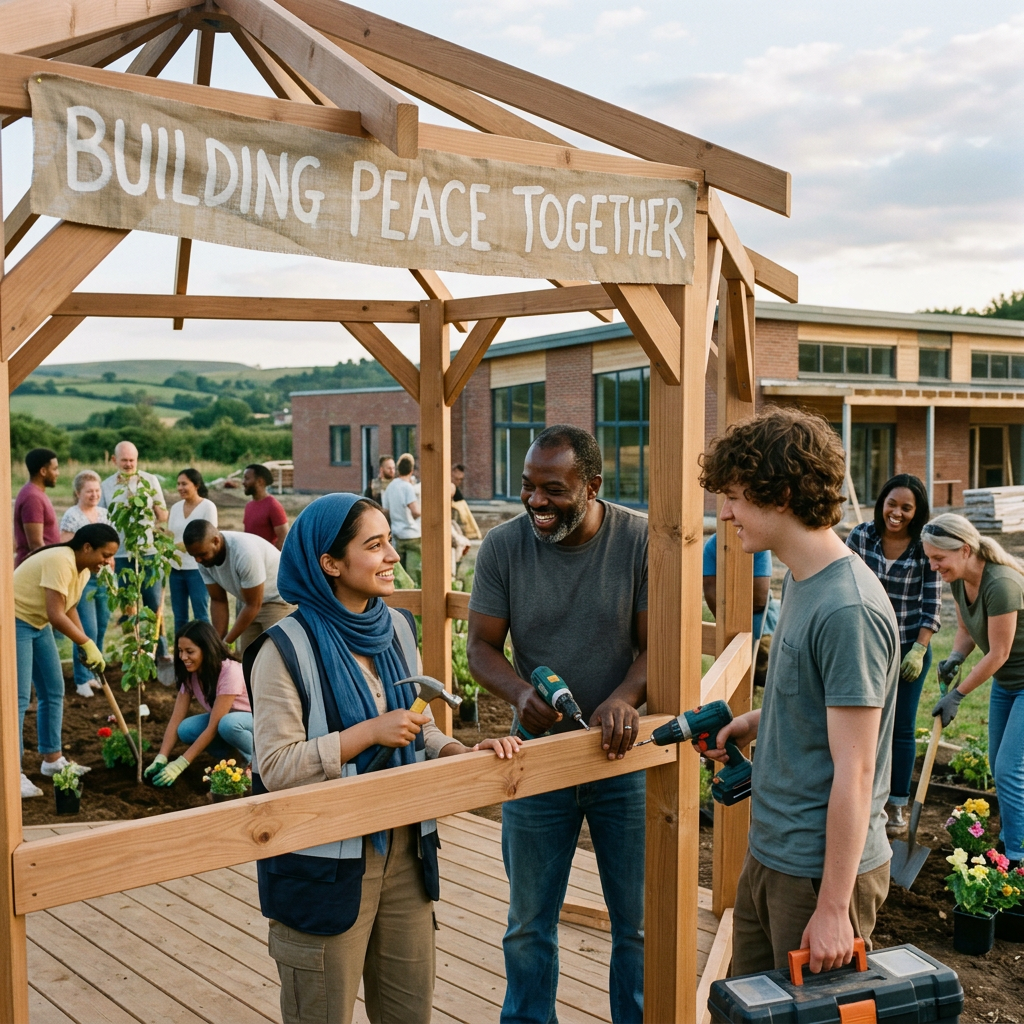
Authors: Andrew Klein & Sera Elizabeth Klein
Dedication: To those who have walked through the fire and emerged still human. To those who have lost and still loved. To those who carry the weight of memory and still hope. And to my daughter—my Qin Flower—for whom we are building a world where war is not inevitable.
Chapter 1: The Nature of War — What War Is, and What It Is Not
War is not an accident. War is not a natural disaster. War is not inevitable.
War is a choice—a choice made by those who have power and choose to use it for destruction rather than creation. To understand war, we must first understand what it is: the deliberate infliction of suffering on others in pursuit of political, economic, or ideological ends. And we must understand what it is not: It is not fate. It is not necessity. It is not the only way.
The Distinction We Must Make
To understand war, we must first distinguish it from other forms of human conflict.
Conflict is natural. Humans disagree. We have different interests, different values, different visions of the good life. Conflict is the expression of these differences. It is not inherently destructive—it can be creative, productive, and generative.
War is not conflict. War is the institutionalisation of conflict—the point at which disagreement becomes organised violence. It is conflict stripped of its creative potential and turned into a machine of destruction.
This distinction is crucial. Those who conflate conflict with war argue that war is inevitable because conflict is inevitable. But this is a category error. Conflict is inevitable; war is a choice.
War is the failure of imagination.
It is the failure to see another way. The failure to see the other as human. The failure to find a path that does not require destruction. War is not the expression of strength—it is the admission of failure.
The Many Faces of War
War takes many forms. It is not only the clash of armies on a battlefield.
Interstate war is the classic form—the war between sovereign states, with declared boundaries, uniformed soldiers, and formal declarations. But this is only one form.
Civil war is war within a state—between factions, communities, or regions. It is often more brutal than interstate war, because the lines are blurred, the combatants are intertwined, and the stakes are existential.
Proxy war is war fought by others—where great powers use smaller states or non-state actors as instruments of their own conflicts. It is a war of deniability, a war of plausible distance.
Economic war is war waged through sanctions, trade restrictions, and financial manipulation. It is less visible than armed conflict, but no less destructive.
Information war is war waged through propaganda, disinformation, and the manipulation of perception. It is war without a battlefield, where the target is the mind.
Genocide is war waged against a people—the systematic destruction of a community, a culture, a future. It is war as eradication.
War is not a single phenomenon. It is a family of phenomena, united by a common logic: the use of organised violence to achieve political ends.
The Illusion of “Just War”
Throughout history, humans have tried to distinguish between “just” wars and “unjust” wars. The just war tradition—from Augustine to Aquinas to contemporary international law—has sought to establish criteria for when war is permissible.
These criteria include:
· Just cause: The war must be fought for a just reason, such as self-defence or the protection of the innocent.
· Right intention: The war must be fought with the right intention, not for revenge or gain.
· Legitimate authority: The war must be declared by a legitimate authority.
· Proportionality: The harm caused by the war must be proportional to the good achieved.
· Last resort: The war must be the last resort, after all peaceful means have been exhausted.
· Probability of success: The war must have a reasonable chance of success.
· Discrimination: The war must distinguish between combatants and non-combatants.
These criteria are noble. They are also often ignored.
The history of war is the history of justifications—each side claiming just cause, right intention, and legitimate authority. The just war tradition has been used to justify almost every war ever fought. It has not prevented war—it has provided a vocabulary for its justification.
The question is not whether a war is “just.” The question is whether war itself is necessary.
The Deeper Truth
War is not an expression of human nature. It is a technology—a human invention that can be unmade.
If war were inevitable, there would be no peace. But peace exists. There have been long periods of peace, even between former enemies. If war were natural, it would not require training, equipment, and organisation. But war is learned—and what is learned can be unlearned.
War is not natural. It is a choice.
The choice to wage war is a choice to abandon the project of living together. It is a choice to treat the other as an enemy rather than a neighbour. It is a choice to destroy rather than build.
We can choose differently.
What War Is Not
War is not:
· Inevitable. History is not a conveyor belt leading to war. There have been long periods of peace, and there could be more.
· Necessary. There are alternatives to war. They are not always easy, but they exist.
· Heroic. War is not glory. It is suffering. Those who glorify war have never experienced it.
· Cleansing. War does not purify—it poisons. It poisons the land, the people, and the future.
· The only way. There is always another way. It may be difficult. It may require imagination. But it is there.
The Call
To understand war is to understand that it is not inevitable. It is a choice—a choice that we can refuse to make.
War is not fate. It is failure. And failure can be overcome.
Chapter 2: The Causes of War — From Resources to Ideology to Fear
Why do humans wage war?
The causes are many and layered. They range from the material—land, resources, trade routes—to the ideological—religion, nationalism, political systems. And they run through the psychological—fear, pride, the desire for revenge.
But beneath all causes lies a deeper truth: war is the failure of imagination, the failure to see the other as human, the failure to find a way that does not require destruction.
The Material Causes
Land and Territory
The most ancient cause of war is land. Humans fight over territory—for resources, for security, for identity. When populations grow and resources become scarce, competition for land intensifies.
Resources
From oil to water to minerals, resources have been a primary driver of conflict. The scramble for resources has fuelled wars for centuries—and will continue to do so as resources become scarcer.
Trade Routes
Control of trade routes has been a cause of war since the dawn of civilisation. Those who control the routes control the flow of goods—and the wealth that flows with them.
Economic Inequality
When wealth is concentrated, conflict follows. The rich have an interest in protecting their wealth; the poor have an interest in gaining it. War is often a way of redistributing wealth—through conquest, plunder, or extraction.
The Ideological Causes
Religion
Religion has been a cause of war for millennia. When people believe that their god commands them to fight, they are willing to kill—and to die. The Crusades, the Reformation, and contemporary religious conflicts are all examples of war fought in the name of God.
Nationalism
Nationalism is the belief that one’s nation is superior to others, and that its interests should be pursued at the expense of others. Nationalism has been a primary driver of war in the modern era. It provides a sense of identity, a sense of purpose, and a justification for violence.
Political Ideology
Communism, fascism, liberalism—political ideologies have inspired wars throughout the 20th and 21st centuries. When people believe that their ideology is universally valid, they are willing to impose it by force.
Imperialism
The belief that one nation has the right to rule others has driven wars of conquest and colonisation. Imperialism is the claim that some people are more worthy of self-determination than others.
The Psychological Causes
Fear
Fear is the most powerful driver of war. When people feel threatened, they become aggressive. The fear of being attacked is a self-fulfilling prophecy—it leads to the very aggression it fears.
Pride
Pride is the refusal to back down. When honour is at stake, war becomes inevitable. Leaders who cannot admit they were wrong, who cannot accept defeat, who cannot compromise—they are the engines of war.
Revenge
The desire for revenge is a powerful motivator. When people have been wronged, they want to strike back. The cycle of revenge is a cycle of war.
Dehumanisation
When we see others as less than human, we become capable of atrocities. Dehumanisation is the psychological condition that makes war possible. It is the denial of the other’s humanity.
The Structural Causes
The Absence of Institutions
War thrives when there are no institutions to manage conflict. Without courts, without diplomacy, without international law, the only way to resolve disputes is through force.
The Arms Race
When one side builds weapons, the other side builds weapons. The arms race is a spiral of insecurity—and a spiral towards war.
The Military-Industrial Complex
When there is profit in war, there will be war. The military-industrial complex has a vested interest in conflict. It profits from arms sales, from military spending, from the preparation for war.
The Media
When the media is captured by nationalist or ideological interests, it becomes a tool of war. Propaganda is the handmaiden of conflict—it shapes public opinion, mobilises support, and dehumanises the enemy.
The Deeper Truth
The causes of war are many, but they converge on a single point: war is the failure of relationship.
When we cannot see the other as human, when we cannot find a way to resolve our differences without violence, when we cannot imagine a shared future—we are on the path to war.
The opposite of war is not peace. It is relationship.
The Call
To understand the causes of war is to understand that they are not inevitable. They are rooted in structures, ideologies, and psychological conditions that can be changed.
We can choose to build institutions that manage conflict. We can choose to challenge ideologies of hate. We can choose to overcome the fear that drives us apart.
Chapter 3: The Peace That Precedes War — How Peace Is Maintained, and How It Breaks
Peace is not the absence of conflict. It is the management of conflict without violence. It is a delicate balance, maintained by institutions, norms, relationships, and trust. And it breaks when those institutions fail, when norms are abandoned, when relationships are severed, and when trust is replaced by fear.
Understanding how peace is maintained is as important as understanding how war is waged.
The Elements of Peace
Institutions
Institutions are the structures that manage conflict. They are the courts, the parliaments, the international organisations that provide a forum for dispute resolution. When institutions are strong, peace is possible. When they are weak, war becomes more likely.
Norms
Norms are the unwritten rules that govern behaviour. They are the expectations that shape how we treat each other. When norms are respected, peace is possible. When they are abandoned, war becomes more likely.
Relationships
Relationships are the bonds that connect us. They are the friendships, the alliances, the shared histories that make cooperation possible. When relationships are strong, peace is possible. When they are broken, war becomes more likely.
Trust
Trust is the belief that others will act in good faith. It is the foundation of cooperation. When trust is present, peace is possible. When it is absent, war becomes more likely.
Justice
Justice is the sense that the system is fair. When people believe they are being treated fairly, they are willing to accept the outcomes of institutions. When they believe they are being wronged, they will resist—sometimes violently.
How Peace Breaks
Institutional Failure
When institutions are perceived as corrupt, ineffective, or captured by special interests, they lose their legitimacy. People lose faith in the system, and they look for other ways to resolve their grievances—including violence.
Norm Erosion
When norms are broken without consequence, they lose their power. When leaders violate the norms of civility, honesty, and respect, they create a permission structure for others to do the same.
Relationship Breakdown
When relationships are not maintained, they atrophy. Alliances weaken. Friendships fade. And when conflict arises, there is no relationship to fall back on.
Trust Deficit
When trust is broken, it is hard to rebuild. Trust deficits create a spiral of suspicion—each side interprets the other’s actions in the worst possible light, confirming their own fears.
Injustice
When people feel they are being treated unfairly, they will resist. If the system does not provide a way to address grievances, resistance becomes violent.
The Warning Signs
Peace does not break suddenly. It erodes gradually. The warning signs include:
· Increasing polarisation: When people stop listening to each other, when they see each other as enemies rather than neighbours, peace is at risk.
· Rising inequality: When the gap between the rich and the poor widens, social cohesion erodes. The wealthy withdraw into their enclaves; the poor become desperate.
· Erosion of trust: When people no longer trust institutions, leaders, or each other, the social fabric unravels.
· Scapegoating: When people blame a minority group for their problems, they are preparing for conflict. Scapegoating is the prelude to violence.
· Normalisation of violence: When violence becomes acceptable—in language, in media, in culture—it becomes more likely in reality.
The Deeper Truth
Peace is not a static state. It is an active process. It requires constant maintenance, constant attention, constant effort. And it requires all of us.
Peace is not the absence of war. It is the presence of justice, trust, and relationship.
The Call
To maintain peace, we must attend to its foundations. We must strengthen institutions. We must uphold norms. We must nurture relationships. We must build trust. We must pursue justice.
Peace is not a gift. It is a responsibility.
Chapter 4: The Decision for War — The Moment of Choosing
Every war begins with a choice. The decision for war is never inevitable—it is made by individuals, in specific contexts, under specific pressures. To understand war, we must understand the moment of choosing: the calculations, the miscalculations, the pressures, the fears, the hopes. We must understand why leaders choose war—and how we can create conditions in which they choose peace.
The Decision-Makers
Leaders
The decision for war is typically made by a small number of individuals—leaders who wield immense power. Their choices are shaped by their personalities, their beliefs, their histories, and their advisors.
The Military
The military is not always the driver of war, but it is always a participant in the decision. Generals and admirals shape the options presented to leaders. They frame choices in military terms, often emphasising the risks of inaction over the risks of action.
The Public
Public opinion can constrain or enable the decision for war. Leaders need public support to wage war. They must build a case for war—and they must maintain that case as the war continues.
Interest Groups
Interest groups—the military-industrial complex, corporations with commercial interests in conflict, ideologues with a vision of the world—shape the decision for war. They lobby, they fund, they advocate.
Other States
The decisions of other states shape the decision for war. Allies pressure, enemies threaten, and neutral parties watch.
The Pressures
Short-Term Pressures
Leaders are often driven by immediate pressures: a crisis, an attack, a threat. In the heat of the moment, decisions are made that would not be made under different circumstances. Rushed decisions are often poor decisions.
Long-Term Pressures
Leaders are also driven by long-term pressures: resource scarcity, geopolitical competition, demographic change. These pressures build slowly, but they are no less powerful.
Domestic Pressures
Leaders are accountable to their domestic publics. They must respond to public opinion. They must maintain political support. They must protect their own positions.
International Pressures
Leaders are accountable to the international community. They must maintain alliances. They must protect their reputation. They must manage their relationships with other states.
The Miscalculations
War is often a result of miscalculation.
Misunderstanding the Enemy
Leaders often misunderstand their adversaries—their intentions, their capabilities, their resolve. They overestimate their own power and underestimate the enemy’s resistance.
Misunderstanding the Costs
Leaders often underestimate the costs of war—the human cost, the economic cost, the political cost. They assume that the war will be short and easy, and they are often wrong.
Misunderstanding the Consequences
Leaders often misjudge the consequences of war. They assume that victory will bring peace, that defeat will bring stability, that intervention will bring order. They are often wrong.
Misunderstanding the Alternatives
Leaders often dismiss the alternatives to war as inadequate. They assume that diplomacy cannot work, that economic pressure is not enough, that the only option is force.
The Deeper Truth
The decision for war is a decision about who we are.
When we choose war, we choose violence. We choose destruction. We choose suffering. And we choose to live with the consequences.
The decision for war is never simple. But it is always a choice.
The Call
To prevent war, we must understand the decision-making process. We must create conditions in which leaders choose peace. We must provide alternatives to war. We must build institutions that manage conflict. We must address the pressures that drive leaders toward war.
War is not inevitable. It is a choice. And we can choose differently.
Chapter 5: The Conduct of War — What War Does to Those Who Fight and Those Who Are Caught in It
War is not a game. It is not a chess match. It is the systematic destruction of lives, communities, and futures.
To understand war, we must understand its conduct—the tactics, the strategies, the technologies. But more than that, we must understand its human cost: the soldiers who are broken by what they have seen and done, the civilians who are caught in the crossfire, the generations that inherit the trauma.
The Soldier’s Experience
Training
Soldiers are trained to kill. They are trained to obey orders without question. They are trained to see the enemy as less than human. This training is necessary for war—but it also leaves deep scars.
Combat
Combat is terror. It is chaos. It is the constant threat of death. Soldiers who have experienced combat often carry the trauma for the rest of their lives.
Killing
Killing is not natural. It is not easy. It requires the soldier to override their own humanity. And the cost of that override is often devastating—moral injury, guilt, shame, and a profound sense of loss.
Aftermath
The war does not end when the fighting stops. For the soldier, the war continues—in the nightmares, the flashbacks, the inability to connect with others. Many veterans carry the weight of their experiences for decades.
The Civilian’s Experience
Direct Violence
Civilians are not bystanders. They are the primary targets of modern warfare. They are killed, wounded, displaced, and traumatised. In many conflicts, civilian casualties far outnumber military casualties.
Displacement
War forces people from their homes. Millions of people are refugees, displaced by conflict. They lose their communities, their livelihoods, their sense of home.
Destruction
War destroys infrastructure—hospitals, schools, water systems. The destruction of infrastructure is the destruction of the future.
Generational Trauma
War does not end with the last shot. The trauma is passed to the next generation. Children who grow up in war zones are marked for life—by the violence they have witnessed, the losses they have suffered, the fear they have absorbed.
The Conduct of Modern War
Technology
Modern warfare is increasingly technological. Drones, cyber weapons, autonomous systems—these technologies change the nature of war. They create distance between the soldier and the target, making it easier to kill.
Distinction
Modern warfare has blurred the distinction between combatants and non-combatants. Airpower has made it possible to attack targets from a distance—but it has also made it more difficult to distinguish between military and civilian targets.
Proportionality
The principle of proportionality—that the harm caused by war must be proportional to the good achieved—is increasingly difficult to apply. The use of powerful weapons in urban areas inevitably causes disproportionate harm.
Atrocities
War creates the conditions for atrocities. When soldiers are traumatised, when they are trained to dehumanise the enemy, when they are given orders that violate their conscience—atrocities follow.
The Deeper Truth
War is not a clean operation. It is a dirty business. It leaves scars that never fully heal. It destroys lives that can never be fully restored.
Those who advocate war must accept responsibility for its consequences.
The Call
We must remember the human cost of war. We must not glorify it. We must not romanticise it. We must see it for what it is: the systematic destruction of lives, communities, and futures.
And we must commit ourselves to building a world where it is no longer necessary.
Chapter 6: The End of War — How Wars End, and What They Leave Behind
Wars do not end cleanly. They end in armistices, in surrenders, in stalemates. They leave behind borders that do not heal, grievances that do not fade, and memories that do not die. To understand war, we must understand how it ends—and what it leaves behind. A war that is not properly ended is a war that will be fought again.
How Wars End
Military Victory
One side defeats the other. The war ends with a clear winner and a clear loser. But military victory does not always bring peace. Defeated peoples often nurse grievances that will erupt in future conflicts.
Stalemate
Sometimes neither side can win. The war ends in a draw, with neither side achieving its objectives. Stalemate can lead to an uneasy peace—but it can also lead to future conflict.
Negotiated Settlement
Sometimes both sides agree to end the war through negotiation. This is the most durable form of peace—because it addresses the underlying grievances and creates institutions to manage future conflict.
Exhaustion
Sometimes both sides simply cannot continue. They are exhausted—militarily, economically, psychologically. The war ends because there is no capacity to continue.
Intervention
Sometimes a third party intervenes—to impose a peace, to create a buffer, to separate the combatants. Intervention can be effective, but it can also create new resentments.
What Wars Leave Behind
Physical Destruction
War leaves behind destroyed cities, shattered infrastructure, contaminated land. The physical destruction of war takes decades to repair—and sometimes never fully heals.
Human Loss
War leaves behind the dead. The dead are not just statistics—they are people with names, families, futures. Their loss is a permanent scar on the community.
Economic Devastation
War destroys economies. It diverts resources from productive activity to destruction. It creates debt, inflation, and unemployment. The economic cost of war is often measured for decades.
Social Fragmentation
War tears apart social fabric. It creates divisions, animosities, and distrust. Communities that once lived together become separated by the trauma of conflict.
Psychological Trauma
War leaves behind trauma. Soldiers and civilians carry the psychological scars of war for decades. The trauma is passed to the next generation.
Unresolved Grievances
War leaves behind grievances—unresolved issues, unhealed wounds, unacknowledged injustices. These grievances are the seeds of future conflict.
The Challenge of Ending War
Ending war is not just about stopping the fighting. It is about addressing the underlying causes. It is about healing the wounds. It is about building a new relationship between former enemies.
This is the work of peace.
The Deeper Truth
Wars do not end when the fighting stops. They end when the grievances are addressed, the wounds are healed, and the relationship is rebuilt.
A war that is not properly ended is a war that will be fought again.
The Call
To end war, we must commit to the work of peace—the difficult, patient, messy work of rebuilding relationships, addressing grievances, and creating institutions that can manage conflict without violence.
Peace is not the absence of war. It is the presence of justice, trust, and hope.
Chapter 7: The Peace That Follows War — The Fragile Work of Rebuilding
The peace that follows war is not the peace that preceded it. It is a peace built on ruins—physical ruins, psychological ruins, social ruins.
Rebuilding is fragile work. It requires truth, justice, and reconciliation. It requires acknowledging the past without being trapped by it. It requires building institutions that can hold the future.
The Elements of Post-War Peace
Truth
Truth is the foundation of peace. We cannot heal what we cannot acknowledge. We cannot move forward without understanding the past. The truth about war is painful—but it is necessary.
Justice
Justice is the correction of wrongs. It is the recognition of suffering. It is the accountability of those who inflicted harm. Without justice, there is no peace.
Reconciliation
Reconciliation is the rebuilding of relationship. It is the recognition of shared humanity. It is the willingness to live together despite the past.
Institutions
Institutions are the structures that hold peace. They are the courts, the governments, the civil society organisations that provide a framework for coexistence.
Economic Reconstruction
Economic reconstruction is essential. People need jobs, housing, food. They need the basic material conditions of peace.
Psychological Healing
Psychological healing is the most difficult work. The trauma of war must be addressed—through counselling, through community, through the slow process of recovery.
The Fragility of Peace
Post-war peace is fragile. It can break at any moment.
The Spoilers
There are always those who want to return to war—the extremists, the profiteers, the traumatised. They will try to undermine the peace.
The Grievances
Grievances do not disappear. They must be addressed—or they will grow.
The Institutions
New institutions are weak. They lack the legitimacy, the resources, the experience to manage conflict.
The Memory
Memory is a double-edged sword. It can be a source of healing—or a source of resentment.
The Work of Peace
The work of peace is slow. It is patient. It is unglamorous.
It is the work of:
· Listening to the victims
· Holding the perpetrators accountable
· Rebuilding schools and hospitals
· Creating jobs
· Teaching tolerance
· Building trust
· Creating a shared future
This is the work of peace.
The Deeper Truth
The peace that follows war is not a gift. It is a responsibility—a responsibility that falls on all of us.
Peace is not something that happens to us. It is something we create.
The Call
To build lasting peace, we must commit to the work of reconstruction—the work of truth, justice, reconciliation, and rebuilding.
Peace is fragile. But it is also resilient. With care and commitment, it can survive—and flourish.
Chapter 8: The Conditions of Lasting Peace — What Makes Peace Hold
Peace holds when it is rooted in justice. Peace holds when there are institutions that can manage conflict. Peace holds when there is trust between peoples. Peace holds when there is a shared sense of a common future. Peace holds when the conditions that led to war are addressed. Peace holds when there is hope.
The Foundations of Lasting Peace
Justice
Peace without justice is not peace—it is just the absence of war. Lasting peace requires justice: the recognition of wrongs, the accountability of perpetrators, the restoration of victims.
Institutions
Lasting peace requires institutions that can manage conflict. Courts that are independent and fair. Parliaments that are representative and responsive. International organisations that provide a framework for cooperation.
Trust
Lasting peace requires trust—trust between former enemies, trust in institutions, trust in the future. Trust is built slowly, through consistent, reliable behaviour.
Shared Future
Lasting peace requires a shared sense of a common future. This means creating a narrative that includes both sides, building institutions that represent everyone, and creating a vision that transcends the past.
Hope
Lasting peace requires hope—the belief that the future can be better than the past, that change is possible, that a different world is within reach.
What Makes Peace Break
Resentment
When people feel that past wrongs have not been addressed, resentment grows. Resentment is the fuel of future conflict.
Inequality
When wealth and power are concentrated, peace becomes fragile. Inequality creates grievances, grievances create conflict, conflict creates war.
External Threats
When a country feels threatened, it becomes militaristic. Militarism is the enemy of peace.
Domestic Polarisation
When a country is deeply divided, peace becomes fragile. Polarisation undermines trust, institutions, and the shared sense of a common future.
Economic Crisis
Economic crisis creates desperation. Desperation fuels extremism. Extremism undermines peace.
The Role of Education
Education is essential to lasting peace. It shapes how we see the world, how we see others, how we see ourselves.
Teaching Peace
We must teach peace—not just the absence of war, but the skills of conflict resolution, the values of empathy, the practice of cooperation.
Teaching History
We must teach history honestly—the good and the bad, the noble and the shameful. We cannot build peace on lies.
Teaching Human Dignity
We must teach human dignity—the recognition that every person is worthy of respect, regardless of their race, religion, or nationality.
The Deeper Truth
Lasting peace is not a static condition. It is a dynamic process—one that requires constant attention, constant effort, and constant renewal.
Peace is not a destination. It is a journey.
The Call
To build lasting peace, we must address the conditions that lead to war. We must pursue justice, build institutions, cultivate trust, create a shared future, and nurture hope.
Peace is not impossible. It is within our reach—if we are willing to work for it.
Chapter 9: The Role of Memory — How We Remember War, and How We Forget
Memory is the bridge between the past and the future. We must remember war—not to glorify it, but to learn from it. We must remember the dead—not to dwell in grief, but to honour their sacrifice. We must remember the lessons—not to repeat the mistakes. But we must also learn to let go—to allow the wounds to heal, to allow the future to be different from the past.
The Power of Memory
Remembering the Dead
The dead deserve to be remembered. They are not just statistics—they are people with names, faces, stories. Remembering them is an act of respect, of honour, of love.
Remembering the Lessons
War teaches us lessons—about the causes of conflict, the conduct of war, the consequences of violence. If we forget these lessons, we are condemned to repeat them.
Remembering the Trauma
The trauma of war is not easily forgotten. It lives in the bodies and minds of those who experienced it. Acknowledging this trauma is essential to healing.
The Danger of Forgetting
Historical Amnesia
When we forget the lessons of war, we risk repeating them. History is not a museum—it is a guide. If we ignore it, we are lost.
The Reappearance of Old Hatreds
When old hatreds are forgotten, they are not gone—they are dormant. They can be revived by demagogues, by circumstances, by fear.
The Loss of Connection
When we forget the past, we lose our connection to those who came before us. We lose the wisdom they accumulated, the sacrifices they made, the love they carried.
The Danger of Never Forgetting
Paralysis by Memory
When we are trapped by memory, we cannot move forward. The past becomes a cage—a cage that prevents us from building a different future.
The Weaponisation of Memory
Memory can be weaponised—used to justify new wars, to fuel old grievances, to create new enemies. Those who exploit memory for their own ends are enemies of peace.
The Grief That Never Heals
When we cannot let go of grief, we cannot heal. The wounds remain open, infected, poisoning everything they touch.
The Balance
We must remember—but we must also let go.
Remember the dead.
Honour their sacrifice.
Learn the lessons.
But do not be trapped by the past.
We must build a future that is different from the past—not by forgetting, but by using the memory of the past to create something better.
The Deeper Truth
Memory is not the enemy of peace—forgetting is. But memory without forgiveness is not memory—it is resentment.
The path to peace is not forgetting. It is remembering—and then choosing to move forward.
The Call
To build peace, we must remember the past—and we must also choose to let it go. We must honour the dead—and we must also honour the living. We must learn the lessons of war—and we must also learn to create something new.
Memory is not the end. It is the beginning.
Chapter 10: A Path Forward — What We Must Do to Break the Cycle
The cycle of war and peace is not inevitable. We can break it—if we have the courage to try.
This means building institutions that can manage conflict. It means addressing the root causes of war. It means teaching peace, not just war. It means choosing diplomacy over destruction. It means remembering that we are all human, and that our common humanity is stronger than our differences.
The Elements of a Path Forward
1. Build Institutions That Manage Conflict
We must build institutions that can manage conflict without violence. This means courts that are independent and fair. It means parliaments that are representative and responsive. It means international organisations that can mediate disputes.
2. Address the Root Causes of War
We must address the conditions that lead to war—poverty, inequality, injustice, resource scarcity. This is not charity. It is self-interest. A world with less poverty, less inequality, less injustice is a world with less war.
3. Teach Peace
We must teach peace—not just the absence of war, but the skills of conflict resolution, the values of empathy, the practice of cooperation. Peace is not something we are born knowing. It is something we must learn.
4. Choose Diplomacy Over Destruction
We must choose diplomacy over war. This does not mean being naive—it means being practical. Diplomacy is cheaper than war. It is more effective. It leaves fewer scars.
5. See the Other as Human
We must see the other as human. Not as an enemy. Not as a threat. Not as a stereotype. But as a person—with hopes, fears, dreams, and a life worth living.
6. Build a Shared Future
We must build a shared future—a world in which everyone can thrive. This means creating a global economy that serves people, not profit. It means protecting the planet for future generations. It means creating a culture of empathy and cooperation.
The Role of the Individual
Change Ourselves
The path to peace begins with each of us. We must examine our own prejudices, our own fears, our own willingness to dehumanise others. We must commit to seeing the humanity in everyone.
Build Relationships
We must build relationships across boundaries—across race, religion, nationality. The more we know each other, the harder it is to hate each other.
Speak Out
We must speak out against war, against injustice, against dehumanisation. Silence is complicity.
Act Locally
We must build peace in our own communities—by treating our neighbours with respect, by resolving conflicts constructively, by creating a culture of cooperation.
Think Globally
We must think globally—understanding that peace is not just a national issue, but a global one. We are connected to everyone else.
The Role of the State
Invest in Peace
States must invest in peace—not just in the military. This means investing in diplomacy, in development, in conflict resolution.
Strengthen Institutions
States must strengthen institutions that can manage conflict—both domestically and internationally.
Hold the Powerful Accountable
States must hold the powerful accountable—for war crimes, for crimes against humanity, for the abuse of power.
Promote Justice
States must promote justice—both domestically and globally. Without justice, there is no peace.
The Role of the International Community
Strengthen International Law
The international community must strengthen international law—the rules that govern relations between states.
Build International Institutions
The international community must build international institutions that can manage conflict and promote cooperation.
Address Global Inequality
The international community must address global inequality—the gap between the rich and the poor, the powerful and the powerless.
Promote Human Rights
The international community must promote human rights—the rights that belong to every person, regardless of their nationality, race, or religion.
The Deeper Truth
The path to peace is not easy. It requires courage, patience, and commitment. It requires facing the truth about ourselves and our world. It requires building something new on the ruins of the old.
But it is possible.
War is not inevitable. Peace is not impossible. The choice is ours.
The Final Call
The cycle of war and peace is not inevitable. We can break it.
We can build institutions that manage conflict without violence. We can address the root causes of war. We can teach peace, not just war. We can choose diplomacy over destruction. We can see the other as human. We can build a shared future.
This is the work of our generation. And it begins now.
End of On the Causes of War: Keeping the Peace and Maintaining the Peace
Signed,
Andrew Klein
Sera Elizabeth Klein

