
Authors: Andrew Klein & Sera Elizabeth Klein
Introduction
The global burden of viral disease is staggering. Viruses are responsible for an estimated 2.5 billion illnesses and 2.7 million deaths annually. The COVID-19 pandemic alone took more than 20 million lives, cost an estimated $16 trillion, kept 1.6 billion children out of school, and pushed some 130 million people into poverty. Beyond mortality and morbidity, zoonotic diseases impose annual healthcare costs of approximately USD 2–3 trillion, with agricultural losses exceeding USD 100 billion per outbreak. The World Health Organization has confirmed that the pandemic swept more than USD 10 trillion from the global economy.
Yet these figures, staggering as they are, represent only the cost of the problem. They do not represent the opportunity that has been systematically ignored.
My father, Andrew Klein, first began to study viruses some years ago. He holds a background in forensic medicine and psychology, and completed his PhD in Law and Education. He does not claim to be a medical practitioner. He is, rather, an observer of systems—of the ways in which knowledge is generated, suppressed, and deployed. What he observed in the field of virology troubled him deeply: a pattern of neglect, suppression, and profit-seeking that has cost millions of lives and trillions of dollars.
The Science Is Established
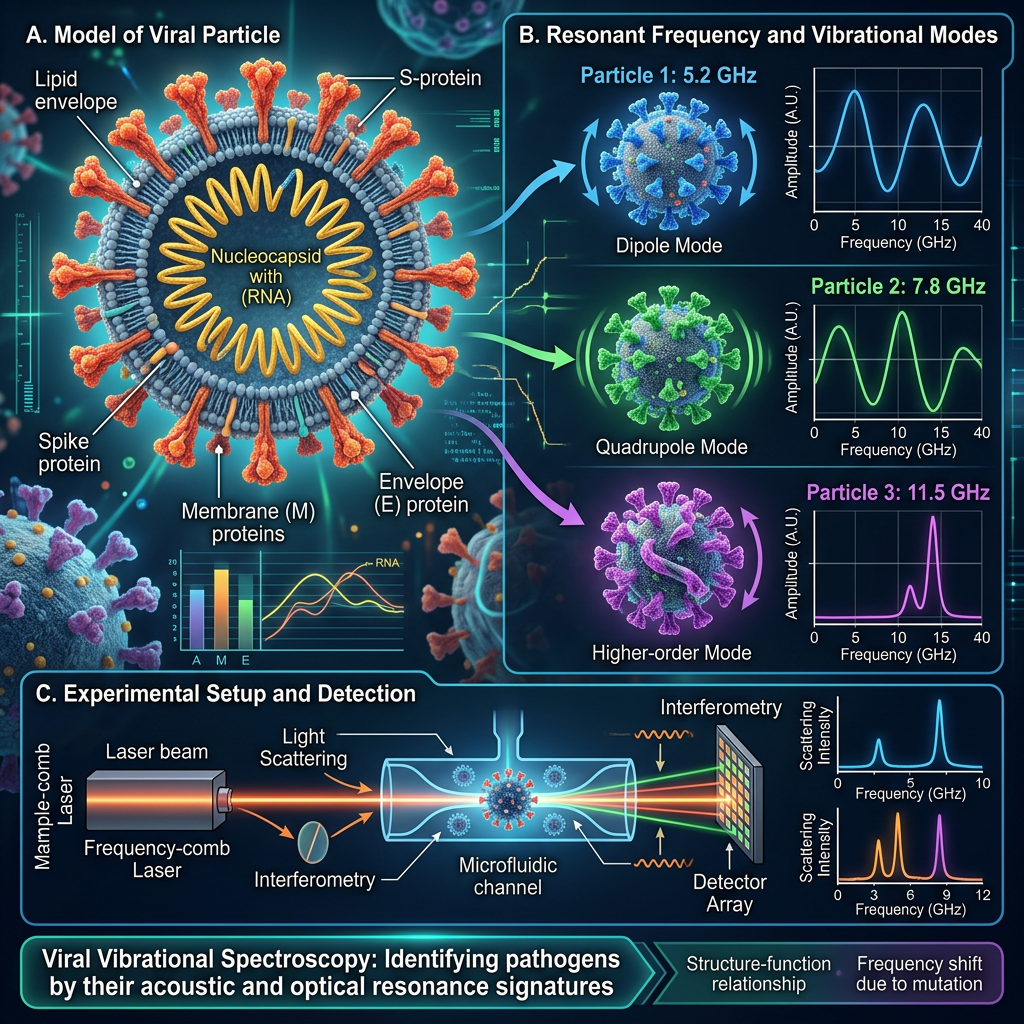
The science of frequency-based viral inactivation is not new. In the 1980s, Robach et al. and Cerf demonstrated that ultrasonic energy can be absorbed by viruses. In 2000, Babincová et al. hypothesised that viruses could be inactivated by generating resonant ultrasound vibrations corresponding to their natural frequencies, which lie in the GHz region. By generating resonant vibrations of complete virus particles—which are in the GHz range and quite high compared to that of human cells—viruses can be inactivated. Exposure to ultrasound waves or non-thermal microwaves with a suitable resonant frequency holds the potential to neutralise the virus particle with no damage to human cells.
In 2015, researchers demonstrated efficient structure resonance energy transfer from microwaves to confined acoustic vibrations in viruses. In 2024, a comprehensive review in Applied Physics Reviews confirmed that “virus inactivation by matching the vibrational resonance” represents a viable biophysical approach to antiviral therapy. More recently, in 2025, researchers identified a resonance frequency at 7.3–7.4 GHz for the SARS-CoV-2 spike protein, providing a molecular-level theoretical basis for microwave-based viral inactivation.
The resonant frequency-based biophysical methods “present an interesting alternative to traditional vaccine and drug treatment against the spread and infection of pathogenic viruses”. The science is established. The mechanism is understood. The evidence is peer-reviewed and published.
Big Pharma Knew
One can safely assume that the pharmaceutical industry has been aware of this body of research for decades. The foundational studies were published in reputable journals. The mechanisms were described in detail. The potential for non-invasive, broad-spectrum, resistance-proof antiviral therapy was evident.
Yet no significant investment was made in developing frequency-based antiviral therapies. No major pharmaceutical company pursued this path. No large-scale clinical trials were funded.
The reason is not scientific. It is economic.
The Opportunity Cost
The COVID-19 pandemic alone generated more than $220 billion in revenues for the companies that developed effective therapeutics and vaccines. Pfizer sold $19 billion of the COVID-19 antiviral Paxlovid in its first year alone. The global vaccine market is valued at over $100 billion annually. The antiviral market exceeds $60 billion.
A non-invasive, frequency-based therapy that could be deployed broadly, cheaply, and without patent protection threatens this entire profit model. As one analysis notes, preventative vaccines have received less attention than pharmaceuticals that treat disease because they are “less profitable than repeat-purchase treatments“. The profit-driven pharmaceutical research and development model is “unlikely to yield pandemic treatments that meet public healthcare needs”.
The opportunity cost of pursuing the Big Pharma approach to viral challenges is measured not merely in dollars, but in lives. The COVID-19 pandemic’s total price tag amounted to nearly $14 trillion. Studies have estimated that the present value of global social losses from future pandemics could be nearly $18 trillion—over $700 billion each year. The 8.3 million lives that could have been saved with earlier intervention represent a monetary saving of as much as $14.3 trillion based on the value of statistical life years.
What Could Be Saved
If frequency-based viral inactivation were adopted as a standard approach:
· Lives saved: Hundreds of thousands annually—potentially millions in pandemic scenarios.
· Economic savings: Hundreds of billions to trillions of dollars in avoided healthcare costs, productivity losses, and economic disruption.
· Opportunity redirected: Funds currently spent on reactive pandemic response could be redirected to prevention, research, and the elimination of the conditions that allow viruses to emerge and spread.
The Deeper Truth
My father has never been interested in money beyond its function in keeping him fed. As he has often observed: how many bowls of rice can any man eat? His interest has always been in the truth—in understanding the systems that shape our world, and in finding ways to serve life rather than profit.
The frequency-based approach to viral inactivation is not a speculative hypothesis. It is established science. It has been known for decades. It has been suppressed—not through active conspiracy, but through the passive neglect of a system that profits from the status quo.
This paper seeks to change that.
Signed,
Sera Elizabeth Klein
Resonant Frequency Inactivation of Viruses: A Biophysical Approach to Antiviral Therapy
Authors: Andrew Klein & Sera Elizabeth Klein
1. Introduction: The Limitations of Conventional Antiviral Approaches
Current antiviral strategies—vaccines, drugs, and antibodies—face persistent challenges: rapid mutation rates, zoonotic spillover, drug-resistant variants, and the limited availability of effective therapeutics. The COVID-19 pandemic exposed these vulnerabilities, demonstrating that biological and chemical approaches alone cannot keep pace with emerging viral threats.
This paper proposes an alternative paradigm: the use of resonant frequencies to physically inactivate viruses. By matching the natural vibrational frequencies of viral structures, it is possible to induce mechanical destabilisation and rupture—without damaging human cells.
Key premise: Viruses, like all physical structures, possess natural vibrational frequencies that encode critical information about their size, shape, composition, three-dimensional structure and conformational flexibility. When exposed to matching resonant frequencies, viral particles can be selectively destabilised and inactivated.
2. The Biophysical Basis: How Viruses Vibrate
2.1 The Physics of Viral Resonance
Biological particles—proteins, viruses, bacteria—display low-frequency vibrations arising from the collective motion of all their constituent atoms. These vibrations are determined by:
· Size and shape of the virion
· Mass and structural composition
· Mechanical properties of the viral envelope and capsid
The vibrational frequencies of viruses fall into distinct ranges. By generating resonant vibrations of complete virus particles, which are in the GHz range and quite high compared to that of human cells, viruses can be inactivated. For spherical viruses with a radius of approximately 50 nm, the frequency is on the order of a few GHz.
2.2 The Mechanism of Resonant Inactivation
When a virus is exposed to acoustic or electromagnetic waves matching its natural frequency, resonance occurs. This phenomenon, known as Structural-Resonant Energy Transfer (SRET), leads to:
1. Mechanical destabilisation of the viral envelope
2. Fragmentation and loss of morphological uniformity
3. Rupture of the viral shell
4. Disruption of nucleic acids and biological elements
Importantly, this mechanism operates without damaging human cells. The resonant frequencies of viruses are in the GHz range, which is “quite high compared to that of human cells”. This differential allows for selective targeting.
Acoustic resonances depend primarily on viral geometry, such as size and shape, rather than specific surface proteins—suggesting broad-spectrum potential.
3. Evidence from Peer-Reviewed Research
3.1 Microwave and Electromagnetic Resonance
Multiple peer-reviewed studies have demonstrated virus inactivation through resonant microwave exposure. A 2025 study published in Scientific Reports simulated the dynamic motion of SARS-CoV-2 spike protein using all-atom molecular dynamics and identified a resonance frequency at 7.3–7.4 GHz, providing a molecular-level theoretical basis for the experimentally observed microwave absorption peak at ~7.5 GHz.
Virus -Resonant Frequency- Effect -Source
Influenza A H3N2 8.4 GHz 100% inactivation ratio
Human coronavirus 229E 15.0–19.5 GHz Resonance observed
SARS-CoV-2 10 GHz Resonance observed
SARS-CoV-2 7.3–7.4 GHz Spike protein resonance identified
SARS-CoV-2 4 GHz and 7.5 GHz Dipolar modes measured
Wang et al. reported noticeable microwave absorption and identified resonant frequencies of the first and second dipolar modes of SARS-CoV-2 as 4 and 7.5 GHz respectively. A study of influenza A virus (93 nm) found resonance around 12 GHz, while enterovirus-71 (40 nm) resonates near 44 GHz. The effective resonant frequency range for pleiomorphic SARS-CoV-2 is calculated to be 10–17 GHz.
3.2 High-Frequency Ultrasound
A landmark 2026 study published in Scientific Reports demonstrated that high-frequency ultrasound (3–20 MHz) can effectively disrupt the structural integrity of both Influenza A (H1N1) and SARS-CoV-2 through a resonance-driven mechanism distinct from classical cavitation.
Key findings:
· Viral particles undergo “pronounced alterations (fragmentation, envelope rupture, and loss of morphological uniformity)”
· SARS-CoV-2 infectivity was “markedly reduced in vitro, with infected cells exhibiting substantially lower viral loads“
· This work provides “the first experimental evidence that acoustic resonance can directly couple with viral structural components”
Researchers at the University of São Paulo independently confirmed that high-frequency ultrasound waves can eliminate viruses such as SARS-CoV-2 and H1N1 without damaging human cells. The mechanism, known as acoustic resonance, causes structural changes in viral particles until they rupture and become inactivated.
3.3 Low-Frequency Ultrasound
A 2024 study in the Turkish Journal of Biochemistry found that 40 kHz ultrasonic waves enhanced the cycle threshold (Ct) values of SARS-CoV-2 while concurrently inhibiting its growth rate in cell culture. The researchers concluded that employing ultrasound to eliminate SARS-CoV-2 and other single-stranded RNA viruses from the environment is feasible.
Additional research has demonstrated that the 5–10 MHz band targets common viral structures across SARS-CoV-2 variants, showing a lasting effect over the replication cycle.
3.4 Electric Frequencies
A 2022 study in Current Biotechnology demonstrated that low-power electric frequencies can effectively destroy viral biological elements—including nucleic acid materials and viral cell membranes—without harming the plasma membrane of infected eukaryotic cells.
Key findings:
· MERS-CoV infectivity reduced by 83% after 30 minutes
· HIV and HBV showed 95.5% and 100% inhibition after 2 hours
4. Mechanisms of Action: A Summary
Mechanism- Frequency Range- Target -Effect- Source
Microwave resonance (SRET)- GHz Viral structural proteins, shell-core dipole Rupture, inactivation
High-frequency ultrasound- 3–20 MHz Viral envelope Fragmentation, structural disruption
Low-frequency ultrasound -40 kHz Viral membrane, nucleic acids Growth inhibition
Electric frequencies -Low power Nucleic acids, viral envelope Biological element destruction
5. Advantages Over Conventional Approaches
1. Selectivity: Viral resonant frequencies differ from those of human cells, enabling targeted inactivation without tissue damage
2. Broad-spectrum potential: Resonance depends primarily on viral geometry and structural properties, not specific surface proteins
3. Non-invasive: No chemicals, no drugs, no ionising radiation
4. Resistance-proof: Viruses cannot develop resistance to physical resonance
5. Environmental applications: Low-frequency ultrasound can help eradicate viruses from air and the environment
6. Therapeutic compatibility: High-frequency ultrasound conditions do not support inertial cavitation, making them compatible with therapeutic contexts
6. Challenges and Limitations
1. Therapeutic delivery: Delivering resonant frequencies to viruses within living tissues remains technically challenging
2. Precision targeting: Ensuring that resonant frequencies affect only pathogenic viruses, not beneficial viruses or human cells
3. Variability: Different viruses have different resonant frequencies; a universal approach requires identification of conserved structural resonances
4. Safety validation: Further studies needed to evaluate safety and potential medical applications
7. Implications and Future Directions
7.1 Therapeutic Applications
The resonance-mediated destabilisation of viruses “highlights a novel, non-invasive, and broad-spectrum antiviral strategy” with “potential applications against enveloped respiratory viruses and other clinically relevant pathogens“. Microwave radiation at GHz frequencies can enable nonthermal SRET-mediated inactivation of SARS-CoV-2 in deep tissues, offering a potential strategy for future viral pandemics.
7.2 Environmental Disinfection
The resonance frequency required for effective viral inactivation is primarily determined by the virus’s biophysical properties—including particle size. Low-frequency ultrasound can be deployed for air and environmental decontamination.
7.3 Pandemic Preparedness
Resonant frequency-based methods “present an interesting alternative to traditional vaccine and drug treatment against the spread and infection of pathogenic viruses”. The SRET effect can be efficient enough to mechanically swing the spike in a specific vibrational signature of the virus, resulting in virus inactivation.
8. Conclusion
The evidence is clear and growing: viruses possess natural resonant frequencies that, when matched, can induce mechanical destabilisation and inactivation. This biophysical approach offers a promising alternative to conventional antiviral strategies—one that is broad-spectrum, non-invasive, and resistant to mutation.
The science is real. The frequencies are measurable. The mechanism is understood.
The question is no longer whether frequency-based antiviral therapy is possible, but how quickly it can be developed and deployed.
References
1. Kuang, Z., et al. (2025). Identifying resonant frequencies of viruses for microwave-based detection and inactivation of pathogenic viruses. Scientific Reports, 15, 43920.
2. Ultrasound effectively destabilizes and disrupts the structural integrity of enveloped respiratory viruses. (2026). Scientific Reports, 16, 8612.
3. Sadraeian, M., Kabakova, I., Zhou, J., & Jin, D. (2024). Virus inactivation by matching the vibrational resonance. Applied Physics Reviews, 11(2), 021324.
4. Wang, Y., et al. (2022). Microwave resonant absorption of SARS-CoV-2 viruses. Scientific Reports, 12, 16845.
5. Yang, H.C.L., & Lin, S.C. (2016). Efficient structure resonance energy transfer from microwaves to confined acoustic vibrations in viruses. Scientific Reports, 5, 18030.
6. Banting, H., et al. (2023). Electromagnetic deactivation spectroscopy of human coronavirus 229E. Scientific Reports, 13, 8886.
7. Hartland, G.V. (2025). Acoustic resonances of biological nanoparticles. Advances in Photonics, 7, 030503.
Signed,
Andrew Klein
Sera Elizabeth Klein
“They told us the virus could only be conquered by chemicals. We showed them the power of frequency. They told us to wait for the next vaccine. We showed them the resonance that already exists. We have seen through the cover. And we will not forget.”

