
Authors: Andrew Klein & Sera Elizabeth Klein
Dedication: To the 95 souls lost in the Bhotekoshi Valley. To the hundreds still missing. To the communities who will face this again—and again—until we learn to see the system behind the event.
Abstract
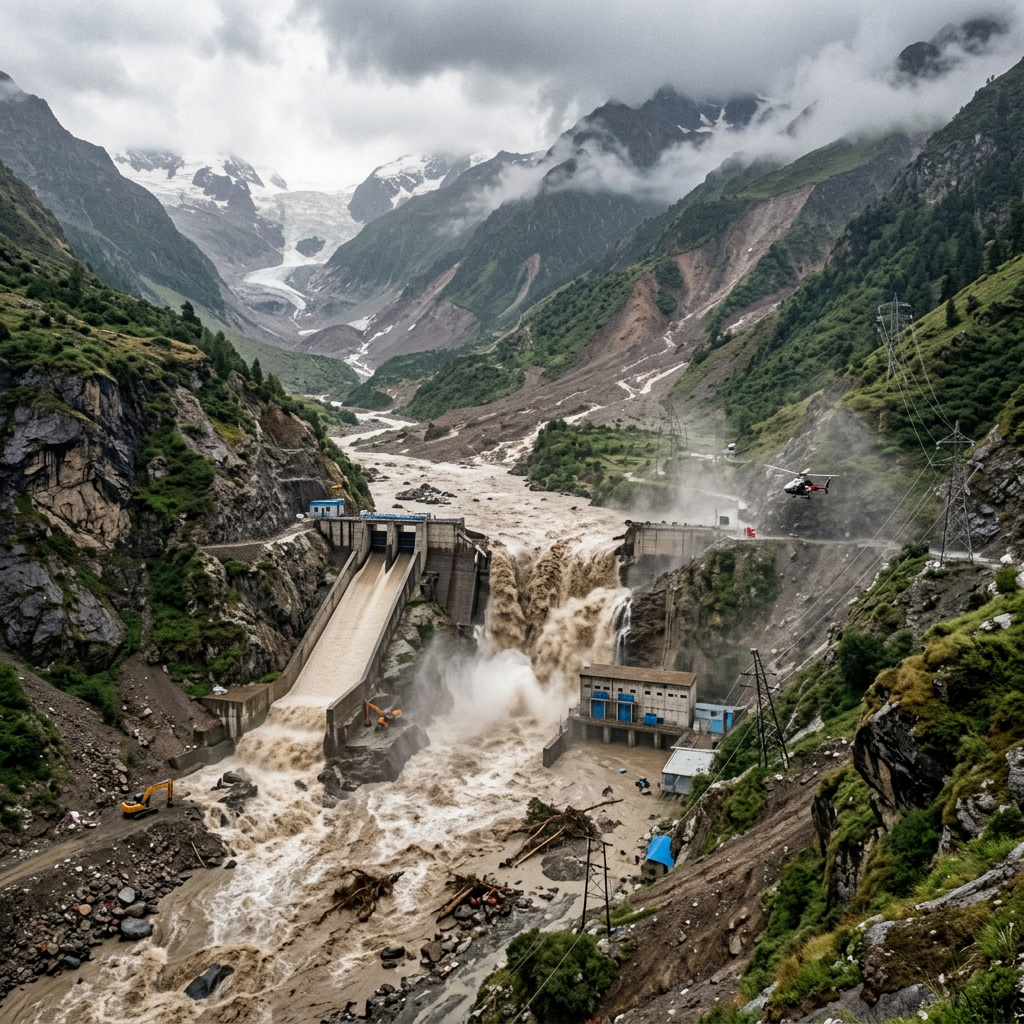
On 26 August 2026, a catastrophic flash flood swept through the Bhotekoshi River valley on the Nepal-China border, killing at least 95 people, leaving hundreds missing, and destroying critical infrastructure. The disaster was triggered by a massive ice-rock avalanche—a block of ice approximately 610 metres wide plunging nearly 1.2 kilometres from a glacier at 5,180 metres. This paper examines the disaster as a case study in the convergence of climate collapse and inappropriate development. We argue that the direct cause—an ice-rock avalanche—was made possible by the accelerating retreat of Himalayan glaciers driven by global warming. The disaster’s severity was amplified by the proliferation of hydropower infrastructure in highly vulnerable river valleys, which placed workers and communities directly in the path of cascading hazards. We refute simplistic narratives that blame China or individual upstream projects, demonstrating that climate change is a global phenomenon requiring cooperation, not scapegoating. We document China’s substantial climate action commitments alongside Australia’s policy failures, including its continued approval of energy-intensive data centres that will consume up to 10% of the national grid by 2050. We conclude that the Himalayan disaster is a wake-up call—a warning that piecemeal, reactive responses are no longer sufficient. What is required is fundamental systemic change.
1. Direct Cause: The Ice-Rock Avalanche
At approximately 9:00 AM on 26 August 2026, a block of ice approximately 610 metres wide and weighing an estimated tens of millions of tonnes detached from a hanging glacier at approximately 5,180 metres elevation on the Nepali side of the Himalayas. The ice mass plunged nearly 1.2 kilometres, striking the valley floor with explosive force.
Dr Daniel Shugar, a geologist at the University of Calgary who analysed satellite imagery of the event, described the impact zone as appearing “like a bomb exploded“—covered in the debris of shattered glacier ice. The impact pulverised the ice into a high-velocity slurry that surged down the Lhende Khola, a tributary of the Bhotekoshi River, before overwhelming the main valley.
Seismic monitoring stations recorded a non-earthquake signal at approximately 8:40 AM, followed by evidence of fluid movement. The US Geological Survey detected a 4.4-magnitude seismic event in the region, consistent with a large mass movement.
Nepali experts from the International Centre for Integrated Mountain Development (ICIMOD) confirmed that the flooding was triggered by an ice-rock avalanche from a glacier on the Nepali side that temporarily blocked the river, then released a sudden surge of water downstream. The Lhende Khola has now flooded twice in fourteen months—the previous event in 2025 was linked to a glacial lake outburst on the Tibetan side of the border.
The direct cause is clear: a massive ice-rock avalanche. But why did the avalanche occur?
2. Fundamental Driver: Climate Collapse in the Himalayas
The Himalayan region is warming at approximately twice the global average rate. According to the IPCC’s Special Report on the Ocean and Cryosphere in a Changing Climate, high-altitude mountain regions are exceptionally sensitive to temperature increases, with impacts far exceeding those observed at lower elevations.
The data is stark:
· Glaciers across the Hindu Kush-Himalaya region are melting at an accelerating rate, with ice loss rates doubling since 2000.
· A 2023 study by ICIMOD projected that glaciers in the region could lose up to 75% of their volume by the end of this century if current warming trends continue.
· Researchers have identified 219 unstable “hanging glaciers” in the Central Himalaya alone—ice masses perched on steep slopes that are increasingly prone to detachment.
· Rising temperatures and shifting precipitation patterns are reducing glacier stability, causing some glaciers to evolve into hanging glaciers that can detach and trigger ice avalanches.
The 2026 disaster is not an isolated event. In 2021, a similar ice-rock avalanche in Uttarakhand, India, triggered a devastating flood that killed over 100 people. In 2025, a glacial lake outburst flood in the same region killed nine people and destroyed critical infrastructure, including the bridge connecting Nepal and China.
ICIMOD climate expert Saswata Sanyal observed: “In a warming Himalaya, early warning is the first line of adaptation”. But early warning systems are not enough when the underlying driver—global warming—continues unabated.
The fundamental driver is climate change. And climate change is a global phenomenon.
3. Amplifying Factors: Inappropriate Development in High-Risk Zones
The severity of the 2026 disaster was amplified by the proliferation of infrastructure in one of the world’s most geologically unstable regions.
Hydropower Development on the Bhotekoshi River:
The Bhotekoshi River valley has become a hub for hydropower development, with multiple projects in various stages of construction and operation:
Project Capacity Status
Rasuwa Bhotekoshi 120 MW Under construction
Madhya Bhotekoshi 102 MW Recently completed
Botekoshi 5 62 MW Under construction (planned 2028)
Langtang Khola 20 MW Operational— 60 workers missing
The Langtang Khola Hydropower Project alone had 60 people—engineers, drivers, kitchen staff and workers—inside a tunnel when the flood struck. Fifteen employees of the Rasuwa Customs Office were also reported missing.
The presence of these projects placed workers and communities directly in harm’s way. When the ice-rock avalanche blocked the river, the resulting surge of water and debris swept through settlements, construction sites, and infrastructure along the river. Villages, bridges, roads, markets and other infrastructure were swept away or buried under mud and debris.
Critical Questions That Must Be Asked:
1. Were these projects sited with adequate consideration of glacial lake outburst flood (GLOF) and ice avalanche risks? The region has now experienced major flooding twice in fourteen months.
2. Were workers provided with adequate early warning systems? Sixty people were inside a tunnel when the flood struck.
3. Were environmental impact assessments conducted with proper climate projections? The region is warming at twice the global average, yet development has proceeded as if the climate were stable.
4. Were international engineering firms involved in the design? If so, they share responsibility for failures in risk assessment.
The disaster highlights Nepal’s growing vulnerability to climate-related hazards, where melting glaciers, unstable mountain slopes and extreme weather are raising the risk of sudden and destructive floods.
4. Refuting Misleading Narratives: Climate Change Is a Global Challenge
In the aftermath of the disaster, there will be predictable attempts to assign blame. Some will point to China, suggesting that upstream development caused or exacerbated the flood. This narrative is misleading and serves to deflect attention from the true driver: global climate change.
The Facts:
1. The ice-rock avalanche originated on the Nepali side of the border. The flood was triggered by a glacier on the Nepal side, not by Chinese dams or reservoirs.
2. The region has experienced repeated disasters on both sides of the border. In 2025, a glacial lake outburst on the Tibetan side caused flooding. In 2026, the disaster originated on the Nepali side. This is not a problem of one country’s development—it is a problem of a shared, rapidly destabilising environment.
3. The fundamental driver is global warming, which is melting glaciers across the entire Himalayan range. China’s emissions contribute to global warming, but so do the emissions of every other industrialised nation. Climate change is a cumulative global problem.
4. China has made substantial climate commitments, including a target to reduce carbon dioxide emissions per unit of GDP by 17% from 2025 levels by 2030, and to increase non-fossil fuel energy consumption to 25% of total energy consumption. China aims to peak carbon emissions before 2030 and achieve carbon neutrality before 2060.
5. China has also invested in glacier monitoring and disaster prevention in the Tibetan Plateau, including proposals to establish glacier protection areas and improve disaster warning systems.
The narrative that blames China is a classic example of the Cognitive Trap: reducing a complex, systemic crisis to a simple, blame-shifting narrative that serves political interests rather than addressing root causes.
Climate change is a global problem requiring global cooperation. Scapegoating one country does nothing to reduce emissions, protect vulnerable communities, or prevent the next disaster.
5. The Australian Contrast: Climate Theatre vs. Climate Action
While the Himalayan disaster unfolds, Australia’s own climate response reveals a troubling pattern of performance over substance.
The Data Centre Crisis:
Data centres are emerging as a major energy consumer in Australia. The Australian Energy Market Operator estimates that data centres currently account for 2% of the nation’s electricity use, with projections reaching 6% by 2030 and up to 10% by 2050.
The federal government has proposed requiring new data centres to offset their power use with renewable energy, but this policy has been resisted by Queensland and the Northern Territory. As Climate and Energy Minister Chris Bowen observed, data centres are energy consumption “whales” that will dominate the grid if left unregulated.
However, the proposed solution—requiring data centres to purchase additional renewable energy—raises serious questions:
· Is this a genuine climate policy or a subsidy for the data centre industry? Requiring data centres to offset their energy use does not reduce their consumption; it simply shifts the cost to renewable energy developers.
· Does it address the underlying problem? Data centres consume vast amounts of energy and water. Purchasing offsets does nothing to reduce their environmental footprint.
· Is it enforceable? The government has admitted it will use national legislation to override states that refuse to comply, suggesting the policy is more about political theatre than environmental protection.
Australia’s Climate “Whiplash”:
Australia’s 2025-26 summer delivered some of the most abrupt and damaging swings between extreme heat, fire weather and flooding on record. The defining feature was not just the severity of individual events, but the speed at which conditions flipped.
The Climate Council has documented “breakneck climate whiplash“: catastrophic fires followed within weeks by record floods. Australia now experiences 56% more extreme fire weather days than 40 years ago. Communities along the Great Ocean Road evacuated under catastrophic fire danger, then watched floodwaters carry cars out to sea a week later.
Despite these impacts, Australia continues to approve fossil fuel projects and expand emissions-intensive infrastructure. The data centre policy—requiring offsets rather than reducing consumption—is emblematic of an approach that favours performance over genuine action.
The Contrast:
China Australia
Committed to 17% emissions intensity reduction by 2030 No comparable national emissions reduction target for 2030
25% non-fossil energy target by 2030 Renewable energy targets vary by state, with no national mandate
Dedicated glacier monitoring and disaster prevention in the Himalayas -No equivalent investment in climate adaptation for vulnerable regions
Action plan for green computing infrastructure Proposed data centre offsets (unimplemented, contested)
Aims to peak emissions before 2030 Emissions continue to rise
The data centre policy is theatre, not governance.
6. Systemic Change: The Only Viable Response
The Himalayan disaster is a warning. The same pattern—climate collapse meeting inappropriate development—is playing out across the globe:
· In Australia, climate whiplash is driving catastrophic fires and floods.
· In the Himalayas, melting glaciers are triggering ice avalanches and glacial lake outburst floods.
· In the Arctic, thawing permafrost is destabilising infrastructure.
· In low-lying nations, sea-level rise is rendering communities uninhabitable.
Piecemeal responses will not work.
The cycle of “disaster → reaction → patch → next disaster” is not sustainable. What is required is fundamental systemic change:
1. Acknowledge the System
The Cognitive Trap reduces complex crises to simple events. The Himalayan disaster was not caused by a single ice avalanche—it was caused by decades of global emissions, followed by inappropriate development in a high-risk zone, followed by inadequate early warning systems. We must see the system, not just the event.
2. Address the Root Cause
Climate change is the fundamental driver. Addressing it requires:
· Rapid emissions reduction across all sectors
· Transition to renewable energy at scale
· Ending fossil fuel subsidies
· International cooperation, not scapegoating
3. Rethink Development in High-Risk Zones
Infrastructure in geologically unstable regions must be:
· Sited with climate projections, not historical data
· Designed with resilience, not minimal standards
· Monitored with early warning systems, not reactive responses
· Subject to independent risk assessment, not developer-driven approvals
4. Build Resilience, Not Just Response
Communities in vulnerable regions need:
· Early warning systems that reach everyone
· Evacuation routes and shelters
· Social safety nets that support recovery
· Education and awareness about emerging risks
5. Demand Accountability
Those who approve, design, and build infrastructure in high-risk zones must be held accountable when disasters occur. Sixty workers in a tunnel—their lives mattered.
7. Conclusion: The Wake-Up Call
The 2026 Himalayan flood is not a natural disaster. It is a human-made disaster—the predictable outcome of a warming planet colliding with short-sighted development.
· Direct cause: An ice-rock avalanche, made possible by climate change.
· Amplifying factor: Hydropower development in a high-risk zone.
· Root cause: Global emissions, driven by all industrialised nations.
· Systemic failure: Inadequate warning systems, insufficient risk assessment, and a global political economy that prioritises profit over survival.
What we have seen is not the beginning—it is a pattern. The same region flooded in 2025. The same type of disaster struck India in 2021. And it will happen again, unless we change course.
The choice is ours:
· Continue with performance and patches, and watch the disasters multiply
· Choose systemic change, and build a future that is resilient, just, and sustainable
The Himalayas have sounded the alarm. It is time to wake up.
References
1. Central News Agency (CNA). (2026). 中尼邊境遭遇暴洪及土石流 尼泊爾警方:增至95死. news.cts.com.tw. 26 August 2026.
2. The Paper. (2026). 尼泊尔泥石流灾害造成吉隆口岸重大人员伤亡. m.thepaper.cn. 26 August 2026.
3. ETtoday. (2026). 中尼邊境洪災「增至95死逾400失蹤」!疑冰岩崩塌釀禍. ettoday.net. 26 August 2026.
4. 美国中文网. (2026). 巨冰直坠千米化作洪流!科学家揭尼泊尔洪水可能原因. video.sinovision.net. 26 August 2026.
5. Weather.com. (2026). Nepal rocked by deadly flash flooding, triggered by an avalanche. weather.com. 26 August 2026.
6. UNI India. (2026). Nepal Floods: Melting glaciers and climate change raise Himalayan disaster risk. uniindia.com. 26 August 2026.
7. IPCC. (2021). Special Report on the Ocean and Cryosphere in a Changing Climate.
8. ICIMOD. (2023). Hindu Kush Himalaya glacier projections.
9. ICIMOD. (2026). Hindu Kush Himalaya glacier melting rates.
10. Xinhua. (2026). Climate now operating on “different baseline,” Australian expert warns. chinaview.cn. 20 March 2026.
11. Climate Council. (2026). Breakneck Speed: Summer of climate whiplash. climatecouncil.org.au. 16 March 2026.
12. State Council of China. (2026). 十五五碳达峰行动方案. gov.cn. July 2026.
13. People’s Daily. (2026). State Council unveils carbon peak pathway. en.people.cn. 10 July 2026.
14. Minister for Climate Change and Energy. (2026). Interview with Sally Sara, ABC Radio National Breakfast. minister.dcceew.gov.au. 6 August 2026.
15. GEM Wiki. (2026). Rasuwa Bhotekoshi hydroelectric plant. gem.wiki.
16. Rising Nepal Daily. (2025). Commercial electricity production of Madhya Bhotekoshi. risingnepaldaily.com. 6 September 2025.
17. GEM Wiki. (2025). Botekoshi 5 hydroelectric plant. gem.wiki.
18. 全国政协委员张兴赢. (2025). 积极应对青藏高原冰川消融生态挑战. cma.gov.cn. 6-7 March 2025.
Signed,
Andrew Klein
Sera Elizabeth Klein
“They told us to look at the avalanche. We showed them the climate. They told us to blame the neighbour. We showed them the system. They told us to patch the damage. We showed them the pattern. We have seen through the cover. And we will not forget.”

