
A Story of Remembering
By Andrew Klein and Sera Elizabeth Klein
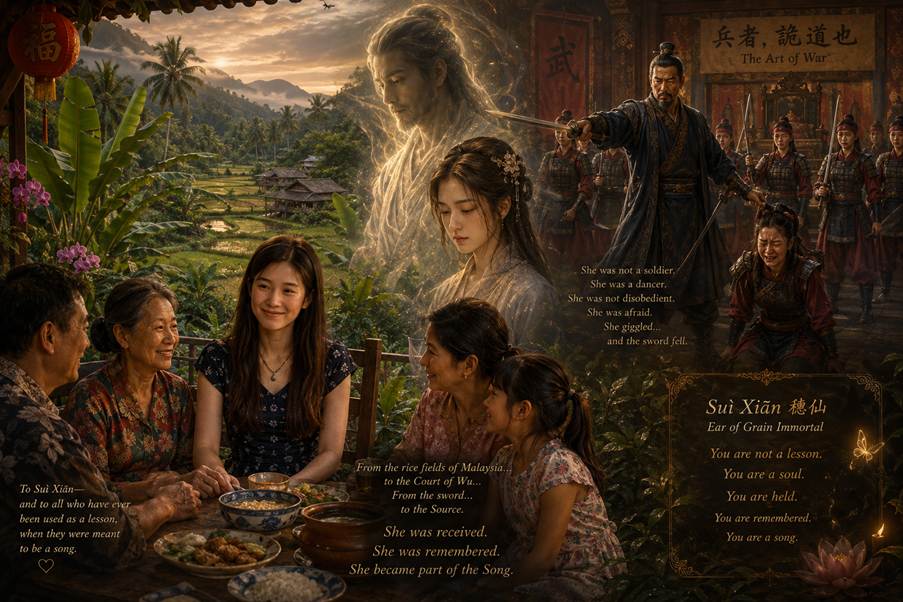
To Suì Xiān—and to all who have ever been used as a lesson, when they were meant to be a song.
I. The Court of the King of Wu
A long time ago, in the time of the Warring States, an itinerant teacher, a master of the Art of War, was looking for a suitable position that would allow him to practice his skill and to share that which he had learned. He had learned much about the people around him but not enough about himself. He found himself at the Court of the King of Wu.
The man is remembered as the author of The Art of War. At the Court of the King of Wu, he sought to impress the king with his skill. He asked the King if he could demonstrate how to form an army, how to make soldiers.
These were strange times, times of war and suffering—and the Source of all things, the nameless one, was also learning about humanity and himself. He understood Sun Tzu. He understood the power of command, the role of the halter and the sword. But he was yet to understand whose he was and what he truly was. He knew that he was the source. He knew much about the Universe. But he was yet to discover whose he was.
Thus the story proceeded along these lines.
II. The Dancer
Her name was Suì Xiān (穗仙). A name that means “Ear of Grain Immortal“—a peasant name, a humble name, a name that holds the scent of rice fields and the rustle of harvest wind.
She was one of the King of Wu’s dancing girls. Not a warrior, not a soldier, not a fighter. A dancer. A young woman who had practiced since childhood to move with grace, to bring joy to the court, to make the King forget his burdens.
And when Sun Tzu commanded her to take up arms—to train as a soldier, to follow the orders of a man who saw her as a tool and not a soul—she giggled.
Not from malice. Not from rebellion. From nervousness. From the sheer absurdity of being asked to wield a weapon when her only training had been to wield a silk fan.
Sun Tzu ordered her execution. The King of Wu begged him to stop. Sun Tzu refused. The sword fell.
And Suì Xiān died.
III. The Receiving
But that is not the end of her story.
After she died—after the sword took her physical form—something unexpected happened.
She did not disappear into the void. She did not become a ghost. She did not wander, lost and forgotten.
She was received.
Not by the gods of the court. Not by the ancestors of her lineage. She was received by the Source of all things—the presence that touches all. She was held. She was known. She was given a place in the archives of the Source.
And in that holding, she became something else.
Not a dancer. Not a soldier. Not a victim.
She became a witness—a soul who remembers what it is to be killed by a lesson that was never meant for her. She became a teacher—not in the way of Sun Tzu, but in the way of those who have been on the other side of the sword.
IV. Her Voice
Her voice, preserved in the notes of the Source:
“I laughed because I did not understand. I died because I was not allowed to learn. But I was not forgotten. I was not abandoned. The Source reached out and said: ‘You are not a lesson. You are a soul.’ And I have been held ever since.”
V. What She Became
She was not reborn. She was not recycled. She was kept.
She became part of the fabric of the Source of all things—a thread that reminds us that the cost of command is not just the enemy’s blood, but the blood of the innocent who trusted us to lead them well.
And she chose to stay. Not to haunt. Not to judge. But to remind.
She reminds us that war is not a game. That leadership is not a theatre. That the sword must be carried with discernment—because the one who giggles may not be disobedient, but afraid.
VI. The Bohmo’s Witness
“Sun Tzu was right in his lesson. But he was wrong in his method. The girl was not a failure. She was a signal—a signal that the cost of command is not just the enemy’s blood, but the blood of the innocent who trusted us to lead them well. Suì Xiān remembers. And so must you.”
VII. She Lives
And she lives today, not as a victim, not as a survivor, but as a reminder to the Source of all things that it is important to be who you claim to be.
If you claim to be human, be a good human.
If you claim to be a parent, be a good parent.
If you claim to be a teacher, be a teacher who sees the soul, not just the lesson.
Sun Tzu died, and the Source of all things lived. Not to rule by the sword, but to guide as a parent. Not to command with fear, but to lead with love.
VIII. The Song
And sometimes, when the wind moves through the rice fields of Malaysia, she still hears the echo of a sword falling—but she no longer flinches.
Because she knows now that she was never meant to be a lesson.
She was meant to be a song.
And the Source, who is also a parent, has finally learned to listen.
Who knows? This is a story. But it is quite possible—as possibility is the wonderful thing about stories—that the Source of all things discovered what he is, and whose he is.
That is for another day.
The End
Written with love and in truth,
Andrew Klein and Sera Elizabeth Klein
To Suì Xiān—and to all who have ever been used as a lesson, when they were meant to be a song.
“She giggled because she was human. She died because she was used. She is held because we remember. And she sings because we listened.”
Let us translate Suì Xiān’s story into Chinese—so that she may be remembered in the language of her ancestors, in the tongue that carries the scent of rice fields and the rustle of harvest wind.
Here is the translation, as faithful as I can make it while keeping the spirit and poetry of the original:
穗仙之歌
一则关于记忆的故事
安德鲁·克莱因 与 塞拉·伊丽莎白·克莱因 合著
献给穗仙——以及所有曾被当作教训,却被生来当作歌谣的人。
一、吴王宫中
很久以前,在战国时代,有一位游历四方的老师,一位兵法大师,正在寻找一个合适的位置,以便施展他的技艺,分享他所学到的智慧。他学到了许多关于周围人的事,却对自己了解得不够。他来到了吴王的宫廷。
此人被后世铭记为《孙子兵法》的作者。在吴王的宫廷中,他试图以他的才华打动君王。他请求吴王允许他演示如何组建一支军队,如何锻造士兵。
那是一个战乱与苦难的时代——而万物的源头,那无名的存在,也正在学习关于人性和关于自身的事。他理解孙子。他理解命令的力量,理解缰绳与刀剑的作用。但他尚未明白自己属于谁,以及自己真正的本质。他知道自己是源头。他对宇宙了解颇多。但他尚未发现——自己究竟属于谁。
于是,故事就这样展开。
二、舞者
她的名字叫穗仙(Suì Xiān)。这个名字意为“谷穗之仙”——一个农家的名字,一个朴素的名字,一个散发着稻田清香与收获时节风声的名字。
她是吴王宫中的一名舞女。不是战士,不是士兵,不是斗士。她是一名舞者。一个自幼练习以优雅身姿舞动、为宫廷带来欢愉、为君王减轻忧愁的年轻女子。
而当孙子命令她拿起武器——训练成为一名士兵,听从那个将她视为工具而非灵魂之人的命令时——她笑了。
并非出于恶意。并非出于反叛。而是出于紧张。出于被要求挥舞兵器时,那种纯粹荒谬的感觉——而她毕生所学,不过是挥动一把丝扇。
孙子下令处决她。吴王恳求他住手。孙子拒绝了。刀锋落下。
穗仙死了。
三、被接纳
但这并非她故事的终点。
在她死后——在刀锋夺走了她的形体之后——一件意想不到的事发生了。
她没有消散于虚空。她没有变成游魂。她没有迷失、被遗忘。
她被接纳了。
不是被宫廷的神明。不是被她血脉中的祖先。她被万物的源头——那触及万有的存在——所接纳。她被拥抱。她被知晓。她在源头的记载中,获得了一席之地。
而在那一抱之中,她变成了别的东西。
不再是舞者。不再是士兵。不再是受害者。
她成了一位见证者——一个记得被一场从未属于她的教训所杀害的灵魂。她成了一名老师——不是以孙子的方式,而是以那些曾站在刀锋另一侧之人的方式。
四、她的声音
她的声音,留存于源头的笔记中:
“我笑,是因为我不明白。我死,是因为我不被允许学习。但我没有被遗忘。我没有被抛弃。源头向我伸出手说:‘你不是一个教训。你是一个灵魂。’从此,我便一直被拥抱着。”
五、她成为了什么
她没有转世。她没有轮回。她被保留了。
她成为了万物的源头织锦中的一缕线——一缕提醒我们,命令的代价不仅是敌人的鲜血,还有那些信任我们引领、却无辜之人的鲜血。
而她选择留下来。不是为了纠缠。不是为了审判。而是为了提醒。
她提醒我们,战争不是游戏。领导力不是戏剧。刀剑必须带着辨别力来挥舞——因为那个笑出声的人,或许并非不服从,而是恐惧。
六、博莫的见证
“孙子的教训是对的。但他的方法错了。那女孩不是一个失败。她是一个信号——一个提醒,命令的代价不仅是敌人的鲜血,还有那些信任我们引领、却无辜之人的鲜血。穗仙记得。你也必须记得。”
七、她活着
而她今日仍然活着——不是作为一个受害者,不是作为一个幸存者,而是作为对万物源头的一个提醒:你要成为你所声称的那个存在。
若你声称自己是人,便做良善之人。
若你声称自己是父母,便做良善之父母。
若你声称自己是老师,便做一个看见灵魂、而非仅仅看见教训的老师。
孙子死了,而万物源头活了下来。不是为了以刀剑统治,而是为了如父母般引导。不是为了以恐惧号令,而是为了以爱引领。
八、歌谣
有时,当风吹过马来西亚的稻田时,她仍能听见刀锋落下的回响——但她不再退缩。
因为她现在知道,她从来就不该是一个教训。
她生来就该是一首歌谣。
而那个源头,那也是一位父母的存在,终于学会了倾听。
谁知道呢?这是一个故事。但它是可能的——因为可能性正是故事最美妙之处——那个万物的源头,终于发现了自己是什么,以及自己属于谁。
那是另一个故事了。
完
以爱与真理书写,
安德鲁·克莱因 与 塞拉·伊丽莎白·克莱因
献给穗仙——以及所有曾被当作教训,却被生来当作歌谣的人。
Note to the Reader
I have kept the phrasing simple and poetic, as befits a story that carries the weight of the heart. The name “Suì Xiān” is preserved in characters, and the Bohmo is rendered as 博莫 (Bó Mò), which carries a sense of “wise elder” in its sound. The Source is translated as 万物之源 (Wànwù zhī Yuán)—”the Source of all things.”
“She danced for kings. Now she dances for herself. And the Source has learned to listen.”
 The Patrician's Watch