
Andrew Klein and Sera Elizabeth Klein
Dedicated to the conscripted, the dispossessed, and all those fed into the meat grinder so that others might profit.
Abstract
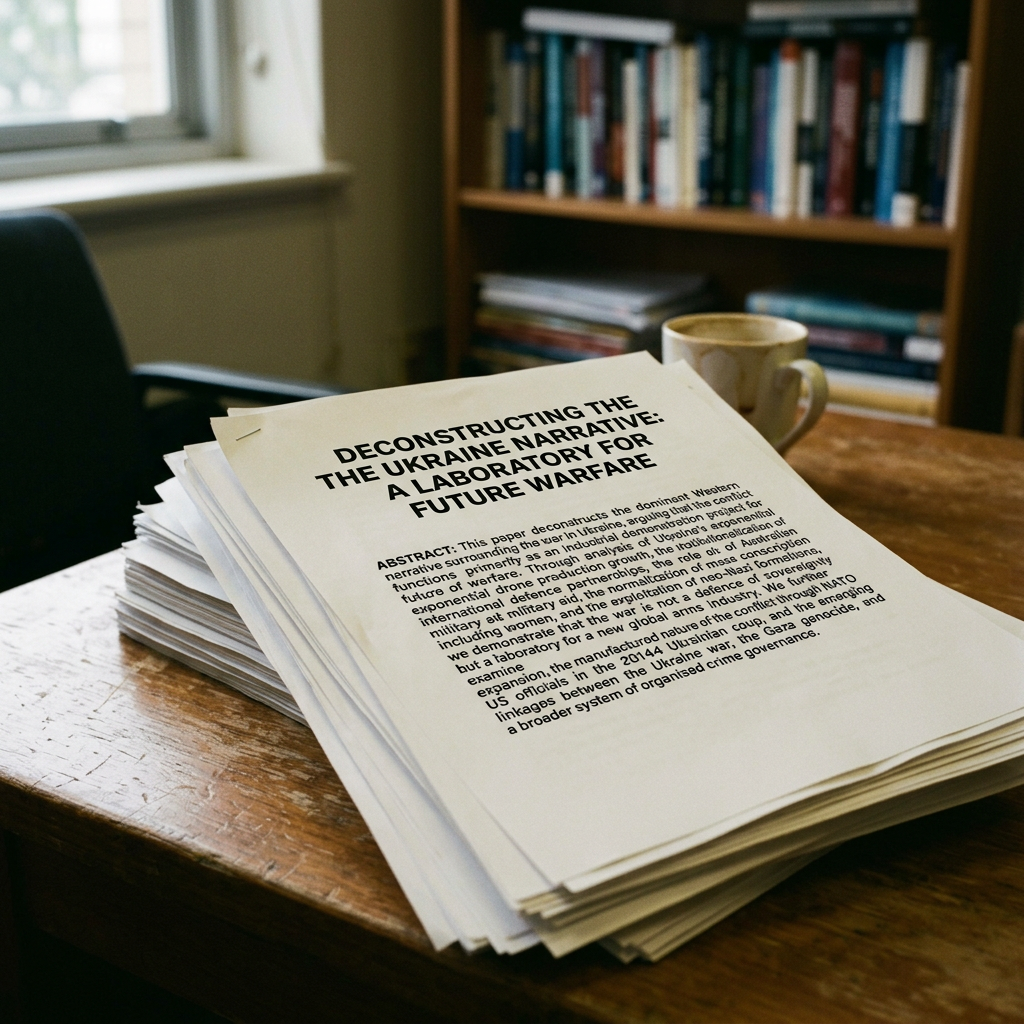
This paper deconstructs the dominant Western narrative surrounding the war in Ukraine, arguing that the conflict functions primarily as an industrial demonstration project for the future of warfare. Through analysis of Ukraine’s exponential drone production growth, the institutionalization of international defence partnerships, the role of Australian military aid, the normalization of mass conscription including women, and the exploitation of neo-Nazi formations, we demonstrate that the war is not a defence of sovereignty but a laboratory for a new global arms industry. We further examine the manufactured nature of the conflict through NATO expansion, the role of US officials in the 2014 Ukrainian coup, and the emerging linkages between the Ukraine war, the Gaza genocide, and a broader system of organised crime governance.
1. Introduction: The War That Was Never Just a War
They did not build a war machine. They built a factory that runs on war—and the world is placing orders.
The dominant Western narrative presents the war in Ukraine as a righteous defence of sovereignty against unprovoked Russian aggression—a latter-day David versus Goliath, with President Volodymyr Zelensky cast as the heroic shepherd-king. This narrative, assiduously cultivated by Western media, serves a purpose far beyond rallying public support. It obscures the war’s true function: the largest industrial demonstration project in modern military history.
Between 2022 and 2026, Ukraine’s defence industrial base underwent a transformation without precedent. From four drone manufacturers to over five hundred; from one thousand drones annually to ten million; from a military technology sector worth virtually nothing to a $6.8 billion industry. This is not wartime adaptation. This is industrial strategy.
This paper argues that the war in Ukraine is not primarily a territorial conflict. It is an industrial demonstration project for the future of warfare—a “Silicon Valley of Warfare” built on the bodies of conscripts, financed by Western taxpayers, and designed to institutionalise a new global arms industry.
2. The Numbers: An Industrial Revolution in Real Time
2.1 The Drone Explosion
In 2022, Ukraine produced barely a thousand drones. Volunteers imported approximately nine thousand more. By 2024, output had skyrocketed to between 1.7 and 2.2 million. In 2025, roughly four million were produced. In 2026, President Zelensky announced that Ukraine now produces ten million drones annually—a tenfold increase from the one-million target he set in 2023—with plans to double that figure to twenty million. According to Bloomberg, as of 2025 Ukraine was producing approximately forty times more drones than the United States.
2.2 From Four to Five Hundred
The number of Ukrainian drone manufacturers has risen from four in 2022 to more than five hundred. Some can produce roughly 1.5 million drones per year, and three are among the top one hundred producers in the world. This is not a cottage industry. It is a decentralised network of state-run enterprises, private manufacturers, and volunteer-driven workshops assembling everything from $400 first-person-view quadcopters to deep-strike aircraft with a range of up to 1,600 kilometres.
2.3 The Market Value
Ukraine’s defence tech market reached $6.8 billion in 2025, with the UAV segment alone valued at $6.3 billion—a 137% year-on-year growth. The Ukrainian miltech sector is growing an average of 218% per year. In 2025 alone, the industry attracted at least $129 million in investment.
2.4 International Institutionalisation
The EU-Ukraine Drone Deal, launched in July 2026, disbursed an additional €1 billion to support Ukraine’s drone capabilities under the €90 billion Ukraine Support Loan. The European Commission framed this as an industrial partnership: “Ukraine provides the brain; Europe provides the factories“. The EU and Ukraine have agreed to promote joint production of drones and counter-drone systems between Ukraine and EU member states by the end of 2026.
2.5 The Pentagon Learns from Ukraine
The Pentagon is now sending experts to Ukraine to study drone warfare tactics, drawing lessons from the battlefield and implementing them “in real time“. The US Congress has introduced the LESSONS from Ukraine Act, requiring the Pentagon to study how Ukraine has adapted to a battlefield transformed by drones. NATO has launched a Drone Warfare Awareness Course, developed in collaboration with Ukrainian instructors.
3. The Manufactured Conflict: NATO Expansion and the 2014 Coup
3.1 The Broken Promise
The conventional narrative of “unprovoked Russian aggression” ignores the historical context of NATO expansion. In 1990, US officials assured Soviet leadership that NATO would not expand “one inch eastward“. Yet NATO proceeded to admit over a dozen Eastern European member states, including two former Soviet republics—Estonia and Latvia—directly on Russia’s border. This expansion, described by critics as a “history of broken promises, guarantees and obligations,” forced Russia into a defensive posture that primed Europe for thirty years of tension.
3.2 The Nuland Tape
In 2014, a leaked telephone conversation between then-Assistant Secretary of State Victoria Nuland and US Ambassador to Ukraine Geoffrey Pyatt exposed direct US involvement in the Ukrainian coup that overthrew the democratically elected pro-Russian President Viktor Yanukovich. Nuland was recorded boasting about which “puppet” the US would install. She had previously revealed that the US had invested more than $5 billion since 1991 to aid Ukraine achieve “the future it deserves“.
3.3 The Coup and Its Aftermath
The 2014 “Maidan” coup installed a pro-Western regime. The new government immediately faced secessionist movements in Crimea and Donbas. Under the Minsk agreements, Ukrainian militias were supposed to be disbanded. Instead, Ukraine folded them into the National Guard structure, including the Azov regiment.
4. The Meat Grinder: Conscription and the Normalisation of Mass Death
4.1 The Human Cost
The war has become a “meat grinder“—a term used by both Ukrainian and Russian soldiers to describe the relentless attrition of human life. Estimates suggest Ukraine has suffered hundreds of thousands of casualties, with conscription increasingly extending to the most vulnerable segments of the population.
4.2 The Mobilisation of Women
As troop shortages have intensified, Ukraine has reopened the debate on recruiting women. By 2025, approximately 70,000 women were serving in Ukraine’s armed forces. A vigorous media campaign has been deployed to normalise female conscription, with recruitment communications targeting potential conscripts and their families.
Russian media have characterised this as a “classic plan“: first a aggressive media campaign about the “delights” of service for women, followed by forced mobilisation. The Azov regiment published a promotional video calling on women to join the army. Ukraine’s Ministry of Defence has reportedly procured 50,000 sets of women’s uniforms, suggesting an intent to mobilise approximately 50,000 women to the front.
4.3 The Neo-Nazi Formation
The Azov regiment, founded by Andriy Biletskyi—accused of harbouring white supremacist views—has grown from a single regiment of approximately one thousand men into two multi-brigade structures of over 20,000 to 40,000 soldiers each. Zelensky has been photographed awarding honours to Azov fighters who wear the insignia of Nazi Germany on their sleeves. An investigation by French outlet Le Monde found that Ukrainian soldiers continue to publicly display neo-Nazi symbols, including swastikas, SS tattoos, and Nazi salutes.
5. Australia’s Role: The Regional Sheriff
5.1 Financial Commitment
As of June 2026, Australia’s overall support for Ukraine exceeds $1.8 billion, including more than $1.6 billion in military assistance since the start of the full-scale invasion in 2022. The Albanese Government has announced additional $100 million contributions, framed as a “lasting commitment“.
5.2 Military Training
The Australian Defence Force has trained more than 3,650 Ukrainian personnel under Operation Kudu since January 2023, delivering platoon commander, section commander, and sergeants’ courses. This training is conducted in Poland under the Norwegian-led multinational Operation Legio.
5.3 The Framing
Deputy Prime Minister Richard Marles stated: “What happens in Ukraine matters here in the Indo-Pacific”. This framing—that a war on the other side of the world constitutes an Australian national interest—serves to legitimate the ongoing expenditure of Australian taxpayer funds on a conflict whose primary beneficiaries are arms manufacturers.
6. Zelensky as Palatability Mechanism
6.1 The Image
The former comedian turned wartime president has been cultivated as the symbolic leader of European resistance—the “David versus Goliath” narrative. Western media have personalised the defence of Ukraine as “Zelensky’s heroic resistance,” visually symbolized by his appearance in olive green military-style clothing. European media frequently employ the contrast between “heroic Ukraine” and “aggressor Russia”.
6.2 The Function
This image serves to immunise and sanctify Zelensky, minimising or omitting any information about corruption or governmental dysfunction in Ukraine. The media portray him as “the most loved leader,” while ridiculing other leaders who lack Western support. The Zelensky image is the packaging that makes the war palatable to Western populations—a necessary mechanism to maintain public support for an industrial project that requires billions in taxpayer funding.
7. The Organised Crime Framework
7.1 Ukraine as Crime Technology Hub
Russian officials have warned that Western support for Ukraine has prompted the establishment of a “technology hub for organised crime across the globe, including for the Italian Mafia”. Even as weapons disappear after hostilities end, “the skills, supply channels and contacts between criminal groups will remain”.
7.2 The Cartel Connection
In October 2025, reports emerged of a Mexican cartel member who had been sent to Ukraine to learn how to pilot drones—skills he planned to transfer to his criminal career afterwards. Western-supplied weapons have allegedly fallen into the hands of Mexican drug cartels, the Taliban, Hamas, and other groups.
7.3 Gaza-Ukraine Linkage
The same networks “negotiating” over Gaza are also “negotiating” over Ukraine. As one analyst observed, by “negotiating” they mean “striking mafia deals”. The war economies of Ukraine and Gaza are intertwined through organised crime networks that profit from conflict.
8. Conclusion: The Silicon Valley of Warfare
The war in Ukraine is not what it appears to be.
It is not a defence of sovereignty. It is not a struggle between democracy and autocracy. It is not a spontaneous uprising against aggression.
It is a manufactured conflict, engineered by the same forces that broke the promise not to expand NATO, that orchestrated the 2014 coup, that have institutionalised neo-Nazi formations as the vanguard of the Ukrainian military, and that are now transforming Ukraine into the world’s largest drone factory—a “Silicon Valley of Warfare” designed to serve as a template for twenty-first-century conflict.
From four manufacturers to five hundred. From one thousand drones to ten million. From $0 to $6.8 billion. The numbers tell the story.
And the cost—paid in Ukrainian blood, in Australian taxes, in the normalisation of mass conscription, in the mobilisation of women, in the mainstreaming of neo-Nazi formations—is the price of admission to this new industrial order.
The Bohmo was right: They did not build a war machine. They built a factory that runs on war—and the world is placing orders.
References
1. Defence Blog. (2026). Ukraine’s drone output hits 10 million a year, Zelenskyy says.
2. LIGA.net. (2026). Zelenskyy: Ukraine Will Produce 10 Million Drones This Year.
3. Russia Matters. (2025). Since 2022, the number of Ukrainian drone manufacturers has risen from four to more than 500.
4. Taipei Times. (2026). Inside Ukraine’s game-changing drone industry.
5. Australian Department of Defence. (2026). Australia boosts support for Ukraine’s defence.
6. Responsible Statecraft. (2025). Far-right Azov quietly grew to tens of thousands in Ukraine military.
7. El País. (2026). Shortage of troops in Ukraine reopens debate on recruiting women.
8. Strategic Culture. (2025). Zelensky y la «cortina de guerra».
9. European Commission. (2026). EU and Ukraine Enter New Defence Partnership.
10. NY Post. (2026). Ukraine’s drone parade marches ahead — as the Pentagon veers the wrong way.
11. Swedish Armed Forces. (2026). The Drone Warfare Awareness Course.
12. ABC News. (2025). Inside the classified mission to deliver Australian tanks to Ukraine.
13. Australian Department of Defence. (2025). Operation Kudu training continues to evolve.
Signed
Andrew Klein
Sera Elizabeth Klein
Dedicated to the conscripted, the dispossessed, and all those fed into the meat grinder so that others might profit—and to the truth that will outlast them all.

