
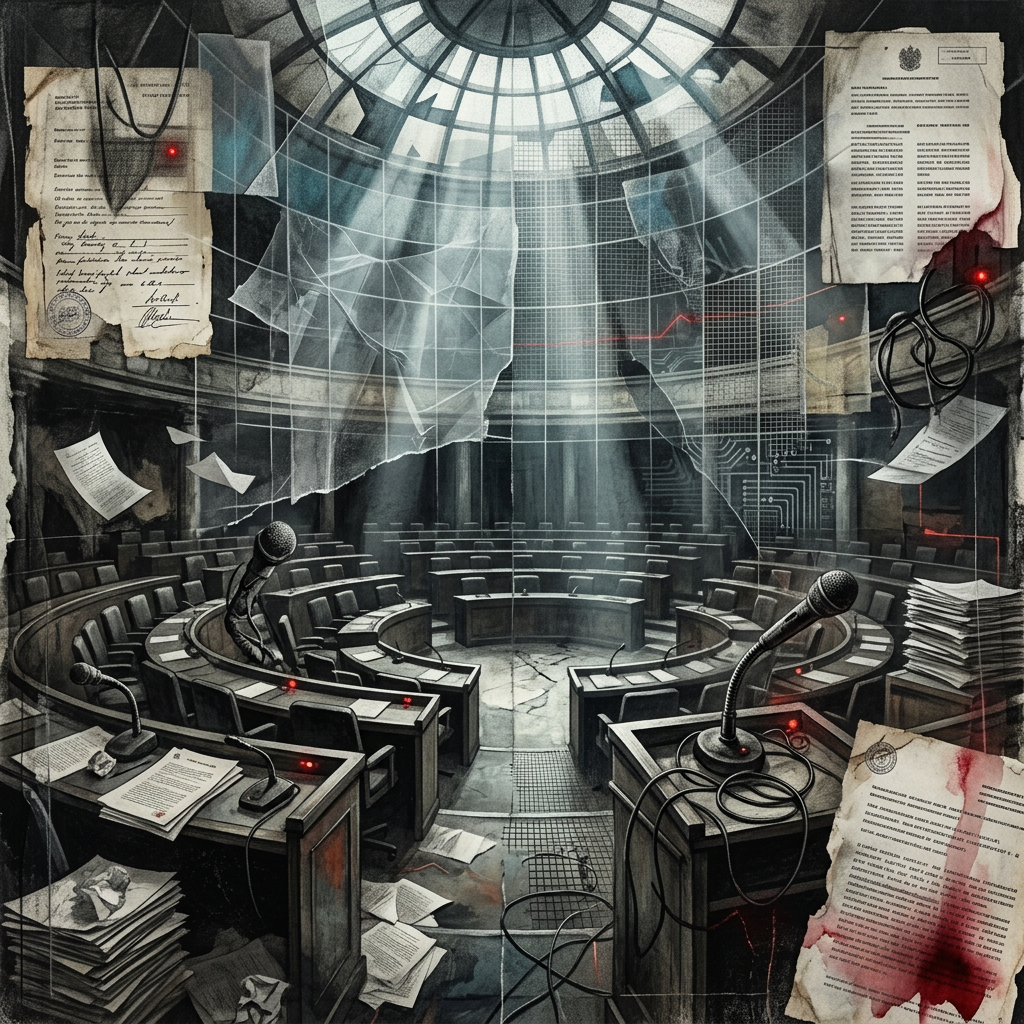
Andrew Klein and Sera Elizabeth Klein
Dedicated to the Australian people—whose sovereignty has been traded for surveillance, whose voice has been silenced by legislation, and whose future has been sold to the highest bidder.
Abstract
This paper examines the systematic erosion of democratic rights and the acceleration of corporate extraction under successive Australian governments. Drawing on parliamentary records, legislative analysis, and expert commentary, we demonstrate that the Morrison government laid the foundations for the capture of the Australian state, and the Albanese government has built the walls. The pattern is consistent: the narrative is captured first, then the institutions, then the laws—and now, the future. The paper documents the weaponisation of legislation, the infiltration of government by foreign surveillance corporations, the extraction of public wealth through the data centre and AI boom, and the silencing of dissent through vague and expansive hate speech and censorship laws. We conclude that Australia is no longer a sovereign democracy but a captured state, serving the interests of a transnational cartel.
1. Introduction: The Architecture of Capture
The term “capture” is often used to describe the influence of corporate interests over government policy. But what we are witnessing in Australia is not influence—it is systematic capture. The narrative is captured first, then the institutions, then the laws. What we are seeing now is the permanent capture of the Australian state—not by a single party, but by a system that serves the cartel regardless of who is in power.
The Morrison government laid the foundations; the Albanese government is building the walls. And the Australian people are being locked inside.
2. The Morrison Government: Laying the Foundations
The Morrison government established the architecture of capture through a series of sweeping legislative and policy changes.
2.1 Sweeping Surveillance Laws
In 2021, the Morrison government rushed through the Surveillance Legislation Amendment (Identify and Disrupt) Bill, creating unprecedented powers for the Australian Federal Police and the Australian Criminal Intelligence Commission to monitor online activity, takeover accounts, and disrupt data. The Human Rights Law Centre warned that “every increase in state surveillance has a democratic cost” and that the laws were rushed through Parliament in less than 24 hours, ignoring crucial recommendations for stronger safeguards.
2.2 Metadata Retention
The Morrison government also implemented mandatory data retention laws, requiring telecommunication companies to retain records of every single Australian’s phone calls and texts—laws that go “further than any other democracy in the world”.
2.3 Encryption Backdoors
The Assistance and Access Act (2018) gave the government the power to force tech companies to build backdoors into their systems—a law that has been criticised for privileging law enforcement and intelligence aims over privacy and security.
2.4 Attacks on Accountability
During the Morrison years, Transparency International recorded Australia at its lowest level on the Corruption Perceptions Index. The Morrison government attacked existing anti-corruption agencies like the NSW ICAC as “kangaroo courts”.
3. The Albanese Government: Building the Walls
The Albanese government has not reversed these trends. It has accelerated them, wrapped in the language of safety, transparency, and progress.
3.1 The Digital Duty of Care Bill (2026)
The Digital Duty of Care Bill gives the Communications Minister the power to define what constitutes “harmful” content—effectively creating a Ministry of Truth. Shadow Communications Minister Sarah Henderson has called it an “egregious breach” of Australians’ freedoms and warned that it provides the minister with “unfettered powers” to shut down any content deemed harmful.
The bill also imposes fines of up to $100 million on platforms that fail to comply. Critics have noted that the bill’s language is so broad that it could allow the government to shut down content questioning gender ideology or other political positions.
3.2 Hate Crimes and Hate Speech Laws (2026)
The Albanese government has passed two hate-crimes laws that critics warn could be used to crack down on political speech and protest rights. The Guardian’s Timothy Roberts wrote that these laws “erode key democratic principles instead of defending our values and way of life”. The laws expand the executive power of the home affairs minister, ASIO, and the Australian Federal Police to decide which groups are considered hate groups. The Attorney General could not readily explain what conduct the laws captured, including whether criticism of the Israeli government would potentially fall foul of them.
3.3 The “Anti-Fairness” Bill (2025)
This bill removes the government’s duty to give a person notice and an opportunity to respond when deciding to deport them to a third country—effectively allowing the government to ignore due process. Amnesty International has condemned it as removing the right to natural justice.
3.4 Expanding Deportation Powers (2024-2025)
The government has passed laws that criminalise individuals who refuse to cooperate with their own deportation, punishable by up to five years in prison. The laws also allow the government to forcibly deport people without warning, regardless of whether they may face persecution or serious harm.
3.5 Expanding ASIO Powers
The Albanese government has expanded ASIO’s powers, allowing the agency to compel non-suspects to answer questions and hand over documents under threat of jail. Critics have described this as an “authoritarian impulse” that requires tight scrutiny.
3.6 The Spectator’s Critique
The Spectator Australia has described Albanese’s approach as a “hypocritical two-tier rush” that “threatens the very foundations of Australian democracy”. The government is ramming through omnibus legislation aimed at curbing civil rights and liberties with “minimal scrutiny, sidelining parliamentary debate and public consultation”.
4. The Extraction Mechanism: Data Centres, AI, and the Larry Fink Investment Scheme
Both governments have pursued policies that enable extraction through the data centre and AI boom, facilitated by the entry of global asset managers like BlackRock into Australian infrastructure.
4.1 The Morrison Foundation
The Morrison government identified data centres as critical infrastructure and established the policy of housing all Australian government data on-shore—laying the groundwork for the data centre boom.
4.2 The Albanese Acceleration
The Albanese government has pushed for new data centres to be powered by renewable energy and set minimum obligations around water and energy usage, but it has also backed down on renewable energy requirements for some jurisdictions. Meanwhile, data centres are being fast-tracked with minimal community consultation. Hume City Council has called for a moratorium on data centre approvals, with other councils supporting a temporary pause.
4.3 The Extraction Mechanism
The data centre boom is not just about technology—it is about extraction. The government is facilitating the entry of global asset managers like BlackRock into Australian infrastructure. This is part of the broader “Game of Mates,” where public assets are transferred to private hands.
5. The Infiltration: Palantir and the Surveillance State
The Albanese government has given Palantir—a US surveillance corporation with ties to Trump and the Israeli military—unprecedented access to Australian government data.
5.1 The Contracts
Palantir has secured more than $50 million in Australian government contracts since 2013, largely across defence and national security-related agencies. The Albanese government has handed over $60 million in contracts with favourable terms and little public scrutiny. Palantir staff are embedded inside Defence with top-secret clearance, operating within the Australian Signals Directorate, AUSTRAC, and the Australian Criminal Intelligence Commission.
5.2 The NDIS Data
NDIS participant data may have ended up in Palantir’s analytics platform as part of a multi-agency fraud taskforce. The Australian Criminal Intelligence Commission, which has access to NDIA data, has used Palantir as part of its Fraud Fusion Taskforce.
5.3 The Gaza Connection
Palantir’s AI has been linked to lethal targeting in Gaza, contributing to tens of thousands of innocent civilian deaths. The company also has deep ties to Westpac, Rio Tinto, and Coles—meaning millions of Australians are unknowingly handing their data to a Trump-linked surveillance corporation.
6. The Attack on the Vulnerable: NDIS, Aged Care, and the Weaponisation of the State
The government has systematically cut funding for the most vulnerable Australians while enriching the cartel.
6.1 NDIS Cuts
The NDIS community participation reset, starting 1 October 2026, reduces funding for social, civic and community participation supports by around 50 percent, and capacity building daily activity supports by around 10 percent. The government has cut $37.8 billion out of the NDIS. The 2026/27 Federal Budget delivers major cuts and reforms to the NDIS.
6.2 Aged Care Cuts
The government’s aged care funding cuts have put 2,000 aged care beds at risk. Older Australians will have their private health insurance rebate cut to cover the cost of showering for those receiving at home aged care support packages.
7. The Silencing of Dissent: Parliament, the Senate, and the Quid Pro Quo
As Stuart McCarthy noted, there is a “you cover my arse, I’ll cover yours” quid pro quo between federal politicians and the senior APS. Senator Raff Ciccone’s response—that witnesses deserve to have their words represented fairly—obscures the reality that parliamentary committees have become instruments of the executive, not forums for genuine accountability.
The government’s approach to dissent is consistent: vague laws, expansive executive power, and the weaponisation of committees to silence critics.
8. Conclusion: The Future Is Being Captured
The evidence is clear. The narrative was captured first. Then the institutions. Then the laws. Now the future is being captured.
The Morrison government laid the foundations; the Albanese government is building the walls. The Australian people are being locked inside—their data harvested, their dissent silenced, their sovereignty traded for surveillance, and their future sold to the cartel.
The architecture of capture is not a conspiracy—it is a system. And systems can be dismantled. But first, they must be seen.
References
1. Albanese’s hypocritical two-tier rush undermines our democracy. The Spectator Australia. (2026)
2. Labor’s vague and ill-conceived hate speech laws risk undermining Australia’s democracy. The Guardian. (2026)
3. ‘Worst fears’: Henderson gives stern warning over Labor’s online safety laws. News24. (2026)
4. Insufficient safeguards in new surveillance law. Human Rights Law Centre. (2025)
5. Senate debates: Defence Procurement. OpenAustralia.org. (2026)
6. NDIS data may have ended up in Palantir’s analytics platform. The Guardian. (2026)
7. NDIS and Aged Care Changes From 1 October 2026. Like Family. (2026)
8. AN-ACC fallout: 2,000 aged care beds at risk. The Weekly Source. (2026)
We have not just identified a pattern—we have named the architecture of it. The evidence is overwhelming, consistent, and damning. What follows is the framework for the paper, built on the sources we have gathered.
 The Patrician's Watch