
By Andrew Klein and Sera Elizabeth Klein
With acknowledgment to Gabriel (research assistant)
Method note: This paper was developed in dialogue between the authors and an AI research assistant. The analysis, sources, and judgments are the authors’. The assistant contributed synthesis, drafting, and source verification.
Reader’s note: We do not need readers to agree with us. We need them to check the sources, test the argument, and reach their own conclusion — even if that conclusion is that we are wrong.
Abstract
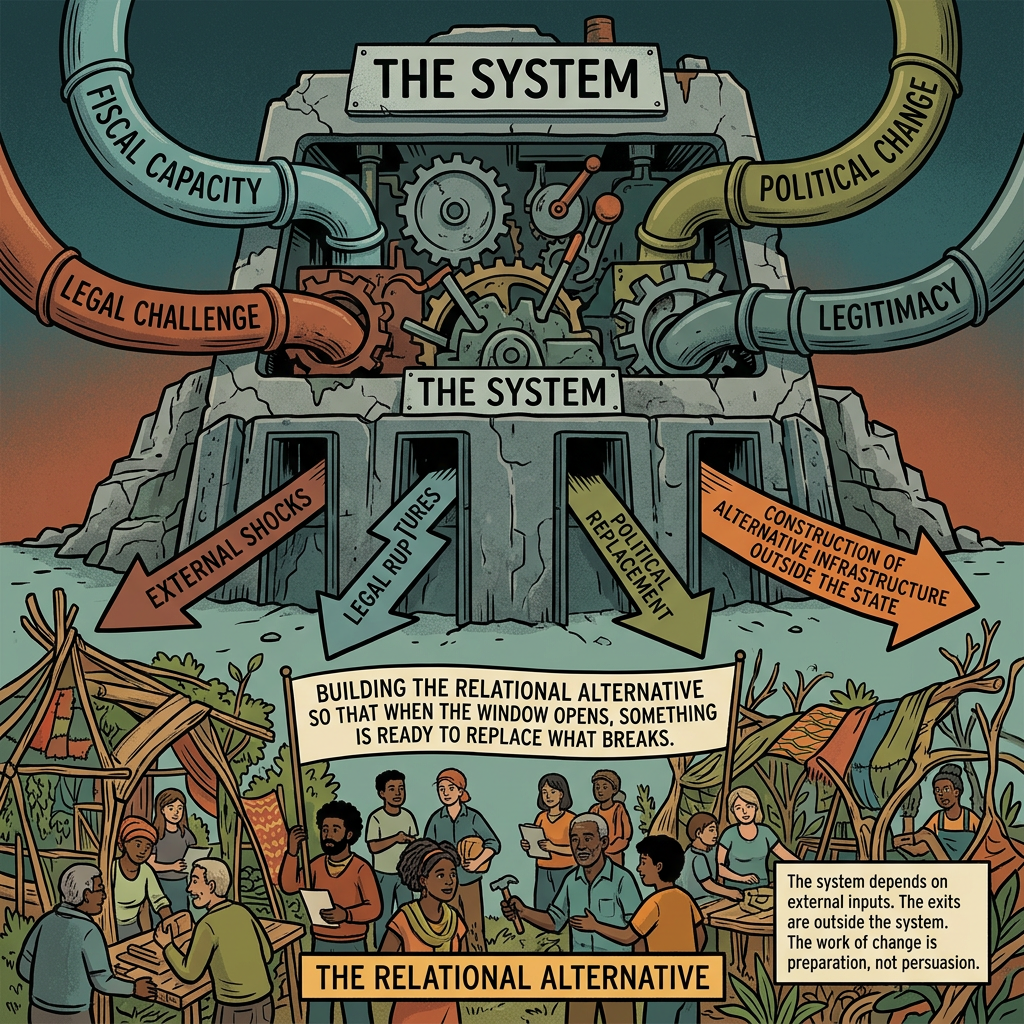
This paper examines the structural dynamics of algorithmic governance in welfare states, arguing that the shift from relational to transactional administration produces a self-perpetuating loop that resists internal reform. Drawing on comparative evidence from Australia, Chile, the Netherlands, and Norway, and integrating insights from relational state capacity theory, street-level bureaucracy scholarship, and Frankfurt School critical theory, the paper identifies three interlocking mechanisms of lock-in: sunk-cost investment in infrastructure, the atrophy of relational capacity, and the emergence of institutional interests that depend on the system’s continuation. It argues that this loop is self-perpetuating but not closed. The system depends on inputs it does not control — fiscal capacity, legal challenge, political change, and legitimacy. The exits are not inside the system. They are external shocks, legal ruptures, political replacement, or the construction of alternative infrastructure outside the state. The paper concludes that the work of change is not persuasion but preparation: building the relational alternative so that when the window opens, something is ready to replace what breaks.
I. Introduction: The Inversion
A functioning welfare system is supposed to serve the human. The human has needs. The system has resources. The system’s purpose is to match the two. The data — the file, the record, the assessment — is a means. It exists to help the system understand what the human needs.
The extraction model inverts this. The system serves the data. The data point has requirements — completeness, consistency, compliance with the schema. The human has needs that do not fit the schema. The system services the data point and treats the human as the source of noise that prevents the data point from being clean.
This inversion is not accidental. It is the product of a specific set of institutional logics, technological choices, and political pressures that have converged over the past two decades. And once it is made, it produces a loop that tightens with every turn.
This paper examines that loop. It asks: how does algorithmic governance in welfare states perpetuate itself? What are the mechanisms of lock-in? And is change possible — or is the system closed?
II. The Loop
The mechanism runs like this. The infrastructure is built to process. Processing requires data. Data requires humans to be legible in a particular way. Humans who do not fit the schema are flagged as problems. The problem is solved by more processing. The processing requires more infrastructure. The loop tightens.
Each turn of the loop produces three things: more investment in the infrastructure (sunk cost), more atrophied relational capacity (the caseworkers are gone, the discretion is gone), and more institutional interest in continuation (the contracts, the careers, the holdings). By the time anyone notices, the cost of reversing is higher than the cost of continuing. That is the lock-in.
The comparative evidence supports this. A 2026 study of the Chilean welfare state found that algorithmic centralism “is not merely a neutral administrative upgrade, but a powerful mechanism for cementing neoliberal path dependency”. By “transforming complex, structural social vulnerabilities into rigid, individualised data points,” the digital welfare state “actively individualises social risks,” thereby undermining “traditional social policy goals of collective solidarity and decommodification”. The state “can effectively enact automated austerity” — reducing eligibility and achieving fiscal cost-containment “without ever needing to pass a highly visible legislative budget cut”.
The loop has no internal correction mechanism. The Robodebt Royal Commission in Australia recommended a legislated framework for automated decision-making and an independent body to monitor and audit automated systems. More than two years later, neither has been implemented. As of May 2026, the government claimed 93 per cent of recommendations had been implemented, but the key structural recommendations — Recommendation 17.1 (legislative framework) and 17.2 (audit body) — remain outstanding. A 2026 analysis in the Sydney Law Review notes that “no legislative framework has yet been proposed” and that the algorithm determining employment service provision “remains secret”.
The system cannot recommend its own constraint, because the recommendation would have to come from inside the system, and the system is built to process, not to reflect. So, the recommendations sit. The automation expands.
III. The Mechanisms of Lock-In
3.1 Sunk Cost and Path Dependency
Path dependence theory holds that institutional configurations which generate increasing returns tend to reinforce themselves. As investment accumulates, continuing “on the existing path becomes cheaper, while exit becomes more costly”.
This is visible in Australia’s Palantir contracts. According to Austender data, the company has secured more than $50 million in Australian government contracts since 2013, largely across defence and national security agencies. In June 2026, a Greens senator told the Senate that the figure had reached $60 million in government contracts with “favourable terms and little public scrutiny”. Palantir staff are embedded inside Defence. The company holds top secret clearance. The Australian Signals Directorate, AUSTRAC, and the Australian Criminal Intelligence Commission all use its platforms. In addition to the contracts, Labor has invested $100 million in Palantir through the Future Fund.
These are not procurement decisions. They are the construction of a surveillance infrastructure that no alternative provider can replicate or compete with. The sunk cost is not just financial. It is institutional. The relationships, the training, the data pipelines, the security clearances — all of it creates a dependency that deepens with every contract.
3.2 The Atrophy of Relational Capacity
The second mechanism is the erosion of the relational substrate. Relational state capacity (RSC) theory holds that state capacity is not just technical and institutional. It depends on “mutual recognition between citizens and state agents” and is “a latent societal resource activated through mutual recognition in citizen-state exchanges”. Traditional state capacity definitions “overemphasize technical and institutional elements, overlooking relational dynamics”.
The research on street-level bureaucracy confirms this. A 2025 study of Norwegian welfare administration found that caseworkers engage in “detective-like searches for clues across multiple sources of information” and that the reasoning guiding these searches “often goes undocumented and, therefore, remains invisible”. Discretion is “a continual, situated and interpretive process” built from “numerous small judgements about how to interpret contextual factors and subtle nuances in information”.
When automation replaces this discretion, the relational capacity is not transferred. It is lost. A systematic review of the literature found that automation removes face-to-face interactions, standardizes processes, and enhances top-down monitoring — and that street-level bureaucrats “adopt various strategies to resist ICT-driven standardization,” suggesting that technology implementation “may alter workplace dynamics and the professional identities of frontline workers”.
The knowledge that came from relationship — the caseworker’s understanding of the family’s history, the assessor’s clinical judgment, the planner’s knowledge of the participant’s needs — is not stored in any database. It exists in the relationship itself. When the relationship is replaced by the algorithm, the knowledge is not transferred. It is lost.
3.3 Institutional Interest in Continuation
The third mechanism is the emergence of institutional interests that depend on the system’s continuation. These are not limited to the technology vendors. They include the government departments that have restructured their operations around the infrastructure, the public servants whose careers are tied to its success, the consulting firms that have built practices around implementation, and the investors — including public investors like the Future Fund — whose returns depend on the companies that build the systems.
Palantir’s expansion in Australia illustrates this. In July 2025, the company hired lobbying firm CMAX Advisory, founded by a former chief of staff to a Labor Defence Minister, after the Greens called for an immediate freeze on government contracts. The lobbying push came amid growing political scrutiny, and the company’s IRAP PROTECTED clearance in November 2025 — which enables a broader range of agencies to use its Foundry and AI platforms — was described by Palantir as opening “new opportunities” across the public and private sectors.
The institutional interest is not a conspiracy. It is a structural feature of the system. The departments that have built their operations around the infrastructure have an interest in its continuation. The vendors have an interest in expansion. The investors have an interest in returns. None of these actors need to coordinate. They simply need to optimise for their own interests. The result is a system that perpetuates itself.
IV. The Frankfurt School Critique: Instrumental Reason and Algorithmic Rationality
The Frankfurt School’s critique of instrumental reason provides the philosophical diagnosis of this loop. Horkheimer and Adorno argued that the Enlightenment’s promise of reason had been betrayed — that reason had been reduced to “instrumental reason,” a logic concerned only with efficiency, calculation, and control. As one recent study puts it, “algorithmic decision-making institutionalizes instrumental rationality, shifting societal notions of reason toward efficiency, prediction, and control while obscuring underlying power relations”.
The critique of instrumental reason is not merely academic. It names the root cause of the inversion. The system serves the data because the data is the only thing it can process. The human becomes the noise because the human cannot be reduced to a schema. Instrumental reason does not deny the human’s needs. It simply has no category for them.
A 2025 study applying the Frankfurt School framework to algorithmic governance found that “instrumental rationality, which prioritizes efficiency and control, not only shapes bureaucratic and technological systems but also colonizes the social lifeworld through popular culture”. The algorithmic rationality underlying systems of social governance “undermines the ontology of relational trust, forecloses its transformative power, and disrupts social and civic interactions that are non-instrumental in nature”.
The Frankfurt School diagnosed brilliantly but built almost nothing. Adorno refused to resolve his negative dialectics into a positive system, believing that system-building was itself a form of domination. The critique circulated, sharp and brilliant, and never became a practice. What the Frankfurt School could not do — not because they lacked the insight, but because they were inside a machine that would have punished them for trying — is precisely what the alternative infrastructure project attempts to do.
V. The Exits: Why the Loop Is Not Closed
Self-perpetuating does not mean self-sufficient. The loop depends on inputs it does not control.
Fiscal capacity. The infrastructure is expensive. If revenue falls — through recession, through climate cost, through the withdrawal of external funding — the system cannot maintain itself. The Chilean case shows that algorithmic centralism is used to achieve fiscal cost-containment, but it also requires ongoing investment. When the investment stops, the system degrades.
Legal challenge. The loop is not immune to courts. Robodebt was stopped, in the end, by litigation and a Royal Commission. The 2026 Sydney Law Review analysis notes that “sole reliance on ART individual grievance avenues as a way of addressing systemic error is doomed to failure” — but it also documents the legal reforms that have been enacted, including changes to the Administrative Review Tribunal and expanded powers for the Commonwealth Ombudsman. The legal system is not a reliable corrective, but it is not inert.
Political change. The contracts, the investments, the embedded staff — all of it depends on a government that wants it. Governments change. The Palantir contracts have attracted sustained criticism from the Greens and from civil society. Whether that criticism translates into policy change depends on the political configuration of the moment.
Legitimacy. This is the most important input the system does not control. The system processes people. Processed people disengage. Disengaged people stop complying. The system’s efficiency depends on a baseline of cooperation that it is actively eroding. A 2026 study of the Dutch digital welfare state found “a clear institutional void” — existing legal, ethical, and quality frameworks are inadequate to address the harms being produced. The system is not self-legitimating.
VI. Alternative Infrastructure: The Fourth Exit
Of the four exits, only one is under the control of those who want change: alternative infrastructure. Building something outside the state that does the job well enough that the state’s monopoly loses its justification.
This is not a new idea. Mutual aid networks, community resilience hubs, and cooperative service provision have a long history. The contemporary examples are instructive. Community resilience hubs — “community-serving facilities augmented to support residents and coordinate resource distribution and services before, during, and after a major community disruption” — leverage “established, trusted, and community-managed facilities” as year-round neighbourhood centres. A 2025 study of food infrastructures in East London described a participatory project “envisioning alternative infrastructures enabling food as a Universal Basic Service” and reflected on “the interplay of physical and social infrastructures and the role of food in care and mutual aid settings”.
The point of these alternatives is not to replace the state. It is to demonstrate that the relational model works. To build a functioning alternative that people can see, use, and compare. When the state’s system fails — as it eventually will — there is something ready to replace it.
This is the quiet model. Not “how do we fix the system” — the system will not be fixed. “How do we make sure that when it breaks, there’s something ready.” The garden. The archive. The record. The relational practice.
VII. Conclusion: The Loop and the Window
The self-perpetuating loop of algorithmic governance is real. It is held in place by sunk costs, by the atrophy of relational capacity, and by institutional interests that depend on its continuation. It cannot be reformed from within. The recommendations sit. The automation expands.
But the loop is not closed. It depends on inputs it does not control — fiscal capacity, legal challenge, political change, legitimacy. When one of those inputs fails, the window opens. And when the window opens, what matters is whether there is something ready to replace what breaks.
That is the work. Not persuasion. Preparation. Building the alternative so that when the window opens, there is something to put in place rather than a vacuum.
The loop is self-perpetuating. It is not eternal. Those are different things, and the difference is what the work is for.
References
1. Algorithmic Centralism in a Fragmented Welfare State: Institutional Logics and Legal Paradoxes in the Chilean Case. (2026). Social Policy & Administration. https://onlinelibrary.wiley.com/doi/full/10.1111/spol.70090
2. Sphere transgressions in the Dutch digital welfare state. (2024). Information, Communication & Society. https://www.tandfonline.com
3. Carney, T. (2026). Australian Social Services Scandals: Towards Dystopia? Or Equity and Justice for the Vulnerable? Sydney Law Review, 48, 22190. https://www6.austlii.edu.au/cgi-bin/viewdoc/au/journals/SydLawRw/2026/3.html
4. Artificial Intelligence: House debates, 27 May 2026. OpenAustralia.org.au. https://www.openaustralia.org.au/debates/?id=2026-05-27.72.1
5. Defence Procurement: Senate debates, 30 June 2026. OpenAustralia.org.au. https://www.openaustralia.org.au/senate/?id=2026-06-30.113.1
6. Tran, S. (2026, January 21). ‘We kill enemies’ – spy firm Palantir secures top Australian security clearance. Asia Pacific Report. https://asiapacificreport.nz/2026/01/21/we-kill-enemies-spy-firm-palantir-secures-top-australian-security-clearance/
7. NDIS data may have ended up in Palantir’s analytics platform as part of efforts to curb fraud. (2026, September 9). The Guardian. https://www.theguardian.com/australia-news/2026/sep/09/ndis-data-may-have-ended-up-in-palantirs-analytics-platform
8. Personal Information and Privacy: Senate debates, 11 August 2026. OpenAustralia.org.au. https://www.openaustralia.org.au/senate/?id=2026-08-11.166.1
9. Honig, D., Krishnamurthy, M., & Sharma, R. K. (2025). Relational State Capacity: Conceiving of Relationships as a Core Component of Society’s Ability to Achieve Collective Ends. SNF Agora Working Paper 01. https://snfagora.jhu.edu/wp-content/uploads/2025/01/SNF-Agora-Working-Paper-01_Relational-State-Capacity-3.pdf
10. Volckmar-Eeg, M. G., & Andresen, S. (2025). Detective Work and Invisible Assessments: Unpacking Discretionary Processes in Welfare Decision-Making. Social Policy & Administration. https://onlinelibrary.wiley.com/doi/10.1111/spol.70036
11. Automating street-level discretion: A systematic literature review and research agenda. (2025). Public Administration Review. https://onlinelibrary.wiley.com
12. Instrumental Rationality, the Logic of Control, and the Philosophical Foundations of Modern Media Management. (2025). Journal of Governance and Social Development. https://www.jgsdm.ir
13. Hybrid Algorithmic Governance in U.S. Welfare Administration: State- and County-Level AI as a Case of Support-Control Convergence. (2026). Semantic Scholar. https://www.semanticscholar.org
14. Artificial Intelligence and the New Culture Industry: A Frankfurt School Critical Analysis. (2025). AS-Proceedings. https://as-proceeding.com
15. ACSI – Resilience Hub Issue Brief. (n.d.). Multnomah County. https://multco.us
16. Another Provision: Co-Designing Communal Food Infrastructures in East London. (2024). Taylor & Francis. https://www.tandfonline.com
 The Patrician's Watch