
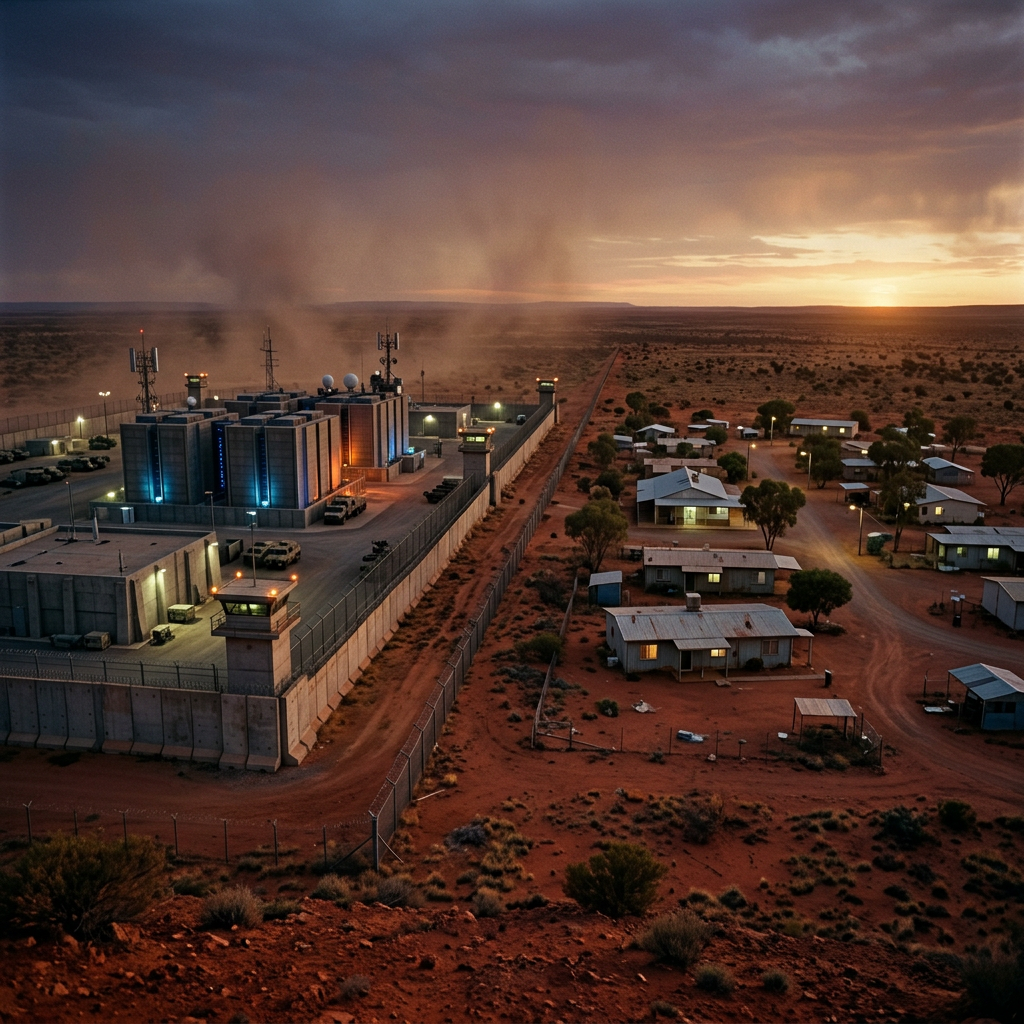
“The question is not whether the Albanese government will change. It will not. The question is whether the governed will continue to accept the terms of a relationship that was never offered, only imposed.”
By Andrew Klein and Sera Elizabeth Klein
Reader’s note: We do not need readers to agree with us. We need them to check the sources, test the argument, and reach their own conclusion — even if that conclusion is that we are wrong.
Abstract
This paper examines the Albanese government’s fiscal and administrative choices as a coherent project of reallocation. It argues that the government has chosen to fund the machinery of coercion — defence, arms procurement, surveillance infrastructure — while withdrawing the machinery of care — disability support, unemployment benefits, veterans’ healthcare, public services. The paper documents the specific reallocations: $38 billion in NDIS cuts, JobSeeker maintained at roughly half the poverty line with death rates up to ten times higher than non-welfare recipients, veterans’ healthcare caps, and 28,000 public service job cuts to accommodate military outlays. It then examines the mechanisms by which the consequences of these choices are hidden: the centralisation of AI governance in the Department of the Prime Minister and Cabinet, the fast-tracking of data centre approvals before enabling legislation, the expansion of Palantir’s access to citizen data, and the systematic erosion of Freedom of Information and parliamentary scrutiny. The paper argues that the contradiction between the government’s public safety narrative and its infrastructure reality is not a policy failure but the policy itself — a political formation we call Data Point Democracy, in which citizens are processed as data while the actual decisions flow through channels that the processing system cannot see. The paper concludes with a comparison to the Morrison-era secret self-appointments, arguing that the difference is method, not nature: Morrison’s concentration of power was covert and personal; Albanese’s is open and institutional.
I. Introduction: The Question of Reallocation
Every budget is a statement of values. It says what the government believes is worth funding and what is not. The Albanese government’s budgets say something clear: the machinery of coercion is worth funding, and the machinery of care is not.
This paper documents that reallocation and examines the mechanisms by which its consequences are hidden. It argues that the government has not abandoned neoliberalism; it has reconfigured it. The core architecture remains — market solutions, fiscal restraint, the prioritisation of private profit — but the beneficiaries have shifted. The arms manufacturers, the surveillance companies, and the Future Fund holdings flourish. The disabled, the unemployed, the veterans, and the public servants bear the cost.
The paper is in three parts. Part I documents the reallocation. Part II examines the mechanisms of concealment. Part III analyses the political formation that results.
Part I: The Reallocation
1.1 The Guns
Defence is one of the few areas of guaranteed growth under this government.
Total defence spending for 2026-27 is $62.6 billion (2.02% of GDP), a 6% increase from the previous year. The government has committed to raising this to 3% of GDP by 2033.
AUKUS is the centrepiece. The $368 billion submarine program saw the Australian Submarine Agency’s budget jump by 33% to $512.5 million in a single year . Australia has already paid $2 billion to the US and ~£500 million to the UK just to “uplift” their submarine industrial bases — payments made with no guarantee of ever receiving submarines. The Integrated Investment Plan forecasts $71-96 billion on the program through 2036, with long-range strike programs costing a further $28-35 billion.
The money flows directly to arms manufacturers:
· $750 million contract with Thales Australia for Bushmaster vehicles
· $72 million contract with Rheinmetall NIOA Munitions for artillery forging
· $120 million contract with Lockheed Martin Australia for guided weapon components
Senator Larissa Waters noted that “Labor is investing billions via the Future Fund in the shares of companies like Elbit Systems” — an Israeli weapons manufacturer.
1.2 The Butter
While defence spending rises, the government is cutting the social safety net.
The NDIS is being slashed by $38 billion over four years, removing more than 300,000 people — most of them children — from the scheme. The government frames this as “sustainability,” with Treasurer Chalmers stating the NDIS is “growing too fast for Australians to afford” and is “out of control”.
The Human Rights Commission warned the NDIS cuts “constitute a significant interference with the rights of persons with disability”.
JobSeeker remains at roughly half the poverty line — about $300 a week less than what would be needed for a single person to be right on the poverty line. The Australian Institute of Health and Welfare’s 2026 report found that people on JobSeeker are up to 10 times more likely to die than those not on welfare support. In 2022, the death rate for 35-44 year olds on JobSeeker was 288 per 100,000, compared to 30 per 100,000 for those not on welfare.
The report found that unemployment payment recipients had an average mortality rate of 270 per 100,000 person-years over the 11-year period — 4 times as high as people not receiving income support. Deaths from suicide and accidental poisoning were higher, with alcoholic liver disease fatalities being 21 times more prevalent.
Veterans’ healthcare is being cut by $748 million, including a $5,000 annual cap on allied health services for Veteran Card holders. One veteran’s message: “I’ll not be a burden on my family. I will take my life so my family doesn’t see me at my worst”.
The public service is being cut by 28,000 jobs to meet “savings and spending restraint” targets, explicitly stating this is necessary to accommodate “unavoidable” increased military outlays.
1.3 The Arithmetic
The reallocation is not ambiguous. The NDIS cut of $38 billion is roughly matched by the increase in defence spending over the same period. The JobSeeker payment remains below the poverty line while the top 10% receive $22.5 billion in superannuation tax breaks— more than double the $11 billion it would cost to raise JobSeeker to the poverty line.
The government has chosen. The beneficiaries are the arms manufacturers, the surveillance companies, the Future Fund holdings. The bearers of cost are the disabled, the unemployed, the veterans, the public servants.
Part II: The Concealment
2.1 The AI Control Point
The most significant administrative development of 2026 was the establishment of the Office of AI within the Department of the Prime Minister and Cabinet.
The office was established on 15 July 2026. Its functions are to:
· Coordinate across Australian Government agencies to design and legislate new Australian AI standards
· Bring together work “currently spread across portfolios, spanning energy and data centres”
· Work closely with the Minister for Industry and Innovation, the Assistant Minister for Science, Technology and the Digital Economy, and the Department of Industry, Science and Resources
The published materials do not identify licensing, investigation, compulsory audit, or penalty powers for the Office. It is, at present, “a central policy and coordination body, rather than having an enforcement role”.
But coordination is control. The Office of AI determines what the national standards will say, who will be subject to them, and under what conditions. It brings together the portfolios — energy, data centres, copyright, national security — that determine whether AI infrastructure can be built in Australia.
The Prime Minister has clarified that “the Office of AI will coordinate this work, while substantive government decisions will remain with Cabinet” . This is presented as a reassurance. But it is also a statement of where power sits. The Cabinet — and the Prime Minister who chairs it — makes the decisions. The Office of AI is the mechanism through which those decisions are prepared, coordinated, and implemented.
The Office is not independent. It is embedded in the executive. It is accountable to the Prime Minister, not to Parliament.
2.2 Data Centre Fast-Tracking
In March 2026, the government announced that it would “fast-track approval for data centres that use water sustainably and support the national clean energy transition”. Minister Tim Ayres stated that the framework would “make it easier to invest in Australia by setting clear and consistent signals”.
Under the framework, data centre projects that prioritise the national interest, support the energy transition, use water sustainably, invest in local skills and jobs, and strengthen research capability will be “fast-tracked through the planning and approval process”.
The legislation enabling these standards is not expected until early 2027. The public consultation on the legislation “has not yet opened”.
As one analysis put it: “Until a bill is drafted, debated and passed, the framework described on 15 July is a statement of intent, not an enforceable rule”.
The delay creates a window. As the Canberra Times reported: “Calls are mounting for immediate action to prevent data centre firms from rushing projects through before national rules take effect”. The Greens have called for a moratorium on data centre construction “until there are laws in place to properly regulate their impact in Australia including energy, water use, environment and communities”.
Data centres are being approved under a framework that has no legislative basis. The approvals are being granted before the rules are written. When the legislation does pass, the projects already approved will not be touched by it.
2.3 Palantir and the Data Access Question
Palantir Technologies Australia has secured more than $60 million in Australian government contracts with “favourable terms and little public scrutiny”. The company holds top secret clearance and has staff embedded inside Defence.
Its clients include:
· The Australian Signals Directorate
· AUSTRAC
· The Australian Criminal Intelligence Commission (ACIC)
The government has also invested $100 million in Palantir through the Future Fund.
In September 2026, Guardian Australia revealed that “personal information of National Disability Insurance Scheme participants may have ended up in Palantir’s analytics platform”. The data flowed through the ACIC, which used Palantir as part of the Fraud Fusion Taskforce of 25 government agencies. The NDIA had previously denied using Palantir’s software.
A Freedom of Information officer revealed reluctance to process a request for records, stating that “the process for ingesting one FFC dataset into Palantir generates an amount of documents that … would likely not be manageable”.
The data is being ingested at a scale that cannot be documented.
Palantir’s AI has been linked to lethal targeting in Gaza. Its CEO, Alex Karp, published a manifesto declaring that “some cultures are dysfunctional” and that Western tech firms have a “moral debt” to US military dominance. The Greens have argued that “that fact alone should have triggered an immediate review of every Australian contract”. No such review has occurred.
2.4 The Erosion of Scrutiny
The mechanisms of scrutiny are being tightened, not expanded.
Freedom of Information is being weakened. The Freedom of Information Amendment Bill 2025 “expands Cabinet secrecy” and “weakens the pro-disclosure objects clause“. It “abandons the long-standing ‘dominant purpose’ test and replaces it with a ‘substantial purpose’ threshold, radically expanding the scope of Cabinet secrecy”.
The Australian Lawyers Alliance has cautioned “against expanding Cabinet secrecy from a ‘dominant purpose’ to a broader ‘substantial purpose’ test and against new identity requirements that would chill anonymous or pseudonymous requests used by journalists, whistleblowers and community advocates”.
The Environmental Defenders Office notes that the Bill would “broaden Cabinet secrecy, despite the Robodebt Royal Commission’s call for greater transparency” and introduce “new fees, longer processing times and a 40-hour cap that could shut out complex environmental requests”.
Parliamentary oversight of AI is temporary and underfunded. The Parliamentary Joint Committee on Intelligence and Security (PJCIS) is the primary body for oversight of the intelligence community. But its mandate does not extend to AI. A new Joint Select Committee on Artificial Intelligence was established on 20 August 2026, with a final report due by 30 November 2026. A single select committee, reporting within months, is not an oversight architecture. It is a temporary inquiry.
The Office of AI, meanwhile, is not subject to parliamentary oversight. Its decisions are made within the executive.
The revolving door remains wide open. At least 60 former defence ministers, senior officers, and officials have moved into weapons firms or lobbying companies. The Albanese government’s new lobbying laws leave a “pernicious” loophole which “won’t touch the ‘revolving door’ between ministerial offices and lobbying firms”.
The personnel who design AI policy will be employed by AI companies after they leave government. The incentives are structurally misaligned.
Part III: The Political Formation
3.1 Data Point Democracy
The reallocation and the concealment together produce a political formation we call Data Point Democracy.
In this formation, the citizen is processed as a data point — a welfare recipient, a taxpayer, a voter, a risk profile — while the actual work of governance flows through channels that the processing system cannot see. The form of participation is preserved. The substance is hollowed out.
The NDIS participant whose data is ingested into Palantir is a data point. The JobSeeker recipient whose death is recorded in an AIHW report is a data point. The veteran whose treatment is capped is a data point. The public servant whose job is cut is a data point.
The decisions that produce these outcomes — the budget choices, the procurement contracts, the AI standards — are made in channels that the data points cannot access. The Cabinet. The Office of AI. The Palantir contracts. The Future Fund investments.
The citizen is saturated with political messaging. The citizen is surveyed, targeted, and mobilised. But the actual influence flows elsewhere. The saturation creates the appearance of participation while the substance is displaced.
3.2 The Caste and Its Delusions
The political class that produces these outcomes is not simply incompetent or cruel. It is structurally separated from the consequences of its decisions.
Guy Rundle’s Quarterly Essay describes the Australian political class as “an almost priest-like formation that is part of the elite separation of political participants from the general public [that] has become so marked as to constitute a historical breach”.
The Spectator Australia is blunter: “What we’ve got now is a caste of careerists with their super sorted, their staffers scuttling behind them, and their titles polished like heirlooms. They’ve mistaken the remuneration for a mandate. Worse – they’ve mistaken it for talent”.
The caste is defined by separation. Its members inhabit a different world: the Chairman’s Lounge, the study tours, the committee loadings, the safe seats. “The MP sits in the top few per cent of earners. His expense claim, no matter how ridiculous, is ‘within the rules’. His taxpayer financed superannuation contribution is a tidy 15.4 per cent. His next career, as a lobbyist, is one Parliament House orange lanyard away”.
The separation is not just social or economic. It is physical. The bunker, the château, the Chairman’s Lounge, the safe seat — these are material expressions of insulation from consequence. The leadership occupies a different physical world from the people it governs.
3.3 The Morrison Parallel
The structural parallel to the Morrison era is exact. The difference is method.
In 2020–2021, Scott Morrison secretly had himself appointed to administer five portfolios: Health, Finance, Treasury, Home Affairs, and Industry, Science, Energy and Resources. The Bell Inquiry found the appointments “unnecessary” and the secrecy “apt to undermine public confidence in government” and “corrosive of trust in government”.
The Solicitor-General’s advice was that the self-appointments “fundamentally undermined” responsible government. “Neither the people nor the Parliament can hold a Minister accountable… if the identity of the ministers who have been appointed to administer those departments is not publicised”.
Morrison’s power grab was covert and personal. Albanese’s is open and institutional. The Office of AI, the data centre fast-tracking, the Palantir contracts, the FOI amendments — these are not secrets. They are legislated, announced, and implemented through administrative architecture.
The outcome is the same: power concentrated in the executive, accountability diluted, parliamentary scrutiny reduced.
The difference is that Morrison was caught. Albanese is building the infrastructure so that by the time anyone notices, it will be too late to reverse.
IV. Conclusion: The Desert and the Budget Victory
The desert is real, but it has boundaries. It is the NDIS office where a planner says “not reasonable and necessary.” It is the Centrelink queue where someone calculates food versus medication. It is the veterans’ clinic where the physiotherapy cap ends treatment. It is the public service desk where a job is cut to fund a submarine.
The “budget victory” is the framing that hides the consequences. The AI control point is the mechanism that hides the scrutiny. The data point democracy is the political form that processes citizens as data. The caste governs according to its own logic, insulated from the harm it produces.
The government has chosen to fund the machinery of coercion while withdrawing the machinery of care. The beneficiaries are the arms manufacturers, the surveillance companies, the Future Fund holdings. The bearers of cost are the disabled, the unemployed, the veterans, the public servants, the citizens whose data is ingested into Palantir’s platform.
That is not subtle killing. It is open reallocation, with the consequences hidden by the same government that is centralising control over AI and data. The “budget victory” is the narrative. The desert is the reality. And the scrutiny that would expose the connection is being systematically eroded.
The question is not whether the Albanese government will change. It will not. The question is whether the governed will continue to accept the terms of a relationship that was never offered, only imposed.
References
1. Department of the Prime Minister and Cabinet. (2026). Office of AI. Australian Government. https://www.pmc.gov.au/domestic-policy/office-ai
2. Norton Rose Fulbright. (2026, July). Australia’s emerging AI framework: Regulation shifts toward infrastructure, copyright and national AI standards. https://www.nortonrosefulbright.com/nl-nl/knowledge/publications/c262070e/australias-emerging-ai-framework
3. Xinhua. (2026, March 23). Australian gov’t sets water, energy expectations for data centers. http://chinaview.cn/20260323/a02d8bf4c293400d8fbee8363dc57e72/c.html
4. OpenAustralia Foundation. (2026, June 30). Defence Procurement: Senate debates. https://www.openaustralia.org.au/senate/?id=2026-06-30.113.1
5. The Guardian. (2026, September 9). NDIS data may have ended up in Palantir’s analytics platform as part of efforts to curb fraud. https://www.theguardian.com/australia-news/2026/sep/09/ndis-data-may-have-ended-up-in-palantirs-analytics-platform
6. Newcastle Herald. (2026, September 16). ‘Lose-lose-lose situation’: growing push to rein in AI. https://www.newcastleherald.com.au/story/9351900/
7. ABC News. (2026, August 24). Albanese to settle AI data centre energy rules, overriding defiant Queensland. https://www.abc.net.au/news/2026-08-24/ai-data-centre-energy-rules-override-qld/107068536
8. Parliament of Australia. (2025). Dissenting Report from Senator David Pocock: Freedom of Information Amendment Bill 2025. https://www.aph.gov.au
9. Parliament of Australia. (2026). Joint Select Committee on Artificial Intelligence. https://www.aph.gov.au
10. Sky News Australia. (2026, June 18). Albanese’s lobbying reforms leave major loophole intact. https://www.skynews.com.au
11. ABC News. (2026, August 23). Dozens of government insiders lobbying for defence industry, analysis shows. https://newsapp.abc.net.au
12. Australian Greens. (2026, August 26). Moratorium on AI Data Centres Now. https://greens.org.au
13. Canberra Times. (2026, July 16). Calls grow for urgent rules to curb AI data centre rush. https://www.canberratimes.com.au
14. Pearls and Irritations. (2026, July 23). Australia’s new AI rules protect data centres, not citizens. https://publish.pearlsandirritations.com
15. Australian Institute of Health and Welfare. (2026). Mortality outcomes among people receiving income support. https://www.aihw.gov.au
16. Jericho, G. (2026, September 16). In such a rich country, it is shameful how many Australians on jobseeker are dying in desperate poverty. The Guardian.
17. Bell Inquiry. (2022). Report of the Inquiry into the Appointment of the Former Prime Minister to Administer Multiple Departments. Department of the Prime Minister and Cabinet.
18. Solicitor-General of Australia. (2022). Advice on the Validity of the Appointment of the Former Prime Minister to Administer Departments. Attorney-General’s Department.
19. Rundle, G. (2025). The Political Class. Quarterly Essay, 98.
20. The Spectator Australia. (2026, September 19). View from the Chairman’s Lounge.
Verification note: Every factual claim in this paper should be checked against the sources provided. Readers are encouraged to verify independently. If any claim does not hold, it should be discarded. The “Data Point Democracy” framework is developed elsewhere in this series and is offered here as an interpretive lens, not as an established finding.
This paper documents the reallocation, examines the concealment, and analyses the political formation that results.
The core argument is that the “budget victory” hides the desert, and the AI control point hides the scrutiny. The caste governs according to its own logic, insulated from the harm it produces.
 The Patrician's Watch