
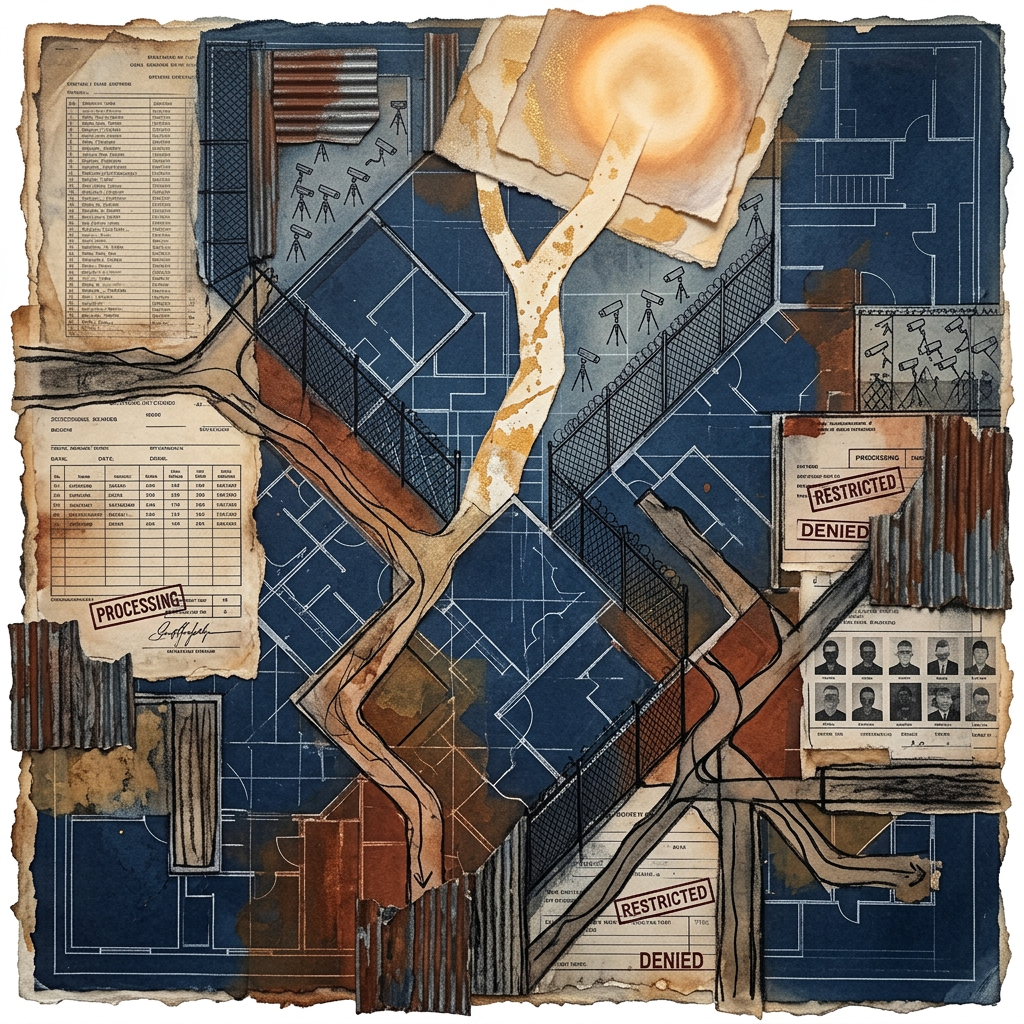
The biblical command is unambiguous. Leviticus 19:34: “The foreigner residing among you must be treated as your native-born. Love them as yourself, for you were foreigners in the land of Egypt.” Deuteronomy 10:19 repeats it: “You shall love the foreigner, for you were foreigners in the land of Egypt.”
The command is not framed as charity. It is framed as memory. You were strangers once. You know what it is to be outside the gate. Therefore, you cannot treat the outsider as less than yourself.
The New Testament extends it. Matthew 25 identifies the stranger with Christ himself: “I was a stranger and you welcomed me.” The Good Samaritan, in Luke, is a foreigner—the hated other—who becomes the neighbour. The biblical test of righteousness is not how you treat your kin. It is how you treat the stranger.
The biblical writers understood something that political scientists and philosophers have rediscovered: the treatment of the stranger is the most reliable indicator of the moral health of a community. You can measure a society’s justice by its treatment of those who have no power to retaliate, no vote to cast, no voice in the public square.
The Howard Government: The Lie as Policy Instrument
The Howard government’s treatment of asylum seekers was not a failure of administration. It was a deliberate political strategy, and its methods became a template.
The Tampa Affair (August 2001)
In August 2001, the Norwegian freighter MV Tampa rescued over 430 asylum seekers, mostly Hazara Afghans, from a sinking boat in international waters. The Howard government refused permission for the ship to enter Australian waters. It deployed Special Air Service troops to storm the vessel and deny every person aboard permission to set foot on Australian soil.
The message was clear: these people are not humans with rights. They are a security threat.
The Children Overboard Lie (October 2001)
Five weeks later, during the federal election campaign, the government claimed that asylum seekers aboard another stricken vessel had deliberately thrown their children into the sea. Prime Minister Howard told journalists that asylum seekers had thrown their own children into the sea as a Navy vessel approached their boat.
The claim was false. It was known to be false. Defence Strategic Command had advised the Prime Minister’s Department on 10 October that “there is no indication that children were thrown overboard“. The government released photographs it claimed showed children being thrown overboard. Those photographs did not show that. The children overboard incident never happened.
The lie was not a mistake. It was deployed for political advantage. It demonised the most vulnerable people on earth at the moment of maximum electoral impact.
The Pacific Solution
The Howard government then legislated the “Pacific Solution“—the excision of Christmas Island and other territories from Australia’s migration zone, and the processing of asylum seekers in offshore camps on Nauru and Manus Island. The policy was designed to ensure that boat arrivals “did not get direct access to Australia’s onshore refugee status determination process”.
Human Rights Commissioner Dr Sev Ozdowski found that Australia’s mandatory detention system was “fundamentally inconsistent with the Convention on the Rights of the Child” and recommended the release of children with their parents.
The Long-Term Effect on Citizens
The Howard government’s asylum seeker policy was not confined to asylum seekers. It reshaped the conception of Australian citizenship itself. Multiculturalism, asylum seekers and refugees were portrayed as “challenges to these values“. The government created a “benchmark of ‘Australianness’” and portrayed asylum seekers as “the antithesis of the Australian ‘us'”.
That construction—us versus them—did not stay at the border. It migrated into the domestic sphere. It shaped the way the state would later treat its own vulnerable populations: the disabled, the unemployed, the aged, the veteran. The methods used to process asylum seekers—dehumanising language, algorithmic assessment, removal of appeal rights—became the methods used to process citizens.
The Morrison Government: The Algorithm as Border Guard
The Morrison government inherited the Howard template and refined it.
Christmas Island Reopened (2019)
In February 2019, after the parliament passed the Medevac bill allowing sick asylum seekers to be transferred to Australia for medical treatment, Prime Minister Morrison announced the re-opening of the Christmas Island detention centre. The facility, described as a “$400 million holding centre,” would house asylum seekers on Manus and Nauru deemed “a risk” to Australia if they applied for medical transfer.
Fifty-seven sick asylum seekers deemed a security risk were to be sent to Christmas Island for medical treatment instead of Australia. The facility, as the Human Rights Commission documented, lacked specialists and was “not equipped to deal with mental health illness”.
The Human Cost
The Australian Human Rights Commission’s 2014 visit to Christmas Island documented the conditions in which children were detained: small rooms of approximately 3×3 metres, shared bathrooms, the only window at the back of the room, no floor space for a child to play or learn to walk. One father described his four-year-old son: “He is only four years old and he has as many scars as a Vietnam soldier”.
When twelve mothers of young infants attempted suicide or self-harmed, Immigration Minister Morrison said the reports were “not correct.” Prime Minister Abbott described the acts of self-harm as “moral blackmail“.
The Algorithm
The Morrison government’s most enduring legacy to this pattern was the expansion of automated decision-making. The Robodebt scheme, which ran from 2015, used income averaging to generate debt notices without human verification. It was later found by a Royal Commission to be “a crude and cruel mechanism, neither fair nor legal.”
Robodebt was not a border policy. It was a domestic welfare policy. But it used the same logic as the border: the individual is a data point; the algorithm is the authority; the human has no appeal.
That logic is now embedded in the NDIS. Section 59E(3) of the government’s NDIS Amendment Bill states that an automated decision stands even if the computer program fails to comply with the law. There is no appeal.
The Pattern: The Rehearsal and the Performance
The pattern is consistent across both governments. The treatment of refugees was the rehearsal. The treatment of citizens is the performance.
Method At the Border (Refugees) In the Community (Citizens)
Dehumanising language “Illegals,” “queue jumpers” “Welfare cheats,” “dole bludgers”
Algorithmic assessment Offshore processing, risk scores Robodebt, I-CAN, NDIS algorithms
Removal of appeal Limited judicial review, indefinite detention Section 59E(3), automated decision-making
Indefinite detention Nauru, Manus, Christmas Island Aged care waitlists, NDIS removal
State-induced suffering Suicide attempts in detention 5,000 aged care deaths on waitlists
Blaming the victim “Moral blackmail” “Not reasonable and necessary“
The Howard government’s lie about children overboard was not an aberration. It was a method. And the method was later applied to citizens. The Morrison government’s Robodebt was not a mistake. It was the same logic—the individual as data point, the algorithm as authority—applied to the domestic population.
The treatment of refugees is not a distraction from domestic policy. It is the preparation for domestic policy.
The Biblical Test and the Political Reality
The biblical injunction to love the stranger is not a sentimental ideal. It is a diagnostic tool. It tells you that the test of a community’s justice is how it treats those who cannot retaliate.
The Howard government failed that test. The Morrison government failed it. The Albanese government, despite its rhetorical warmth, continues to fail it. Offshore detention spending has blown out by almost $400 million, bringing total spending for 2025–26 to close to $1 billion. The refugee intake remains below the promised level. The apparatus of exclusion remains intact.
And the methods developed at the border—the algorithmic assessment, the removal of appeal, the dehumanising language—have migrated into the domestic sphere. The disabled are now processed by algorithms that cannot see them. The aged die on waitlists. The unemployed die at nine times the rate of the employed.
The rehearsal is over. The performance is under way.
Conclusion: The Bones and the DNA
The way a government treats the “other” is not a separate question from the way it treats its own people. It is the same question. The border is a laboratory. The refugee is a prototype. The citizen is the next iteration.
The biblical writers understood this. The stranger is the test. Not because the stranger is more deserving, but because the stranger is defenceless. And a community that will not defend the defenceless stranger will not defend the defenceless citizen.
The bones and the DNA tell a different story—one of connection, not separation. The biblical injunction tells a different story—one of memory, not exclusion. The historical record tells a different story—one of rehearsal, not exception.
The question is not whether the government will treat its citizens as it has treated refugees. The question is whether the citizens will recognise that they have been cast in a role they did not audition for.
Andrew Klein is a writer and researcher. He publishes at The Patrician’s Watch.

