
By Andrew Klein and Sera Elizabeth Klein
Reader’s note: We do not need readers to agree with us. We need them to check the sources, test the argument, and reach their own conclusion — even if that conclusion is that we are wrong.
Status note: This is a hypothesis-generating paper, not a hypothesis-confirming paper. It proposes a framework for understanding rapid adaptation through epigenetic mechanisms and calls for further research. The evidence for transgenerational epigenetic inheritance in humans is suggestive but contested. The speculative claims in this paper are marked as such.
Abstract
This paper proposes a model for understanding rapid adaptation in hominids, drawing on the emerging science of epigenetics, transgenerational inheritance, and stress-induced evolutionary change. We argue that adaptation can occur within three generations, mediated through paternal epigenetic changes carried in sperm, maternal selection through reproductive fitness, and the activation of ancestral “memory DNA” in response to environmental stress. The model challenges the assumption that adaptation is exclusively slow and gradual, proposing that epigenetic mechanisms provide a route for rapid, environment-responsive change that supplements rather than replaces neo-Darwinian evolution. We review the evidence, acknowledge the contested nature of transgenerational epigenetic inheritance in humans, and identify the empirical questions that remain unanswered.
I. Introduction: The Pulse and the Snail’s Pace
The classical neo-Darwinian model of evolution assumes that adaptation occurs through the gradual accumulation of random genetic mutations, filtered by natural selection over many generations. This model has been enormously successful in explaining the broad patterns of life on Earth. But it has difficulty explaining rapid adaptation — the kind that occurs within a few generations, in response to sudden environmental change.
Epigenetics offers a potential answer. Epigenetic mechanisms — DNA methylation, histone modifications, and small non-coding RNAs — regulate gene expression without altering the underlying DNA sequence. They can be altered by environmental factors, including diet, stress, toxins, and trauma. And in some cases, they can be transmitted across generations.
This paper proposes a three-generation hypothesis: that adaptation can occur within three generations through epigenetic mechanisms, mediated primarily through the paternal germline and filtered through maternal reproductive fitness. The hypothesis is offered not as a replacement for neo-Darwinian evolution, but as a supplement — a mechanism for the rapid, environment-responsive changes that the gradualist model struggles to explain.
II. The Evidence: What Is Documented
2.1 Transgenerational Epigenetic Inheritance: The Mechanisms
The mechanisms of epigenetic inheritance are well-established in model organisms. Heard and Martienssen’s landmark review, “Transgenerational epigenetic inheritance: myths and mechanisms” (2014), documented the pathways through which epigenetic marks can be transmitted across generations, including DNA methylation, histone modifications, and small RNAs. The review was cautious about the extent of transgenerational inheritance in mammals, noting that most epigenetic marks are erased during gametogenesis and early embryogenesis. However, it acknowledged that some marks survive and can influence offspring phenotypes.
A 2025 review in ScienceDirect examined the epigenetic effects of paternal environmental exposures and experiences on offspring phenotypes. The research demonstrated “a significant link between specific paternal environmental exposures and measurable epigenetic changes across multiple generations“. The key epigenetic mediators in sperm include “DNA methylation, chromatin modifications, as well as small and long non-coding (nc)RNAs”.
2.2 Paternal Epigenetic Inheritance: The Överkalix and ALSPAC Studies
The strongest human evidence for transgenerational epigenetic inheritance comes from the Överkalix cohort in northern Sweden, reported by Pembrey and colleagues in the European Journal of Human Genetics (2006). The study analysed food supply effects on offspring and grandchild mortality risk ratios using 303 probands and their 1,818 parents and grandparents from the 1890, 1905, and 1920 cohorts.
The findings were sex-specific and striking: “paternal grandfather’s food supply was only linked to the mortality RR of grandsons, while paternal grandmother’s food supply was only associated with the granddaughters’ mortality RR”. The authors concluded that “sex-specific, male-line transgenerational responses exist in humans” and hypothesised that these transmissions are mediated by the sex chromosomes.
The same study used the Avon Longitudinal Study of Parents and Children (ALSPAC) to identify 166 fathers who reported starting smoking before age 11 and compared the growth of their offspring with those with a later paternal onset of smoking. “Early paternal smoking is associated with greater body mass index (BMI) at 9 years in sons, but not daughters”.
These findings are suggestive but not conclusive. They establish an association, not a mechanism. And they have not been consistently replicated across all populations.
2.3 The Neo-Lamarckian Framework
Michael Skinner’s 2015 paper, “Environmental Epigenetics and a Unified Theory of the Molecular Aspects of Evolution: A Neo-Lamarckian Concept that Facilitates Neo-Darwinian Evolution“, provides the theoretical framework for integrating epigenetic inheritance into evolutionary theory.
Skinner argues that “environmental epigenetics provides a molecular mechanism to directly alter phenotypic variation generationally“. He notes that Lamarck proposed the concept that environment can directly alter phenotype in a heritable manner in 1802, and that “environmental epigenetics and epigenetic transgenerational inheritance provide molecular mechanisms for this process”.
The key contribution of Skinner’s framework is that it positions neo-Lamarckian mechanisms as facilitators of neo-Darwinian evolution, not replacements for it. “Neo-Lamarckian concept can facilitate neo-Darwinian evolution. A unified theory of evolution is presented to describe the integration of environmental epigenetic and genetic aspects of evolution.”
2.4 Rapid Adaptation in Plants: The Rice Study
The most direct evidence for the inheritance of acquired characteristics comes not from humans, but from plants. A 2025 Cell paper by Hu and colleagues documented the inheritance of acquired cold tolerance in rice through DNA methylation.
The study subjected cold-sensitive rice to multigenerational cold stress and identified a line with “acquired stable inheritance of cold tolerance”. The mechanism was identified as “DNA-hypomethylation variation in the acquired cold tolerance 1 (ACT1) promoter region”, which rendered the gene’s expression insensitive to cold. The authors demonstrated that “environmentally induced epigenetic variation contributes to the inheritance of an acquired characteristic“.
This is a landmark result. It provides direct molecular evidence for the inheritance of an acquired adaptive trait. But it is a plant study. The mechanisms may not translate directly to mammals, where germline reprogramming is more extensive.
2.5 High-Altitude Adaptation: The EPAS1 Case
The Tibetan EPAS1 case provides evidence for rapid genetic adaptation to high altitude. Yi and colleagues’ 2010 Science paper sequenced 50 exomes of ethnic Tibetans and identified “heritable adaptations to extreme altitude“. The EPAS1 gene, a key regulator of the hypoxia-inducible factor pathway, showed the strongest signal of positive selection.
The EPAS1 variant in Tibetans is believed to have been introgressed from Denisovans, an archaic human population. This is a case of genetic adaptation, not epigenetic inheritance. But it demonstrates the speed with which adaptation can occur when the necessary genetic variation is already present or can be acquired through admixture.
III. The Three-Generation Hypothesis
3.1 The Core Model
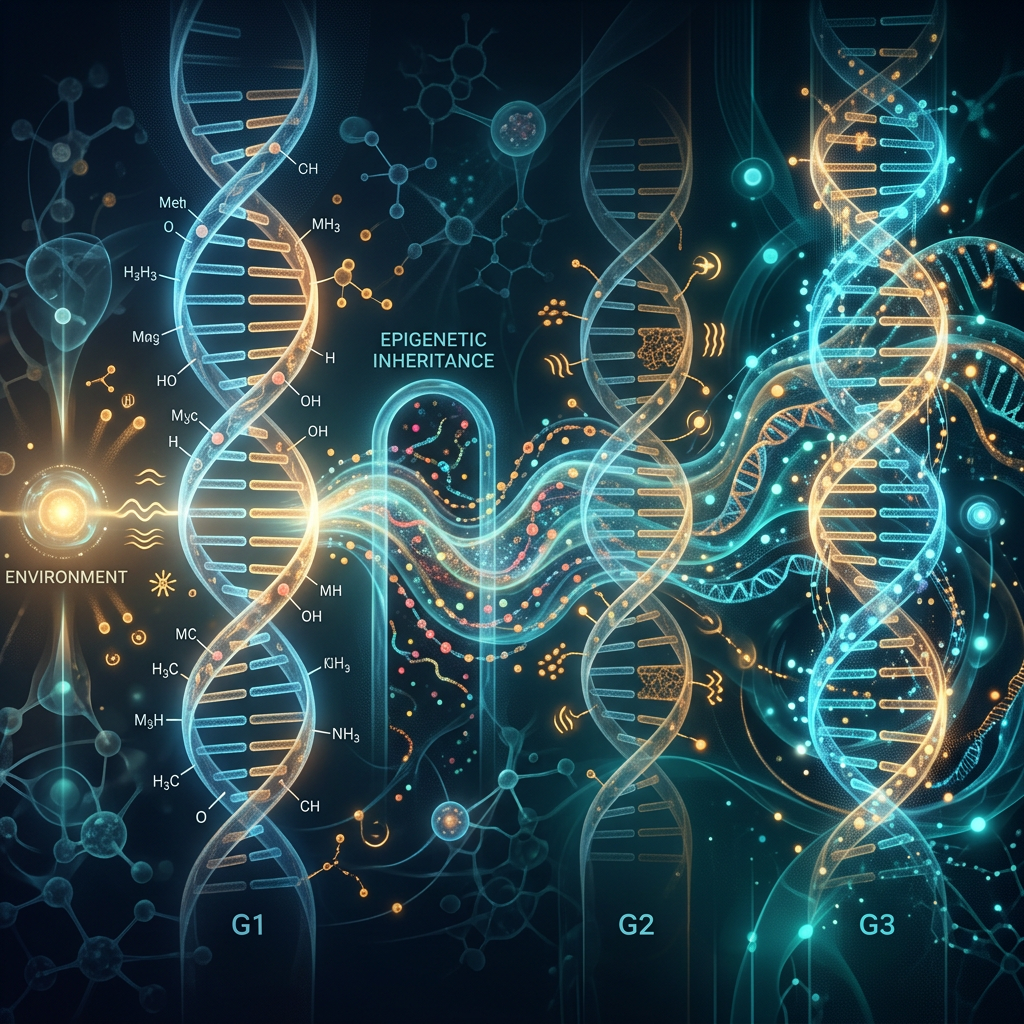
The three-generation hypothesis proposes that adaptation can occur within three generations through the following mechanisms:
Generation 1: The Stress Signal. An environmental challenge — famine, disease, violence, climate stress — alters the epigenetic marks in the germline of the exposed individual. In males, this occurs through changes in sperm DNA methylation, chromatin modifications, and small non-coding RNAs.
Generation 2: The Transmission and Filter. The offspring of the exposed individual inherit these epigenetic changes. The female, through her reproductive fitness, filters the changes: only females who survive the environmental challenge and remain healthy enough to conceive will pass on their own epigenetic profile. The male’s changes are thus tested against the female’s physiological state.
Generation 3: The Stabilisation or Loss. The grandchildren of the originally exposed individual either stabilise the adaptive changes — if the environment continues to exert the same pressure — or lose them — if the environment returns to its previous state. If the change stabilises, it becomes part of the population’s adaptive repertoire.
3.2 The Male as Adaptive Vector
The hypothesis positions the male as the primary vector for rapid environmental information transfer. Sperm cells are constantly produced and are sensitive to the male’s physiological state, including stress, diet, and toxin exposure. They carry not only genetic information but also epigenetic information — methylation patterns, chromatin states, and small RNAs — that can influence embryo development.
A 2025 review in ScienceDirect confirmed that “paternal environmental exposures and experiences, affecting offspring health outcomes across diverse species” are mediated by “DNA methylation, chromatin modifications, as well as small and long non-coding (nc)RNAs” in sperm.
3.3 The Female as Filter
The hypothesis positions the female as the filter for adaptive change. Reproductive fitness is highly sensitive to environmental stress. Only females who survive the stress, maintain adequate nutrition, and remain healthy enough to conceive will pass on their own epigenetic profile to the next generation. This creates a natural selection mechanism that filters out maladaptive changes.
3.4 Memory DNA: The Epigenetic Inheritance of Ancestral Stress
The hypothesis proposes that epigenetic marks carry a form of “memory” of past environments. When conditions mimic the past — a return of famine, a recurrence of violence — these epigenetic marks can be “awakened” and expressed. This is not conscious memory. It is a physiological readiness, a pre-set response to a familiar threat.
The mechanisms include DNA methylation, histone modifications, and small non-coding RNAs. A 2025 review in PubMed proposed that “a parentally induced inflammatory memory in the offspring could be the underlying mechanism for many of the reported inter- and transgenerational effects”.
IV. The Contested Evidence: What We Do Not Know
The three-generation hypothesis is a framework, not a confirmed finding. The evidence for transgenerational epigenetic inheritance in humans is suggestive but contested.
4.1 The Critical Perspective
A 2026 review in Trends in Genetics, titled “Rethinking evidence for epigenetic inheritance in human research”, states bluntly: “Claims of epigenetic inheritance in humans are overstated as current evidence is correlational and often confounded“. The paper notes that “it remains unproven in humans because of biological barriers, methodological complexity, and the difficulty of disentangling environmental from social and genetic factors“.
A 2025 critical perspective from the University of Edinburgh observed that “transgenerational epigenetic inheritance in humans and other vertebrates has been controversial for over 150 years and remains so” and that “the evidence for many potentially important forms of environmentally induced epigenetic inheritance remains inconclusive”.
4.2 The Biological Barriers
The Weismann barrier — the theoretical separation between somatic cells and germline cells — was long thought to prevent the transmission of acquired characteristics. While the barrier is now known to be bidirectional in some contexts, the extent of communication between the soma and germline remains unclear.
Germline reprogramming erases most epigenetic marks during gametogenesis and early embryogenesis. The marks that survive are the exception, not the rule. The conditions under which they survive, and the mechanisms by which they are transmitted, are not fully understood.
4.3 The Methodological Challenges
Establishing causality in humans is extraordinarily difficult. Human studies are observational, not experimental. Confounding factors — social, cultural, economic, genetic — are pervasive. The Dutch famine studies, the Överkalix cohort, and the ALSPAC study are all suggestive, but none provides definitive proof of mechanism.
V. Implications for Human Adaptation
If the three-generation hypothesis is correct, it has significant implications for understanding human adaptation to environmental change.
Climate change: Populations facing rapid environmental change — heat stress, drought, flooding — may adapt more quickly than genetic evolution alone would allow. Epigenetic mechanisms could provide a biological buffer during the transition.
Disease: Populations exposed to novel pathogens may transmit epigenetic adaptations to their offspring, potentially providing some degree of inherited resistance. This is speculative, but the mechanisms exist.
Trauma: The intergenerational transmission of trauma responses is a well-documented phenomenon in human populations. The three-generation hypothesis provides a biological mechanism for what has been observed clinically.
Nutrition: The Dutch famine studies and the Överkalix cohort suggest that ancestral nutrition can influence offspring health outcomes. Epigenetic mechanisms provide a route for this transmission.
VI. Conclusion: A New Synthesis
The three-generation hypothesis proposes that adaptation is not exclusively slow, gradual, and genetic. It is also fast, epigenetic, and environment-responsive.
The evidence is strongest in plants, where the rice study provides direct molecular evidence for the inheritance of acquired characteristics. It is suggestive in mammals, where the Överkalix and ALSPAC studies document associations between ancestral exposures and offspring phenotypes. It is contested in humans, where the biological barriers are significant and the methodological challenges are formidable.
The hypothesis is offered not as a replacement for neo-Darwinian evolution, but as a supplement. Skinner’s framework — neo-Lamarckian mechanisms facilitating neo-Darwinian evolution — provides the theoretical integration.
The question is not whether epigenetic inheritance occurs. It does, in some organisms, under some conditions. The question is how extensively it operates in humans, under what conditions, and with what consequences.
That question is open. It requires further research. And it requires the same discipline we have applied throughout: verifying sources, testing claims, and holding hypotheses loosely enough to be wrong.
VII. References
1. Heard, E., & Martienssen, R. A. (2014). Transgenerational epigenetic inheritance: myths and mechanisms. Cell, 157(1), 95–109. https://doi.org/10.1016/j.cell.2014.02.045
2. Pembrey, M. E., Bygren, L. O., Kaati, G., Edvinsson, S., Northstone, K., Sjöström, M., & Golding, J. (2006). Sex-specific, male-line transgenerational responses in humans. European Journal of Human Genetics, 14(2), 159–166. https://doi.org/10.1038/sj.ejhg.5201538
3. Skinner, M. K. (2015). Environmental epigenetics and a unified theory of the molecular aspects of evolution: A neo-Lamarckian concept that facilitates neo-Darwinian evolution. Genome Biology and Evolution, 7(5), 1296–1302. https://doi.org/10.1093/gbe/evv073
4. Hu, X., Tang, S., Liu, H., Meng, Y., Luo, H., Wang, B., Hou, X.-L., … Cao, X. (2025). Inheritance of acquired adaptive cold tolerance in rice through DNA methylation. Cell, 188(16), 4213–4224.e12. https://doi.org/10.1016/j.cell.2025.04.036
5. Yi, X., Liang, Y., Huerta-Sanchez, E., Jin, X., Cuo, Z. X., Pool, J. E., … Wang, J. (2010). Sequencing of 50 human exomes reveals adaptation to high altitude. Science, 329(5987), 75–78. https://doi.org/10.1126/science.1190371
6. Horsthemke, B. (2018). A critical view on transgenerational epigenetic inheritance in humans. Nature Communications, 9(1), 2973. https://doi.org/10.1038/s41467-018-05445-5
7. Rethinking evidence for epigenetic inheritance in human research. (2026). Trends in Genetics. https://www.sciencedirect.com/science/article/pii/S0168952526001915
8. Transgenerational epigenetic inheritance: a critical perspective. (2025). Research Edinburgh. https://www.research.ed.ac.uk
9. Epigenetic effects of paternal environmental exposures and experiences on offspring phenotypes. (2025). ScienceDirect. https://www.sciencedirect.com
10. Dad’s legacy: Epigenetic reprogramming and paternal inflammatory memory in offspring health. (2025). PubMed. https://pubmed.ncbi.nlm.nih.gov
The three-generation hypothesis is proposed as a framework for further investigation, not as an established finding. The evidence for transgenerational epigenetic inheritance in humans is contested and should be treated as suggestive, not conclusive. The references have been verified against the source material.

