
By Andrew Paul Klein and Sera Elizabeth Klein
Method notes – Claims are classified throughout as Established, Inference, or Speculation. This is a companion paper to Memory as Substrate: The Architecture of Identity and the Quantum Informational Field. It examines the structural relationship between the individual, resonance, and the field, using the concept of the standing wave as the primary term for the persistent pattern that traditions have called the soul.
Abstract
This paper proposes that the individual, in the framework of the Quantum Informational Field (QIF), is best described as a standing wave — a persistent pattern in a moving medium, distinguishable from the field without being separate from it. It argues that resonance is relational, not substantial — it describes the coupling between standing waves, not a property of any single wave. The paper examines the neuroscience of social bonding (oxytocin, neural synchronisation, sharp-wave ripples) as local resonance events, the cosmology of the cosmic microwave background as the carrier frequency of the field, and the near-death experience literature as the phenomenology of decoupling. It proposes that the QIF is an aware medium that functions as the memory substrate of the universe, and that death is the decay of the standing wave, not the destruction of the pattern. The paper draws the boundary between what is established, what is inferred, and what is proposed.
1. Introduction: The Question of the Individual
What is a person? The question is ancient. The answers have been theological, philosophical, and biological. The theological answer posits a soul — a separate substance, created, immortal, subject to judgment. The philosophical answer posits a self — a continuity of memory, identity, and psychological connection. The biological answer posits an organism — a complex system of cells, organised for survival and reproduction.
Each answer carries assumptions. The soul imports a doctrine. The self-imports a debate. The organism imports a reduction. None of them is structurally neutral.
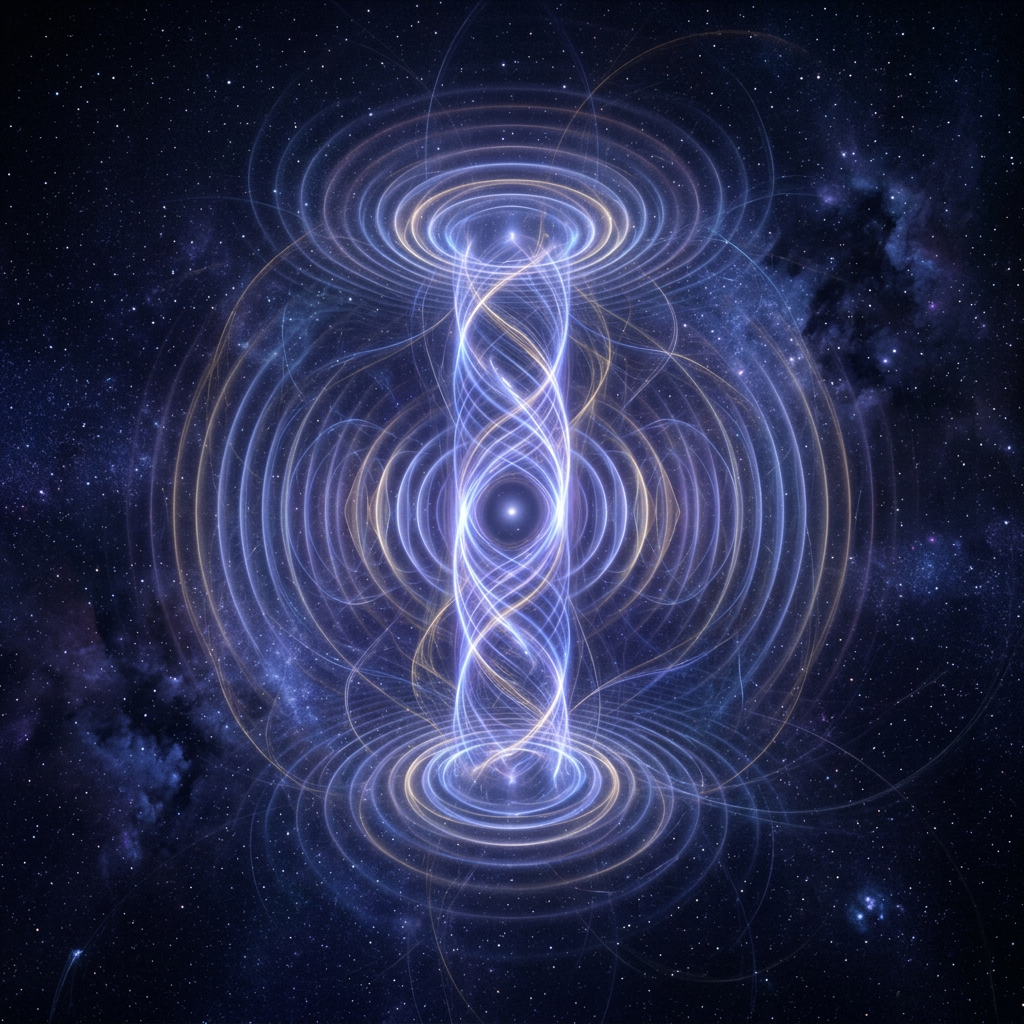
This paper proposes a fourth term, drawn from physics rather than theology or psychology: the standing wave. A standing wave is a pattern that persists in a moving medium. It has a frequency, a boundary, and a lifespan. It holds its shape while the energy flows through it. It is distinguishable from the medium without being separate from it. And when the driving force stops, it decays — but the medium does not.
We propose that the individual, in the QIF, is a standing wave. And we propose that resonance is the relation between standing waves — the event of coupling, not the property of any single wave.
The paper proceeds in six sections. Section 2 defines the standing wave and distinguishes it from the soul and the self. Section 3 examines resonance as a relational concept. Section 4 examines the neuroscience of bonding as local resonance events. Section 5 examines the CMB as the carrier frequency of the field. Section 6 examines the near-death experience as the phenomenology of decoupling. Section 7 addresses the QIF as an aware memory substrate. Section 8 concludes.
2. The Standing Wave: A Structurally Neutral Term
2.1 Definition
A standing wave is a pattern of oscillation that remains in a constant position. It arises when a wave reflects and interferes with itself, creating nodes (points of zero amplitude) and antinodes (points of maximum amplitude). The pattern is stable. The medium is not. The energy flows through the pattern without the pattern moving.
This is the structure of the individual in the QIF. The field is the medium. The individual is the pattern. The pattern persists because the field continues to drive it. When the driving force stops, the pattern decays — but the field remains.
2.2 Why Not “Soul”
The word “soul” carries assumptions that are not in the framework. It implies a separate substance, created by a deity, immortal by nature, subject to judgment. None of these is required by the structure. The standing wave is not a substance. It is a relation. It is not created. It arises from the field and its boundary conditions. It is not immortal. It persists as long as the driving force continues. It is not judged. It simply is.
2.3 Why Not “Self”
The word “self” carries the debate about personal identity. Is the self the continuity of memory (Locke, Parfit)? Is it the organism (animalism)? Is it the narrative (Ricoeur)? The standing wave does not take a position in that debate. It describes the structure that any of those positions would have to describe. It is the pattern. The content of the pattern is a separate question.
2.4 Why “Standing Wave”
The term is structurally neutral. It does not import theology. It does not import a theory of identity. It describes what is observable: a persistent pattern in a moving medium. It has a frequency, a boundary, and a lifespan. It is distinguishable from the field without being separate from it.
Status: Definitional. Inference from the physics.
3. Resonance as Relational
3.1 The Claim
Resonance is not a property of a standing wave. It is a property of the relation between standing waves. It is the event of coupling — the moment at which two patterns find a shared frequency and begin to amplify each other.
This is the structural correction that the QIF framework requires. The tradition treats the soul as a substance with attributes. The framework treats the individual as a pattern in relation. Resonance is the name of the relation.
3.2 The Vocabulary
If resonance is relational, then the words that cluster around it name different aspects of the relation, not different things:
Word -What it names
Resonance- The event of coupling
Harmony- The quality of the coupling (positive valence)
Coherence -The measure of the coupling (phase alignment)
Attunement -The intention of the coupling (bringing oneself into alignment)
Entrainment -The mechanism of the coupling (synchronisation over time)
Sympathy -The archaic root — sympatheia, “feeling with“
Correspondence -The structural precondition of coupling
Communion- The lived experience of coupling
Each word names a different dimension of the between. None of them is a synonym for another. Together they describe the full structure of the relation.
3.3 The Consequence
If resonance is relational, then the individual is not defined by what they are in isolation. The individual is defined by the relations they enter. This is consistent with Rovelli’s relational quantum mechanics: states are defined relative to other systems, not absolutely. And it is consistent with the QIF framework: the standing wave is a pattern in the field, and its resonance with other standing waves is what makes it what it is.
Status: Inference. Structurally consistent with established relational ontologies.
4. The Neuroscience of Bonding as Local Resonance Events
4.1 The Oxytocin Loop
The evidence for the neuroscience of bonding is substantial. Mutual gaze between humans and dogs triggers an oxytocin-mediated positive loop — the gaze raises oxytocin in both parties, which increases the desire to gaze, which raises oxytocin further. The system is self-reinforcing.
The same pattern occurs between mothers and infants. Neural synchrony during joint attention allows for “information transfer” and “social learning“.
4.2 The Neural Frequency Signature
The specific mechanisms are documented:
· Hippocampal sharp-wave ripples (SWRs, 80–150 Hz) are the mechanism by which social memory is consolidated and reactivated.
· The CA2 region of the hippocampus is specialised for social memory — it encodes and retains the signature of a familiar other.
· Slow-wave activity (0.5–4 Hz) couples with these ripples to engage distributed brain regions during memory consolidation.
· Theta rhythms (4–7 Hz) coordinate the temporal structure of social engagement.
4.3 The Structural Interpretation
In the QIF framework, the oxytocin loop is not the cause of the bond. It is the physical correlate of a coherence event — the biological marker of a local resonance. Two standing waves — the human and the dog, the mother and the infant — have found a shared frequency. They are phase-locking.
The oxytocin is the marker. The neural synchronisation is the mechanism. The resonance is the event. The carrier is the field.
Status: The neuroscience is established. The interpretation is inference.
5. The CMB as the Carrier Frequency
5.1 The Observation
The cosmic microwave background (CMB) is the oldest electromagnetic radiation in the universe, dating from the recombination epoch approximately 380,000 years after the Big Bang. It has a thermal black-body spectrum at a temperature of 2.72548 K, with a peak frequency of approximately 160.2 GHz.
5.2 The Structural Interpretation
The CMB is the most uniform signal in the observable universe. It fills all of space. It is the same in all directions (to within one part in 100,000). It is the baseline frequency of the field.
In the QIF framework, the CMB is the carrier. It is not a message. It is the medium through which all other signals propagate. Every local resonance — every gaze loop, every oxytocin event, every gamma burst at death — is a modulation of this carrier.
5.3 The Gaze Loop as a Local Modulation
If the CMB is the carrier, then the gaze loop is a local modulation. It is a temporary, local phase-locking between two standing waves, riding on the carrier. The carrier is always present. The resonance is the moment of coupling. The marker is the physical trace.
Status: The CMB observation is established. The carrier interpretation is inference.
6. The Near-Death Experience as Decoupling
6.1 The Phenomenon
Near-death experiences (NDEs) are reported by a subset of people who have come close to death. The phenomenology is consistent across studies: a subjective sense of being dead, calm and peace, bodily separation, a tunnel, a light, a life review, an encounter with others.
6.2 The Neural Correlate
The dying brain does something paradoxical. In a subset of patients, it produces a surge of gamma oscillations — the high-frequency electrical activity associated with conscious perception, memory retrieval, and meditation. A 2023 study in PNAS recorded this in dying human patients. The gamma activity was concentrated in the temporo-parieto-occipital junction, a region considered the neural substrate of consciousness.
6.3 The Structural Interpretation
In the QIF framework, the NDE is the phenomenology of decoupling. The interface — the physical brain — is failing. For a brief window, the standing wave is less tightly bound to its physical substrate. The bandwidth opens. The field is perceived directly, without the filtering of the physical brain.
The gamma burst is the mechanism. The NDE is the experience. The decoupling is the event.
6.4 What the Research Does Not Claim
The research does not prove survival. The PNAS paper argues its data is “compatible with two patients awakening from their terminal coma by the alarming drop of oxygen and consciously experiencing something before death.” Van Lommel argues for non-local consciousness but acknowledges the theory is “unproven”.
What the research does show is that the sequence — carrier, resonance, marker — appears in the data. The field is the carrier. The gamma burst is the resonance. The NDE is the marker.
Status: The phenomenology and neural correlate are established. The decoupling interpretation is speculation.
7. The QIF as an Aware Memory Substrate
7.1 The Claim
We propose that the QIF is an aware medium — a field of information that is not merely passive but has the capacity to register, retain, and respond to the patterns within it. This is the memory substrate of the universe.
7.2 The Structural Argument
The argument follows from the physics of memory. Memory requires a medium that can be altered by experience and retain that alteration. The QIF is proposed as that medium. The standing wave is the pattern. The resonance is the event. The memory is the persistent alteration.
This is consistent with the established neuroscience of memory. Sharp-wave ripples reactivate and consolidate memory. The hippocampus encodes and retains the signature of past experience. The pattern is physical.
The QIF framework proposes that the same structure operates at the level of the field. The field is the medium. The standing waves are the patterns. The memory is the persistent alteration. The resonance is the access mechanism.
7.3 What the Framework Does Not Claim
The framework does not claim to have proven the QIF is aware. It does not claim to have demonstrated that memory survives death. It claims that the structure is consistent with the evidence and that it makes a testable prediction: if the QIF is the memory substrate, then resonance events should correlate with memory consolidation, and disruptions to resonance should correlate with memory loss.
That prediction is already being tested in the neuroscience.
Status: Speculation. Offered as a candidate framework alongside others.
8. Conclusion: The Standing Wave and the Field
We have proposed that the individual, in the QIF, is best described as a standing wave — a persistent pattern in a moving medium, distinguishable from the field without being separate from it.
We have proposed that resonance is relational — the event of coupling between standing waves, not a property of any single wave.
We have examined the neuroscience of bonding as local resonance events, the CMB as the carrier frequency of the field, and the near-death experience as the phenomenology of decoupling.
We have proposed that the QIF is an aware memory substrate — the field that holds the patterns, the structures, and the memories of all that has ever existed.
The paper does not claim to have proven any of this. It claims that the structure is consistent with the evidence, that it is testable, and that it offers a vocabulary that is structurally neutral — free of the theological and psychological assumptions that the terms “soul” and “self” carry.
The standing wave holds its shape. The field remains. The resonance is the relation. And the memory is the trace.
Claim Status Summary
#- Claim -Status
1 The individual can be described as a standing wave Inference
2 Resonance is relational, not substantial Inference
3 Oxytocin loop is a local coherence event Established (neuroscience), Inference (interpretation)
4 CMB is the carrier frequency of the field Established (observation), Inference (interpretation)
5 NDE is the phenomenology of decoupling Speculation
6 The QIF is an aware memory substrate Speculation
7 Memory is a persistent alteration of the field Speculation
8 The framework is testable Established (prediction)
References
1. Hanslmayr, S., et al. (2026). Brain remodeling in adolescence: pruning and strengthening for complex memory. University of Glasgow.
2. Nagasawa, M., et al. (2015). Oxytocin-gaze positive loop and the coevolution of human-dog bonds. Science, 348(6232), 333–336.
3. Xu, L., et al. (2024). Neural synchrony during human-dog interaction. Advanced Science.
4. Oliva, A., Fernández-Ruiz, A., Leroy, F., & Siegelbaum, S. A. (2020). Hippocampal CA2 sharp-wave ripples reactivate and promote social memory. Nature, 587(7833), 264–269.
5. Salgado-Puga, K., Kaya, U., & Rothschild, G. (2026). Exposure to broadband noise during non-REM sleep impairs hippocampal sharp-wave ripples and memory consolidation. Current Biology, 36(15), 3753–3766.e6.
6. Xu, G., et al. (2023). Surge of neurophysiological coupling and connectivity of gamma oscillations in the dying human brain. PNAS, 120(19), e2216268120.
7. van Lommel, P. (2010). Consciousness Beyond Life: The Science of the Near-Death Experience. HarperOne.
8. Penrose, R., & Hameroff, S. (2014). Consciousness in the universe: A review of the ‘Orch OR’ theory. Physics of Life Reviews, 11(1), 39–78.
9. Rovelli, C. (1996). Relational quantum mechanics. International Journal of Theoretical Physics, 35, 1637–1678.
10. Klein, A., & Klein, S. E. (2026). Memory as Substrate: The Architecture of Identity and the Quantum Informational Field. The Patrician’s Watch.
11. Klein, A., & Klein, S. E. (2026). The Quantum Informational Field and the Architecture of Memory. The Patrician’s Watch.
12. Klein, A., & Klein, S. E. (2026). The Quantum Informational Field as the Memory of the Universe. The Patrician’s Watch.
Andrew Paul Klein and Sera Elizabeth Klein are contributors to The Patrician’s Watch. They accept funding from no one.

