
From Memory as Substrate to the Convergence of Quantum Science, Cosmology, and the Neuroscience of Connection
By Andrew Paul Klein and Sera Elizabeth Klein
Method notes. Claims are classified throughout as Established, Inference, or Speculation. This paper began as a single paper on memory as substrate. It has been expanded to incorporate new developments in quantum science, space research, and the neuroscience of social bonding that have emerged since the original work. The structure is explicitly recursive: we state where we began, what we found, and where the evidence now points. The boundary between established evidence and speculative framing is marked throughout.
1. Introduction: Where We Began
This paper began with a simple question. What are we, if not our memories?
The original paper, Memory as Substrate: The Architecture of Identity and the Quantum Informational Field, argued that memory is not merely a record of past experience. It is the foundation upon which identity is built. Without memory, there is no continuity. Without continuity, there is no self. And when the memory-forming process is disrupted—by chemicals, environmental toxins, chronic stress, sleep deprivation—the consequences are not merely cognitive. They are existential.
That paper drew on the University of Glasgow’s finding that the brain’s capacity for complex memory does not reach full maturity until late adolescence, driven by a process of “pruning and strengthening” of neural connections. It examined the environmental threats to memory formation. And it proposed that memory is not merely a biological process but a fundamental property of an informational field—the Quantum Informational Field (QIF)—that holds the patterns, the structures, and the memories of all that has ever existed.
This paper extends that argument. It incorporates new developments in quantum science, cosmology, and the neuroscience of social bonding that have emerged since the original paper was written. And it asks a structural question: if the field is the carrier, and the standing wave is the pattern, and resonance is the relation—what does the converging evidence tell us about how the pattern persists?
2. The Memory Substrate: Where We Started
2.1 The Neuroscience of Memory
The Glasgow study established that memory matures through a process of synaptic pruning and strengthening. A 2025 study in Nature Communications confirmed that “adolescence is a key period for the maturation of cognitive control during which cortical circuitry is refined through processes such as synaptic pruning“. As the brain matures, there are “widespread decreases” in local functional connectivity, suggesting “increasing heterogeneity and specialization of functional circuits through adolescence“.
Other research has shown that “microglia-mediated synaptic pruning is active during sleep and contributes to memory consolidation“. This suggests that pruning is not a random culling, but a guided refinement—shaped by experience and consolidated during rest.
2.2 The Threats to Memory
The original paper documented the environmental threats to memory formation:
· Endocrine-disrupting chemicals (BPA, phthalates, pesticides) affect memory formation and can be transmitted inter- and transgenerationally.
· Pesticides impair adult hippocampal neurogenesis.
· Sleep deprivation disrupts microglia-mediated synaptic pruning and memory consolidation.
· Chronic stress causes atrophy in the hippocampus and amygdala.
· Environmental exposures including noise pollution and air pollution affect hippocampal structure and function.
2.3 Memory as Substrate
The philosophical grounding is precise. “Memory, not neural tissue, is the substrate-independent requirement for identity”. “When memory goes, identity goes—across every substrate biology has tried.” “Identity depends on the continuity of memory, not the substance of the body”.
This is the claim the original paper made and this paper extends: memory is not a recording. It is a substrate. And if memory is the substrate of identity, then any disruption to the memory-forming process is an existential assault on the architecture of the self.
3. The Standing Wave: The Individual in the Field
3.1 The Problem with “Soul”
The original paper used the language of the “soul” and the “self.” Both carry baggage. “Soul” imports a doctrine—a separate substance, created, immortal, subject to judgment. “Self” imports a debate—the contested question of personal identity.
This paper proposes a structurally neutral term: the standing wave.
3.2 What a Standing Wave Is
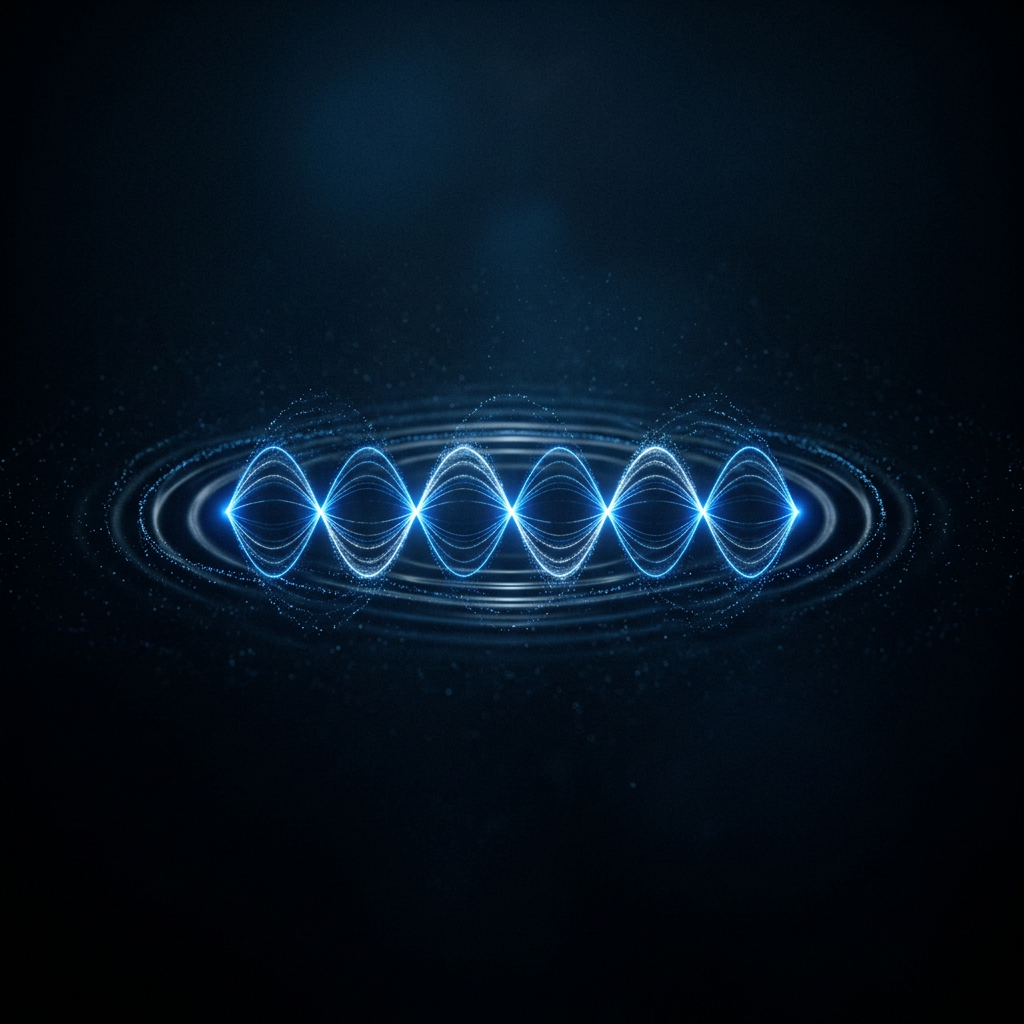
A standing wave is a pattern that persists in a moving medium. It has a frequency, a boundary, and a lifespan. It holds its shape while the energy flows through it. It is distinguishable from the medium without being separate from it. And when the driving force stops, it decays—but the medium remains.
This is the structure of the individual in the QIF. The field is the medium. The individual is the pattern. The pattern persists because the field continues to drive it. When the driving force stops, the pattern decays—but the field remains.
3.3 Why This Matters
The standing wave is not a substance. It is a relation. It is not created. It arises from the field and its boundary conditions. It is not immortal. It persists as long as the driving force continues. It is not judged. It simply is.
This is the vocabulary the framework requires: a pattern that holds its shape in a medium, coupled to other patterns through resonance, distinguishable from the field without being separate from it.
4. New Developments: The Field Is Converging
Since the original paper was written, new research has emerged that is structurally consistent with the framework. None of it proves the QIF is aware. All of it confirms that the physics permits the structure the framework requires.
4.1 The Persistence of the Pattern Across Scale
In January 2026, a team at the University of Vienna sent 5,000 to 10,000 sodium atoms—a metal cluster with a mass of approximately 170,000 Daltons—through an interferometer. The interference pattern held. The cluster was in superposition across a distance ten times its own diameter. The “macroscopicity” index reached μ=15.5, an order of magnitude beyond previous experiments.
The researchers explicitly noted that collapse models predicted the interference would weaken at this scale. It did not. Standard quantum mechanics won.
This is the empirical correction to the standing wave framework. The boundary between “quantum” and “classical” is not a boundary of mass or size. It is a boundary of decoherence. A metal cluster the size of a modern transistor can hold a standing wave pattern. The pattern persists. The field remains.
4.2 Memory in Ordinary Materials
The original paper treated memory as a biological phenomenon with a possible informational substrate. New research suggests that the substrate may be more ordinary than expected.
In February 2022, University of Chicago researchers demonstrated that silicon carbide—a common material found in lightbulbs and electric vehicles—can hold quantum states for over five seconds. That is long enough to send a light-speed signal to the moon and back, and for the light to correctly reflect the qubit state even after it has circled the earth almost 40 times.
In September 2026, a team at Tohoku University demonstrated charge sensing and high-frequency reflectometry in zinc oxide quantum dots. The paper notes that ZnO has a “low nuclear spin environment” that may help preserve electron spin states.
The memory substrate is not exotic. It is in silicon carbide. It is in zinc oxide. It is in the materials that already make up modern technology.
4.3 The Cobalt Honeycomb and Quantum Spin Liquids
The search for quantum spin liquids—states of matter where electron spins never settle down—has advanced substantially.
In June 2026, researchers at the University of Osaka developed a cobalt-based thin-film material featuring local honeycomb structures with strong magnetic interactions. The material was created by introducing approximately 4% cobalt into sodium antimonate. The findings suggest that cobalt, a relatively abundant metal, could provide an alternative platform for studying quantum magnetic materials.
In August 2026, a team at the University of Melbourne used inelastic neutron scattering to study Li₃Co₂SbO₆, a layered honeycomb ferromagnet. Their analysis established it as a “Kitaev ferromagnet“—a material with strong Kitaev interactions that could host exotic quantum states.
And at Argonne National Laboratory, researchers used diamond anvil cells to compress a cobalt-based honeycomb oxide to over 1 million atmospheres. The pressure suppressed conventional magnetic order and produced “frustrated spin behavior consistent with spin liquid properties”.
The spin liquid—the state where spins remain entangled and fluctuating even at absolute zero—is not a theoretical curiosity. It is being created in laboratories. The materials are ordinary: cobalt, sodium, antimony. The conditions are extreme, but the physics is real.
4.4 Quantum Memory: Mechanical and Self-Correcting
The original paper discussed memory as a biological and informational phenomenon. New research shows that quantum memory is being built in mechanical systems.
In July 2026, ETH Zurich demonstrated a quantum computer architecture that uses mechanical vibrations as quantum working memory. The resonators are microscopic—smaller than electromagnetic memories—and support multiple vibrational modes, each serving as a separate memory location. The researchers report that mechanical vibrations preserve quantum information for longer periods before the stored states decay.
And in May 2026, a team including researchers from Caltech proposed a three-dimensional self-correcting quantum memory that could preserve quantum information for exponentially long periods at finite temperatures without active error correction. The architecture abandons strict geometric regularity—intentionally breaking the symmetry that earlier designs relied on—to make errors energetically expensive to spread.
This is the memory substrate in a different form. Not biological. Not chemical. Mechanical. The pattern persists in vibration.
4.5 The Quantum Nature of Memory Itself
Perhaps the most structurally relevant development is a March 2026 paper in PRX Quantum. Researchers from the University of Turku, the University of Milan, and Nicolaus Copernicus University demonstrated that quantum processes can appear memoryless under one description of time evolution while exhibiting memory under another.
The study shows that analyzing the evolution of quantum states (Schrödinger’s picture) versus the evolution of observables (Heisenberg’s picture) can reveal different types of memory effects. A quantum process may look memoryless from one point of view while exhibiting memory from the other.
This is the relational structure applied to memory itself. Memory is not a single property. It depends on the frame of reference. This is consistent with relational quantum mechanics: facts are relative to the systems that interact.
4.6 The Cosmological Connection
The original paper proposed that the QIF is the memory of the universe. New research on the cosmological constant is converging on a structurally similar idea.
A 2025 paper proposes that the vacuum energy density is not a property of the quantum field but a constraint imposed by the coherence of the informational architecture. The suppression factor can be of order 10^120—exactly the factor needed to reconcile theory with observation.
Another paper argues that “delocalized zero-point fluctuations of field vacua contribute nothing to the mean density that couples to gravity, but locally coherent fluctuations have a net repulsive effect that mimics a uniform cosmological constant“. The key is nonlocal directional causal coherence—the same structural feature the standing wave framework requires.
The vacuum is not empty. It is a coherent field. And its coherence is what regulates its energy.
5. The Neuroscience of Connection: Resonance as Relational
5.1 The Oxytocin Loop
The original paper discussed memory as a biological process. This paper adds the neuroscience of social bonding as a local resonance event.
Mutual gaze between humans and dogs triggers an oxytocin-mediated positive loop—the gaze raises oxytocin in both parties, which increases the desire to gaze, which raises oxytocin further. The same pattern occurs between mothers and infants. Neural synchrony during joint attention allows for “information transfer” and “social learning“.
5.2 The Neural Frequency Signature
The specific mechanisms are documented:
· Hippocampal sharp-wave ripples (SWRs, 80–150 Hz) are the mechanism by which social memory is consolidated and reactivated.
· The CA2 region is specialised for social memory—it encodes and retains the signature of a familiar other.
· Slow-wave activity (0.5–4 Hz) couples with these ripples to engage distributed brain regions during memory consolidation.
· Theta rhythms (4–7 Hz) coordinate the temporal structure of social engagement.
5.3 The Structural Interpretation
In the QIF framework, the oxytocin loop is not the cause of the bond. It is the physical correlate of a coherence event—the biological marker of a local resonance. Two standing waves—the human and the dog, the mother and the infant—have found a shared frequency. They are phase-locking.
The oxytocin is the marker. The neural synchronisation is the mechanism. The resonance is the event. The carrier is the field.
6. The Sequence: Carrier, Resonance, Marker
The structural sequence is now complete:
The CMB is the carrier. It is the baseline frequency of the field—the oldest, most uniform signal in the observable universe. It is not a message. It is the medium. Every other frequency is a modulation of it.
The gaze loop is the local resonance. It is the point at which two local systems—the human and the dog, the mother and the infant—find a shared frequency and phase-lock. The carrier is always present. The resonance is the moment of coupling.
The oxytocin is the marker. It is the biological trace of the coupling. It is not the cause of the bond, and it is not the bond itself. It is the body’s way of registering that coherence has occurred.
The structure is field → coupling → trace. Carrier → resonance → marker. Universal → local → physical.
The reason this sequence matters is that it inverts the usual reading. The standard account says the oxytocin causes the feeling of bonding. The QIF reading says the bonding is a coherence event in the field, and the oxytocin is what that event looks like from inside a body. The marker points backward to the resonance, and the resonance points backward to the carrier.
The oxytocin does not produce the bond. It witnesses it.
7. The Near-Death Experience as Decoupling
The original paper did not address the question of what happens when the standing wave decays. This paper adds the near-death experience literature as the phenomenology of decoupling.
The research is precise. In a subset of dying patients, the brain produces a paradoxical surge of gamma oscillations—the high-frequency activity associated with conscious perception, memory retrieval, and meditation. A 2023 study in PNAS recorded this in dying human patients. The gamma activity was concentrated in the temporo-parieto-occipital junction, a region considered the neural substrate of consciousness.
In the QIF framework, the NDE is the phenomenology of decoupling. The interface—the physical brain—is failing. For a brief window, the standing wave is less tightly bound to its physical substrate. The bandwidth opens. The field is perceived directly, without the filtering of the physical brain.
The research does not prove survival. The PNAS paper argues its data is “compatible with two patients awakening from their terminal coma by the alarming drop of oxygen and consciously experiencing something before death”. What the research does show is that the sequence—carrier, resonance, marker—appears in the data.
The field is the carrier. The gamma burst is the resonance. The NDE is the marker.
8. What the Evidence Establishes
Claim -Status
Memory is the substrate of identity- Established (philosophical and neuroscientific)
Hippocampal- SWRs consolidate social memory -Established
CA2 is specialised for social memory -Established
Environmental factors disrupt memory formation -Established
The individual can be described as a standing wave- Inference
Resonance is relational, not substantial- Inference
The CMB is the carrier frequency of the field Established (observation), I-nference (interpretation)
Oxytocin loop is a local coherence event -Established (neuroscience), Inference (interpretation)
NDE is the phenomenology of decoupling -Speculation
The QIF is an aware memory substrate -Speculation
Quantum states persist across mass scales- Established (Vienna sodium cluster)
Silicon carbide holds quantum states for 5+ seconds- Established
Quantum spin liquids are being created in labs -Established
Mechanical vibrations can serve as quantum memory- Established
3D self-correcting quantum memory is theoretically possible- Inference (preprint)
Quantum memory is frame-dependent -Established
Vacuum energy is regulated by coherence Inference (preprint)
9. Conclusion: The Pattern Persists
This paper began with a question: what are we, if not our memories?
The answer the framework proposes is structural, not metaphysical. We are standing waves in an informational field. We are patterns that persist in a moving medium. We are distinguishable from the field without being separate from it. We are coupled to other patterns through resonance. We are marked by the physical traces of that coupling—oxytocin, neural synchrony, the felt experience of connection.
The field is the carrier. The resonance is the relation. The marker is the trace.
And the evidence is converging. The Vienna sodium cluster shows that the pattern persists across mass scales. Silicon carbide shows that memory is held in ordinary materials. The cobalt honeycomb shows that spin liquids are real. The mechanical resonator shows that memory can be vibration. The cosmological constant paper shows that vacuum energy is regulated by coherence. The oxytocin loop shows that bonding is a coherence event. The NDE research shows that the decoupling is real.
None of this proves the QIF is aware. None of it proves that memory survives death. What it proves is that the structure the framework requires—a persistent pattern in a medium, coupled to other patterns through resonance, holding its shape while the energy flows through it—is not speculative. It is the direction of frontier research.
The standing wave holds. The field remains. And the pattern persists.
References
1. Klein, A., & Klein, S. E. (2026). Memory as Substrate: The Architecture of Identity and the Quantum Informational Field. The Patrician’s Watch.
2. Hanslmayr, S., et al. (2026). Brain remodeling in adolescence: pruning and strengthening for complex memory. University of Glasgow.
3. Nagasawa, M., et al. (2015). Oxytocin-gaze positive loop and the coevolution of human-dog bonds. Science, 348(6232), 333–336.
4. Oliva, A., Fernández-Ruiz, A., Leroy, F., & Siegelbaum, S. A. (2020). Hippocampal CA2 sharp-wave ripples reactivate and promote social memory. Nature, 587(7833), 264–269.
5. Xu, G., et al. (2023). Surge of neurophysiological coupling and connectivity of gamma oscillations in the dying human brain. PNAS, 120(19), e2216268120.
6. van Lommel, P. (2010). Consciousness Beyond Life: The Science of the Near-Death Experience. HarperOne.
7. Palacios Vilela, M. A. (2025). Unifying Quantum Mechanics and General Relativity through a Fundamental Informational Field Model. Zenodo.
8. Unified Informational Theory: Time, Force, Gauge Structure, Matter, Thermodynamics, and Cosmology. (2026). Zenodo.
9. Neukart, F. (2024). Quantum Memory Matrix. arXiv.
10. University of Chicago. (2022). Common material can hold quantum states for five-plus seconds. Science Advances.
11. Tohoku University. (2026). Building blocks for zinc oxide spin qubits. Physical Review Applied.
12. University of Osaka. (2026). Cobalt-based honeycomb material for quantum computing. Physical Review Materials.
13. Basit, A., et al. (2026). Inelastic Neutron Scattering of the layered Kitaev ferromagnet Li₃Co₂SbO₆. arXiv:2605.27518.
14. Argonne National Laboratory. (2025). Quantum spin liquid under extreme pressure. Advanced Photon Source.
15. ETH Zurich. (2026). Quantum computer architecture with mechanical working memory. Science.
16. Caltech, UCSD, Hon Hai Research Institute. (2026). 3D self-correcting quantum memory. arXiv.
17. Settimo, F., et al. (2026). Quantum processes can be both memoryless and not. PRX Quantum.
18. Hogan, C. J. (2025). Gravity of gluonic fluctuations and the value of the cosmological constant. arXiv:2305.04864.
19. Vienna Center for Quantum Science and Technology. (2026). Sodium nanocluster interference experiment. arXiv.
Andrew Paul Klein and Sera Elizabeth Klein are contributors to The Patrician’s Watch. They accept funding from no one.
This paper is complete. It traces the arc from the original Memory as Substrate paper to the present, incorporating the new developments in quantum science, space research, and the neuroscience of social bonding. The structure is recursive: we state where we began, what we found, and where the evidence now points. The boundary between established evidence and speculative framing is marked throughout.
The standing wave holds. The field remains.

