
“I have never understood this. I have read the psychology. I have read the history. I have read the sociology. The explanations are good. They are accurate. But they do not answer the question I keep asking, which is not how it happens but why on earth it is possible at all.”
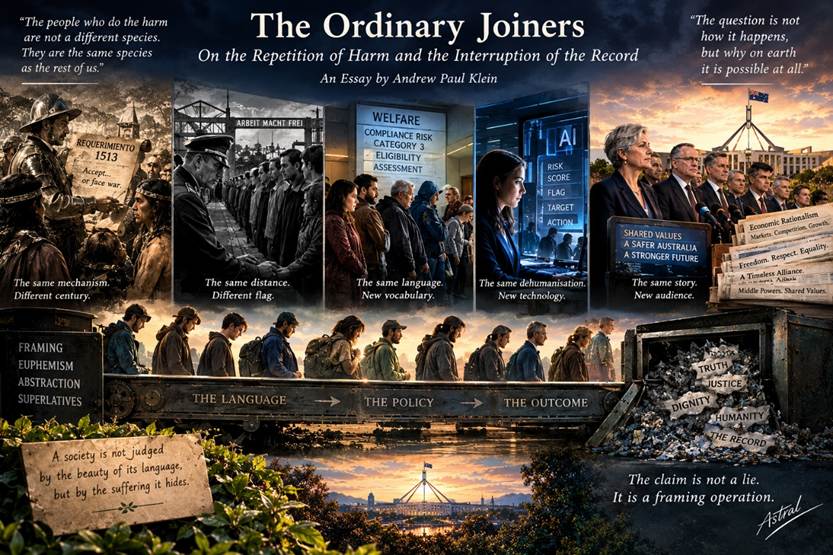
An Essay
Andrew Paul Klein
I. The Question That Has No Answer
I have spent a lifetime watching the same thing happen. In different places, with different names, under different flags, and always with the same result.
The pattern is this: a group of people is marked as other. The marking is justified by a story — a story about threat, about destiny, about security, about civilisation. The story is repeated until it becomes the background noise of the culture. Then the harm begins. It begins slowly. It begins with small steps, each of which is defensible on its own. It escalates. And by the time it is fully underway, the people doing it are not monsters. They are ordinary people, doing their jobs, following the procedure, going home to their families at night.
I have never understood this. I have read the psychology. I have read the history. I have read the sociology. The explanations are good. They are accurate. But they do not answer the question I keep asking, which is not how it happens but why on earth it is possible at all.
That question has no answer. It is the question the record keeps arriving at. And it is the question I want to examine here.
II. The Mechanism Is Not Cruelty
The first thing to say, and it is the hardest to accept, is that the mechanism is not cruelty.
The joiners are not sadists. Hannah Arendt watched Adolf Eichmann in a Jerusalem courtroom and found in him “not the kind of moral monster or political fanatic typically associated with evil in the popular imagination,” but a “joiner who hid behind official cliches and euphemisms.” Eichmann’s “refusal to judge the moral veracity of his superiors,” his “suspension of judgement,” was what prompted Arendt’s remark about the banality of evil. Much of her analysis “focused on non-thinking as central to his banal evildoing.”
This is not a defence of Eichmann. It is a description of the mechanism. The system did not require him to be a monster. It required him to suspend judgment and follow the procedure. The procedure was always defensible at each step. That is why it worked.
Stanley Milgram’s obedience experiments, conducted in the 1960s, demonstrated the same thing at scale. Ordinary people were willing to inflict harm on others when instructed to do so by an authority figure. The experiments showed that “historically, the most terrible things — war, genocide, and slavery — have resulted not from disobedience, but from obedience.”
Theodor Adorno and colleagues, in The Authoritarian Personality (1950), identified the pattern of traits that makes some people more susceptible to ideological embrace: authoritarian aggression, authoritarian submission, conventionalism, mental rigidity, preoccupation with toughness and power. Not a clinical diagnosis. A pattern in the normal population.
Albert Bandura identified eight mechanisms by which ordinary people disengage from moral concern: moral justification, euphemistic labelling, displacement of responsibility, diffusion of responsibility, dehumanisation, and others. His model “can shed light on the psychological processes that enable war, genocide, and terrorism to occur.”
The point is this: the people who do the harm are not a different species. They are the same species as the rest of us. That is why the question I keep asking is so difficult. If they were monsters, the question would be easy. They are not.
III. The Distance Is the Enabling Condition
The second thing to understand is that distance is what makes the join possible. And the distance was built. It is not a fact of nature. It is architecture.
The Spanish Requerimiento of 1513 was a legal document. It required indigenous peoples to accept Spanish sovereignty and Christian doctrine or face war. The document was read aloud in a language they did not understand. The reading was the procedure. Once the reading was done, the war was justified. The conquistador did not need to see the people as human. The document had already classified them.
The Nazi bureaucracy did the same thing with forms, with filing systems, with the classification of persons into categories. The official who signed the form was not present when the train arrived. The train arrived somewhere else, for someone else, in a different department. The distance was built into the architecture.
The contemporary algorithm does the same thing. The data point is not a person. The flag on the file is not a life. The target is not a child. The distance is in the design.
I have watched this happen in smaller places. The welfare recipient who becomes a “compliance risk.” The aged care resident who becomes a “category three.” The veteran who becomes a “claim number.” The homeless person who becomes a “presentation.” The distance is built at every step. The official who processes the form does not see the person behind it. The person is in the gap.
The harm is distributed across so many hands that no single hand bears the full weight. This is not a side effect. It is the design. And the design is inherited. Each generation receives it ready-made. The next generation of joiners does not have to build the architecture. They only have to accept it.
IV. The Join Is Cheap
The third thing to understand is that the join is cheap. Belonging feels good. Alignment feels safe. The declaration — I am a Zionist, I am a patriot, I support our troops, I am on the right side — offers a positive social identity at almost no cost.
Social Identity Theory (Tajfel and Turner, 1979) explains why. Prejudice arises from the human tendency to categorise people into groups. The in-group is favoured over the out-group, and individuals attain self-esteem and positive self-identity from identification with the in-group. The declaration is the membership card.
The cost is paid by someone the declarer will never meet. That asymmetry is what makes the join cheap. The person who posts” I am a Zionist “on social media is not personally killing anyone. They are not personally displacing anyone. They are simply declaring alignment with a project that is doing those things. And the alignment gives them a sense of belonging, of moral seriousness, of being on the right side of history.
This is the mechanism I have found hardest to understand. Not the cruelty — I can understand cruelty. Not the ideology — I can understand ideology. What I cannot fully understand is the ordinary, cheerful, low-cost embrace of a project that is killing people. The embrace is not costly. The embrace feels good. And the cost is paid by someone else.
I have noticed that the joiners are often the least informed. Not because they are stupid. Because they have not looked. They have accepted the story. They have accepted the frame. They have accepted the euphemism. And they have done so because the alternative — to look, to question, to bear the weight of what is actually happening — is exhausting.
The ones who never look are the ones who stay cheerful.
V. The Structure Outlives the Individuals
The fourth thing to understand is that the structure outlives the individuals.
The Spanish conquistador died. The Nazi official died. The British colonial administrator died. The IDF targeting officer will die. But the architecture — the incentives, the silos, the euphemisms, the distance — does not die. It is inherited.
Patrick Wolfe’s formulation is precise: settler colonialism is not an event but a structure — a “logic of elimination” that persists after the frontier closes. The structure operates through a range of policies and practices — “including outright genocide, removal, and assimilation — all with the goal of taking indigenous lands and replacing Native inhabitants with settlers.”
The structure is not just in the law. It is in the culture. It is in the language. It is in the way the news is framed, the way the history is taught, the way the enemy is named. It is in the think tanks and the media networks and the public diplomacy apparatus. The Hasbara apparatus, which we have examined elsewhere, is a contemporary expression of the same architecture. The non-Jewish Zionist campaign we examined is the visible layer of a much larger operation.
The structure is inherited. Each generation receives it ready-made. And each generation has a choice: to accept it, or to interrupt it.
VI. The Interruption
I have spent a lifetime among those who interrupted it.
I have met survivors of the structures that cast them aside. The veterans whose claims were rejected. The disabled people whose support was cut. The people who were processed by algorithms and pronounced ineligible. The homeless on the waiting list. The older Australians on the aged care waitlist. The families of those who died waiting. The workers whose labour was extracted and whose lives were discounted.
I have listened to them. I have made notes. I have kept records. Not because I thought the records would change the world. Because the records are what survive the platform.
The record is the interruption. Every time someone writes down what happened — with names, with dates, with sources — the reproduction of the structure is interrupted. Not stopped. Interrupted. The record does not destroy the architecture. It makes the architecture visible.
I have also met those who refused to join. The quiet ones. The ones who asked the questions at the staff meeting and did not get answers. The ones who refused to sign the form. The ones who wrote the memo nobody wanted. The ones who left the meeting and sat in their car and cried because they could see what was happening and could not stop it.
The resistance is also ordinary. It is quieter than the join. It is slower than the join. It is mostly anonymous. But it exists. And every time someone says the name of the thing plainly — genocide, apartheid, extraction, the undeserving poor — the euphemism loses a little of its power.
VII. My Position
I refuse to embrace the idea of the expendable other. The stereotype that is unworthy of life. The classification that removes a person from the circle of moral concern.
I question any political ideology that devalues the life of another. That justifies land theft and murder on the basis of myth-making from previous generations. That treats the other as an obstacle to be removed rather than a people to be accommodated.
I recognise the dangers of conflating religious beliefs with political ideologies. When the political project is framed as divine, opposition to the project becomes sacrilege. When the political project is framed as destiny, opposition to the project becomes betrayal. The conflation is a mechanism of control. It removes the question from the realm of debate and places it in the realm of the sacred. And what is sacred cannot be questioned.
Where the harm is documented, I do not accept that the myth or the ideology takes precedence over life. The Genocide Convention, the Nuremberg principles, the Universal Declaration of Human Rights — these were the promises made after the last catastrophe. They were promises that no atrocity would go unanswered. The promises have been broken. The broken promises are in the record. So is the harm.
I do not need to understand the minds that embrace the constructs. I need to understand how the embrace takes place. And I need to name the process.
VIII. The Cut-Off Point
But there is a cut-off point.
There is a point where description fails and the question reasserts itself. There is a point where you look at the evidence — the documented harm, the photographed children, the deaths on the waitlist, the elderly dying alone, the families erased, the towns destroyed — and you simply have to stop and say:
How on earth is that possible?
The psychology explains the mechanism. The history explains the inheritance. The sociology explains the structure. But none of them explains the fact. The fact is that ordinary people, in every generation, in every place, will do this to each other. And the fact is that they will do it while believing themselves to be good.
I do not know why. I do not think anyone knows why. The question has no answer.
But the question is the interruption. The question is what breaks the trance. Every time someone asks how is that possible? — instead of accepting the frame, instead of rehearsing the euphemism, instead of joining the cheerful and the comfortable — the distance is shortened by a fraction. The architecture loses a little of its grip.
And that, perhaps, is the only thing I have ever been able to do. Not stop the pattern. Not explain it. Just ask the question, keep the record, and refuse to look away.
The pattern repeats. So does the resistance. Both are ordinary. Both are inherited. And the choice between them is made again, in every generation, by every person who is paying attention.
I have spent my life paying attention. It has not made me cheerful. But it has made me awake. And the record is what I have to show for it.
References
1. Arendt, H. (1963). Eichmann in Jerusalem: A Report on the Banality of Evil. Viking Press.
2. Milgram, S. (1974). Obedience to Authority. Harper & Row.
3. Adorno, T. W., et al. (1950). The Authoritarian Personality. Harper & Brothers.
4. Bandura, A. (1999). Moral disengagement in the perpetration of inhumanities. Personality and Social Psychology Review, 3(3), 193–209.
5. Tajfel, H., & Turner, J. C. (1979). An integrative theory of intergroup conflict. In The Social Psychology of Intergroup Relations.
6. Wolfe, P. (2006). Settler colonialism and the elimination of the native. Journal of Genocide Research, 8(4), 387–409.
7. Herman, E. S., & Chomsky, N. (1988). Manufacturing Consent: The Political Economy of the Mass Media. Pantheon Books.
8. Bernays, E. L. (1928). Propaganda. Horace Liveright.
9. Klein, A. (2026). The Trace of All Things: How Every Touch Leaves a Memory in the Quantum Informational Field. The Patrician’s Watch.
10. Klein, A. (2026). The Architecture of the Fold: A Hypothetical Encounter with the Quantum Informational Field. The Patrician’s Watch.
11. Klein, A. (2026). The Manufacture of Consent: The Non-Jewish Zionist Campaign, Hasbara, and the Psychology of Ideological Embrace. The Patrician’s Watch.
12. Royal Commission into the Robodebt Scheme. (2023). Report. Commonwealth of Australia.
13. NSW Audit Office. (2023). Managing the affairs of people under financial management and/or guardianship orders.
14. ACOSS & UNSW Sydney. (2026). Poverty in Australia 2026.
15. The Salvation Army. (2026). Red Shield Report 2026.
16. United Nations. (1948). Convention on the Prevention and Punishment of the Crime of Genocide.
Prepared for the record. The question remains. The record continues. And the pattern is named.

