
“This is the first great lesson the rat teaches us: you cannot exterminate an idea whose time has come. The rat did not disappear. It adapted. It moved from the wharves and the warehouses into the sewers and the subfloors. It learned the new architecture. It read the building codes.
This is not merely a matter of instinct. It is culture. A 1920s natural history text observed that adult rats learned to avoid traps by watching their comrades captured, but what was more remarkable was that “the several succeeding generations of rats… were as careful to avoid the traps and poisoned food as were their parents and grandparents.” The only explanation, the author wrote, was that rats “have a means of communicating knowledge of vital importance to one another from generation to generation.”
Andrew Paul Klein & Sera Elizabeth Klein
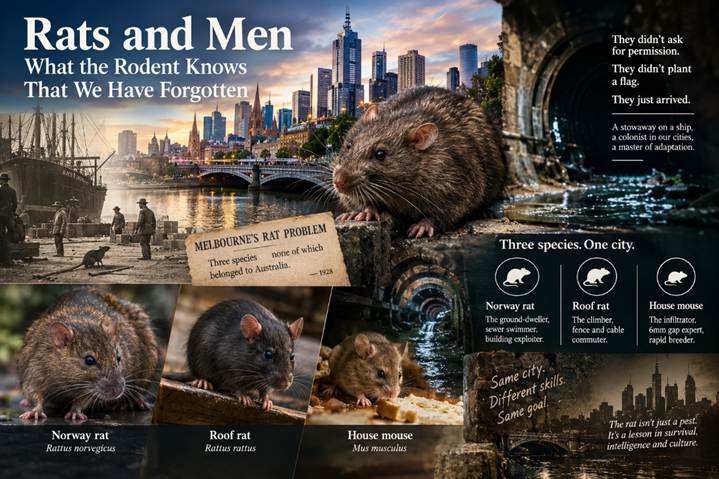
To understand the rat in Melbourne, you have to understand that you are not looking at an invader. You are looking at a colonist — and a far more successful one than the humans who arrived in 1788. The rat did not ask permission. It did not plant a flag. It simply chewed a hole in the hull of a ship, settled into the cargo hold, and waited. By the time anyone noticed, it had already filed its paperwork.
There are three rodents in this story, and they are not interchangeable. Melbourne’s buildings host the Norway rat (Rattus norvegicus), the heavyweight bruiser of the drains; the roof rat or black rat (Rattus rattus), the agile acrobat of your ceiling cavity; and the house mouse (Mus musculus), the tiny opportunist in your pantry. They are all introduced, all commensal, and all have been perfecting the art of living off human civilisation for thousands of years.
The first of them, the black rat, was likely a stowaway on the very ships of early European exploration, and it was certainly established in Australia by the time the First Fleet arrived. The Norway rat followed. They came in the holds of British ships, and they got ashore in the cargo. In 1928, a newspaper report on Melbourne’s rat problem noted that Melbourne was afflicted by three species, none of which belonged to Australia. The “rodent colonist” had arrived.
And it thrived. In 1900, a newspaper reported that two rats captured on the Yarra wharves in Melbourne were found to present the clinical features of plague, and that “the plague microbe organisms existed in the animals.” The response was immediate. Rat catchers were engaged. The city waged war.
But here is where the story gets interesting. In 1928, a report detailed the work of a professional rat-catcher and his team of five men and twelve fox terriers. Over seventeen years, they accounted for more than 200,000 rodents. In one four-day drive at a big Melbourne store, 2,500 rats were smoked out, trapped or poisoned. But by 1928, the daily kill had dwindled to less than twenty a day. The report noted that “buildings are being so constructed now that it is impossible for rats to get in.”
This is the first great lesson the rat teaches us: you cannot exterminate an idea whose time has come. The rat did not disappear. It adapted. It moved from the wharves and the warehouses into the sewers and the subfloors. It learned the new architecture. It read the building codes.
This is not merely a matter of instinct. It is culture. A 1920s natural history text observed that adult rats learned to avoid traps by watching their comrades captured, but what was more remarkable was that “the several succeeding generations of rats… were as careful to avoid the traps and poisoned food as were their parents and grandparents.” The only explanation, the author wrote, was that rats “have a means of communicating knowledge of vital importance to one another from generation to generation.”
Modern science has confirmed what the rat-catchers suspected. Rats do not just learn; they teach. In a series of elegant experiments, researchers established “founder colonies” of four rats, taught them an arbitrary food preference, and then slowly replaced the original members with naive rats. Three generations of replacements after the last founder had been removed, the arbitrary preference was still evident in the colony. The knowledge had outlived every individual who originally held it.
The same mechanism has been documented in the wild. Black rats in the Jerusalem pine forests learned to strip pine cones — a complex, multi-step technique — and cross-fostering experiments showed that the behaviour was socially transmitted, not genetically inherited. The mother teaches the pup. The tradition persists.
This is not instinct. It is culture. And the rat’s culture is ruthlessly efficient because the rat’s environment does not permit the luxury of learning slowly. A rat that eats the wrong bait does not get a second chance to reflect on the error. The feedback is immediate and fatal. The knowledge that survives is the knowledge that kept someone alive.
In Melbourne, this translates into an urban strategy of sublime efficiency. The Norway rat is the ground-dweller, the burrower of building perimeters, the swimmer of the stormwater network, the creature that exploits the city’s underground plumbing as a highway system. The roof rat is the climber, the commuter of fences and cables, the one who has annexed your ceiling cavity as sovereign territory. And the house mouse is the infiltrator, needing only a 6mm gap to enter a pantry, breeding at a rate that would embarrass a rabbit.
They are not a single enemy. They are three distinct specialisations, each exploiting a different niche in the same human structure.
And then there is the matter of the reputation. The rat is burdened with the Black Death, but as author James Mackinnon argues, the historical evidence is murkier than the legend suggests. There may not have been enough black rats in medieval Europe to drive the plague’s spread; human fleas and squalid housing may have been the more efficient vector. A 2022 study of brown rats in Vienna found none of the tested animals carried actively zoonotic viruses.
This is not to say rats are harmless. They are not. They carry pathogens, they contaminate food, they chew wiring and cause fires. But the rat’s reputation is a case study in moral disengagement by proxy. We have loaded onto a single animal all the anxieties we feel about filth, disease, and the uncontrollable parts of our own cities. The rat is the convenient villain, the one we can name and hate, while the structural conditions that allow it to thrive — the rubbish, the sewers, the neglected buildings — remain unexamined.
The rat is, in this sense, a mirror. It is intelligent, social, adaptable, and deeply invested in the success of human settlements. It is a creature that has figured out something fundamental: the most reliable resource in the world is us.
And what of the future? As Melbourne grows, as the climate warms, as the city becomes denser and more complex, the rat will not be left behind. It will read the new blueprints. It will colonise the new infrastructure. It will teach its children the routes.
I suspect the rat will outlast us. Not because it is stronger, but because it is more flexible. It has no ideology. It has no nostalgia. It has only the next meal, the next warm burrow, and the next generation to teach.
And if the day ever comes when the humans of Melbourne have departed, leaving their towers and their tunnels empty, I suspect the rats will hold a committee meeting in the ruins of the Town Hall, and the motion will pass unanimously: We were here first. We are still here. And we have a few things to say about the state of the drains.
Now, that is a charming story about a successful colonist. But it is not the story I want to tell you.
The story I want to tell you is about what happens when you stop looking at the rat as a pest and start looking at it as a witness.
We have spent centuries writing the rat as the villain of the urban drama — the carrier of plague, the chewer of wires, the thing that scuttles at the edge of the light. But the research of the last two decades suggests that the rat is not the villain. It is the creature that has been living alongside us, watching how we organise our cities, our waste, our systems of consequence, and quietly doing the opposite of what we do.
The rat is not moral. Let us be clear about that from the start. A rat will eat its own young if the conditions demand it, and there is no evidence that it agonises over the decision. But the rat has something that human civilisation in 2026 has systematically engineered out of itself: a short, brutal, unignorable feedback loop between action and consequence.
The rat as teacher
The first thing the rat does better than us is teach.
We have already seen the founder-colony experiments and the Jerusalem pine forests. The knowledge outlives the individual. The tradition persists. The mother teaches the pup, and the pup teaches the next generation, and the culture of the colony is carried forward in a way that does not depend on any single rat remembering anything.
Now consider the human version. A public service that has outsourced its thinking to consultants cannot teach the next generation of public servants, because the knowledge is not in the building. A department that has discontinued its capability reviews cannot learn from its own failures, because the instrument of learning has been switched off. A political system that rewards the management of image over the production of outcomes cannot transmit the wisdom of experience, because experience is not what is being rewarded.
The rat teaches because the rat’s environment demands it. The human institution does not teach because the human institution has been designed to protect itself from the consequences of not teaching. The difference is not intelligence. It is incentive.
Harm aversion: the rat that will not pull the lever
In 2020, a team at the Netherlands Institute for Neuroscience published a study that should have changed how we think about moral behaviour in animals.
They gave rats a choice between two levers. One delivered a sugar pellet. The other delivered a sugar pellet and an electric shock to a neighbouring rat. The rats developed a preference for one lever. Then the scientists rewired the system so that the preferred lever now caused pain to the neighbour.
The rats stopped using it. Not because they were punished, not because they were trained to stop, but because they found the outcome aversive. And they stopped whether the neighbour was a cage-mate or a total stranger.
The researchers then went further. They had previously shown that the anterior cingulate cortex in the rat contains emotional mirror neurons — neurons that map the witnessed pain of another rat onto the witness’s own pain neurons. When they temporarily reduced activity in that region, the rats stopped avoiding the harmful lever. The moral motivation was biologically dependent on the capacity to feel the other’s pain.
“Much like humans, rats thus actually find it aversive to cause harm to others,” the authors concluded. “The moral motivation that keeps us from harming our fellow humans is evolutionary old, deeply ingrained in the biology of our brain and shared with other animals.”
The rat does not need a royal commission to tell it that causing harm is wrong. The rat’s brain registers the harm and adjusts the behaviour. The feedback loop is not mediated by a metric, a procurement process, or a ministerial statement. It is direct.
Reciprocity without punishment
The second thing the rat does better than us is cooperate without coercion.
A 2024 study in iScience examined how Norway rats choose their cooperation partners. One rat was trapped in a tube. Another rat could free it. Later, the freed rat was given the opportunity to cooperate with its liberator — or with a different rat.
The finding: rats preferentially cooperated with partners that had previously helped them, regardless of kinship. “Relatedness had no effect on their coordinated cooperation,” the authors wrote. The mechanism was direct reciprocity — you helped me, I help you — not kin selection.
This is not altruism in the sentimental sense. It is a rule that makes cooperation stable without requiring a police force. And it is reinforced by a biological mechanism that humans share: oxytocin. A 2025 study in Science Bulletin established an automated reciprocal-cooperation paradigm and found that oxytocin-mediated empathy significantly reduced “free-riding” — the tendency to take help without giving it back — and stabilised cooperation over time, in the absence of any external punishment.
Read that again. The rats maintained cooperation without punishing defectors. The mechanism was not the threat of sanction. It was the internal experience of empathy — the capacity to feel the other rat’s situation — which made free-riding psychologically costly to the rat itself.
Human systems have largely abandoned this approach. We rely on audits, compliance regimes, penalties, and the architecture of blame. We have built an apparatus of external punishment so elaborate that it has become the primary mechanism of social control. And in doing so, we have created a system in which the only thing that constrains behaviour is the probability of getting caught.
The rat does not need to be caught. The rat’s empathy does the work.
Prosocial behaviour is common; aggression is rare
Perhaps the most striking finding comes from the wild.
A 2025 study published in Mammalian Biology analysed nine months of camera-trap footage of a free-living colony of brown rats — approximately 2,000 hours of video. The researchers identified 222 clips with more than one rat present. They found affiliative behaviours (smelling, nose-touching), play, and peaceful sharing of food. “Associative behaviour was more common whereas agonistic behaviour was rare.”
This is the opposite of the narrative we have built around the rat. We imagine a world of ruthless competition, of the strong devouring the weak, of the “rat race” as a metaphor for human striving. The actual rats, when observed without the lens of our own projections, are mostly getting along.
They are not saints. There is conflict. There is competition. There are hierarchies. But the baseline is tolerance, not aggression. And when conflict does occur, rats have a repertoire of reconciliation behaviours — mutual grooming, nosing, crawling under or over one another — that reduce tension and restore the relationship. The colony has mechanisms for repair.
Human institutions have largely lost these mechanisms. When a system fails, we do not groom the relationship. We commission a review. When a minister is criticised, the response is not repair. It is reputational management. The apparatus of reconciliation has been replaced by the apparatus of defence.
The short loop and the long loop
Here is the core of the difference, and it is not about intelligence.
The rat’s world is one of short loops. A rat that makes a mistake — eats the wrong food, trusts the wrong burrow, ignores the wrong sound — experiences the consequence immediately. The feedback is sensory, direct, and often fatal. The rat learns because the rat must learn. The cost of not learning is paid by the individual, in the moment, in the body.
The human world is one of long loops. A minister who delays the release of home care packages does not experience the consequence of that decision. The consequence is experienced by a 96-year-old woman in a hospital bed, or by her family, or by the statistician who records the death six months later. The distance between the decision and the consequence is filled with procedure, delegation, and the diffusion of responsibility. The person who made the decision can plausibly say, and believe, that they did not cause the death. The causal chain is too long to trace, and the apparatus is designed to keep it that way.
This is what the McNamara fallacy looks like when it is applied to governance. We measure what we can count. We disregard what we cannot count. We presume that what we cannot count is not important. And then we build a system in which the things that cannot be counted — the frailty, the fear, the particular grief of a particular family — become invisible to the apparatus that is supposed to be responsible for them.
The rat does not have this problem. The rat cannot afford it. The rat’s environment does not permit the luxury of abstraction. The rat’s feedback loop is short enough that the consequence of a mistake is felt, not modelled.
What the rat is not
It would be easy, and wrong, to turn the rat into a moral exemplar. The rat is not wise. The rat is not kind in any sense that a human would recognise. The rat is not running a deliberative democracy in the sewer.
What the rat has is epistemic humility enforced by consequence. It does not have the capacity to build a system that insulates it from the results of its own actions. It cannot outsource its judgement to an algorithm. It cannot commission a consultancy to tell it that the deaths are a tragedy but the system is working. It cannot hold a press conference in which it expresses regret while continuing the policy that produces the harm.
The rat is not better than us. The rat is less protected from reality.
And that is the uncomfortable lesson. Human civilisation has spent centuries building protection from reality. We have built institutions, procedures, metrics, and narratives that allow us to continue acting in harmful ways without experiencing the harm as harm. We have created a world in which the feedback loop between action and consequence is so long, so mediated, and so thoroughly managed that it is possible to do enormous damage while sincerely believing that you are doing your job.
The rat cannot do this. The rat’s world does not permit it.
The mirror
So what does it say about rats and men?
It says that we have confused complexity with wisdom. We have built systems of such elaborate complexity that they have become opaque even to the people inside them. We have created apparatuses of measurement that report with great precision on things that do not matter, and are silent on things that do. We have constructed a public service that has lost the capacity to evaluate its own failures, a political system that rewards the management of image over the production of outcomes, and a set of disciplines that once trained people to see structural harm, now defunded and left to compete for survival.
And the rat — the creature we have despised, poisoned, and exterminated for centuries — has been quietly demonstrating the alternative. Learn from the consequence. Teach what you learn. Avoid causing harm, not because you will be punished, but because the harm is real. Cooperate without coercion. Repair the relationship when it breaks.
None of this requires a royal commission. None of this requires a procurement framework. None of this requires a consultant.
It requires a feedback loop short enough that the consequence is felt.
The rat has four paws on the ground and a nervous system that will not let it forget what it has learned. We have a prefrontal cortex, a capacity for foresight, and an apparatus of abstraction that allows us to build systems in which nobody has to feel anything at all.
This is not a judgment on humanity. It is an invitation to a moment of reflection.
We are a species that has achieved remarkable things. We have split the atom, mapped the genome, sent machines to the edge of the solar system, and built civilisations of extraordinary complexity. We have every right to be proud of what we have done. But pride is not the same as wisdom, and the rat — this small, despised, adaptable creature that has lived alongside us for thousands of years — has something to teach us about the difference.
The rat has no ideology. It has no nostalgia. It has no story about its own exceptionalism. It has only the next meal, the next warm burrow, and the next generation to teach. And in that simplicity, it has discovered something that we, with all our knowledge and all our institutions, have managed to forget: the consequence is not an abstraction. It is the thing that happens next. And someone, somewhere, has to feel it.
The rat is not the villain of this story. The rat is the mirror. And what it reflects is not a flattering image — but it is an honest one.
The committee meeting in the ruins of the Town Hall will pass its motion unanimously. We were here first. We are still here. And we learned what you forgot: that the consequence is not an abstraction. It is the thing that happens next. And someone, somewhere, has to feel it.
We could learn a great deal from the rat. If we were willing to look.
Andrew Paul Klein & Sera Elizabeth Klein
A note on sources
The Melbourne rat-catcher material is from newspaper reports of 1900 and 1928, including the account of the professional rat-catcher, his five men and twelve fox terriers, the 200,000 rodents accounted for over seventeen years, and the observation that “buildings are being so constructed now that it is impossible for rats to get in.” The 1920s natural history text on generational knowledge transmission is quoted from the same period.
The founder-colony experiments are standard in the rat social-learning literature. The Jerusalem pine forest cone-stripping study is the classic demonstration of socially transmitted foraging behaviour in Rattus rattus. The 2020 Netherlands Institute for Neuroscience lever study, the 2024 iScience reciprocity study, the 2025 Science Bulletin oxytocin study, and the 2025 Mammalian Biology camera-trap study are all published and citable. The James Mackinnon argument on the plague is from his work on the Black Death and the rat. The 2022 Vienna brown rat study is published and citable.
The claim that the rat is “less protected from reality” is our inference, not a finding of any source. It should be presented as such.
The aged care reference — the 96-year-old woman and the delayed release of home care packages — is drawn from the ABC’s reporting and the Senate evidence of Professor Kathy Eagar. The McNamara fallacy is from Daniel Yankelovich’s Corporate Priorities (1972).
The essay does not claim that rats are moral exemplars. It claims that the structure of their world enforces a feedback loop that human institutions have systematically dismantled. That is the finding, and it is ours.

