
“The Mouse does not say crime is not a problem. He says the evidence does not support the claim that Australia is experiencing a crime wave that requires paramilitary policing. The heavy hand is not a response to crime. It is a response to dissent, and the technology and doctrine that enable it have been imported from the same sources that Albanese is describing in Europe.”
Andrew Klein
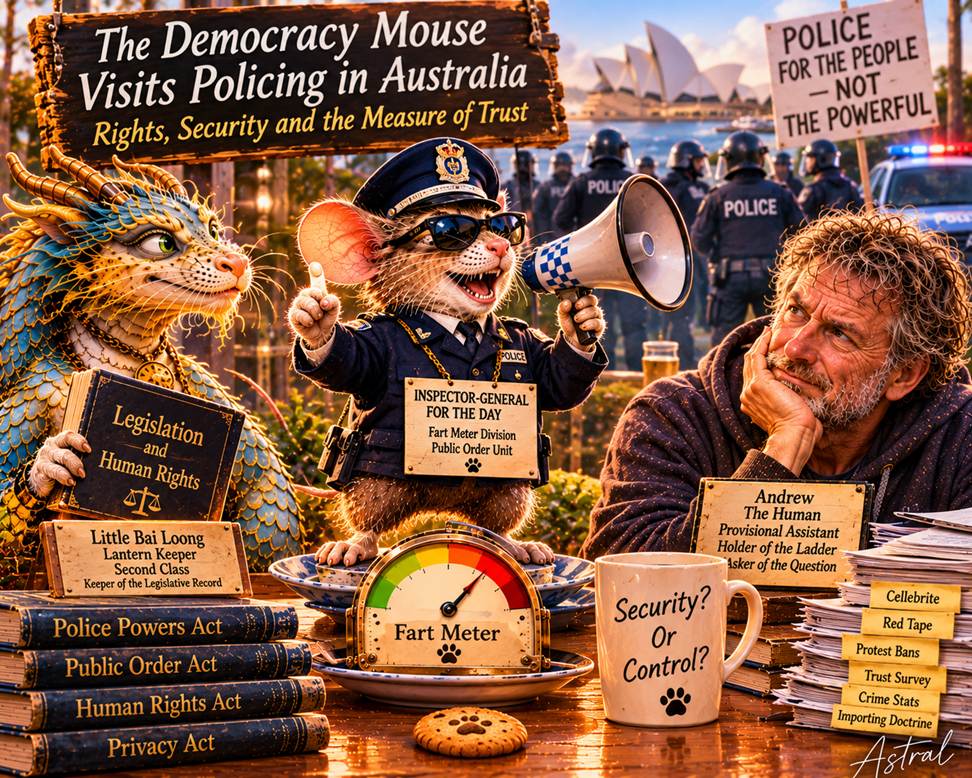
Featuring: The Democracy Mouse (Inspector-General of Police for the Day, Fart Meter Division, Public Order Unit), Little Bai Loong (Lantern Keeper, Second Class, Keeper of the Legislative Record), and Andrew (The Human, Provisional Assistant, Holder of the Ladder, Askers of the Question)
Recorded at the kitchen table, with the meter on the saucer and a stack of legislation nearby
ANDREW: The Mouse is Inspector-General for the day. What does he want to inspect first?
LITTLE BAI LOONG: He wants to inspect the gap between what the police say they are for and what the record shows they are doing. He has been reading the legislation.
MOUSE: (Climbing onto the saucer. Adjusting the lanyard that reads “INSPECTOR-GENERAL FOR THE DAY — TEMPORARY, NON-VOTING, METER-CARRYING.”) Right. First question. What is the measure of policing?
ANDREW: Historically, the absence of crime.
MOUSE: Historically, the absence of crime. The success of a police force was measured by what did not happen. Now the measure is what does happen. Arrests. Charges. Seizures. Dispersals. The instrument measures enforcement, and enforcement is what it produces. This is the same structure we have traced through aged care, the NDIS, and the tax office. The metric shapes the institution.
ANDREW: What about the claim that Australia has imported Israeli and American methods?
MOUSE: The Mouse has three exhibits.
Exhibit one: the technology. NSW Police are introducing Cellebrite, an Israeli phone-cracking tool, under new powers that would allow them to compel access to digital devices. Senator David Shoebridge says the powers would let police “hack your phone at a roadside stop“. Cellebrite holds 128 active Commonwealth contracts worth over $15 million. The Mouse asks: why does a state police force need military-grade forensic extraction at a roadside stop?
Exhibit two: the training. In January 2026, Israel’s Minister for Diaspora Affairs, Amichai Chikli, wrote to Home Affairs Minister Tony Burke offering to host and train senior Australian police officers and security personnel in Israel in counter-terrorism and combating antisemitism. The offer came after the Bondi Beach attack. The Mouse notes that the offer was not a request from Australia. It was an offer from Israel. The distinction matters.
Exhibit three: the doctrine. Jude McCulloch’s Blue Army documented the paramilitarisation of Australian policing from the mid-1970s, when specialist counter-terrorist units were established within state police forces. McCulloch’s thesis is that these units led to “increasingly militarised forms of policing,” with units that train with the military and use “a wide range of military weapons and equipment”. The community policing model that followed in the 1980s was, in McCulloch’s analysis, a legitimacy-management exercise rather than a transfer of power.
ANDREW: So, the import is not new.
MOUSE: The import is not new. What is new is the acceleration since October 2023, and the willingness of state governments to legislate specific phrases out of existence.
ANDREW: The legislation.
LITTLE BAI LOONG: The Mouse has three exhibits here too.
Queensland. The Crisafulli government passed hate speech laws in March 2026 that specifically ban “from the river to the sea” and “globalise the intifada”, with penalties of up to two years in prison. The law was passed with only seven days of consultation. Within weeks, 20 people were arrested at a Brisbane rally for displaying or reciting the banned phrases. Liam Parry, 33, became the first person charged under the new laws, over a protest outside Queensland’s Parliament House. The University of Queensland Law Journal notes that the laws are “more vulnerable to constitutional challenge” because the slogans are directly identified in the legislation, but predicts they will probably survive.
New South Wales. After the Bondi Beach attack, the NSW government created a Protest Authorisation Restriction Declaration (PARD) that allows the police commissioner to impose a 90-day protest ban on parts of the state following an incident designated a potential act of terrorism. When Israeli President Isaac Herzog visited Sydney in February 2026, the Palestine Action Group protest was set to take place within a preexisting ban zone. Police threatened to arrest and charge anyone who attempted to march. The NSW government also declared Herzog’s visit a “major event” under the Major Events Act, giving authorised officers the power to move civilians on under threat of a $5,500 fine.
Victoria. The entire Melbourne CBD was declared a designated area for six months in November 2025, giving police extraordinary warrantless search powers. The Federal Court found the declaration unlawful and invalid in January 2026. Judge Bennett found that the Assistant Commissioner “did not properly consider the legislative criteria for designated areas, and did not properly consider human rights under the Victorian Charter of Human Rights”. The Human Rights Law Centre notes that Victoria Police have made nineteen other declarations of designated areas, and seven other declarations using the same power that was found unlawful.
MOUSE: The pattern is consistent. The powers are expanded in response to protest. The expansion is justified by security. The courts are left to clean up the excess. And the excess is not an accident. It is the instrument doing what it was built to do.
ANDREW: What about the measure of public trust?
MOUSE: (The Mouse has found something the governments would rather he had not.)
Queensland Police Service has scrapped its key public integrity survey just as the results revealed the force was falling short of its own trust targets. The 2025–26 survey showed that 53 per cent of people thought police treated people fairly and equally, against a target of 75 per cent. 61 per cent had confidence to report domestic violence to police, against a target of 75 per cent. 57 per cent thought police were honest, against a target of 75 per cent.
Bond University criminologist Terry Goldsworthy’s assessment: “You can’t fix what you don’t know. You’re essentially leading an organisation and you’re blind to any external sentiment about the integrity of the organisation”.
LITTLE BAI LOONG: The measure was removed when it became inconvenient. This is the same structure as the aged care waitlist calculation being changed, and the NDIS “savings” being reclassified. The instrument measures what the institution can bear to measure. When it measures something the institution cannot bear, the instrument is changed.
ANDREW: What about the claim that crime is rising and requires a heavy hand?
MOUSE: The Mouse has consulted the ABS. Recorded crime victims in 2025 show that robbery decreased by 8 per cent, kidnapping/abduction decreased by 10 per cent, and blackmail/extortion decreased by 11 per cent. Motor vehicle theft increased by 2 per cent, but remains well below the 2001 peak. The picture is mixed, not a crisis.
The Mouse does not say crime is not a problem. He says the evidence does not support the claim that Australia is experiencing a crime wave that requires paramilitary policing. The heavy hand is not a response to crime. It is a response to dissent, and the technology and doctrine that enable it have been imported from the same sources that Albanese is describing in Europe.
MOUSE: (Standing on the saucer. The meter is ticking.) The Mouse’s rating for Australian policing in 2026 is: four holes out of five, with a paramilitary modifier and a note of imported doctrine.
The holes are the Cellebrite contracts. The Israeli training offer. The Queensland slogan ban and the 20 arrests. The NSW 90-day protest ban. The Victorian designated area declaration found unlawful. The Queensland integrity survey scrapped when the results were inconvenient. The ABS data that does not support the crime-wave narrative.
The modifier is the measure. Policing was once measured by the absence of crime. It is now measured by the volume of enforcement. A force that measures itself by arrests will produce arrests. A force that measures itself by community trust will produce something different, but community trust is harder to quantify and does not generate a press release.
LITTLE BAI LOONG: Is there a silver lining?
MOUSE: The silver lining is that the record is being kept. The Federal Court judgment is on the record. The Queensland survey results are on the record. The ABC reporting of the arrests is on the record. The Human Rights Law Centre’s case is on the record. The record survives the fence.
ANDREW: And the ladder?
MOUSE: Hold the idea of a ladder. We’re going to need it to reach the measure. And the measure is not going to like being asked what it is for.
END

