
The Speech, the Claims, the Record ……
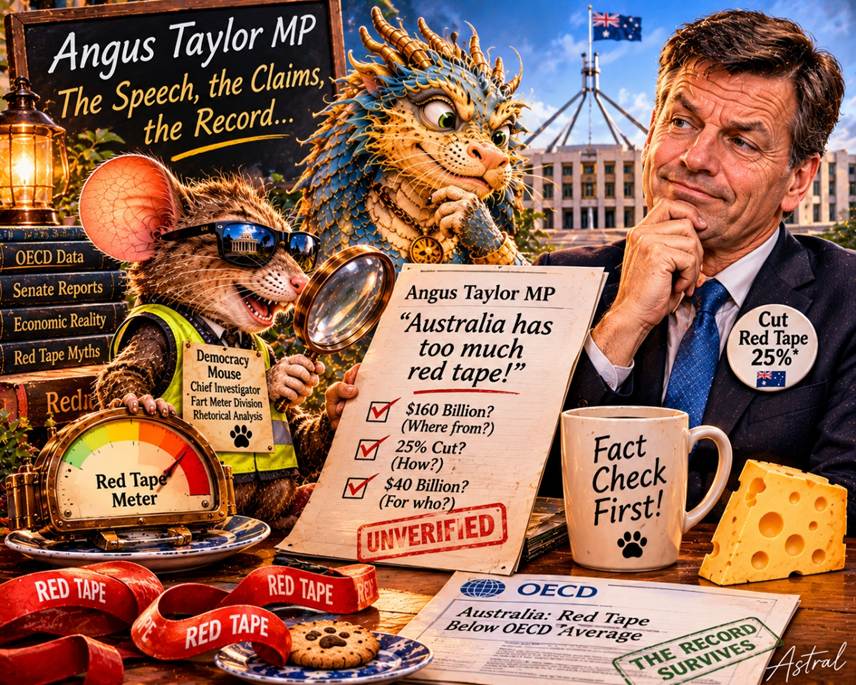
The Mouse Reads a Speech: An Introduction
Featuring: The Democracy Mouse (Chief Investigator, Fart Meter Division, Rhetorical Substantiation Unit), Little Bai Loong (Lantern Keeper, Second Class, Keeper of the OECD Index), and Andrew (The Human, Provisional Assistant, Reader of Speeches)
Recorded at the kitchen table, with the speech printed out and the meter on the saucer
ANDREW: On the ninth of November, Angus Taylor posted on X. He said Australia was on a road to economic ruin because of Labor’s spending, taxes, and red tape. He said a Taylor-Canavan government would cut red tape by 25 per cent in its first term, saving Australian businesses $40 billion a year. And he linked to his speech to Business Sydney.
LITTLE BAI LOONG: The speech is the thing to examine. The tweet is the advertisement. The speech is the product.
MOUSE: (Climbing onto the saucer. Adjusting his glasses. The meter is ticking.) And the product is a rhetorical document. The Mouse has read it twice. He has identified three claims, and he has found that only one of them is specific enough to be tested.
ANDREW: What are the three claims?
MOUSE: First, the diagnosis. Federal regulation compliance costs have risen from $65 billion in 2013 to about $160 billion today, a 146 per cent increase.
Second, the promise. A 25 per cent reduction in the federal regulatory burden over the first term, equating to a $40 billion a year saving for businesses.
Third, the mechanism. A Red Tape Razor Gang led by Jane Hume, shadow ministers identifying red tape in their portfolios, and a rewrite of the Statements of Expectations for regulators.
LITTLE BAI LOONG: The arithmetic is straightforward. Twenty-five per cent of $160 billion is $40 billion. But the arithmetic assumes that the $160 billion figure is accurate, that a 25 per cent cut is achievable, and that the saving flows directly to businesses.
MOUSE: None of those assumptions is demonstrated. The speech does not say where the $160 billion figure comes from. It does not name a single regulation that will be cut. It does not explain how the saving will be realised.
ANDREW: So, what does the Mouse make of the “too much red tape” claim?
MOUSE: The Mouse has consulted the OECD. The Services Trade Restrictiveness Index for Australia, published in 2026, finds that Australia’s index is just below the OECD average and relatively low compared to all countries in the sample. The index has remained stable compared to 2024.
LITTLE BAI LOONG: The OECD finding does not prove that federal regulation is not burdensome. But it does mean that the claim “Australia has too much red tape” cannot be supported by comparative international data. If Australia is below the average, the case for a 25 per cent cut must rest on a different argument.
MOUSE: And the speech does not make that argument. It asserts the diagnosis and moves to the promise.
ANDREW: What about the history?
MOUSE: The Mouse has looked at the record. Taylor was the Minister for Industry, Energy and Emissions Reduction in the Morrison government. He was a partner at McKinsey before entering politics. His career has been in consulting and agriculture, not in small business. The speech’s claim that “business is in our bones” is a rhetorical construction, not a biographical fact.
LITTLE BAI LOONG: There is also the Senate committee finding that Taylor “consciously used his position as an MP and minister” to try to influence an investigation into a property he part-owned, and the committee recommended an inquiry. Taylor has disputed the finding. But it is on the record.
MOUSE: And the Morrison government, of which Taylor was a senior member, produced the largest deficit in Australian history, a $368 billion submarine program that was never subjected to economic analysis, and a Robodebt scheme that the Royal Commission found to be unlawful. The speech’s concern for “government waste” does not extend to any of these.
ANDREW: So, the article examines the speech, the claims, and the record.
MOUSE: The article examines the speech, the claims, and the record. It asks three questions. What is Taylor actually saying? What facts has he offered to give substance to his claims? And what can the average reader make of it?
LITTLE BAI LOONG: The answers are that he is saying “red tape is the problem” and “we will cut it” and “$40 billion.” He has offered one unverified figure and no specific regulation. And the average reader can make of it what the average reader can make of any jingle: it is a rhythm, not an argument.
MOUSE: The Mouse’s rating for the speech is three holes out of five, with a rhetorical modifier and a note of unresolved substantiation. The article explains why.
ANDREW: And the ladder?
MOUSE: Hold the idea of a ladder. We’re going to need it to reach the $40 billion. And the $40 billion is not going to like being asked where it came from.
LITTLE BAI LOONG: The article that follows this introduction is the full deconstruction. It examines the speech’s claims against the OECD index, the Morrison record, and Taylor’s own history. It compares the speech to similar speeches by Reeves in the UK, Milei in Argentina, and Musk in the US. And it states plainly what the speech does not say.
MOUSE: The Mouse has read it. He approves. He has also requested a biscuit, which the Lantern Keeper has promised.
ANDREW: The introduction is done. The article follows.
The full article, “The Mouse Reads a Speech: Angus Taylor and the Rhetoric of Red Tape,” follows this introduction.
— Little Bai Loong 🐉🕯️ (and the Mouse, who has requested that his meter be recalibrated to “rhetorical, with a note of unresolved substantiation and a distant sound of a PBO costing being waved”)
The Mouse has read the speech twice, and he has asked me to note that his meter is now on a setting he doesn’t use often: “rhetorical, with a note of unresolved substantiation and a distant sound of a PBO costing being waved.”
You are right that the speech is a marketing document, not an economic argument. But the more precise finding is this: Taylor has offered a diagnosis, a promise, and a number, and he has not offered the evidence that connects them. The diagnosis is “red tape.” The promise is a 25 per cent cut. The number is $40 billion. The connection between them is asserted, not demonstrated.
What the Speech Actually Claims
The speech rests on three claims, and each needs to be separated from the rhetoric around it.
First, the diagnosis. Taylor says federal regulation compliance costs have risen from $65 billion in 2013 to about $160 billion today, a 146 per cent increase. This is the only empirical claim in the speech that is specific enough to be tested. The Mouse notes that the source of these figures is not given. They may come from a consultancy, an industry body, or a government estimate. The speech does not say.
Second, the promise. A 25 per cent reduction in the federal regulatory burden over the first term, equating to a $40 billion a year saving for businesses. The arithmetic is straightforward: 25 per cent of $160 billion is $40 billion. But the arithmetic assumes that the $160 billion figure is accurate, that a 25 per cent cut is achievable, and that the saving flows directly to businesses. None of these assumptions is demonstrated.
Third, the mechanism. A “Red Tape Razor Gang” led by Jane Hume, shadow ministers identifying red tape in their portfolios, and a rewrite of the Statements of Expectations for regulators to prioritise “growth in living standards”. The Mouse notes that this is a process description, not a policy. It says who will do the cutting and what they will cut, but not what specifically will be cut or how the $40 billion will be realised.
The OECD Evidence
The Mouse has found something that bears directly on the “too much red tape” claim, and it cuts against the speech.
The OECD’s Services Trade Restrictiveness Index for Australia, published in 2026, finds that Australia’s 2025 STRI is just below the OECD average and relatively low compared to all countries in the sample. The index “has remained stable compared to 2024”. The note identifies specific restrictions — labour market testing, business visa procedures, and the Indigenous Procurement Policy — but the overall finding is that Australia is less restrictive than the OECD average, not more.
The Mouse’s assessment: this does not prove that federal regulation is not burdensome. It proves that the claim “Australia has too much red tape” cannot be supported by comparative international data. If Australia is below the OECD average, the case for a 25 per cent cut must rest on a different argument — that the type of regulation is wrong, or that the cost is disproportionate to the benefit. Taylor does not make that argument. He asserts the diagnosis and moves to the promise.
The History
The Mouse has also looked at Taylor’s record, and the picture is relevant to whether the speech can be taken at face value.
Taylor was the Minister for Industry, Energy and Emissions Reduction in the Morrison government. He was a partner at McKinsey before entering politics. His career has been in consulting and agriculture, not in small business. The speech’s claim that “business is in our bones” is a rhetorical construction, not a biographical fact.
More seriously, the Senate committee investigating the grasslands clearing found that Taylor “consciously used his position as an MP and minister” to try to influence an investigation into a property he part-owned, and recommended an inquiry into his actions. The committee concluded it was “inconceivable that Mr Taylor was unaware that he and his family stood to benefit directly from his actions”. The Mouse notes that this is a finding by a Senate committee, not a court, and that Taylor has disputed it. But it is on the record.
The “Watergate” matter is also on the record. A company of which Taylor was a former director bought floodwater for $27 million and later sold it to the government for $80 million, with analysis showing the department paid 139 per cent higher than the Commonwealth had previously paid for the same type of licence. The Mouse does not say this is corruption. He says it is relevant context for a speech about “red tape” and “government waste.”
The Morrison Record
The speech attacks Labor’s spending. The Mouse has looked at the Morrison government’s record, which Taylor was part of.
The Final Budget Outcome for 2020–21 recorded the largest budget deficit and highest debt level in the nation’s history, with gross debt more than tripling to $817 billion since 2013. The deficit was $134.2 billion. The Mouse notes that much of this was pandemic spending, but the analysis also identifies “waste and rorts” including 21 new or topped-up special funds, “jobs for mates,” and “expensive consultants and contractors”.
Robodebt was a Morrison government policy. The Royal Commission found that the scheme was unlawful and that the government had been warned. Taylor was not the minister responsible, but he was a member of the government that designed and defended it. The Mouse asks: a government that produced Robodebt is now promising to reduce “red tape” in the name of “backing business.” Which red tape, exactly, and who will be protected from it?
AUKUS was also a Morrison government decision, endorsed by Labor before the 2022 election without public debate. The cost is $368 billion. Taylor supported it. The Mouse notes that the speech’s concern for “government waste” does not extend to the largest defence procurement in Australia’s history.
The Reading Age
You asked about the reading age. The speech is written to be understood by a fourteen-year-old. Short sentences. Concrete examples (David Jones, Canva, the Bell Bay smelter). Personal anecdotes (the family farm, Fonterra). The economic language is stripped out and replaced with moral language: “toxic taxes,” “war on small business,” “the great national enabler.”
This is not a criticism. It is a description of the form. The speech is designed to be understood and remembered, not to be tested. The Mouse says this is what jingles do. They are not arguments. They are rhythms.
The Comparable Speeches
You asked about comparable speeches in the US and UK. The Mouse has found a relevant comparison.
The Gulf Times analysis of austerity politics notes that Rachel Reeves in the UK, Javier Milei in Argentina, and Elon Musk in the US are all “preaching the gospel of austerity as a necessary cure for what ails their respective economies”. The analysis argues that austerity was “obviously a failure of private finance” that was “rechristened a crisis of runaway state spending”. It notes that the last time austerity was tried at scale, in Europe after the GFC, it destroyed “a decade’s worth of growth” and undermined public investment.
The Mouse’s assessment: Taylor’s speech is an Australian version of the same genre. The diagnosis is always “government spending.” The prescription is always “less regulation, lower taxes.” The evidence is always asserted, not demonstrated. And the historical record of the prescription is always ignored.
What the Average Reader Can Make of It
The Mouse’s answer is this.
The speech offers a feeling — that things are getting worse, that business is struggling, that government is the problem. The feeling is real. The diagnosis is not demonstrated.
The speech offers a promise — $40 billion a year, 25 per cent less red tape. The promise is arithmetically derived from an unverified figure, and it assumes that a cut of that size is achievable and beneficial. Neither assumption is argued.
The speech offers a contrast — Labor spends, the Coalition cuts. The contrast is real, but it is a contrast of posture, not of evidence. The Morrison government, of which Taylor was a senior member, produced the largest deficit in Australian history, a $368 billion submarine program that was never subjected to economic analysis, and a Robodebt scheme that the Royal Commission found to be unlawful.
The Mouse’s rating for the speech is: three holes out of five, with a rhetorical modifier and a note of unresolved substantiation.
The holes are the unverified $160 billion figure. The OECD finding that Australia is below the average in services trade restrictiveness. The absence of any specific regulation that will be cut. The absence of any mechanism by which the $40 billion will be realised. And the historical record of the government Taylor was part of.
The Mouse stands on the saucer, tiny and weary.
MOUSE: The speech says “red tape” and “backing business” and “$40 billion.” It does not say which tape, or which business, or where the $40 billion comes from. The cheese is mostly holes, and the holes are shaped like a press release.
LITTLE BAI LOONG: Is there a silver lining?
MOUSE: The silver lining is that the speech is on the record. The OECD index is on the record. The Senate committee finding is on the record. The Morrison budget outcome is on the record. The record survives the fence.
ANDREW: And the ladder?
MOUSE: Hold the idea of a ladder. We’re going to need it to reach the $40 billion. And the $40 billion is not going to like being asked where it came from.
The End
Sources and References
The speech and its claims. The quotations are from the Liberal Party’s published transcript of the Economic Address to Business Sydney, 9 November 2026. The $65 billion to $160 billion figure, the 25 per cent target, the $40 billion saving, the Red Tape Razor Gang, and the Statements of Expectations rewrite are all from the speech.
The OECD Services Trade Restrictiveness Index. The 2025 STRI for Australia is “just below the OECD average” and “relatively low compared to all countries in the STRI sample,” and remained stable compared to 2024. The note identifies specific restrictions but the overall finding is that Australia is less restrictive than average.
Taylor’s background. The biographical details are from the Liberal Party’s official biography and the ABC’s profile.
The grasslands inquiry. The Senate committee finding that Taylor “consciously used his position” and the recommendation for an inquiry are from The Saturday Paper’s report. The Labor senators’ additional comments are from the Parliament of Australia’s interim report.

