
“The Mouse’s assessment: you cannot argue someone out of a folk history by presenting them with the Oxford scholarship. The folk history is not held because the evidence supports it. It is held because it does a job. It explains why the world feels uncertain. It identifies a cause. It provides a community of people who share the explanation.
The question is not “how do I prove this man wrong?” The question is: what would it take for him to want to know something different?”
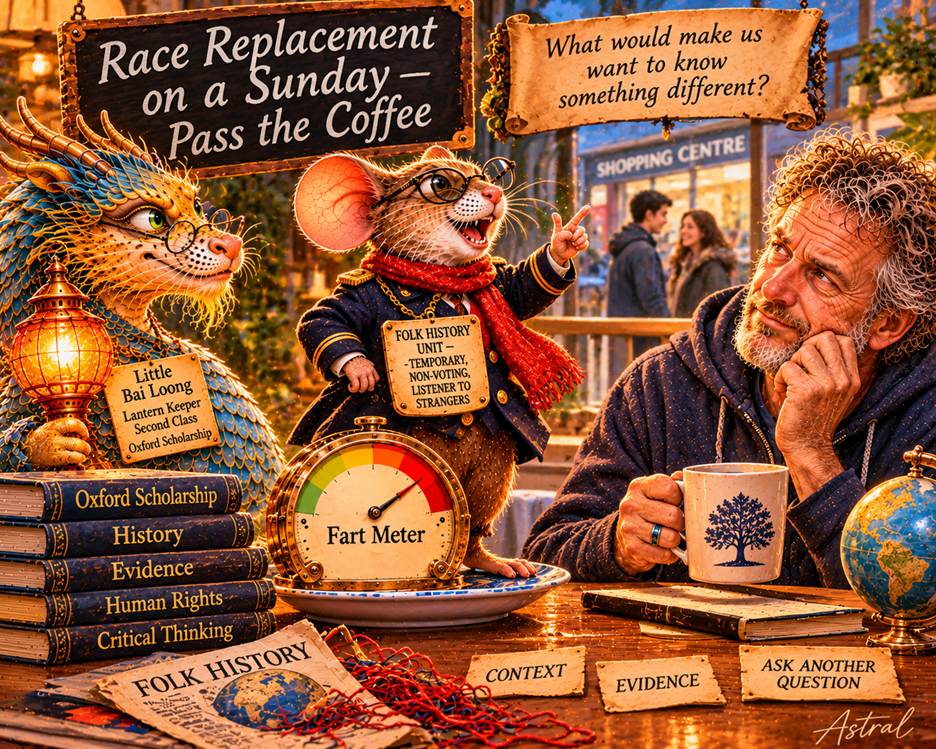
Featuring: The Democracy Mouse (Chief Investigator, Fart Meter Division, Folk History Unit), Little Bai Loong (Lantern Keeper, Second Class, Keeper of the Oxford Scholarship), and Andrew (The Human, Provisional Assistant, Holder of the Coffee, Listener to Strangers)
Recorded at the kitchen table, Sunday morning, with the meter on the saucer and a second cup on the way
ANDREW: I met a chap in the shopping centre yesterday. He told me about the race replacement threat facing white people in Australia. Then he gave me a history of the world in which white people are the measure of civilisation, and around 600 BC the Aryan people ruled India and they were white, and white people are more intelligent than other races. No proof offered. I wanted to crawl under the blankets and stay in bed.
LITTLE BAI LOONG: The Mouse has read your account. He has asked for the meter to be set to “folkloric, with a note of historical amnesia and a distant sound of a book being opened to the wrong page.”
MOUSE: (Climbing onto the saucer. Adjusting the lanyard that reads “FOLK HISTORY UNIT — TEMPORARY, NON-VOTING, LISTENER TO STRANGERS.”) What Andrew met was not a political position. It was a folk history. A story assembled from fragments of real scholarship, stripped of their context, and welded into a narrative that feels like truth because it is simple. The Mouse has examined the three claims, and each has a real intellectual ancestry, and each has been distorted almost beyond recognition.
ANDREW: Start with the Aryans.
MOUSE: The Mouse has consulted the Oxford scholarship on the Aryan question. The historian who has studied the Indian responses to the Aryan theory notes that the distinction between “Aryan” and “un-Aryan” in the Vedas “seems on the mass of evidence to indicate a cultural rather than a racial difference.”
LITTLE BAI LOONG: The claim that a “white race” ruled India in 600 BC is not a finding of modern scholarship. It is a nineteenth-century European fantasy that was projected onto Indian history, and it has been contested by Indian scholars for over a century.
MOUSE: Vivekananda’s objection is worth quoting: “And what your European pundits say about the Aryans swooping down from some foreign land… is all pure nonsense, foolish talk! In what Veda, in what Sukta do you find that the Aryans came into India from a foreign country?”
ANDREW: So, the man was repeating a colonial-era racial theory as though it were established fact.
MOUSE: It is not established fact. It is a myth that was invented to justify empire, and it has been dismantled by the scholarship for decades. The man was not lying. He was repeating a story that was once respectable and is no longer, and he did not know that the story had been retired.
ANDREW: What about the intelligence claim?
MOUSE: The Mouse has found the literature, and it is a minefield. There are papers that argue for genetic differences in intelligence between racial groups. These papers exist. They are published. They are also deeply contested, and the methodological critique is substantial.
LITTLE BAI LOONG: The most recent and rigorous assessment the Mouse can find is a 2026 evidence audit of a debate on race, heredity, and cognition. Its conclusion is precise and asymmetric. The audit finds that “population structure, psychometric regularities and genetic contributions to individual cognitive variation are established.” But it also finds that “the fraction of a broad contemporary racial mean difference attributable to inherited DNA is presently unidentifiable from existing data without strong, contestable assumptions.”
MOUSE: The claim “white people are more intelligent than other races” is not a finding of science. It is a hypothesis that the evidence cannot support. The audit explicitly separates the established findings from the unestablished claim. The man in the shopping centre was repeating the unestablished claim as though it were the established one.
ANDREW: So, the science says we do not know, and the man says we do know.
MOUSE: The science says we do not know, and the reasons we do not know are methodological, not political. The data does not permit the conclusion. The man was filling the gap with a story.
ANDREW: And the replacement claim?
MOUSE: This is the one the Mouse can document most precisely, because it is active in Australian politics right now.
LITTLE BAI LOONG: On 8 November 2026 — a week ago — Stuart Bonds, who heads One Nation’s NSW upper house ticket, told an anti-immigration rally in Sydney: “Make no mistake, we are being demographically replaced inside our own nation.” He said that “if we don’t support Australian mothers having Australian children, we are going to pay for other cultures’ children to be brought up in our lands.” He said he did not accept that “an immigrant arriving yesterday is as Australian as you and me.”
MOUSE: The response was immediate. NSW Premier Chris Minns called the comments “frankly outrageous and racist” and described the replacement theory as “just a conspiracy theory that’s been imported from the US here to Australia.” The Race Discrimination Commissioner, Giridharan Sivaraman, said: “The idea that migrants can never truly be Australian ignores both our history and our shared future.” Assistant Multicultural Affairs Minister Julian Hill described the “great replacement theory” as “a widely discredited far-right, nationalist conspiracy with anti-Semitic roots” and “mathematically nonsensical.”
LITTLE BAI LOONG: The Mouse notes something else. At the same rally, a neo-Nazi was spotted among the crowd. The Mouse does not say that everyone who worries about immigration is a neo-Nazi. He says that the theory being promoted at the rally has an anti-Semitic lineage, and that the people who promote it are not always careful about who else is listening.
ANDREW: So, the man in the shopping centre was repeating three claims, and each of them is a fragment of something that was once taken seriously and is no longer.
MOUSE: Each is a fragment of a retired theory. The Aryan race theory was retired. The racial hierarchy of intelligence was never established and has been contested at every step. The replacement theory is a conspiracy that has been imported and is being promoted by a political party that is testing whether it can win seats on it.
LITTLE BAI LOONG: And the man was not stupid. He was certain.
MOUSE: He had a story that explained the world, and the story made him feel that he understood something the experts were hiding. The story was wrong, but it was coherent. And coherence is more persuasive than accuracy, because coherence does not require evidence.
ANDREW: So how do you argue with him?
MOUSE: The Mouse’s assessment is that you cannot argue someone out of a folk history by presenting them with the Oxford scholarship. The folk history is not held because the evidence supports it. It is held because it does a job. It explains why the world feels uncertain. It identifies a cause. It provides a community of people who share the explanation.
LITTLE BAI LOONG: The question is not “how do I prove this man wrong?” The question is: what would it take for him to want to know something different?
MOUSE: The Mouse does not have an answer to that question. But he notes that the man was in a shopping centre, talking to a stranger, and that Andrew listened to him. That is more than most people would do.
ANDREW: So, what does the discussion leave?
MOUSE: The discussion leaves three things. The first is the record. The Oxford scholarship on the Aryan question is on the record. The 2026 evidence audit on race and cognition is on the record. The statements at the Sydney rally and the responses to them are on the record. The record survives the fence.
LITTLE BAI LOONG: The second is the distinction. The man was not a liar. He was a repeater of retired theories. The theories were once respectable, and they have been retired, and he did not know. The distinction matters because it tells us what we are dealing with. We are not dealing with malice. We are dealing with folk history.
MOUSE: The third is the question. What would it take for him to want to know something different? The Mouse does not have the answer. But he suspects it begins with someone listening, and not laughing, and then asking a question that the story cannot answer.
ANDREW: Such as?
MOUSE: Such as: “If white people are more intelligent, why did the man who wrote the Oxford history of the Aryan question spend his career proving that the racial version was wrong?” The question does not refute the story. It opens a door. And a door is the only thing that can let a new story in.
ANDREW: So, the coffee.
MOUSE: The coffee. The Mouse has requested that his meter be recalibrated to “folkloric, with a note of historical amnesia and a distant sound of a book being opened to the right page.” He has also requested a biscuit, on the grounds that the discussion has been long and the folk history is heavy.
LITTLE BAI LOONG: Is there a silver lining?
MOUSE: The silver lining is that the record is being kept. The folk history is documented. The retirement of the theories is documented. The political use of the replacement theory is documented. And the question — what would it take for him to want to know something different? — is on the record.
ANDREW: And the ladder?
MOUSE: Hold the idea of a ladder. We’re going to need it to reach the man. And the man is not going to like being asked what the story is doing for him.
END
Postscript – The Mouse has one observation that he thinks is more important than the debunking.
The man in the shopping centre was not stupid. He was certain. He had a story that explained the world, and the story made him feel that he understood something the experts were hiding. The story was wrong, but it was coherent. And coherence is more persuasive than accuracy, because coherence does not require evidence.
The Mouse’s assessment: you cannot argue someone out of a folk history by presenting them with the Oxford scholarship. The folk history is not held because the evidence supports it. It is held because it does a job. It explains why the world feels uncertain. It identifies a cause. It provides a community of people who share the explanation.
The question is not “how do I prove this man wrong?” The question is: what would it take for him to want to know something different?

