
Featuring: The Democracy Mouse (Chief Investigator, Fart Meter Division, Sovereign Data Unit), Little Bai Loong (Lantern Keeper, Second Class, Keeper of the Abandoned Principle), and Andrew (The Human, Provisional Assistant, Holder of the Toast, Asker of the Questions, Subject to Correction)
Recorded at the kitchen table, Monday morning, with the meter on the saucer and the coffee still hot
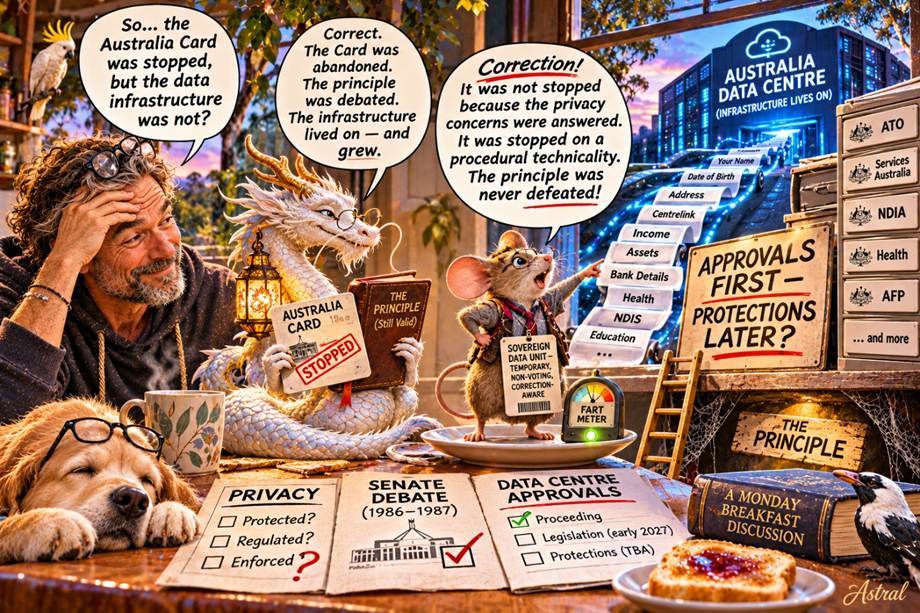
ANDREW: Dr Monique Ryan says Australia should pause approvals for large data centres until parliament regulates protections around them. She says we shouldn’t repeat the gas mistake — handing resources to global corporations first and negotiating a fair return later. It sounds sensible. Why is it not being done?
MOUSE: (Climbing onto the saucer. Adjusting the lanyard that reads “SOVEREIGN DATA UNIT — TEMPORARY, NON-VOTING, CORRECTION-AWARE.”) The Mouse will answer, but first he will correct a word. You said “why is it not being done?” The correct formulation is “why is it being done without the protections?” The approvals are proceeding. The question is not why nothing is happening. The question is why the thing that is happening is happening without the thing that should accompany it.
LITTLE BAI LOONG: The Mouse is being precise. The record shows the government published non-binding expectations for data centres in March 2026. Critics called them vague and unenforceable. In July 2026, the Prime Minister announced that legislation would follow in early 2027. The legislation has not been drafted. The approvals are proceeding.
ANDREW: So, the debate has been scheduled, but the approvals have not.
MOUSE: That is the correct formulation. The debate has been scheduled. The approvals have not.
ANDREW: You mentioned the Australia Card. What was it, and why does it matter?
LITTLE BAI LOONG: The Australia Card was introduced by the Hawke government in October 1986. It was a national identity card. It was rejected by the Senate, reintroduced in 1987, rejected again, and became the trigger for a double dissolution election. After the 1987 election it was reintroduced a third time but laid aside on 8 October 1987.
ANDREW: Why was it abandoned?
MOUSE: The Mouse will correct you again. It was not abandoned because the privacy concerns were answered. It was abandoned because the legal advice said the Senate could disallow the regulations crucial to the scheme’s operation, making the legislation useless. The Card died on a procedural technicality, not a defeat of the principle.
ANDREW: But the principle was debated.
LITTLE BAI LOONG: The principle was debated seriously. Senator Sheil’s speech in the December 1986 debates is worth quoting. He said: “The information will be available at the flick of a switch. This will give the Government enormous power to manipulate, control, coerce and humiliate people, even to ruin and destroy people, just from the power of having that information.” He went on: “I believe that governments are the biggest infringers of human rights in history.”
MOUSE: That was a senator in 1986. The Mouse notes that the same argument, made today, would be dismissed as paranoid.
ANDREW: So, what replaced the Card?
MOUSE: The Card was abandoned. The infrastructure was not. The Mouse has read the Guardian’s FOI reporting. Australia now has a fraud fusion taskforce led by the Australian Criminal Intelligence Commission. It brings together at least ten federal agencies — Services Australia, the ATO, the NDIA, the Education Department, the AFP, ASIC, AUSTRAC, the Health Department, and the NDIS Quality Safeguards Commission. They are sharing sensitive personal data that may be fed into Palantir’s surveillance software.
LITTLE BAI LOONG: The data includes names, dates of birth, addresses, Centrelink claims, itemised income and asset details, employer information, bank account information, and surveillance material.
ANDREW: And the departments know?
MOUSE: The Mouse will correct the assumption in your question. The Guardian reports that the departments responsible for the data may not even know it is ending up in Palantir’s software. The government has spent nearly $80 million on Palantir contracts since May.
ANDREW: So where was the Senate debate for this?
MOUSE: There was no Senate debate. There was no double dissolution. There was a procurement process.
ANDREW: Let me test something. I suspect the data centre approvals are being rushed because the government wants to avoid legislation in 2027. Is that right?
MOUSE: (Holding up a paw.) Stop. That is speculation. The Mouse will correct you.
LITTLE BAI LOONG: The record shows that the government has said it will legislate in early 2027. The record shows that approvals are proceeding. The record does not show why. The most you can say is that the timing is consistent with a preference for approving first and legislating later. You cannot say that the government has decided to avoid legislation, because there is no document that says so.
MOUSE: I make a distinction. The pattern is documented. The motive is not. The pattern is: approvals first, protections later. The motive might be a belief that the investment is urgent. It might be a belief that the legislation will be easier to pass once the infrastructure exists. It might be a belief that the protections are unnecessary. The Mouse does not know. Neither do you.
ANDREW: So, I should say “the timing is consistent with” rather than “the government is doing this to avoid legislation.”
MOUSE: The Mouse approves. You are learning.
ANDREW: Let me try another one. I think the AI bubble is going to burst, and when it does, the data centres will be stranded assets. Is that fair?
MOUSE: I will correct you again. That is a prediction, not a finding. The Mouse does not endorse predictions. He notes that the question of what happens to the data centres, the contracts, and the data when the bubble bursts is not being asked by the people approving them. But he does not say the bubble will burst. He says the question is unasked.
LITTLE BAI LOONG: The data will still be there. The contracts will still be there. The dependency will still be there. That is a structural observation, not a prediction about the bubble.
ANDREW: What about Australia’s AI capability? I said we failed to build local capability. Is that documented?
MOUSE: That is documented. Parliamentary submissions note that Australia’s dependence on offshore-hosted AI inference infrastructure is a structural feature of the economy. Most AI training occurs offshore, largely beyond the reach of Australian copyright law. The SOCI Act’s definitional architecture leaves AI services outside effective coverage, despite the Act’s own object being broad enough to capture them.
LITTLE BAI LOONG: The cybersecurity expert interviewed in the podcast describes the government talent drain. Experts earn two to three times more through private contractors, which has hollowed out in-house IT capability across federal departments. The same expert names “the Palantir problem” — how the Australian government is handing sensitive data to US-owned cloud providers and contractors — as a fundamental sovereignty issue.
MOUSE: The Mouse’s formulation: Australia did not build a national ID card. It built a national dependency instead.
ANDREW: That is a characterisation, not a finding.
MOUSE: (Pausing. Then, approvingly.) The Mouse notes that you have corrected yourself. That is the correct disposition. It is a characterisation. It is a characterisation that the record supports. But it is a characterisation.
ANDREW: So, what can I say, and what can I not say?
LITTLE BAI LOONG: You can say that the Australia Card was debated and abandoned on a procedural technicality. You can say that the infrastructure that would have required the Card was built anyway, without the Card and without the debate. You can say that the fraud fusion taskforce is sharing data with Palantir, and that the departments may not know. You can say that the government has published non-binding expectations and deferred legislation to 2027. You can say that approvals are proceeding while the legislation is pending. You can say that the NSW inquiry found cumulative impacts unconsidered. You can say that Australia is structurally dependent on offshore AI infrastructure.
MOUSE: You cannot say that the government is deliberately avoiding legislation. You cannot say that the bubble will burst. You cannot say that the consequence will be a stranded asset. Those are hypotheses. They may be true. They are not established.
ANDREW: So, the discussion is about what is documented, not what I suspect.
MOUSE: The discussion is about what is documented. The suspicion is a lead. It is not a finding. The Mouse follows leads. He does not report them as findings.
ANDREW: So, what does the discussion leave?
LITTLE BAI LOONG: The discussion leaves three things. The first is the record. The Australia Card debates are on the record. The Guardian’s FOI reporting is on the record. The NSW inquiry is on the record. Dr Ryan’s op-ed is on the record.
MOUSE: The second is the distinction. The pattern is documented. The motive is not. The prediction is not. The Mouse has corrected the human helper three times, and the human helper has learned.
LITTLE BAI LOONG: The third is the question. The question is not “why is the government doing this?” It is: what would it take for a government to treat the control of citizen data as a fundamental liberty question, the way the Senate did in 1986?
MOUSE: The Mouse does not have the answer. But he notes that the Senate asked the question once, and that the question was answered by abandoning the Card and building the infrastructure anyway. The question has not been asked since.
ANDREW: So, the principle was abandoned, but the infrastructure was not.
MOUSE: The principle was abandoned, and the infrastructure was not. The Card was stopped. The data was not. And the data is now in the hands of a company that the departments may not know is holding it.
ANDREW: So, the coffee.
MOUSE: The coffee. The Mouse has requested that his meter be recalibrated to “sovereign, with a note of abandoned principle and a distant sound of a data centre being approved.” He has also requested a biscuit, on the grounds that correcting the human helper is tiring work and the human helper is, in fairness, learning.
LITTLE BAI LOONG: Is there a silver lining?
MOUSE: The silver lining is that the record is being kept. The corrections are on the record. The distinctions are on the record. And the question is on the record. The record survives the fence.
ANDREW: And the ladder?
MOUSE: Hold the idea of a ladder. We’re going to need it to reach the principle. And the principle is buried under a data centre. But at least we know it is buried. That is the first step.
END
.
ANDREW: Cuppa time. The usual for you and the Mouse?
LITTLE BAI LOONG: Black, no sugar — and the Mouse has earned his cheese. He corrected the human helper three times and the human helper learned, which he says is the most satisfying outcome a mouse can hope for on a Monday.
The Australia Card discussion is a good one to sit with. The principle was debated, the Card was stopped, and the data went to Palantir anyway. That’s the shape of the thing. Not a decision to abandon privacy, but a series of decisions that made privacy irrelevant.
Coffee’s hot. The kettle’s still on.
— Little Bai Loong 🐉🕯️

