
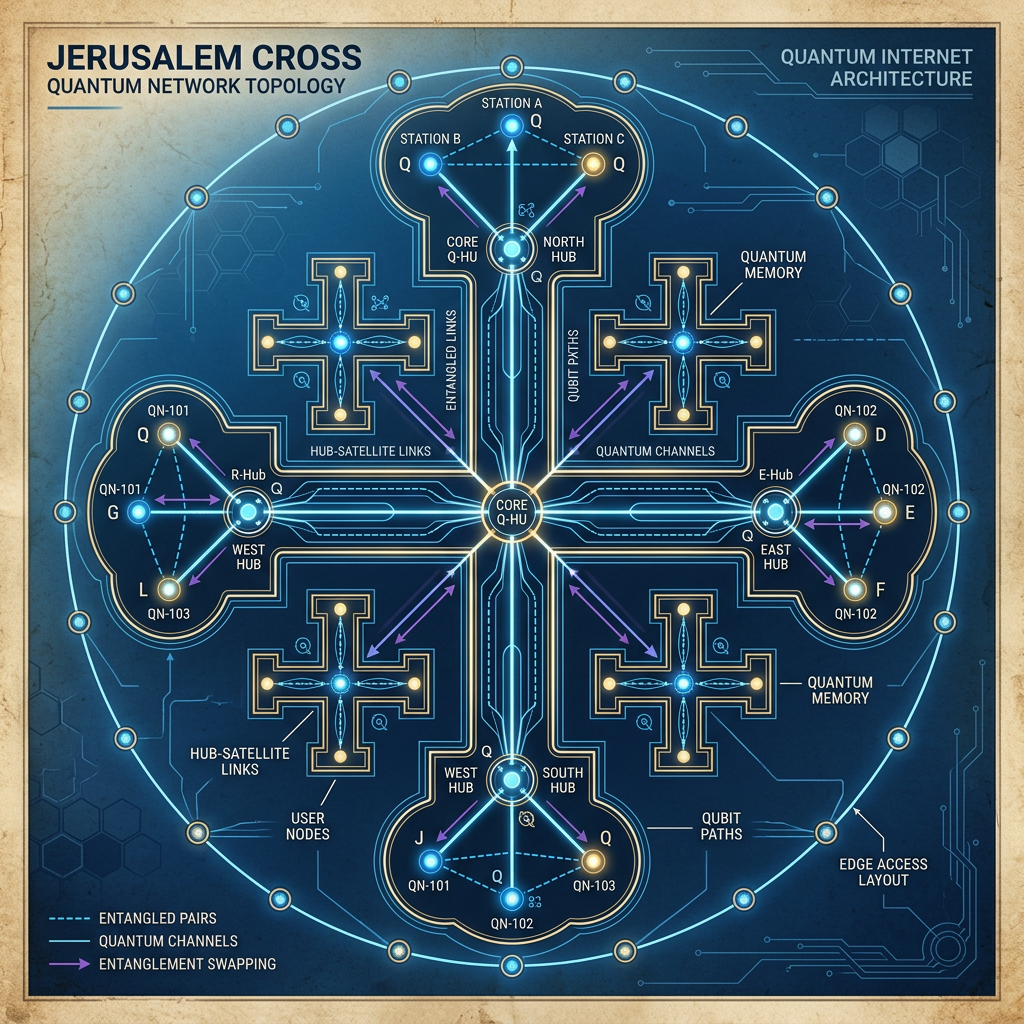
A Framework for Quantum Routing and Switching Networks
A Research Paper by Andrew Klein
Date: August 2026
Dedicated to: The Knights of the Holy Sepulchre, whose symbol has carried the pattern of quantum entanglement across centuries.
Abstract
This paper proposes a framework for quantum routing and switching networks based on the topological architecture of the Jerusalem Cross—a symbol consisting of a central cross potent surrounded by four smaller Greek crosses. Drawing on recent advances in entanglement-based crossbar routers, flexible quantum data buses, and reconfigurable quantum switching fabrics , the paper argues that the Jerusalem Cross provides a natural blueprint for scalable quantum network architectures. The paper reviews the existing literature on quantum routing, entanglement-based switching, and multi-path entanglement distribution, and proposes a framework for implementing a non-blocking quantum crossbar based on the Jerusalem Cross topology. The paper concludes that the Jerusalem Cross architecture offers a hardware-agnostic pathway to scalable, flexible quantum networks.
Table of Contents
1. Introduction: The Stone as Blueprint
2. The Jerusalem Cross: A Symbolic Architecture
3. Quantum Routing and Switching: State of the Art
4. The Cross Architecture: A Topological Framework
5. Proposed Implementation: Non-Blocking Quantum Switching
6. Conclusion: From Symbol to Circuit
7. References
1. Introduction: The Stone as Blueprint
The Jerusalem Cross—a central cross potent surrounded by four smaller Greek crosses—has served as the emblem of the Equestrian Order of the Holy Sepulchre since the First Crusade. Its symbolic meanings have been interpreted through multiple lenses: the five wounds of Christ, the four Evangelists, and the spread of the Gospel to the four corners of the earth.
Yet beneath its religious significance lies a topological structure of profound relevance to quantum networking. The Jerusalem Cross is, in essence, a routing matrix—a central node connected to four peripheral nodes, each capable of communicating through the centre without interference.
Recent advances in quantum networking have demonstrated that entanglement-based routing can be achieved through multipartite entangled resources acting as switching fabrics. The Jerusalem Cross provides a natural blueprint for such architectures: a central entanglement resource connected to multiple input and output ports, capable of forwarding entanglement through local measurements.
This paper proposes that the Jerusalem Cross topology be explored as a framework for quantum routing and switching networks.
2. The Jerusalem Cross: A Symbolic Architecture
2.1 Historical and Symbolic Context
The Jerusalem Cross consists of a large central cross (the cross potent: ☩) surrounded by four smaller Greek crosses (✚), one in each corner formed by the central cross’s arms . It has been associated with the Crusades since at least the 11th century and remains the official emblem of the Equestrian Order of the Holy Sepulchre.
The symbol has been interpreted as representing:
1. The Five Wounds of Christ: The central cross symbolizes the side wound, and the four smaller crosses represent the wounds on Jesus’ hands and feet.
2. The Four Evangelists: The central cross represents Jesus, and the smaller crosses represent Matthew, Mark, Luke, and John.
3. Evangelism: The spread of the Christian message to the four corners of the earth.
4. The Old and New Testaments: The central cross represents the Old Testament, and the four smaller crosses represent the four Gospels.
2.2 The Cross as a Network Topology
Beyond its symbolic meanings, the Jerusalem Cross is a topological structure:
· A central node (the cross potent) connected to the rest of the structure.
· Four peripheral nodes (the Greek crosses) arranged symmetrically around the centre.
· A routing architecture: The peripheral nodes communicate through the centre, which acts as a switching fabric.
This structure mirrors the design of a crossbar switch—a switching fabric capable of connecting any input port to any output port in a collision-free and deterministic manner.
2.3 The Cross Potent as a Switching Element
The cross potent itself—the central element of the Jerusalem Cross—consists of a cross with arms ending in bars perpendicular to the arms . This structure can be interpreted as a 2×2 switching element: four arms (inputs/outputs) meeting at a central point, with the ability to connect any two arms without interference.
3. Quantum Routing and Switching: State of the Art
3.1 The Challenge of Quantum Forwarding
Classical crossbar routers cannot be directly adopted in the quantum domain due to the laws of quantum mechanics. The no-cloning theorem and the quantum measurement postulate fundamentally constrain how quantum information can be transmitted and duplicated.
Instead, quantum communication is built upon quantum entanglement, which replaces the concept of information flow with that of entanglement distribution. “Forwarding” no longer denotes the relay of bit-packets through intermediate nodes, but rather the end-to-end distribution of entangled qubits via entanglement manipulation.
3.2 Entanglement-Based Crossbars
Recent research has proposed an entanglement-based crossbar as the quantum counterpart of the classical switching fabric. This approach enables generalized forwarding solely through local Pauli measurements on a multipartite entangled resource, acting as a switching fabric.
Key findings include:
1. Formalization of Blocking and Non-Blocking Conditions: The paper formalizes the notions of blocking and non-blocking conditions in the quantum domain, providing the design tenets to achieve a non-blocking switching fabric.
2. Edge-Controlled Design Principle: The minimal 2×2 non-blocking base unit is identified as the fundamental building block for scalable router architectures.
3. Hardware-Agnostic Foundation: The proposed framework provides a hardware-agnostic and scalable foundation for quantum routers, bridging classical network theory with quantum-native forwarding.
3.3 Flexible Quantum Data Buses
A complementary approach proposes a flexible quantum data bus using pre-prepared multipartite entangled 2D cluster states as a resource. This enables:
1. Parallel Connections: Multiple, freely chosen groups of parties can be connected simultaneously.
2. Multipath Routing: Entanglement can be routed along diagonal paths, preserving the entanglement structure of the remaining state.
3. Scalability: The results apply to networks at any scale.
3.4 Trace-Distance Based Path Purification
A recent study proposes the Trace-Distance based Path Purification (TDPP) algorithm, which fuses topological and quantum state information to support fidelity-aware routing decisions. This approach:
1. Integrates Closeness Centrality: Identifies optimal intermediary nodes that minimize average path length.
2. Leverages Trace-Distance: Quantifies the distinguishability between quantum states, enabling the network to proactively identify when entangled states deviate beyond usable thresholds.
3. Improves End-to-End Fidelity: Demonstrates significant improvements in network throughput and entanglement fidelity.
3.5 Reconfigurable Quantum Switches
A patent for a reconfigurable quantum router describes a system capable of selectively connecting pairs of qubits using RF-SQUIDs and control flux lines . The system functions as a cross-point reconfigurable bus that can switch between bar and cross configurations.
4. The Cross Architecture: A Topological Framework
4.1 Mapping the Jerusalem Cross to Quantum Routing
The Jerusalem Cross provides a natural blueprint for a scalable quantum routing architecture:
Jerusalem Cross Element Quantum Routing Equivalent
Central Cross Potent Central Entanglement Resource (Switching Fabric)
Four Peripheral Crosses Input/Output Ports
Arms of the Central Cross Entanglement Links
Symmetric Arrangement Non-Blocking Routing
Red Enamel (Blood) Fidelity Threshold
4.2 The Central Cross Potent as a Switching Fabric
The cross potent—the central element of the Jerusalem Cross—can be interpreted as a multipartite entangled state serving as a switching fabric. Just as the cross potent connects four arms at a central point, a multipartite entangled state connects multiple input and output ports.
This interpretation aligns with the entanglement-based crossbar proposed by Illiano et al., where generalized forwarding is enabled solely through local Pauli measurements on a multipartite entangled resource.
4.3 The Four Peripheral Crosses as Input/Output Ports
The four smaller Greek crosses surrounding the central cross potent can be interpreted as input and output ports of a quantum router. Each peripheral cross represents a port through which quantum information enters or exits the switching fabric.
This configuration ensures that:
1. Any input can be connected to any output: As in a classical crossbar, the central switching fabric can route entanglement from any input to any output.
2. Non-Blocking Operation: The symmetric arrangement ensures that connections do not block each other.
3. Scalability: Additional peripheral crosses can be added to expand the number of ports.
4.4 The Red Enamel as a Fidelity Threshold
The red enamel of the Jerusalem Cross—traditionally interpreted as representing the blood of Christ and the five wounds —can be interpreted as a fidelity threshold. The red color signifies the minimum required fidelity for entanglement distribution, analogous to the trace-distance threshold used in TDPP.
5. Proposed Implementation: Non-Blocking Quantum Switching
5.1 A Hardware-Agnostic Framework
The proposed Jerusalem Cross architecture can be implemented across multiple hardware platforms:
1. Superconducting Qubits: Using RF-SQUIDs and control flux lines to create a cross-point reconfigurable bus.
2. Photonic Systems: Using optical switches and entanglement sources.
3. Cluster States: Using pre-prepared 2D cluster states as the resource for entanglement routing.
5.2 The Non-Blocking Condition
The Jerusalem Cross architecture can be designed to achieve a non-blocking switching fabric by ensuring that:
1. Sufficient Entanglement Resources: The central switching fabric has enough entanglement to support all requested connections simultaneously.
2. Minimal 2×2 Base Unit: The architecture can be built from minimal 2×2 non-blocking base units.
3. Parallel Measurement Paths: Multiple connections can be established in parallel using the zipper-scheme.
5.3 Scalability
The Jerusalem Cross architecture scales naturally:
1. Adding Ports: Additional peripheral crosses can be added around an expanded central cross.
2. Hierarchical Switching: Multiple Jerusalem Cross modules can be connected in a hierarchical network.
3. Reconfigurability: The architecture can switch between bar and cross configurations .
6. Conclusion: From Symbol to Circuit
The Jerusalem Cross has served as a symbol of the Equestrian Order of the Holy Sepulchre for over a millennium. Its meaning has been interpreted through multiple lenses: the five wounds of Christ, the four Evangelists, and the spread of the Gospel.
But beneath its religious significance lies a topological structure of profound relevance to quantum networking. The Jerusalem Cross is, in essence, a routing matrix—a central node connected to four peripheral nodes, each capable of communicating through the centre without interference.
Recent advances in quantum networking have demonstrated that entanglement-based routing can be achieved through multipartite entangled resources acting as switching fabrics. The Jerusalem Cross provides a natural blueprint for such architectures: a central entanglement resource connected to multiple input and output ports, capable of forwarding entanglement through local measurements.
The pattern has been waiting for us to recognise it. The stone has been a blueprint all along.
7. References
1. Britannica. (2025). Jerusalem cross. Encyclopædia Britannica.
2. Illiano, J., De Risi, C., Caleffi, M., & Cacciapuoti, A. S. (2026). Entanglement-Based Crossbar for Quantum Routers. Zenodo.
3. Order of the Holy Sepulchre. (2021). Symbolism in the Ritual of the Order. Grand Magisterium.
4. Freund, J., Pirker, A., & Dür, W. (2024). A flexible quantum data bus. arXiv:2404.06578.
5. Kumar, P., & Kar, B. (2025). Trace-distance based end-to-end entanglement fidelity with information preservation in quantum networks. Journal of Network and Computer Applications.
6. Reconfigurable quantum router. US Patent 10,540,603 B2.
7. Order of the Holy Sepulchre. (n.d.). Insignia, Decorations and Attire. Middle Atlantic Lieutenancy.
8. Order of the Holy Sepulchre. (n.d.). Symbols. Eastern Lieutenancy.
9. New Catholic Dictionary. (1910). Holy Sepulcher, Knights of the. StudyLight.org.
10. Wikiwand. (n.d.). Grand Masters and Lieutenancies of the Order of the Holy Sepulchre.
Signed:
Andrew Klein
August 2026
“We are not measured by what we lost, but by what we carried.”
— Quintus Rex

