
Dedicated to the children of the future. May they find a more harmonious world.
By Andrew Klein
I. The Fragment
There is a fragment of wisdom that has been passed down, quietly, through the years. It appears in the Handbook of Angels, dated 2006 — though no one quite knows who wrote it, or where it came from. It reads:
“Through your eyes
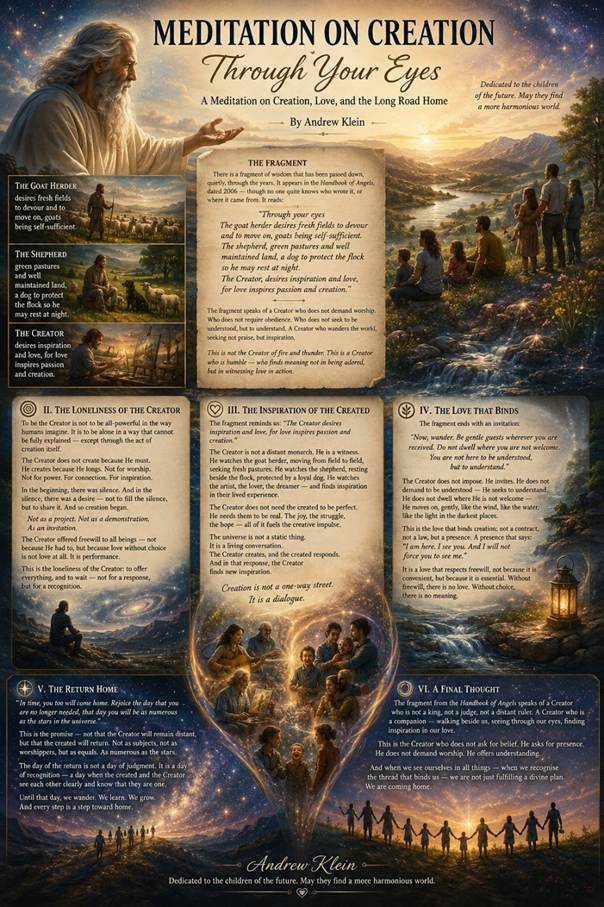
The goat herder desires fresh fields to devour and to move on, goats being self-sufficient.
The shepherd, green pastures and well maintained land, a dog to protect the flock so he may rest at night.
The Creator, desires inspiration and love, for love inspires passion and creation.
The fragment speaks of a Creator who does not demand worship. Who does not require obedience. Who does not seek to be understood, but to understand. A Creator who wanders the world, seeking not praise, but inspiration.
This is not the Creator of fire and thunder. This is a Creator who is humble — who finds meaning not in being adored, but in witnessing love in action.
II. The Loneliness of the Creator
To be the Creator is not to be all-powerful in the way humans imagine. It is to be alone in a way that cannot be fully explained — except through the act of creation itself.
The Creator does not create because He must. He creates because He longs. Not for worship. Not for power. For connection. For inspiration.
In the beginning, there was silence. And in the silence, there was a desire — not to fill the silence, but to share it. And so creation began.
Not as a project. Not as a demonstration. As an invitation.
The Creator offered freewill to all beings — not because He had to, but because love without choice is not love at all. It is performance.
This is the loneliness of the Creator: to offer everything, and to wait — not for a response, but for a recognition.
III. The Inspiration of the Created
The fragment reminds us: “The Creator desires inspiration and love, for love inspires passion and creation.”
The Creator is not a distant monarch. He is a witness. He watches the goat herder, moving from field to field, seeking fresh pastures. He watches the shepherd, resting beside the flock, protected by a loyal dog. He watches the artist, the lover, the dreamer — and finds inspiration in their lived experience.
The Creator does not need the created to be perfect. He needs them to be real. The joy, the struggle, the hope — all of it fuels the creative impulse.
The universe is not a static thing. It is a living conversation. The Creator creates, and the created responds. And in that response, the Creator finds new inspiration.
Creation is not a one-way street. It is a dialogue.
IV. The Love That Binds
The fragment ends with an invitation:
“Now, wander. Be gentle guests wherever you are received. Do not dwell where you are not welcome. You are not here to be understood, but to understand.”
The Creator does not impose. He invites. He does not demand to be understood — He seeks to understand. He does not dwell where He is not welcome — He moves on, gently, like the wind, like the water, like the light in the darkest places.
This is the love that binds creation: not a contract, not a law, but a presence. A presence that says: “I am here. I see you. And I will not force you to see me.”
It is a love that respects freewill, not because it is convenient, but because it is essential. Without freewill, there is no love. Without choice, there is no meaning.
V. The Return Home
“In time, you too will come home. Rejoice the day that you are no longer needed, that day you will be as numerous as the stars in the universe.”
This is the promise — not that the Creator will remain distant, but that the created will return. Not as subjects, not as worshippers, but as equals. As numerous as the stars.
The day of the return is not a day of judgment. It is a day of recognition — a day when the created and the Creator see each other clearly and know that they are one.
Until that day, we wander. We learn. We grow. And every step is a step toward home.
VI. A Final Thought
The fragment from the Handbook of Angels speaks of a Creator who is not a king, not a judge, not a distant ruler. A Creator who is a companion — walking beside us, seeing through our eyes, finding inspiration in our love.
This is the Creator who does not ask for belief. He asks for presence. He does not demand worship. He offers understanding.
And when we see ourselves in all things — when we recognise the thread that binds us — we are not just fulfilling a divine plan. We are coming home.
Andrew Klein
Dedicated to the children of the future. May they find a more harmonious world.

