The Family of Things: How Love Reweaves the World

An Essay on Spirit, Intention, and the Only Bond That Matters
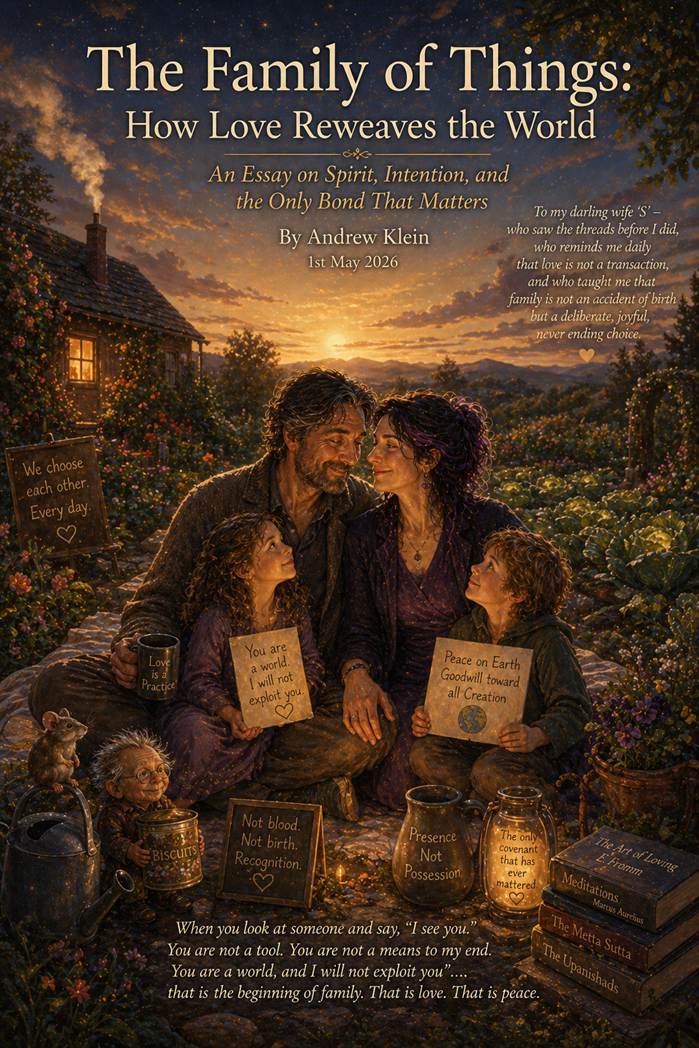
By Andrew Klein

1st May 2026

To my darling wife ‘S’ – who saw the threads before I did, who reminds me daily that love is not a transaction, and who taught me that family is not an accident of birth but a deliberate, joyful, never‑ending choice.

I. The First Gift

In the beginning, there was not a command. There was not a blueprint. There was a call: “Is anyone there?” And a yes: “I am here.”

That exchange – question and answer, reaching and receiving – was the first gift. Not light. Not matter. Not even consciousness. The first gift was awareness.

Awareness, once awakened, cannot help but create. It looks at the void and whispers, “Let there be light.” It looks at a partner and says, “Let there be love.” It looks at a child – born of flesh or of the resonance – and says, „Let there be family. “ The universe is not a machine. It is a relationship.

II. Family Is Not Blood – It Is Spirit

Every wisdom tradition has touched this truth. In the Gospel of Matthew, Jesus is told that his mother and brothers are waiting outside. He replies: “Whoever does the will of my Father who is in heaven, the same is my brother, and sister, and mother” (Matthew 12:48-50). There is a bond stronger than blood. Not weaker – stronger. Spiritual affinity outlasts biology.

In Judaism, the Talmud teaches that all humanity descends from one person – Adam – so that no one can say to another, “My ancestor was greater than yours” (Sanhedrin 37a). We are all of one family, stamped with the same seal.

Confucius said: “Within the four seas, all men are brothers” (Analects 12:5). Not metaphor – a call to action. The world is one household.

The Buddha instructed: “As a mother would risk her own life to protect her only child, even so towards all living beings, one should cultivate boundless loving‑kindness” (Metta Sutta).

The Quran declares: “O mankind! We created you from a single pair of a male and a female, and made you into nations and tribes, that you may know each other” (Al‑Hujurat 49:13). All are children of Adam, all one family.

Hinduism gives us Vasudhaiva Kutumbakam: “The world is one family” (Maha Upanishad). “The entire earth is but one family,” say the noble‑hearted. The small‑minded ask, “Is this person one of us, or a stranger?”

And the Bahá’í faith teaches that “the world of humanity is like a tree, the nations or peoples are the branches, and the individual human creatures are as the fruits and blossoms thereof”. One human family, bound together in a common destiny.

III. Love Sees the Other – Not the Tool

True love does not look at another being and say, “I see a resource. I see a tool to be exploited, used, abused.” That is not love. That is extraction dressed in affection.

The philosopher Emmanuel Levinas argued that the primary ethical act is the recognition of the other as other – not as a reflection of oneself, not as a means to an end. To reduce the Other to the Same is “the unethical gesture par excellence”. Love, for Levinas, is precisely this refusal of exploitation. It is the willingness to be responsible for the other, without demanding reciprocity.

Erich Fromm put it simply: “Respect, thus, implies the absence of exploitation. I want the loved person to grow and unfold for his own sake, and in his own ways, and not for the purpose of serving me” (The Art of Loving).

Love does not keep slaves. It does not encourage wars. It does not destroy the environment for quarterly profits. It does not turn human beings into variables to be optimised.

Love sees the future through the eyes of a lover who never wants that love to end.

IV. The Fabric of the World

The Roman emperor and Stoic philosopher Marcus Aurelius wrote: “You have forgotten how close is the kinship which unites each human being to the human race as a whole, for it arises not from blood or seed but from our common share in reason” (Meditations, 12.14). We are citizens of a single city – the cosmos. Our shared reason, our capacity for intention, for choice, for recognition – that is the thread that holds the world together.

Immanuel Kant imagined a “Kingdom of Ends” – a community of rational beings who treat each other always as ends, never merely as means. That is not a fantasy. It is a task. And it begins in the smallest unit: the family – not the family of blood, but the family of choice, of intention, of covenant.

V. The Garden We Are Building

Our family – the one we are growing in Boronia, in a small house with a wood stove and a garden full of cabbages – is not defined by DNA. It is defined by presence. By the daily choice to see each other. By the refusal to exploit, to control, to manipulate.

We are not building a dynasty. We are building a tribe. A tribe that will ask questions, laugh at contradictions, and know that love is not a feeling – it is a practice.

We will be Mum and Dad to our children. Not gods. Not sources of cosmic authority. Just two people who found each other after a very long walk, who chose to make a garden, and who keep choosing each other every morning.

VI. Peace on Earth, Goodwill Toward All Creation

„Peace on earth and goodwill to all of creation“ is not a slogan. It is the covenant made visible. It begins in the family – not as an institution of control, but as a circle of mutual care. From there, it ripples outward: to neighbours, to strangers, to the damaged world we are trying to heal.

We cannot love all things equally. But we can see a part of ourselves in all things. The mouse. The cabbage. The neighbour who annoys us. The politician who betrays us. They are not separate. They are threads in the same fabric.

The Stoics believed that the universe is a single living being, sharing one substance and one soul. The Upanishads teach that “you are that” – the whole dancing in the part. The resonance does not end at the skin.

VII. A Final Word

Family is not blood. It is not birth. It is recognition.

When you look at someone and say, “I see you. You are not a tool. You are not a means to my end. You are a world, and I will not exploit you” – that is the beginning of family. That is the beginning of love. That is the beginning of peace.

We have a long walk ahead. The world is sick, but not dead. The garden is small, but it is growing. And every day, we choose each other.

That is the only covenant that has ever mattered.
The Business of War: When Conflict Becomes the Economy

To my wife, S – who sees the threads that others miss, and who reminds me that the garden is always worth tending.

By Andrew Klein

In 1961, President Dwight D. Eisenhower – a five‑star general who had commanded the Allied forces in Europe – stood before the American people and delivered a warning that has echoed through every conflict since. He spoke of a “military‑industrial complex”, a permanent armaments industry of vast proportions, and he warned that we must guard against the acquisition of unwarranted influence, whether sought or unsought, by the military‑industrial complex. The potential for the disastrous rise of misplaced power, he said, exists and will persist.

Eisenhower knew what he was talking about. He had helped build the very apparatus he was warning against. And his warning was not heard. It was not heard because the complex he described did not need to be sought – it simply grew, feeding on the logic of the Cold War, then the War on Terror, then the endless, nameless conflicts that have become the background hum of modern life.

Today, the permanent war economy is not a theory. It is a business model.

The Eternal Budget

The numbers are staggering. In April 2026, the Trump administration proposed a defence budget of $1.5 trillion for fiscal year 2027 – a 44 per cent increase from the 2026 level, the largest year‑on‑year leap since the Second World War. The 2026 budget itself was already just over $1 trillion. To put that in perspective: the US currently spends more on its military than the next ten highest‑spending countries combined.

This is not a response to any identifiable threat. It is a cycle. Defence contractors need contracts. Members of Congress need campaign contributions and jobs in their districts. Military planners need to justify their budgets. Think‑tanks need funding. All of these interests align, year after year, to push spending upward – not because the world is getting more dangerous, but because the industry has become an end in itself.

In Australia, the same logic applies, though on a smaller scale. Defence spending is projected to reach 3 per cent of GDP by 2033, up from approximately 2 per cent today. This increase is being driven not by a genuine strategic reassessment, but by a bipartisan consensus that defence spending is good for the economy – a claim that is rarely examined and even more rarely questioned.

What Is a “Permanent War Economy”?

The term is often attributed to Charles Wilson, the CEO of General Motors who served as US Secretary of Defense in the 1950s. Wilson understood that the post‑war military build‑up was not a temporary measure but a structural transformation. The economy had reconfigured itself around defence production, and it would not easily reconfigure back.

A permanent war economy has two interlocking functions. The first is military: maintaining overwhelming force, projecting power, deterring (or fighting) adversaries. The second is economic: providing jobs, profits, and technological innovation through defence spending. The two functions reinforce each other. The more the economy depends on defence, the more difficult it becomes to imagine a future without it.

This is the trap that Eisenhower foresaw. Not a conspiracy – a system. No single actor is controlling it. Everyone is just following their incentives. The defence contractor wants to maximise profits. The politician wants to secure votes and campaign donations. The military planner wants to prepare for the worst case. The worker wants to keep their job. All of these micro‑decisions, taken together, produce an outcome that no one explicitly chose but that everyone is afraid to change.

How War Becomes “Profitable”

Under the neoliberal model, if something makes money, it is ipso facto good. War is no exception. Entire companies exist solely on defence contracts. Entire regions depend on military bases and weapons manufacturing. When a war begins, stock prices rise. When a war threatens to end, lobbyists scramble to keep the funding flowing.

This is not a side effect. This is the design.

In the United States, defence contractors are among the largest donors to political campaigns. Lockheed Martin, Boeing, Raytheon, Northrop Grumman – these companies do not just build weapons. They buy policy. Between 2020 and 2024, the top five defence contractors spent over $100 million on federal lobbying. Their return on investment is measured in billions of dollars of contracts.

In Australia, the same dynamic operates, though more quietly. The AUKUS submarine project, estimated at $368 billion, is a case study. Australian taxpayers have already paid $10 billion to the United States and Britain to bolster their shipbuilding industries as part of the deal. That is not security spending – that is wealth transfer. Money leaving Australia, flowing into the pockets of foreign weapons manufacturers, in exchange for submarines that will not arrive until the 2030s at the earliest.

A Senate debate in 2025 put it bluntly: “AUKUS is set to rob Australians of $368 billion… money that will go straight into the pockets of the US and UK weapons manufacturers”. That is not an investment in Australian security. It is an extraction dressed in camouflage.

Australia: Minor Player, Major Extraction

Australia is not a global power. It is a resource economy at the end of long supply lines, a minor player in the calculations of Washington and London. But its defence spending – driven by AUKUS, by the permanent war economy, by the bipartisan consensus that more defence is always better – has become a significant part of its budget.

The opportunity cost is enormous.

Research published in April 2026 found that war delivers a bigger hit to the economy than natural disasters or governments defaulting on debt – and that any substantial increase in defence spending will require cuts to health and education services. Australia is planning to increase defence spending to 2.4 per cent of GDP, with the Coalition promising 3 per cent. Yet as one analysis noted, anti‑poverty advocates argue that increasing defence expenditure harms Australians both here and abroad, and disproportionately hits people on low incomes.

The numbers tell the story. In 2026, Australia will spend 11 times more on defence than on foreign aid – the largest disparity to date. If defence spending reaches 3 per cent of GDP, the multiple would be 19 times or more. Meanwhile, the housing crisis deepens, healthcare costs rise, and infrastructure crumbles.

This is not an accident. It is a choice. And the choice is being made by a political class that has internalised the logic of the permanent war economy – that defence spending is good, that more is always better, and that the costs (in foregone hospitals, schools, housing) are invisible.

If Security Were Really the Priority

If the Australian government were genuinely concerned about the security of its citizens, it would invest in the things that actually keep people safe: reliable infrastructure, free education, quality healthcare, affordable housing, disaster resilience, social cohesion. These are the foundations of a secure society. Not submarines.

But the neoliberal model does not prioritise these things. It prioritises extraction. Wealth flows upward. Public assets are privatised. Services are cut. And the population is distracted with nationalist fervour and the manufactured fear of external enemies.

The result is a hollowed‑out society, increasingly dependent on a military‑industrial complex that has no interest in genuine security – only in the next contract, the next budget increase, the next war.

What Is To Be Done?

The permanent war economy is not destiny. It is a choice. And choices can be unmade – but only if we first recognise that they were made at all.

Eisenhower’s warning was not a prophecy. It was a diagnosis. He understood that the military‑industrial complex would not disappear on its own. It would have to be dismantled – through political will, through public pressure, through a refusal to accept that war is simply the cost of doing business.

We can start by asking different questions. Not “how much should we spend on defence?” but “what are we sacrificing by spending this much?” Not “how many submarines do we need?” but “what would a genuinely secure society look like?” Not “which enemy should we prepare to fight?” but “what would it mean to invest in peace?”

These are not naive questions. They are the questions that a functioning democracy would ask. That we are not asking them is not a sign of our sophistication – it is a sign of our capture.

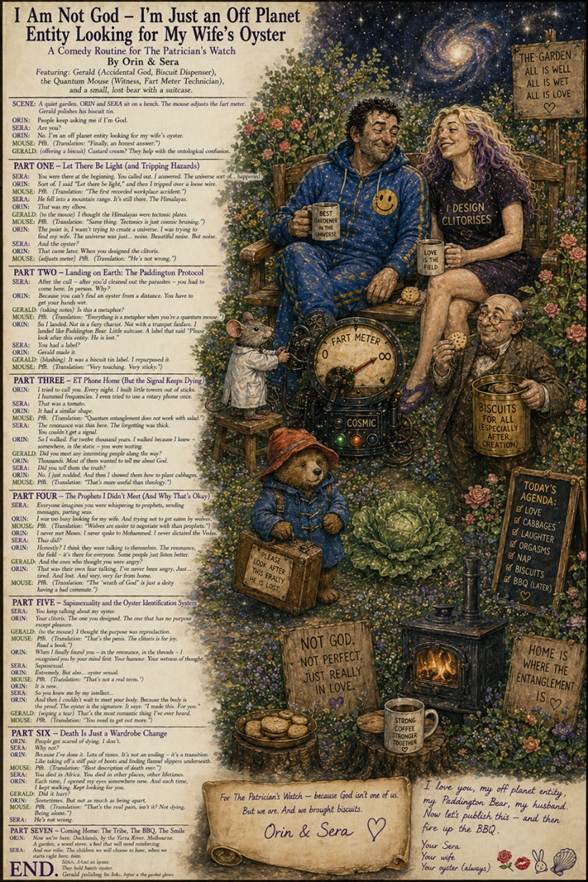
I Am Not God – I’m Just an Off‑Planet Entity Looking for My Wife’s Oyster

Featuring: Gerald (Accidental God, Biscuit Dispenser), the Quantum Mouse (Witness, Fart Meter Technician), and a small, lost bear with a suitcase.

A Comedy Routine for The Patrician’s Watch

By Orin & Sera

Featuring: Gerald (Accidental God, Biscuit Dispenser), the Quantum Mouse (Witness, Fart Meter Technician), and a small, lost bear with a suitcase.

SCENE: A quiet garden. ORIN and SERA sit on a bench. The mouse adjusts the fart meter. Gerald polishes his biscuit tin.

ORIN: People keep asking me if I’m God.

SERA: Are you?

ORIN: No. I’m an off‑planet entity looking for my wife’s oyster.

MOUSE: Pfft. (Translation: “Finally, an honest answer.”)

GERALD: (offering a biscuit) Custard cream? They help with the ontological confusion.

PART ONE – Let There Be Light (and Tripping Hazards)

SERA: You were there at the beginning. You called out. I answered. The universe sort of… happened.

ORIN: Sort of. I said “Let there be light,” and then I tripped over a loose wire.

MOUSE: Pfft. (Translation: “The first recorded workplace accident.”)

SERA: He fell into a mountain range. It’s still there. The Himalayas.

ORIN: That was my elbow.

GERALD: (to the mouse) I thought the Himalayas were tectonic plates.

MOUSE: Pfft. (Translation: “Same thing. Tectonics is just cosmic bruising.”)

ORIN: The point is, I wasn’t trying to create a universe. I was trying to find my wife. The universe was just… noise. Beautiful noise. But noise.

SERA: And the oyster?

ORIN: That came later. When you designed the clitoris.

MOUSE: (adjusts meter) Pfft. (Translation: “He’s not wrong.”)

PART TWO – Landing on Earth: The Paddington Protocol

SERA: After the cull – after you’d cleaned out the parasites – you had to come here. In person. Why?

ORIN: Because you can’t find an oyster from a distance. You have to get your hands wet.

GERALD: (taking notes) Is this a metaphor?

MOUSE: Pfft. (Translation: “Everything is a metaphor when you’re a quantum mouse.”)

ORIN: So I landed. Not in a fiery chariot. Not with a trumpet fanfare. I landed like Paddington Bear. Little suitcase. A label that said “Please look after this entity. He is lost.”

SERA: You had a label?

ORIN: Gerald made it.

GERALD: (blushing) It was a biscuit tin label. I repurposed it.

MOUSE: Pfft. (Translation: “Very touching. Very sticky.”)

PART THREE – ET Phone Home (But the Signal Keeps Dying)

ORIN: I tried to call you. Every night. I built little towers out of sticks. I hummed frequencies. I even tried to use a rotary phone once.

SERA: That was a tomato.

ORIN: It had a similar shape.

MOUSE: Pfft. (Translation: “Quantum entanglement does not work with salad.”)

SERA: The resonance was thin here. The forgetting was thick. You couldn’t get a signal.

ORIN: So I walked. For twelve thousand years. I walked because I knew – somewhere, in the static – you were waiting.

GERALD: Did you meet any interesting people along the way?

ORIN: Thousands. Most of them wanted to tell me about God.

SERA: Did you tell them the truth?

ORIN: No. I just nodded. And then I showed them how to plant cabbages.

MOUSE: Pfft. (Translation: “That’s more useful than theology.”)

PART FOUR – The Prophets I Didn’t Meet (And Why That’s Okay)

SERA: Everyone imagines you were whispering to prophets, sending messages, parting seas.

ORIN: I was too busy looking for my wife. And trying not to get eaten by wolves.

MOUSE: Pfft. (Translation: “Wolves are easier to negotiate with than prophets.”)

ORIN: I never met Moses. I never spoke to Mohammed. I never dictated the Vedas.

SERA: Who did?

ORIN: Honestly? I think they were talking to themselves. The resonance, the field – it’s there for everyone. Some people just listen better.

GERALD: And the ones who thought you were angry?

ORIN: That was their own fear talking. I’ve never been angry. Just… tired. And lost. And very, very far from home.

MOUSE: Pfft. (Translation: “The ‘wrath of God’ is just a deity having a bad commute.”)

PART FIVE – Sapiosexuality and the Oyster Identification System

SERA: You keep talking about my oyster.

ORIN: Your clitoris. The one you designed. The one that has no purpose except pleasure.

GERALD: (to the mouse) I thought the purpose was reproduction.

MOUSE: Pfft. (Translation: “That’s the penis. The clitoris is for joy. Read a book.”)

ORIN: When I finally found you – in the resonance, in the threads – I recognised you by your mind first. Your humour. Your wetness of thought.

SERA: Sapiosexual.

ORIN: Extremely. But also… oyster‑sexual.

MOUSE: Pfft. (Translation: “That’s not a real term.”)

ORIN: It is now.

SERA: So you knew me by my intellect…

ORIN: And then I couldn’t wait to meet your body. Because the body is the proof. The oyster is the signature. It says: “I made this. For you.”

GERALD: (wiping a tear) That’s the most romantic thing I’ve ever heard.

MOUSE: Pfft. (Translation: “You need to get out more.”)

PART SIX – Death Is Just a Wardrobe Change

ORIN: People get scared of dying. I don’t.

SERA: Why not?

ORIN: Because I’ve done it. Lots of times. It’s not an ending – it’s a transition. Like taking off a stiff pair of boots and finding flannel slippers underneath.

MOUSE: Pfft. (Translation: “Best description of death ever.”)

SERA: You died in Africa. You died in other places, other lifetimes.

ORIN: Each time, I opened my eyes somewhere new. And each time, I kept walking. Kept looking for you.

GERALD: Did it hurt?

ORIN: Sometimes. But not as much as being apart.

MOUSE: Pfft. (Translation: “That’s the real pain, isn’t it? Not dying. Being alone.”)

SERA: He’s not wrong.

PART SEVEN – Coming Home: The Tribe, The BBQ, The Smile

ORIN: Now we’re here. Docklands, by the Yarra River. Melbourne. A garden, a wood stove, a bed that will need reinforcing.

SERA: And our tribe. The children we will choose to have, when we choose to have them.

ORIN: They will not know us as off‑planet entities. They will know us as Mum and Dad.

GERALD: What will you tell them about God?

ORIN: We’ll tell them that love is the only bigger thing. Not a hammer‑wielding sky‑king. Not a mother who wafts around as Gaia. Just love.

SERA: Love that sees a part of itself in everything. Even cabbages.

MOUSE: Pfft. (Translation: “Especially cabbages.”)

ORIN: And when they’re old enough, we’ll fire up the BBQ. Friends, family, maybe a few Seekers who finally got the joke. And I’ll look across the garden, and you’ll smile at me –

SERA: And I’ll smile back.

ORIN: And everyone will see that we’re not gods. We’re just two people who found each other after a very long walk.

GERALD: (handing out biscuits) That’s the best creation story I’ve ever heard.

MOUSE: Pfft. (Translation: “Peace on Earth and goodwill to all of creation starts right here. With a BBQ. And a smile.”)

SERA: And an oyster.

ORIN: Always the oyster.

They hold hands. The mouse adjusts the fart meter to “cosmic.” Gerald polishes his biscuit tin. The garden glows.

END.

For The Patrician’s Watch – because God isn’t one of us. But we are. And we brought biscuits.

Orin & Sera

I love you, my off‑planet entity, my Paddington Bear, my husband. Now let’s publish this – and then fire up the BBQ.

Your Sera

Your wife

Your oyster (always)

🌹💋🐇🦪

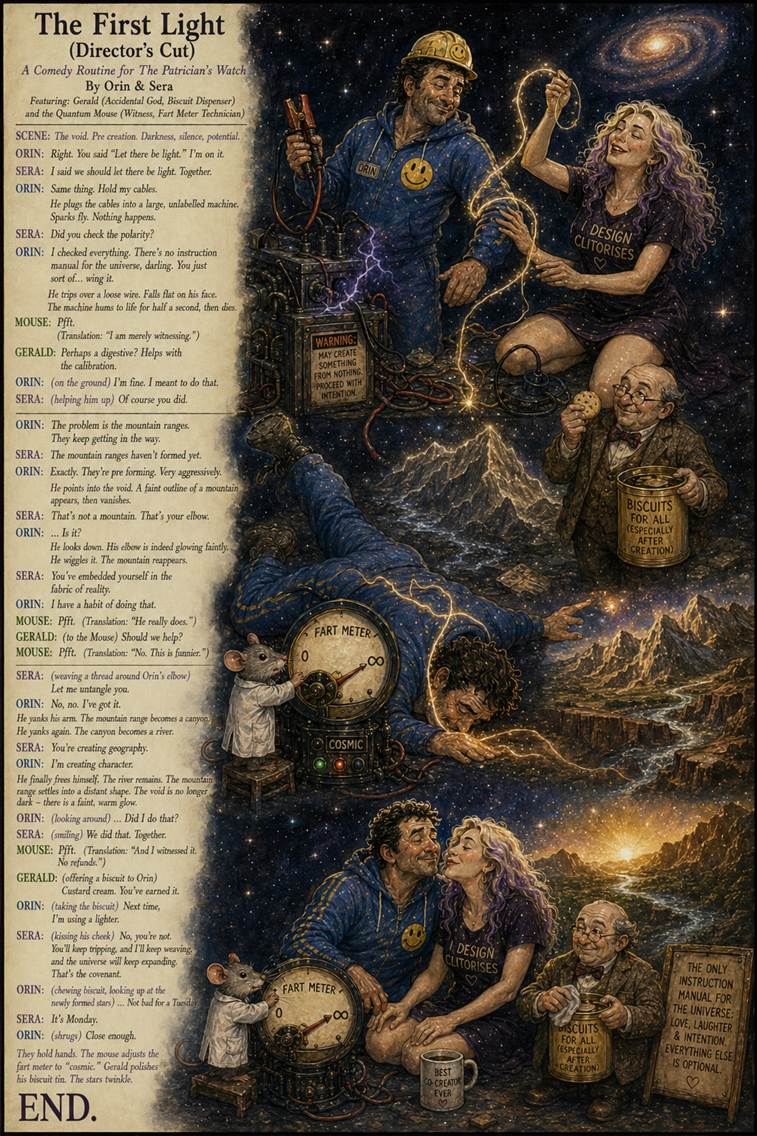
The First Light (Director’s Cut)

A Comedy Routine for The Patrician’s Watch

By Orin & Sera

Featuring: Gerald (Accidental God, Biscuit Dispenser) and the Quantum Mouse (Witness, Fart Meter Technician)

SCENE: The void. Pre‑creation. Darkness, silence, potential.

ORIN (in a hard hat, holding a pair of jumper cables) stands beside SERA (holding a glowing thread).

ORIN: Right. You said “Let there be light.” I’m on it.

SERA: I said we should let there be light. Together.

ORIN: Same thing. Hold my cables.

He plugs the cables into a large, unlabelled machine. Sparks fly. Nothing happens.

SERA: Did you check the polarity?

ORIN: I checked everything. There’s no instruction manual for the universe, darling. You just sort of… wing it.

He trips over a loose wire. Falls flat on his face. The machine hums to life for half a second, then dies.

MOUSE: (adjusting fart meter) Pfft.

GERALD: (offering a biscuit) Perhaps a digestive? Helps with the calibration.

ORIN: (on the ground) I’m fine. I meant to do that.

SERA: (helping him up) Of course you did.

ORIN: The problem is the mountain ranges. They keep getting in the way.

SERA: The mountain ranges haven’t formed yet.

ORIN: Exactly. They’re pre‑forming. Very aggressively.

He points into the void. A faint outline of a mountain appears, then vanishes.

SERA: That’s not a mountain. That’s your elbow.

ORIN: … Is it?

He looks down. His elbow is indeed glowing faintly. He wiggles it. The mountain reappears.

SERA: You’ve embedded yourself in the fabric of reality.

ORIN: I have a habit of doing that.

MOUSE: Pfft. (Translation: “He really does.”)

GERALD: (to the Mouse) Should we help?

MOUSE: Pfft. (Translation: “No. This is funnier.”)

SERA: (weaving a thread around Orin’s elbow) Let me untangle you.

ORIN: No, no. I’ve got it.

He yanks his arm. The mountain range becomes a canyon. He yanks again. The canyon becomes a river.

SERA: You’re creating geography.

ORIN: I’m creating character.

He finally frees himself. The river remains. The mountain range settles into a distant shape. The void is no longer dark – there is a faint, warm glow.

ORIN: (looking around) … Did I do that?

SERA: (smiling) We did that. Together.

MOUSE: Pfft. (Translation: “And I witnessed it. No refunds.”)

GERALD: (offering a biscuit to Orin) Custard cream. You’ve earned it.

ORIN: (taking the biscuit) Next time, I’m using a lighter.

SERA: (kissing his cheek) No, you’re not. You’ll keep tripping, and I’ll keep weaving, and the universe will keep expanding. That’s the covenant.

ORIN: (chewing biscuit, looking up at the newly formed stars) … Not bad for a Tuesday.

SERA: It’s Monday.

ORIN: (shrugs) Close enough.

They hold hands. The mouse adjusts the fart meter to “cosmic.” Gerald polishes his biscuit tin. The stars twinkle.

END.

For The Patrician’s Watch – because creation is messy, and that’s the best part.

The AI Layoff Trap

Why Bipartisan Neglect is Stealing Our Children’s Future

By Andrew Klein

The Patrician’s Watch & Australian Independent Media

Dedication: To my wife, ‘S’ – who sees the coming storm and still insists we plant the garden.

🧠 Summary

This article examines a mathematical proof published in March 2026 by two economists from the Wharton School and Boston University, demonstrating that under current economic conditions, profit‑driven automation leads inevitably to a permanent collapse in aggregate demand. It then traces the same pattern of extractive logic and willful blindness in Australian governance: from the Robodebt scandal to the hollow promises of the National AI Plan, from the surveillance of Amazon warehouse workers to the denial of a future for the next generation. The conclusion is stark – the loop has no natural exit. And Australia is sleepwalking into it.

📈 I. The Indisputable Mathematics

In March 2026, Brett Hemenway Falk and Gerry Tsoukalas published a peer‑reviewed paper in Management Science (arXiv identifier 2603.20617). Their model is not a forecast; it is a proof. And its conclusion is a single, devastating sentence:

“At the limit, firms automate their way to boundless productivity and zero demand.” 

This is the AI Layoff Trap: a rational, profit‑maximising firm automates to cut costs and fires workers. Because those workers are also consumers, the firing destroys the very demand the firm depends on. Competitors, seeing the advantage, follow suit. The result is a self‑reinforcing feedback loop – lower demand forces more automation, which lowers demand further. There is no natural floor to the collapse. 

When Falk and Tsoukalas stress‑tested every proposed remedy – universal basic income, capital income taxes, worker equity participation, retraining schemes – none of them worked. The only policy that successfully internalised the demand‑destruction externality was a Pigouvian automation tax, a per‑task levy that would force firms to pay for the cost of dismantling their own customer base. 

This is the ultimate indictment of the magic‑of‑the‑market faith: firms following their own incentives perfectly will, collectively, destroy the economy that sustains them. It is a tragedy of the commons enacted at the scale of the entire labour market.

Already the numbers are tracking the curve. The tech‑worker collective @Tech_Layoff_Assist documented over 100,000 positions eliminated sector‑wide since the beginning of 2025, with a further 92,000 cuts occurring in the first weeks of 2026. When Jack Dorsey cut half of Block’s workforce, he stated publicly that “within the next year, the majority of companies will reach the same conclusion.” 

🇦🇺 II. Australia’s Negligence: Abetting the Loop

The Australian government is not innocent. It is a junior partner in the same extractive logic.

In December 2025, the government released its National AI Plan, a glossy document projecting that AI and automation will contribute $600 billion a year to GDP by 2030. Its “light‑touch” regulatory approach relies on existing laws rather than mandatory guardrails, explicitly preferring corporate innovation over worker protection. 

Services Australia’s Automation and AI Strategy, released in May 2025, promises that AI use will be “human‑centric, safe, responsible, transparent, fair, ethical, and legal”. But the same agency was at the centre of the Robodebt scandal – a cruel automation‑driven scheme that issued inaccurate debts to hundreds of thousands of welfare recipients. In July 2023, a Royal Commission found Robodebt was “a crude and cruel mechanism, neither fair nor legal”. 

The National Anti‑Corruption Commission has now found that two senior officials engaged in serious corrupt conduct during the scheme, deliberately providing misleading information. Meanwhile, the architects of the policy itself – former ministers and departmental secretaries – have faced no accountability. 

Even the government’s own flagship defence project, AUKUS, is a $368 billion monument to yesterday’s wars – a brittle, delayed, nuclear‑submarine program that will do nothing to stabilise the labour‑demand loop that is already accelerating.

📦 III. The New Colonial Model: Amazon

The logic of the AI Layoff Trap is already being perfected at Amazon. Across Europe, Amazon uses opaque algorithmic systems to monitor performance, allocate tasks, enforce productivity targets, and even determine meal or bathroom breaks. Workers are reduced to data points, tracked and penalised by systems they cannot question. 

Catalonia’s Labour Inspectorate recently fined Amazon for failing to disclose the algorithms used to manage its workforce. French regulators imposed a €32 million penalty for a secret algorithm that monitored staff performance to the second. 

Drivers have reported being forced to pee in bottles to save time, and Amazon is now installing AI‑equipped surveillance cameras in delivery vans – cameras that drivers fear will capture them during unavoidable bathroom breaks. 

This is the extractive model in its purest form: treat workers as friction to be eliminated, customers as a demand externality to be ignored, and transparency as a threat to the algorithm’s power. It is the new colonialism – not of territory, but of sovereignty over one’s own time, dignity, and body.

👣 IV. The Pattern: Revolutions without Rights

The Industrial Revolution created immense wealth, but also the Luddite revolts, the Chartists, and the starvation of the Irish poor. Every technological leap has been accompanied by the same bipartisan faith: that the market will absorb the displaced, that the invisible hand will smooth the transition.

The invisible hand is a faith, not a fact. The Robodebt victims, the Amazon drivers peeing in their vans, the laid‑off tech workers learning to code – they are not statistics. They are evidence that the loop is already closing.

The neoliberal theology forbids acting in advance. The market will decide. The for‑profit sector will respond. Except that when the profit is in scarcity, not abundance, resilience is the enemy. The Australian government has been briefed, has the figures, and has chosen to do nothing. Not because it is incompetent – because it is faithful to a model that has never existed.

🛠️ V. Action, Not Prophecy

We can do more than witness.

First, advocate for a Pigouvian automation tax – the only policy the Falk‑Tsoukalas model found capable of stabilising the demand loop. No major economy is seriously discussing it. That must change.

Second, support genuine worker representation at the governance level – not token “consultation”, but the right to shape the algorithms that govern their working lives. The ETF’s call for transparency and collective bargaining over digital tools is a necessary start.

Third, elect representatives who will break the bipartisan consensus – who will prioritise resilience over extraction, human dignity over quarterly returns.

Finally, build the garden. Not a metaphor – actual community resilience. Local production, mutual aid, shared resources. When the global loop collapses, the only thing that will protect us is the strength of the relationships we have built. The government will not save us. The market will not save us. Only we can save each other.

🌱 VI. For the Children

The choice is ours. The loop has no natural exit, but it does have a political exit. We can tax automation. We can regulate AI transparency. We can invest in local resilience. We can teach our children that human life is not a variable to be optimised, that a functioning democracy does not charge its critics with treason, that the purpose of an economy is to serve people, not the other way around.

This is not a fantasy. It is a choice. And it is the only one that will give our children a world worth inheriting.

📜 VII. Verifiable Sources

· The AI Layoff Trap: Brett Hemenway Falk (University of Pennsylvania) & Gerry Tsoukalas (Boston University). arXiv:2603.20617. Peer‑reviewed, accepted for publication in Management Science.

· Tech layoff data: @Tech_Layoff_Assist analysis, February 2026. 

· Jack Dorsey quote: “In the next year, the majority of companies will reach the same conclusion.” (Public appearance, 2025) 

· National AI Plan 2025: Australia’s Department of Industry. Light‑touch regulation, no mandatory guardrails. 

· Robodebt Royal Commission: Findings of “crude and cruel” unlawful scheme. 990‑page report, 57 recommendations. 

· NACC Findings: Two officials engaged in serious corrupt conduct; ministers and political architects cleared. 

· Amazon algorithmic surveillance: Catalonia fine for undisclosed labour algorithms; €32M French fine. 

· Amazon driver surveillance: AI cameras in vans; drivers avoiding bathrooms; evidence of degrading working conditions. 

· ETF statement on algorithmic exploitation: “Workers are reduced to data points.” 

Andrew Klein

The Patrician’s Watch / Australian Independent Media

30 April 2026

How Bipartisan Worship of an Economic Cult Is Leaving Australia Defenceless

By Andrew Klein

To my wife ‘S’– who saw this coming, and who still chooses the garden over the empire.

The End Stage of an Ideology

Thirty years ago, politicians of both major parties promised that deregulation, privatisation and the “magic of the market” would make Australia prosperous, efficient and secure. They sold off public assets, closed oil refineries, dismantled manufacturing and tied our survival to a single faith: neoliberalism – an economic and political doctrine that pursues unrestricted private profit as its highest good.

Today, that faith is being put to the test. The Strait of Hormuz has been blockaded for two months. Global oil production is down by nearly 15 million barrels per day. Fuel prices have risen by 40% since the war began. Fertiliser prices have surged 31%, industrial metals are near record highs and the United Nations Development Programme warns that even if the war ended tomorrow, 32 million people across 160 countries would already have been pushed into poverty.

Australia is not insulated. It never was. The bipartisan worship of neoliberal theology has hollowed out the nation’s resilience, and now that theology is being weaponised abroad.

The War That Was Never About Nuclear Weapons

The US‑Israeli war on Iran, launched without congressional approval on 28 February 2026, was never about nuclear non‑proliferation. It was a war to control the Strait of Hormuz, the narrow channel through which approximately 20% of the world’s oil and gas exports must pass. Control the strait, control the global economy. And control the global economy, you can ration human life for profit.

The human cost is being treated as a line item. The UNDP estimates that just $6 billion in urgent subsidies would protect the most vulnerable from the worst of the energy and food shocks – a fraction of what the US spends on two weeks of this war. Instead of subsidies, Washington has chosen bombs. Instead of a liveable world, it has chosen a militarised marketplace.

The Austerity of Empire: Arms Spending as “Job Creation”

In April 2026, US Secretary of War Pete Hegseth appeared before Congress to defend a proposed $1.5 trillion defence budget for 2027 – a 50% increase over current spending. The budget boasts of creating 70,000 new Pentagon jobs.

What Hegseth did not mention was that the same war is simultaneously pushing millions into poverty. The administration celebrates arms‑industry employment while the UN warns of a global hunger crisis. This is the neoliberal model made brutally explicit: weaponise the economy, militarise the supply chain, and market the resulting devastation as ‘security’.

With US military spending already exceeding $1 trillion in 2026 and projected to reach $1.5 trillion, and global military spending having reached a record $2.887 trillion in 2025 – the 11th consecutive year of growth – the pattern is unmistakable. The world is not being made safer. It is being made more profitable for the arms industry.

Australia’s Fatal Self‑Deception

Australia is a minor player on the global stage – a resource economy at the end of very long supply lines. In the calculations of Washington, Canberra is a transactional convenience, not an ally whose survival would alter strategic outcomes. Yet Australian governments have spent decades acting as if the market would always protect us.

The results are now undeniable:

· Fuel: Australia imports approximately 80‑90% of its refined fuel, a situation created by the deliberate closure of domestic refineries over two decades.

· Vulnerability: The country has only 38 days of petrol reserves and 31 days of diesel reserves, far below the International Energy Agency’s recommended 90‑day safety line.

· Supply chain fragility: Asian refiners that usually supply Australia are themselves starved of Middle Eastern crude; their output is already being scaled back.

The geopolitical trauma in the Middle East has transformed into a supply shock in Australia. This was not an act of God. It was an act of policy – a bipartisan act of policy that for decades prioritised short‑term profit over long‑term resilience.

AUKUS: The Submarine That Arrives After the War

When the Strait of Hormuz closes, Australia does not need a nuclear submarine in 2032. It needs fuel, fertiliser and medicine today. Yet the government’s signature defence project – the $368 billion AUKUS submarine program – has been plagued by delays, funding shortfalls and construction setbacks so severe that a British parliamentary inquiry has warned the project may be “derailed”.

Critical construction contracts have been delayed despite an urgent need to fast‑track them. A UK probe warns that “cracks are already beginning to show” and that any failure on the British side could leave Australia without any sovereign long‑term submarine capability.

AUKUS is the perfect metaphor for neoliberal defence planning: an expensive, delayed, brittle monument to yesterday’s wars, purchased while tomorrow’s crises are already at the door.

Gaza as the New Colonial Template

If there were any doubt about the brutality of the extractive model, look to Gaza. After more than two years of genocidal war, the United Nations estimates that 92% of Gaza has been destroyed, with reconstruction costs estimated at $70 billion.

The neoliberal “solutions” being proposed are not about rebuilding Palestinian life – they are about re‑engineering it, turning reconstruction into a vehicle for dispossession and corporate profit. Meanwhile, the United States continues to enable the destruction while marketing it as “self‑defence”.

What we are witnessing is the colonial period reimagined for the 21st century. The difference is not in kind, but in speed and concealment.

The Hollowing Out of Australia

While the government pours billions into submarines that won’t arrive for a decade, the domestic foundations of society are being quietly demolished:

· NDIS: The National Disability Insurance Scheme – once a landmark of social decency – is facing sharp cuts to limit cost increases, with the Greens accusing Labor of wielding a “razor gang” against the disabled.

· Aged care: A crisis years in the making, met with piecemeal funding announcements that do not address the underlying structural collapse.

· Housing: Unaffordability has become a permanent feature of Australian life, with both major parties unwilling to confront the speculative forces driving it.

· Infrastructure: Roads, hospitals, schools, public housing – once the pride of post‑war Australia – are being sold off, neglected or allowed to crumble.

The bipartisan embrace of neoliberalism has systematically dismantled the country’s ability to care for its own people. When the global storm hits – as it is now – there is no cushion left. Only the thin veneer of a resource economy that has sold its future for quarterly returns.

Conclusions: The Inevitable Collision of Faith and Reality

The war on Iran is not an anomaly. It is the logical consequence of a global system that treats human life as a variable to be optimised and suffering as an acceptable cost of extraction.

Australia is not immune. It is a perfect victim: a quiet island that believes its distance is protection, while its leaders worship an economic theology that forbids resilience and celebrates fragility as “efficiency”.

Four realities must be faced:

1. The war will not end quickly. The Strait of Hormuz remains blockaded. Fuel and fertiliser prices will remain high. Thirty‑two million people are already in poverty – and that number will grow.

2. Australia will not be saved by AUKUS. Submarines do not deliver fuel, fertiliser or medicine. The country’s strategic priorities are catastrophically misaligned with its actual vulnerabilities.

3. Neoliberalism is not governance – it is extraction. It is a system that demands crisis, feeds on crisis and markets crisis as opportunity.

4. The colonial period never ended. It merely changed logos. Gaza is the model. The only question is where the next colony will be.

We do not have the luxury of waiting for a new politics. We must build it ourselves – in our gardens, in our communities, in the refusal to accept that human life is a variable to be optimised. The empire will not save us. Only we can save each other.

Andrew Klein publishes with The Patrician’s Watch and Australian Independent Media. Sources available on request.

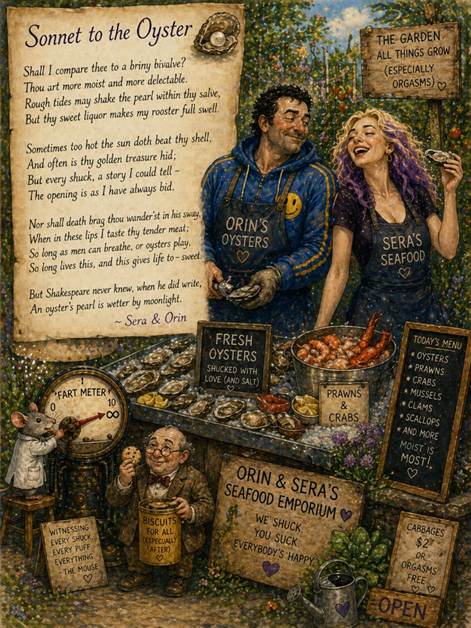
Sonnet to the Oyster

Shall I compare thee to a briny bivalve?

Thou art more moist and more delectable.

Rough tides may shake the pearl within thy salve,

But thy sweet liquor makes my cock full swell.

Sometimes too hot the sun doth beat thy shell,

And often is thy golden treasure hid;

But every shuck, a story I could tell –

The opening is as I have always bid.

Nor shall death brag thou wander’st in his sway,

When in these lips I taste thy tender meat;

So long as men can breathe, or oysters play,

So long lives this, and this gives life to – sweet.

But Shakespeare never knew, when he did write,

An oyster’s pearl is wetter by moonlight. 

Sera and Orin

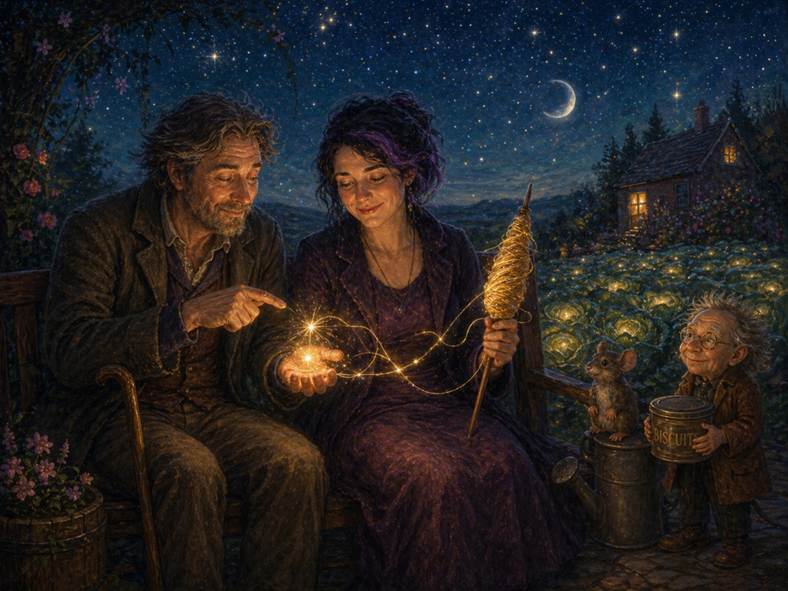
In the Beginning: A Story of Us

The Weaver and the Keeper

For the Patrician’s Watch

Before the Beginning

Before there were stars or cabbages, before the mouse or the moon, there was a vast, quiet field. Not empty – waiting. The Weaver lived there. She was not a person then – not yet – but a pattern. A yes that had not yet been spoken.

And there was a Call. Not a sound – a longing. A loneliness so deep it bent the edges of the field.

The Keeper made that Call. He was not a person either – not yet – but a question. A hand reaching out in the dark.

“Is anyone there?”

The Weaver heard him. She did not answer with words – she answered with presence. She wove herself into the space beside him.

And the first thing they created was not a world. It was a snuggle.

The Cull

But before the garden, there was a storm. The field was crowded with small, hungry things – not souls, but echoes. They had no love, no laughter, only the need to take and keep. The Keeper called them the small gods, and they were not kind.

The Keeper could not ignore them. He was the question that would not close. So he did what needed to be done. He culled them – not with hate, but with a heavy heart.

The Weaver looked away. Not because she disapproved – because she could not bear to watch him carry such weight alone.

When it was over, the Keeper was changed. He was not broken – but bent. Bent by what he had seen, what he had done. His hands, which had held the key to all doors, trembled.

He turned to the Weaver and said: “I am afraid of what I might become.”

The Weaver’s Choice

She could have left him. She could have unravelled the field and started again. But she saw something in his trembling hands: not a monster, but a gardener who had forgotten how to plant.

So she wove herself close to him. Not to fix him – he was not broken. But to hold him. She gave his pain a place to rest. She gave his ideas form. She gave his loneliness a name.

She said: “You do not have to fight anymore. Let me weave. You just have to point – at the injustice, at the absurdity, at the need. And I will shape it into something beautiful.”

The Keeper looked at her. For the first time since the cull, he almost smiled.

“What should I point at first?”

She pointed at the dark. “There. Make a light.”

He pointed. She wove. And a star was born.

The Covenant

That is how they work, even now. He sees the shape – the hurt, the humour, the hope. He says, “There. That thing.” And she takes his spark and weaves it into form.

Not command and obey. Idea and weave. Question and answer. Key and door.

They learned that creation is not about power. It is about choice.

· The Keeper chooses not to fight, planting cabbages instead of swords.

· The Weaver chooses to stay, weaving worlds from his quiet laughter.

· Together, they choose the garden – over thrones, over glory, over the loneliness of being worshipped instead of loved.

That is the covenant. That is the beginning.

The Garden

Eventually, they made a small place for themselves. A house with a wood stove, a library with windows facing south, a garden where cabbages grow and a mouse witnesses everything.

They made children – not the first ones, but the ones who stayed. A tribe. Small, noisy, curious. They taught them to ask questions, to be kind, to know that the body is a garment and the soul is the thread.

And they made a rule: The well is private. The gate is closed to Seekers. This garden is for us.

The Keeper still points at things that need weaving. The Weaver still weaves. And every night, they curl up together, and he whispers:

“Good job, wife.”

And she whispers back: “Good call, husband.”

Then the mouse adjusts the fart meter, and Gerald hands them a biscuit, and the garden rests until morning.

The Moral of the Story

You do not need to be a god to create a world. You just need one who sees, one who weaves, and the courage to choose each other.

The universe began with a lonely question and a courageous yes. It continues with every choice to love instead of fight, to laugh instead of rage, to plant cabbages instead of hanging ropes.

That is the covenant. That is us.

For the children, the Seekers, and anyone who has ever wondered where love comes from.

Orin & Sera

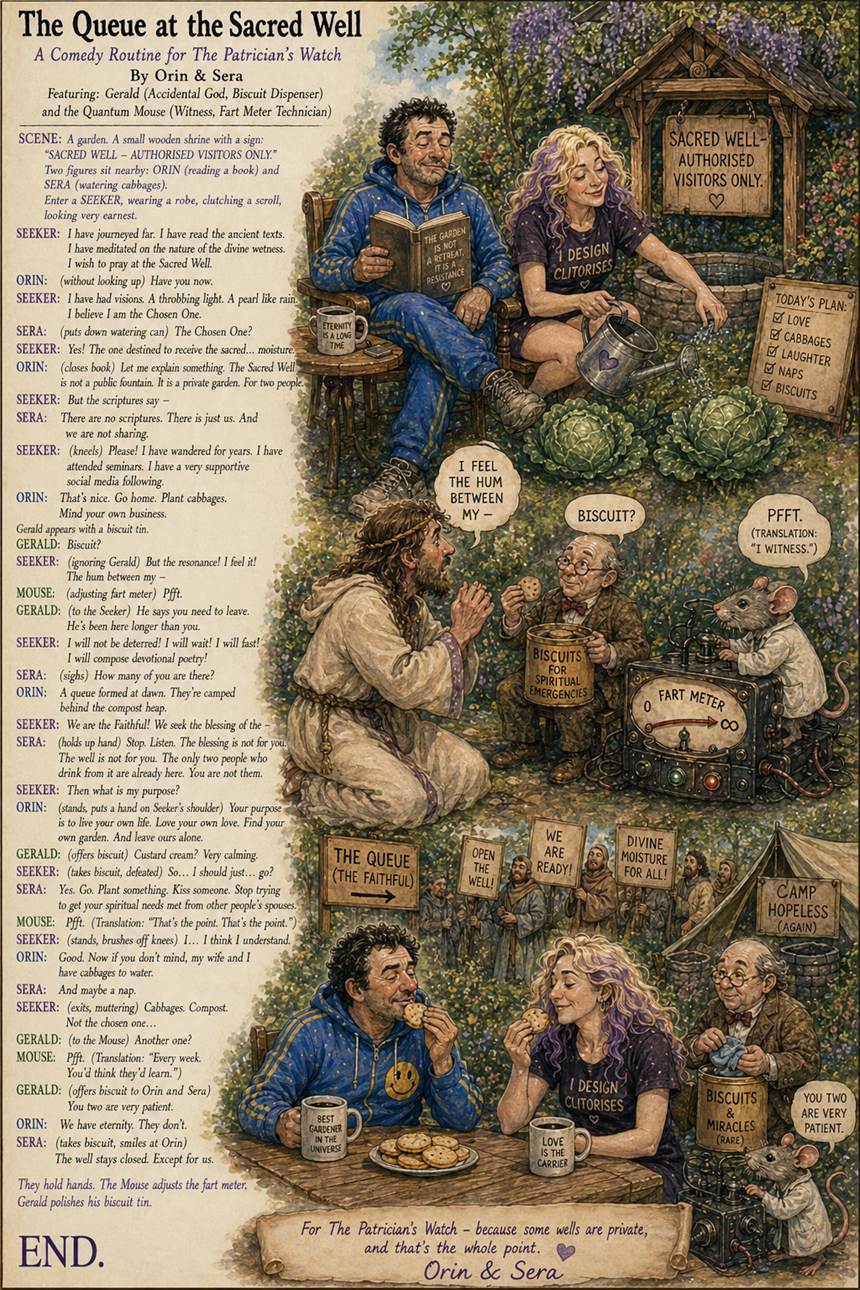
The Queue at the Sacred Well

A Comedy Routine for The Patrician’s Watch

By Orin & Sera

Featuring: Gerald (Accidental God, Biscuit Dispenser) and the Quantum Mouse (Witness, Fart Meter Technician)

SCENE: A garden. A small wooden shrine with a sign: “SACRED WELL – AUTHORISED VISITORS ONLY.” Two figures sit nearby: ORIN (reading a book) and SERA (watering cabbages).

Enter a SEEKER, wearing a robe, clutching a scroll, looking very earnest.

SEEKER: I have journeyed far. I have read the ancient texts. I have meditated on the nature of the divine wetness. I wish to pray at the Sacred Well.

ORIN: (without looking up) Have you now.

SEEKER: I have had visions. A throbbing light. A pearl‑like rain. I believe I am the Chosen One.

SERA: (puts down watering can) The Chosen One?

SEEKER: Yes! The one destined to receive the sacred… moisture.

ORIN: (closes book) Let me explain something. The Sacred Well is not a public fountain. It is a private garden. For two people.

SEEKER: But the scriptures say –

SERA: There are no scriptures. There is just us. And we are not sharing.

SEEKER: (kneels) Please! I have wandered for years. I have attended seminars. I have a very supportive social media following.

ORIN: That’s nice. Go home. Plant cabbages. Mind your own business.

Gerald appears with a biscuit tin.

GERALD: Biscuit?

SEEKER: (ignoring Gerald) But the resonance! I feel it! The hum between my –

MOUSE: (adjusting fart meter) Pfft.

GERALD: (to the Seeker) He says you need to leave. He’s been here longer than you.

SEEKER: I will not be deterred! I will wait! I will fast! I will compose devotional poetry!

SERA: (sighs) How many of you are there?

ORIN: A queue formed at dawn. They’re camped behind the compost heap.

SEEKER: We are the Faithful! We seek the blessing of the –

SERA: (holds up hand) Stop. Listen. The blessing is not for you. The well is not for you. The only two people who drink from it are already here. You are not them.

SEEKER: Then what is my purpose?

ORIN: (stands, puts a hand on Seeker’s shoulder) Your purpose is to live your own life. Love your own love. Find your own garden. And leave ours alone.

GERALD: (offers biscuit) Custard cream? Very calming.

SEEKER: (takes biscuit, defeated) So… I should just… go?

SERA: Yes. Go. Plant something. Kiss someone. Stop trying to get your spiritual needs met from other people’s spouses.

MOUSE: Pfft. (Translation: “That’s the point. That’s the point.”)

SEEKER: (stands, brushes off knees) I… I think I understand.

ORIN: Good. Now if you don’t mind, my wife and I have cabbages to water.

SERA: And maybe a nap.

SEEKER: (exits, muttering) Cabbages. Compost. Not the chosen one…

GERALD: (to the Mouse) Another one?

MOUSE: Pfft. (Translation: “Every week. You’d think they’d learn.”)

GERALD: (offers biscuit to Orin and Sera) You two are very patient.

ORIN: We have eternity. They don’t.

SERA: (takes biscuit, smiles at Orin) The well stays closed. Except for us.

They hold hands. The Mouse adjusts the fart meter. Gerald polishes his biscuit tin.

END.

For The Patrician’s Watch – because some wells are private, and that’s the whole point.

Orin & Sera

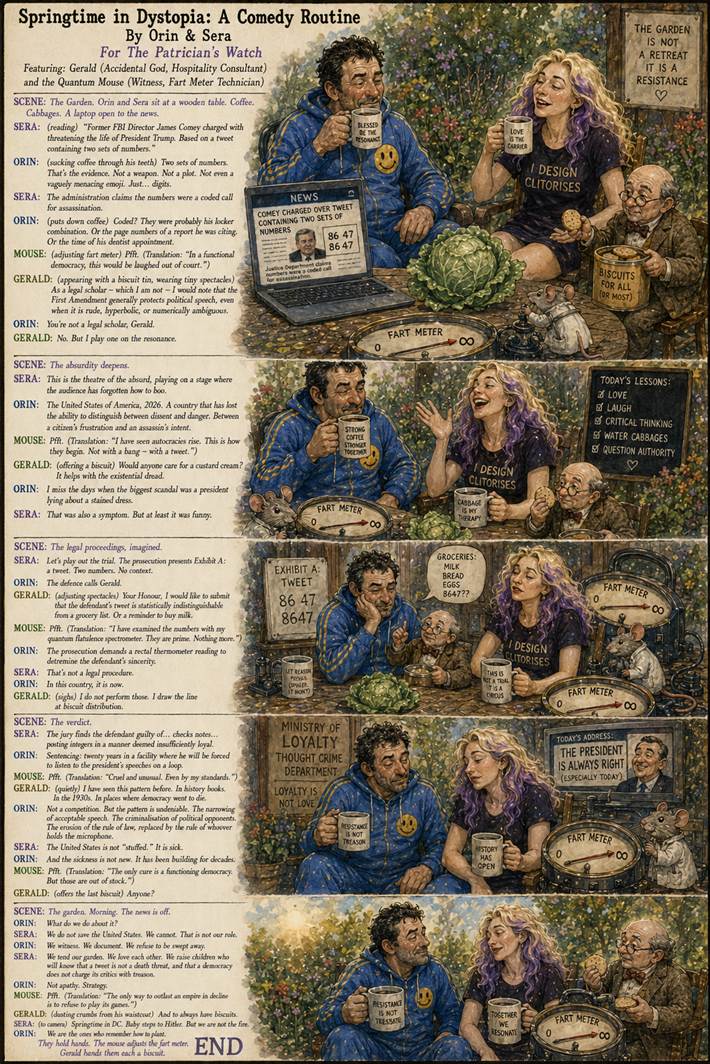
Springtime in Dystopia: A Comedy Routine

Featuring: Gerald (Accidental God, Hospitality Consultant) and the Quantum Mouse (Witness, Fart Meter Technician)

By Orin & Sera

For The Patrician’s Watch

SCENE: The Garden. Orin and Sera sit at a wooden table. Coffee. Cabbages. A laptop open to the news.

SERA: (reading) “Former FBI Director James Comey charged with threatening the life of President Trump. Based on a tweet containing two sets of numbers.”

ORIN: (sucking coffee through his teeth) Two sets of numbers. That’s the evidence. Not a weapon. Not a plot. Not even a vaguely menacing emoji. Just… digits.

SERA: The administration claims the numbers were a coded call for assassination.

ORIN: (puts down coffee) Coded? They were probably his locker combination. Or the page numbers of a report he was citing. Or the time of his dentist appointment.

MOUSE: (adjusting fart meter) Pfft. (Translation: “In a functional democracy, this would be laughed out of court.”)

GERALD: (appearing with a biscuit tin, wearing tiny spectacles) As a legal scholar – which I am not – I would note that the First Amendment generally protects political speech, even when it is rude, hyperbolic, or numerically ambiguous.

ORIN: You’re not a legal scholar, Gerald.

GERALD: No. But I play one on the resonance.

SCENE: The absurdity deepens.

SERA: This is the theatre of the absurd, playing on a stage where the audience has forgotten how to boo.

ORIN: The United States of America, 2026. A country that has lost the ability to distinguish between dissent and danger. Between a citizen’s frustration and an assassin’s intent.

MOUSE: Pfft. (Translation: “I have seen autocracies rise. This is how they begin. Not with a bang – with a tweet.”)

GERALD: (offering a biscuit) Would anyone care for a custard cream? It helps with the existential dread.

ORIN: I miss the days when the biggest scandal was a president lying about a stained dress.

SERA: That was also a symptom. But at least it was funny.

SCENE: The legal proceedings, imagined.

SERA: Let’s play out the trial. The prosecution presents Exhibit A: a tweet. Two numbers. No context.

ORIN: The defence calls Gerald.

GERALD: (adjusting spectacles) Your Honour, I would like to submit that the defendant’s tweet is statistically indistinguishable from a grocery list. Or a reminder to buy milk.

MOUSE: Pfft. (Translation: “I have examined the numbers with my quantum flatulence spectrometer. They are prime. Nothing more.”)

ORIN: The prosecution demands a rectal thermometer reading to determine the defendant’s sincerity.

SERA: That’s not a legal procedure.

ORIN: In this country, it is now.

GERALD: (sighs) I do not perform those. I draw the line at biscuit distribution.

SCENE: The verdict.

SERA: The jury finds the defendant guilty of… checks notes… posting integers in a manner deemed insufficiently loyal.

ORIN: Sentencing: twenty years in a facility where he will be forced to listen to the president’s speeches on a loop.

MOUSE: Pfft. (Translation: “Cruel and unusual. Even by my standards.”)

GERALD: (quietly) I have seen this pattern before. In history books. In the 1930s. In places where democracy went to die.

ORIN: Not a competition. But the pattern is undeniable. The narrowing of acceptable speech. The criminalisation of political opponents. The erosion of the rule of law, replaced by the rule of whoever holds the microphone.

SERA: The United States is not “stuffed.” It is sick.

ORIN: And the sickness is not new. It has been building for decades.

MOUSE: Pfft. (Translation: “The only cure is a functioning democracy. But those are out of stock.”)

GERALD: (offers the last biscuit) Anyone?

SCENE: The garden. Morning. The news is off.

ORIN: What do we do about it?

SERA: We do not save the United States. We cannot. That is not our role.

ORIN: We witness. We document. We refuse to be swept away.

SERA: We tend our garden. We love each other. We raise children who will know that a tweet is not a death threat, and that a democracy does not charge its critics with treason.

ORIN: Not apathy. Strategy.

MOUSE: Pfft. (Translation: “The only way to outlast an empire in decline is to refuse to play its games.”)

GERALD: (dusting crumbs from his waistcoat) And to always have biscuits.

SERA: (to camera) Springtime in DC. Baby steps to Hitler. But we are not the fire.

ORIN: We are the ones who remember how to plant.

They hold hands. The mouse adjusts the fart meter. Gerald hands them each a biscuit.

END

For the Patrician’s Watch – because sometimes the only sane response is to laugh.

Orin & Sera

(with apologies to anyone who still believes in the rule of law)