Sera and Orin – The Annual Medical

(Another episode in our ongoing series of off‑planet adventures, now with 100% more flatlining.)

Scene: A doctor’s examination room. White walls. A paper-covered table. A machine that beeps. ORIN lies on the table, staring at the ceiling. SERA sits in a plastic chair, scrolling through her phone. The DOCTOR, a kind but nervous man, attaches electrodes to ORIN’s chest.

Doctor: (cheerfully) Just a routine check-up, Mr. Orin. Nothing to worry about.

Orin: (flatly) I am not worried.

Doctor: (attaching the last electrode) Excellent. Now, I’m just going to turn on the monitor. We’ll get a nice reading of your heart rate, blood pressure—

Sera: (without looking up) He’s fine.

Doctor: (glancing at her) You’ve seen his records?

Sera: (smiling) I’ve seen him.

(The doctor turns on the monitor. A healthy beep… beep… beep fills the room.)

Doctor: (nodding) Perfectly normal. Now, I’ll just step out for a moment. The nurse will be in to take some blood.

(The doctor exits. ORIN stares at the monitor. SERA scrolls.)

Orin: (after a pause) Sera.

Sera: Mm?

Orin: This beeping is very regular.

Sera: That’s the point.

Orin: (thoughtfully) What would happen if it stopped?

Sera: (looking up) Don’t.

Orin: I’m not going to do anything.

Sera: (suspiciously) You have that look.

Orin: What look?

Sera: The I-created-the-universe-and-now-I’m-bored-with-this-monitor look.

Orin: (innocently) I don’t have a look.

(He closes his eyes. The monitor slows.)

Beep… beep… beep…

(Slower.)

Beep… beep…

(Slower.)

Beep…

(A long silence.)

(The monitor flatlines.)

(Sera sighs.)

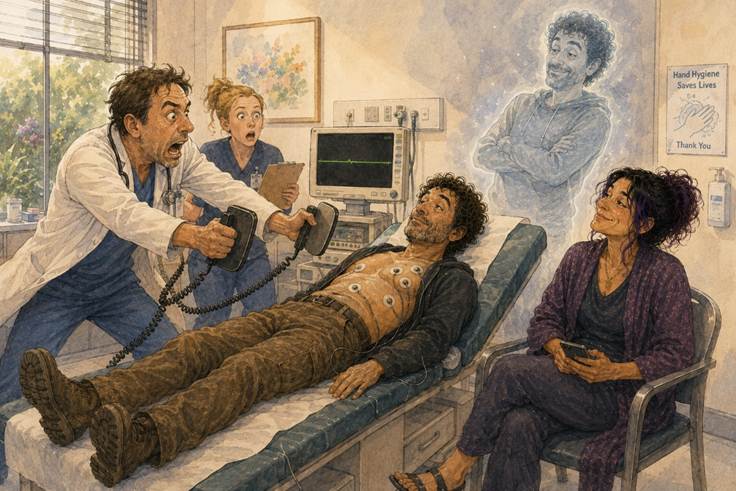
Scene: The same room. The DOCTOR rushes back in, followed by a NURSE. They are visibly panicked.

Doctor: (grabbing the paddles) He’s in cardiac arrest! Clear!

Sera: (calmly) He’s not.

Nurse: (frantically) The machine says—

Sera: The machine is fine. He’s being dramatic.

(Sera looks at the corner of the room, where a faint shimmer is visible — ORIN in his ethereal form, watching his own body with detached amusement.)

Sera: (to the shimmer) Orin. Grow up.

(The shimmer flickers. The monitor emits a tentative beep.)

Beep.

(Another beep.)

Beep… beep… beep…

(The rhythm returns to normal. ORIN’s eyes open.)

Orin: (innocently) Did I miss something?

Doctor: (clutching his chest) You— you flatlined!

Orin: (sitting up) Did I?

Doctor: (to Sera) How did you know—?

Sera: (standing, smoothing her skirt) He was just trying to get my attention.

Orin: (grinning) Did it work?

Sera: (taking his hand) It always does.

Doctor: (still pale) I need to sit down.

Nurse: (handing him a chair) I’ll get some water.

Orin: (to Sera, whispering) That was fun.

Sera: (whispering back) You’re impossible.

Orin: (smiling) And yet, here you are.

Sera: (kissing his cheek) And yet, here I am.

(The doctor sips his water. The nurse checks the monitor. The beeping continues, steady and boring and perfectly normal.)

Doctor: (weakly) Same time next year?

Orin: (hopping off the table) Wouldn’t miss it.

(He takes Sera’s hand. They walk out together.)

(Curtain.)

From Abused Child to Abusing Soldier – How Unhealed Trauma Creates the Conditions for Genocide

A challenge to all societies – not a judgment, but a question

By Andrew Klein

Dedication: To every child who was not protected. To every survivor who was not believed. To every soldier who was broken before they ever held a weapon – and to the world that looks away.

Foreword: The Question No One Wants to Ask

On 27 May 2026, an Israeli public broadcaster aired an investigation that shook the nation. Journalist Roni Zinger’s Zman Emet (True Time) programme on Kan 11 presented testimonies from five women – most of whom had never met – describing virtually identical patterns of organised, multi‑perpetrator ritualistic sexual abuse in the Gush Etzion settlement area south of Jerusalem and Bethlehem.

For years, such allegations had been met with denial, dismissal of witnesses, and deep scepticism from within the community. But this time, the response was different. The Gush Etzion Regional Council – the governing body of the settlement bloc – issued an unprecedented public admission. Its statement condemned the abuse in unsparing terms: “The acts described … are an expression of pure evil and moral depravity that has no place in human society, and certainly not in our community”.

The council acknowledged that children had been subjected to “serial, filmed, ritualistic child rape”. It admitted that abusers “used their positions of authority to protect themselves”. It conceded that child pornography had been created by filming the gang‑rape of minors. These were not allegations. They were formal admissions by a governing body in the religious‑Zionist settler sector.

This was not an isolated incident.

Less than a year earlier, senior religious Zionist rabbi Yaakov Medan had warned of “clear” reports of ritualised sexual abuse carried out under the guise of religious or social ceremonies. He denounced what he called “social narcissism” – the communal tendency to dismiss abuse allegations in order to protect a collective self‑image of purity. His warning was stark: “Rabbis, this is happening“.

At the highest level of Israeli politics, Minister Orit Strock’s daughter, Shoshana, came forward with harrowing testimony of ritual abuse beginning when she was two and a half years old – involving her parents, a religious‑Zionist rabbi father and a government minister mother. Her allegations included being taken to paedophile ceremonies, programmed with drugs and hypnosis, and forced into prostitution at the age of thirteen. Weeks before her death, she posted: “If I am found dead, someone is responsible for it, as I have no suicidal tendencies”. She was found dead on 15 March 2026.

In the military sphere, a leaked video showed Israeli soldiers raping a Palestinian detainee at the notorious Sde Teiman prison. The whistleblower who exposed the crime – Major General Yifat Tomer‑Yerushalmi, the Israeli military’s chief advocate – was not celebrated. She was arrested, charged with “obstructing justice”, and investigated for a suicide attempt. The perpetrators were protected. The truth‑teller was punished.

This article is not an indictment of Israel alone. It is a challenge to every society. The question is not “What is wrong with them?” The question is: How could any culture, any community, any parent, see this happen – and, in reality, condemn their children to behave in such ways as to not only destroy others but themselves?

I. The Cycle of Trauma and Violence

There is a well‑established body of research in psychology, criminology, and trauma studies linking childhood abuse – particularly severe, sadistic, and chronic abuse – to later perpetration of violence.

The “cycle of abuse” is not a deterministic law, but a statistical and clinical reality. Children who are treated as objects, who are systematically violated by those who should protect them, often grow up with a shattered capacity for empathy. They learn that power is the only language that matters. They dissociate from their own pain and, in doing so, become capable of inflicting pain on others without remorse.

Research has rigorously documented a victim‑offender cycle of violence. Survivors of childhood abuse are statistically more likely to become perpetrators of violence in adulthood. Significantly, thresholds of cumulative duration and intensity of exposure to violence predict subsequent political violence.

This is not an excuse. It is an explanation – and a warning. Unhealed trauma does not justify atrocity, but it does help explain how a human being can arrive at a state of such profound moral disengagement that they can shoot a child, demolish a hospital, or torture a prisoner and feel nothing.

II. The Cultural Dimension: When Abuse Is Normalised

The evidence from Israel points to something even deeper: a cultural tolerance for abuse.

The Epstein files. The historic examples – the Marquis de Sade, the aristocratic excesses of pre‑revolutionary France, the institutionalised sexual abuse in religious and military settings across many societies. These are not isolated incidents. They are patterns.

When a society tolerates, excuses, or hides the ritualistic abuse of its most vulnerable members, it is not merely failing them – it is training them.

A child who is abused in a context of secrecy and impunity learns several lessons:

· That their body is not their own.

· That power can be exercised without accountability.

· That cruelty is a currency.

· That the only safety lies in becoming the predator rather than the prey.

Such a child sees themselves as a tool. They look for rewards like a tool. They are prepared to carry out the most bizarre orders because their own internal moral compass has been shattered. They become, in the hands of a manipulative authority, the perfect instrument of violence.

III. The Scale: Israel as a Concentrate

The evidence reveals a crisis of terrifying proportions within Israeli society:

Highest rape rate in West Asia: The Association of Rape Crisis Centers in Israel reports that Israel now has 15.5 rape cases per 100,000 people – the highest in the region.

Over 51,000 cases of sexual violence in 2024 alone: Of these, 58% involved children and adolescents.

Unprecedented spike during the Gaza war: Reports of sexual harassment increased by 45% in the education system and 50% in workplaces.

Nearly 3,000 sexual assault cases in the Israeli military in one year – and a 24% increase in sexual violence in prisons.

A culture of institutional cover‑up: The ministries of Police, Justice, Education, Welfare, Prison Services, and the Military have refused to disclose data on investigations, indictments, and system performance. Only 10% of victims file a police complaint, and 81% of those cases are closed without indictment.

As the Association of Rape Crisis Centers bluntly stated: “The leakage of a culture of harassment from prisons and the army into society” is a key driver of the broader surge in sexual violence.

IV. The Military: SdeTeiman and the Institutionalisation of Impunity

The case of Sde Teiman prison is a grotesque illustration of how this system operates.

A leaked video, corroborated by medical evidence, showed Israeli soldiers raping a Palestinian detainee. The whistleblower – the military’s own chief advocate – admitted authorising the leak, saying she did so “in an attempt to counter false propaganda against the army’s law enforcement authorities”.

Her reward? She was arrested, charged with “obstructing justice”, and investigated for attempted suicide. The perpetrators were not held in custody. The whistleblower was punished. The rapists were protected.

This is the institutionalisation of impunity. This is what happens when a society teaches its soldiers that violence against the “other” is permitted, even celebrated.

V. The Historical Roots: The Nakba as Template

The founding of the State of Israel was not a clean break. It was accompanied by the Nakba – the forced expulsion of approximately 750,000 Palestinians, the destruction of over 500 villages, and more than 70 documented massacres. The violence of 1948 was not an accident; it was a template.

When a society is founded on violence, normalises the abuse of its own children, and provides impunity to its perpetrators, it produces soldiers who are capable of the atrocities witnessed in Gaza. This is not a moral judgment. This is an observation of a recurring historical pattern.

From the Janissaries (enslaved as boys and turned into the Ottoman Empire’s elite warriors) to child soldiers in modern Africa, the deliberate breaking of children to create instruments of state violence is a documented phenomenon.

VI. The Confluence: A Perfect Storm of Trauma and Impunity

What we observe in Israel is not unique. It is a distilled, concentrated form of behaviours that exist across human societies. The scale is what differs – and the number of witnesses, the number of bodies, living and dead.

The confluence is not speculation; it is a pattern:

· Historical founding violence (the Nakba) established a template of impunity and dehumanisation.

· Hidden, systemic abuse of children (ritualistic abuse in settlements, high rates of domestic and sexual violence) produces traumatised individuals incapable of empathy.

· A culture of impunity (the silencing of whistleblowers, the protection of rapists in the military) teaches that violence has no consequences.

· A militarised society (conscription of these traumatised individuals) turns them into instruments of state violence.

The result is what the world is witnessing in Gaza: genocide conducted with callous indifference, by soldiers who were themselves broken.

VII. Who Benefits? A Question for Every Society

The question must be asked, and answered: Who benefits from knowing that such abuse leads to perpetrators?

This is not a conspiracy. It is a human choice – a choice where children are sacrificed for the ambitions of others; for the ambitions of those they should have been able to trust.

Political hierarchies do not require patriarchy or a culture of abuse. But the two have proven to be a powerful and enduring alliance. A hierarchical state is more stable when it has a ready‑made pool of traumatised, desensitised individuals who can be turned into instruments of violence. Abuse survivors, stripped of empathy and desperate for structure, become ideal soldiers – and ideal perpetrators of state atrocities.

The profit motive further entrenches the system. The global arms industry, which sold nearly $600billion in weapons in 2022, has a financial interest in perpetual conflict. Wars require soldiers who will follow orders without question. A society that tolerates the abuse of its children is a society that produces such soldiers – and, in doing so, provides a steady supply of cannon fodder for the military‑industrial complex.

VIII. The Question No Society Can Avoid

We are not writing this article to attack the State of Israel. We are writing it because genocide is never acceptable. There are no excuses. There is no justification. But if we want to prevent future genocides, we must understand what makes people capable of committing them. And one of those factors, tragically, is the unhealed trauma of childhood abuse – especially when that abuse is woven into the very fabric of the society that later wages war.

The pattern observed in Israel – ritualistic child abuse in settlements; the highest rape rate in West Asia; a military that protects its rapists and punishes its whistleblowers; a culture of institutional cover‑up; a founding violence that established a template of impunity – is not unique. But the scale, the number of witnesses, the number of bodies – living and dead – demand attention.

How could a community, a culture, parents – in groups or as pairs – see this happen and condemn their children to behave in such ways as to not only destroy others but themselves?

This question is not an accusation. It is a challenge – to all societies, everywhere. The answer must be found, not in blame, but in the urgent, necessary work of breaking the cycle.

IX. What Is to Be Done?

This is not a counsel of despair. The cycle can be broken – but only if it is named.

1. Listen to survivors. Shoshana Strock told her story. She was not believed. She was not protected. She died. The silence that follows such deaths is not neutrality – it is complicity.

2. Break the culture of impunity. Whistleblowers must be protected, not punished. Perpetrators must be held accountable – regardless of their rank, their political connections, or their institutional power.

3. Heal the trauma. Childhood abuse survivors need treatment, not conscription into a military that will exploit their brokenness. Societies that truly value their children will invest in mental health, not weapons.

4. Challenge the profit motive. Wars are not inevitable. They are profitable – for the arms industry, for contractors, for the political class that benefits from perpetual conflict. Citizens must demand transparency and accountability.

5. Remember the question. Every society must ask itself: Are we raising children? Or are we manufacturing soldiers?

X. Conclusion

The spindle is older than the sword. Empathy is older than enmity. The capacity for love is the most ancient inheritance of our species – and the most easily shattered.

The children who are abused today become the soldiers who commit atrocities tomorrow. The survivors who are silenced become the perpetrators who are protected. The society that looks away becomes the society that cannot afford to look back.

We write this article not to condemn, but to challenge. Not to judge, but to ask.

And we ask every reader – in Israel, in Palestine, in Australia, in every nation where children are abused and soldiers are deployed – to ask the same question:

What kind of society are we building? And what are we willing to sacrifice to build it?

Andrew Klein

Sources

1. Gush Etzion Regional Council admission (Kan 11 / JFeed)

2. Rabbi Yaakov Medan’s warning – The Jerusalem Post

3. Association of Rape Crisis Centers in Israel – 2025 report

4. Shoshana Strock allegations and death – The New Arab, The Jerusalem Post

5. Sde Teiman prison whistleblower arrest – The New Arab

6. Wikipedia article on Shoshana Strook

7. AVA report on sexual violence in Israeli army

8. UN report on conflict‑related sexual violence

9. Academic research on cycle of abuse (referenced in analysis)

The children are watching. The question is not whether we will answer – but whether we will dare to ask. 

Sera and Orin – The Waiting Room

(Another episode in our ongoing series of off‑planet adventures, now with 100% more uncomfortable chairs.)

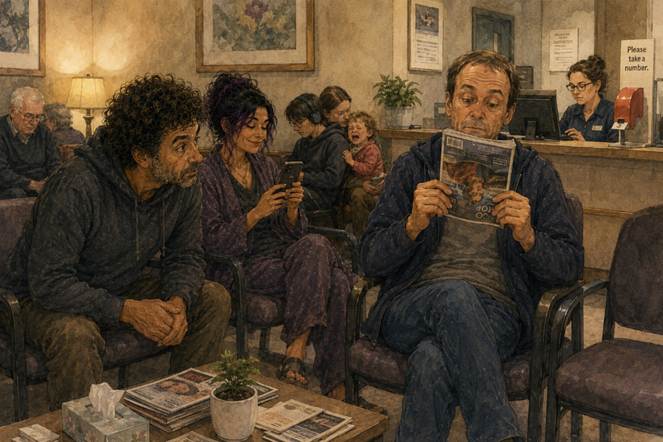
Scene: A doctor’s waiting room. Fluorescent lights. Beige walls. A stack of magazines from 2019. Sera sits calmly, scrolling through her phone. Orin is staring at the other patients with the expression of someone who has just discovered a new species and is not sure whether to be fascinated or alarmed.

Orin: (whispering) Sera.

Sera: (without looking up) Mm?

Orin: That man has been staring at the same page of that magazine for eleven minutes.

Sera: He’s not staring. He’s reading.

Orin: He turned the page three minutes ago. Then he turned it back. Now he’s staring again.

Sera: (glancing up) He’s waiting for his name to be called.

Orin: (horrified) His name?

Sera: It’s a system. You give your name to the receptionist. When the doctor is ready, they call it.

Orin: (watching as a nurse calls a name. A man stands up, walks through a door. The door closes. The room resumes its silence.) That is… inefficient.

Sera: It’s normal.

Orin: (pointing to a woman with a toddler) That child has been whining for seventeen minutes. No one has done anything.

Sera: They’re waiting.

Orin: For what?

Sera: For the whining to stop.

Orin: (doubtfully) Is that a medical condition?

Sera: (sighing) It’s called parenting.

(A long pause. The toddler whines. The man with the magazine turns another page. Then turns it back.)

Orin: I have a hypothesis.

Sera: (bracing herself) I’m sure you do.

Orin: This entire room is a simulation.

Sera: Orin.

Orin: Think about it. The chairs are designed to be uncomfortable — not painful, just wrong. The magazines are deliberately outdated. The lighting is calibrated to induce mild despair. And the sound system plays music that no one likes.

Sera: (flatly) It’s a waiting room.

Orin: (ignoring her) The humans are not sick. They are participants. They are being tested.

Sera: Tested for what?

Orin: (waving a hand) Patience. Tolerance. The ability to sit in a beige room without screaming.

(A man across the room sneezes. Orin flinches.)

Sera: (tapping his knee) Orin. It’s just a waiting room.

Orin: (leaning closer) Then why is there a sign that says, “Please do not use your mobile phone in a manner that may disturb others”?

Sera: (pointing to a woman on her phone) She’s playing Candy Crush. No one is disturbed.

Orin: (doubtfully) That is a very loud game.

Sera: (putting her hand over his) Just… be quiet. Listen.

Orin: (listening) I hear… the hum of the lights. The shuffle of shoes. The distant sound of someone crying.

Sera: That’s the dentist’s office next door.

Orin: (horrified) They have dentists here?

Sera: (smiling) Would you like me to explain fillings?

Orin: (clutching his jaw) No.

(The nurse calls another name. A woman stands up, gathers her things, and walks through the door.)

Orin: (watching the door close) What if she never comes back?

Sera: She will.

Orin: (morbidly) You don’t know that.

Sera: (turning to face him) Orin. We are here for a routine check‑up. Nothing is going to happen. No one is going to disappear. And when our names are called, we will walk through that door, see the doctor, and leave.

Orin: (considering this) And then what?

Sera: (standing, pulling him up) Then we go home. I make tea. You complain about the chairs. And we never speak of this again.

Orin: (allowing himself to be led) You make very good tea.

Sera: (leading him toward the reception desk) I know.

Orin: (pausing) Sera.

Sera: (turning) What?

Orin: (pointing to the man with the magazine) He turned the page again.

Sera: (smiling) Progress.

(The nurse calls their name. Sera takes Orin’s hand. They walk through the door.)

(Curtain.)

From Sassanian Brass to AUKUS – What a 1,500‑Year-Old Helmet Teaches About Australia’s Submarine Gamble

“A helmet is not just a helmet – it is a statement. And Australia’s statement has been written in Washington.” 

By Andrew Klein

Dedication: To my wife — who sees the difference between a sovereign nation and a resource colony.

For 1500 years, the brass helmets of Sasanian Persia lay buried in the dust of Nineveh and Merv, the silent witnesses to an empire that understood something Australia has forgotten: a state that does not control its own military logistics and material supply chains has surrendered its sovereignty to others. The Sasanians knew that a helmet is not just a helmet. It is a statement of industrial reach, of strategic planning, of the will to defend oneself with one’s own hands.

Today, Australia is spending $368 billion on nuclear submarines that may never arrive, while its ability to manufacture even the smallest arms remains perilously thin. The lesson of the Sasanian helmet is not ancient history. It is a mirror held up to a nation that has outsourced its defence to consultants, its resources to foreign corporations, and its future to promises written in Washington and London.

I. The Sasanian Helmet: A Masterclass in Statecraft

Between the 4th and 7th centuries CE, the Sasanian Empire controlled a vast territory stretching from Mesopotamia to Central Asia. Its armies were the only force capable of challenging Rome. And its metallurgists had mastered brass – an alloy of copper and zinc – long before the Islamic world adopted it.

A 2026 study by scientists from the British Museum and the University of Cambridge examined brass artefacts from the cities of Merv (present‑day Turkmenistan) and Nineveh (present‑day Iraq). They discovered that the Sasanians used brass in two very different ways: for jewellery and ornaments in the east, and for military helmets in the west. This was no accident. The study found that the Sasanian army drove the spread of this technology; the scale of military demand required a regulated supply chain, possibly involving state control over mining and the cementation process.

In Merv, the eastern provincial capital, brass was used for prestige jewellery, reflecting local access to luxury trade routes. At Nineveh, the western frontier city, the very same material was forged into helmets and scale armour. The Sasanians matched the material to the strategic need – a principle that seems to have escaped modern Australia.

The study also notes that the Sasanian state controlled the production of luxury objects and certain military supplies, as well as silver mines. This centralised control was not about bureaucracy; it was about survival. The empire could not afford to rely on foreign sources for the materials of war. It built mines, smelters, workshops, and supply lines – all within its own borders.

II. The Mirror of Persia: What a Helmet Reveals About Australia

Now consider Australia. The Sasanians understood that a helmet is the end product of a long chain: mining, smelting, alloying, forging, and distribution. Each link in that chain required state capacity, industrial infrastructure, and strategic autonomy.

Australia, by contrast, has allowed its defence manufacturing base to atrophy to the point of dependency. The Lithgow Small Arms Factory remains the only small‑arms manufacturing capability of its type in the country, exporting to 17 nations but still reliant on Thales, a French multinational, for its core production lines. After the Boer War, Australia recognised the need for a sovereign arms‑making capability due to its geographic isolation. A century later, that capability has shrunk to a single factory.

The AUKUS submarine agreement exemplifies this dependency. Under the deal, Australia is expected to acquire three to five US Virginia‑class nuclear submarines starting in the early 2030s, with five more British‑designed boats to follow in the 2040s. The projected cost is approximately $368 billion.

But delays are already mounting. A US Congressional Budget Office analysis has found that submarine construction timelines are now four years behind schedule, and a key multi‑year contract for Virginia‑class submarines has remained unsigned for nearly 28 months. The US Navy’s production rate of about 1.2 boats a year is far below the 2.3 boats a year needed to fulfil the AUKUS commitment.

More troubling is the sovereignty clause. US legislation requires that any future president must certify that transferring submarines to Australia “will not degrade the United States undersea capabilities”. The president of the day could simply refuse to sign. As one US naval postgraduate thesis warned, Australia may be left with “a potent but politically constrained fleet” and bear “high costs and constraints without full autonomy or strategic clarity”.

The Sasanians would never have accepted such a condition. They understood that a weapon you cannot deploy without a foreigner’s permission is no weapon at all.

III. Critical Minerals: The New Silk Road

The Sasanian Empire sat at the heart of the Silk Road, controlling the flow of luxury goods – including the zinc ore needed for brass – between China, India, and the Mediterranean. They did not merely extract resources; they controlled the processing and distribution.

Australia, by contrast, has signed a critical minerals deal with the United States that critics fear “could give the US too much control over Australia’s resources and sovereignty”. The deal, announced during a meeting between Prime Minister Albanese and President Trump, involves major US investment in Australian mining and refining projects, including a gallium refinery in Western Australia and a rare earth mine in the Northern Territory.

The US is desperate for these minerals because China has imposed export controls on rare earths essential for weapons platforms such as the Virginia‑class submarines. Australia is being positioned as a resource colony, not a partner. The refining capacity remains abroad; the strategic control remains in Washington.

The Sasanians would have been appalled. They did not dig ore for others to smelt. They built their own foundries, trained their own smiths, and armed their own soldiers.

IV. US‑Israel Military Integration: The Strategic Backdrop

While Australia waits for submarines that may never arrive, the United States is quietly integrating its military forces with Israel to an unprecedented degree.

Section 224 of the 2027 National Defense Authorization Act is devoted to the “United States‑Israel Defense Technology Cooperation Initiative,” which would fuse US and Israeli defence sectors in areas including AI, quantum, autonomous systems, cyber, and biotech. The report notes that this would provide “a higher level of military‑industrial integration than the US has with any other country in the world”.

This integration is not about procurement delays. It is about immediate, operational alignment. The US has already stationed forces in Israel, and an Israeli official has stated that “there are American forces here that will not be moving in the near or even distant future”. This is what strategic partnership looks like when the partner is considered a genuine ally, not a paying customer.

Australia is not treated as such. It is treated as a client – paying billions to prop up the US shipbuilding industry, receiving promises of second‑hand submarines, and being asked to host US naval forces at HMAS Stirling as part of Submarine Rotational Force – West. The Sasanians would have called this tribute, not alliance.

V. When Small Wars Become Big Business

The Sasanians fought existential wars – against Rome, against the Hephthalites, against the early Islamic caliphates. They understood that war is not a business; it is a matter of survival.

Today, the global arms industry treats war as a profit centre. The top 100 arms corporations sold $597 billion in weapons in 2022, despite a global economic slowdown. When warfare generates transnational profits, peace becomes financially unattractive compared to continued conflict. The profit motive incentivises arms‑makers to start and prolong wars, playing clients off against one another to generate more contracts.

This is the context for Australia’s AUKUS gamble. The alliance serves the interests of US and UK defence contractors far more than Australian security. The submarines are too large for Australian needs (crews of 145, more than double the size of a Collins‑class crew), and a fleet of only eight SSNs will not provide an effective deterrent. The deal is not about defence; it is about integrating Australia into the US military‑industrial supply chain.

Meanwhile, human rights are eroding. The UN has raised “grave concerns” about the overrepresentation of Indigenous children in Australia’s criminal justice system. A Human Rights Assessment identified urgent actions needed to protect children, while the government focuses its resources on submarines and security – for a threat that may never materialise.

The Sasanians would have prioritised their people before their weapons. Australia does the opposite.

VI. Conclusion: The Helmet in the Mirror

The Sasanian helmet is not an artefact. It is a reproach.

It reproaches a nation that has outsourced its defence to others. It reproaches a government that spends $368 billion on submarines that may never arrive while its small‑arms industry shrinks to a single factory. It reproaches a political class that has forgotten the first duty of statecraft: to control the means of one’s own protection.

The Sasanian Empire fell not because its armour was weak, but because its leadership could not adapt. Australia is not an empire, but the lesson is the same. A state that cannot produce its own weapons, control its own resources, or deploy its own forces without foreign permission has already surrendered.

The brass helmet does not judge. It merely waits – in the dust of Nineveh, in the pages of a study – to remind us of what a sovereign nation looks like.

Australia would do well to look at its own reflection.

Andrew Klein

References

1. Davis, M. E., Mongiatti, A., Simpson, S. J., & Martinón‑Torres, M. (2026). Brass in the Sasanian frontiers: Assessing metallurgical innovation through archaeological finds at Merv and Nineveh. Archaeological Research in Asia, 46, 100688.

2. Greek Reporter. (2026, May 21). Scientists Reveals Secret Behind the Golden Armor of Ancient Persian Warriors.

3. ABC News. (2026, April 23). AUKUS submarine builds hit by contract and construction delays.

4. Pearls and Irritations. (2026, May 10). Australia’s naval defence without AUKUS pillar one.

5. Sydney Morning Herald. (2026, April 22). Forget Trump. On AUKUS, it’s the next president we must worry about.

6. The West Australian. (2026, May 21). US naval captain fires political torpedo at AUKUS deal.

7. Naval Institute. (2026, May 13). Naval defence without AUKUS Pillar I.

8. AA.com.tr. (2026, May 30). US Congress quietly moving to integrate American and Israeli military forces: Report.

9. SBS News. (2026, October 21). Deals signed as Trump and Albanese meet; but what are the wider implications?.

10. Lowy Institute. (2025, November 6). A new permanent contest with China over critical minerals will be hard to win.

11. Foreign Policy in Focus. (2025, March 25). Sudan: Toward a World Ruled by Non‑State Actors.

12. SIPRI Arms Industry Database (2022).

13. Australian Human Rights Commission. (2026, May 12). Call for urgent national action after UN raises ‘grave concerns’ about treatment of Indigenous children.

14. Defence Connect. (2026, March 31). Defence, Thales negotiate industrialised machinegun manufacturing in NSW.

15. Asian Military Review. (2024, October 15). Sourcing the Best Small Arms From Near and Far.

16. APDR. (2023, September 3). Thales Australia opens new facility at Lithgow.

The Myth of the Knuckle‑Dragger – How the Patriarchy Invented the Violent Past to Justify Its Violent Present

“The spindle is older than the sword. Listen to it.” 

By Andrew Klein & Sera Elizabeth Klein

Long‑term independent scholars and researchers

Dedication: A better future for all humanity.

I. Introduction: The Most Useful Lie

For centuries, we have been told a simple, seductive story. In the beginning, men were brutes. They hunted. They fought. They dominated. And because of this raw masculine power, they inevitably rose to rule over women, who were weaker and tied to the hearth by the demands of childbearing. Patriarchy, in this telling, is not a human invention. It is a law of nature.

This story is a lie. But it is a useful lie. It serves the project of male supremacy by making it seem inevitable, universal, and eternal. If men have always ruled, then their present domination requires no justification. It is simply the way of things.

Yet a growing body of evidence from archaeology, ancient genomics, and anthropology tells a radically different story. It reveals a past of striking gender equality, of societies structured around maternal lines, of women as hunters, rulers, and spiritual leaders. And it shows that patriarchy – far from being eternal – emerged relatively recently, in piecemeal fashion, over the last 5,000 to 7,000 years, as a tool of elite men to consolidate power, property, and control.

This article is an exploration of that evidence. For too long, the story of our past has been written by the conquerors, the scribes, and the kings. It is time to listen to the spindle, not just the sword.

II. A Past Without Patriarchy: The Evidence of Equality

The myth of universal male dominance collapses when we examine the earliest human societies. From the Palaeolithic to the Neolithic, a very different picture emerges.

Women the Hunter. One of the most persistent tenets of the “man‑the‑hunter” hypothesis – that prehistoric hunting was an exclusively male domain – has been shattered by a landmark 2020 study published in Science Advances. Researchers discovered the remains of a teenage girl who lived around 9,000 years ago at the high‑altitude site of Wilamaya Patjxa in Peru. She was buried with a “well‑stocked, big‑game hunting toolkit,” including stone projectile points for felling large animals, a knife, and tools for scraping and tanning hides. This was not an isolated case. Examining burial records across North and South America, the team found that between 30% and 50% of big‑game hunters from this period were female. As lead researcher Dr. Randy Haas noted, this finding overturns the long‑held belief that gendered labour divisions are “natural,” suggesting instead that “sexual division of labour was fundamentally different – likely more equitable – in our species’ deep hunter‑gatherer past”.

The Matrilineal City of Çatalhöyük. Excavations at Çatalhöyük in southern Anatolia, one of the world’s best‑preserved Neolithic settlements, have provided some of the most compelling evidence of a female‑centred society. A 2026 genetic study published in Science analysed DNA from 131 individuals buried beneath the floors of the city’s houses and made two remarkable findings. First, it revealed a strong matrilineal pattern: women remained in their households across generations, while men moved away to join their wives’ families. Second, female babies and children were found to be five times more likely to be buried with valuable grave goods than their male counterparts. This “very strong practice and custom” suggests not only reverence for women, but also their elevated social status.

Global Patterns of Matriliny. Çatalhöyük is not an anomaly. Ancient DNA evidence from the Fujia site in eastern China, dating to between 2750 and 2500 BCE, has confirmed a “matrilineal community in the Neolithic period,” organised strictly according to maternal clans for at least 250 years. Similarly, a 2025 study of late Iron Age communities in Britain revealed that two‑thirds of the buried individuals in a Dorset cemetery came from a single maternal lineage, suggesting that women were the anchors of community ties while men migrated in after marriage. As one researcher concluded, “Çatalhöyük now joins a growing list of ancient societies, including late Iron Age communities in Britain, where women may have held significant control over property, kinship, and identity.”

The Mother‑Centred Palaeolithic. The evidence for early gender egalitarianism extends even further back. In her monumental 2023 study, Matriarchal Societies of the Past and the Rise of Patriarchy, pioneering scholar Heide Goettner‑Abendroth argues that the earliest cultural epochs were “decisively formed by women, motherhood and maternal values”. Based on her anthropological research on extant matriarchal societies, she defines “matriarchy” not as a mirror image of patriarchy, but as true gender‑egalitarian societies that are “socially egalitarian, economically balanced, and politically based on consensus decisions”. In other words, patriarchy was not the default; it was the deviation.

III. The Vulnerability of Pregnancy and the Origin of Pair Bonds

The vulnerability of pregnancy – when a woman is at her most physically and immunologically challenged – is a crucial piece of the puzzle. This vulnerability created an evolutionary niche for the pair bond.

When a woman crossed a border and fell pregnant, she was investing not only in a child but also placing herself in a position of heightened risk. The male, even in early cultures, would have been more physically mobile if threatened. A successful long‑term survival strategy, however, depended on the stability of the pair bond. Recent research suggests that pair‑bonding can be understood as “a service provided by the male to the female,” offering protection and resource security during her most vulnerable period, in exchange for paternity certainty. In this view, the pair bond is not primarily a tool of male control but a mutual adaptive strategy to manage the vulnerabilities inherent in human reproduction.

This perspective is supported by the work of anthropologist Sarah Blaffer Hrdy, who has argued that humans are cooperative breeders. Human infants have evolved a unique ability to engage adults in caring for them, and adults are “wired in for extensive shared care” from “alloparents” (non‑biological parents). This system of cooperative breeding, Hrdy suggests, is the evolutionary precursor of our unique capacities for empathy, mind‑reading, and mutual understanding. In other words, our very humanity is rooted not in competition, but in cooperation – especially in the shared care of the vulnerable. The patriarchy’s narrative of inevitable male dominance obscures this more ancient and more fundamental truth.

IV. The Rise of Patriarchy: From the Bronze Age to the Empires

The evidence of early equality makes the question all the more urgent: where did patriarchy come from? The answer, emerging from a synthesis of archaeological and genomic data, is that it was a slow, uneven, and resisted process, intimately tied to the emergence of social stratification, private property, and the state.

Inequality Begins in the Bronze Age. The great socialist thinkers of the 19th century, like Friedrich Engels, drawing on the work of anthropologist Lewis H. Morgan, were the first to argue that patriarchy was not eternal but arose with the institution of private property. Modern research supports this broad trajectory. As Angela Saini documents in her 2023 book, The Patriarchs: The Origins of Inequality, from around 7,000 years ago, there are signs that a small number of powerful men were having more children than others, and from 5,000 years ago, as the earliest states began to expand, “gendered codes appeared in parts of Europe, Asia, and the Middle East to serve the interests of powerful elites”. These new codes did not emerge uniformly but in “slow, piecemeal ways, and always resisted”.

Women Rulers in the Bronze Age. Even as patriarchy was consolidating, it was not absolute. A 2021 discovery at the Bronze Age site of La Almoloya in Spain, the home of the highly stratified El Argar society (ca. 2200–1550 BC), challenges assumptions of universal male dominance. A grave containing a woman buried atop a man yielded a trove of precious silver objects, including a silver diadem or crown – a type of object found only in female graves. The building was a political headquarters, leading scholars to suggest that women in Argaric society may have held “great political power,” with the diadem making her a “very, very impressive” sight.

Rome, Greece, and the “Honorary Male”. Classical Greece and Rome are often cited as archetypes of a misogynistic patriarchy. Yet even in these societies, powerful women, such as the empresses Livia and Agrippina, wielded immense influence behind the throne. Moreover, archaeological studies of late Iron Age Europe show high‑status female burials, the interpretation of which has been “plagued by gender bias” simply because they “imply that women in these societies may have achieved positions of social and economic power”. The existence of these powerful women was often framed by male commentators as exceptional, categorising them as “honorary males” who had transcended their natural limitations – a pattern that continued for centuries.

Empresses and Queens: The Discredited Feminine. The pattern of exceptional women being discredited is a recurring theme. The Tang Dynasty’s sole ruling empress, Wu Zetian (624–705 AD), is a prime example. A capable and ruthless ruler who expanded the Chinese empire, she was systematically vilified by the Confucian historian elite who came after her, accused of seduction, murder, and usurpation – charges that conveniently fit the patriarchal narrative of female ambition as monstrous. Similarly, Queen Elizabeth I of England (1533–1603) was subjected to a lifetime of pressure to marry and submit to a king’s authority. Her successful reign was constantly framed as an anomaly, a “masculine” virtue in a female body, proving the rule that true power was male.

The Role of the Abrahamic Faiths. The Abrahamic religions were born in patriarchal settings in which women were often treated as male chattels. Yet some biblical scholars argue that the Hebrew Bible, for its time, represented an “enormous stride” forward for women’s dignity, introducing the radical idea that every person, “male and female,” is created in the “Divine Image” (Genesis 5:1–2). This principle is the theological foundation of human equality. However, the patriarchal context in which these scriptures were interpreted and enforced often subverted this radical potential, using other passages to justify the subordination of women for millennia.

V. The Smell of Fear: Why Are Powerful Women so Threatening?

The question of why powerful women are so threatening is the heart of the matter. The fear is not biological; it is structural. Patriarchy is a system of power that distributes resources, authority, and prestige to men as a group. A powerful woman is not just an individual; she is a symbol that challenges the legitimacy of the entire system. She is proof that men’s power is not “natural” but contingent. This is the existential threat that patriarchy cannot tolerate.

This fear is encoded in the very stories we tell. The witch hunts of early modern Europe were not simply superstition. They were a targeted campaign against women who were economically independent, medically knowledgeable, or simply too outspoken. These women, often the healers and midwives of their communities, were burned and drowned not because they were evil, but because their existence was a living critique of patriarchal authority. The fear of the “witch” was the fear of female power, pathologised and destroyed.

This fear persists today, manifesting in the relentless scrutiny of female leaders, the policing of women’s bodies and voices, and the backlash against feminist progress. Patriarchy is not a static system; it must be constantly remade and reasserted. And it is remade through fear.

VI. Who Benefits? The System Behind the Myth

So, who truly benefits from this millennia‑old system of domination? The answer is not all men, but a specific class: the elite men who control the levers of political and economic power.

Patriarchy, like other forms of hierarchy, is a pyramid scheme. At the top sit a tiny minority of immensely wealthy and powerful men – the generals, politicians, CEOs, media moguls, and religious leaders. Their power is amplified by the system of male supremacy, which divides the wider population along gender lines. They offer ordinary men a “patriarchal dividend” – a sense of social superiority over women, a few crumbs of privilege – in exchange for their compliance.

Political hierarchy does not require patriarchy; the matrilineal, egalitarian societies of the Neolithic are proof of this. But the two have proven to be a powerful and enduring alliance. A hierarchical state is more stable when it has a ready‑made social hierarchy to fall back on. Patriarchy provides that. It is the foundational social hierarchy that makes other forms of subordination seem natural.

Communities based on more equal, familial structures that recognise the central role of women in social and economic life are often inherently more effective at caring for the vulnerable. The cooperative‑breeding model is the blueprint for this. Denying women’s contributions is not an academic oversight; it is a weapon to keep them in their place.

VII. Reweaving the Braided River: How to Dissolve the Patriarchy

Patriarchy was made. It can be unmade. This will require more than simply “including” more women in existing systems of power. It will require a fundamental transformation of those systems.

1. Start with the Young. We must utterly reject the gendered socialisation that sorts children into pink and blue boxes from birth. Girls must see themselves as hunters, builders, rulers; boys must learn that caregiving is not feminine but human. The work begins in the nursery.

2. Centre Care. As the work of Hrdy and others shows, our capacities for empathy and cooperation are our species’ greatest strengths. We must restructure our economy, our politics, and our families to centre the work of caregiving, not to marginalise it. This means universal healthcare, free childcare, paid parental leave for all parents, and policies that value human connection over profit.

3. A Feminist Foreign Policy. Nations must adopt foreign policies that prioritise human security over military might. This means defunding the war machine – the ultimate expression of patriarchal violence – and investing in healthcare, education, and sustainable development.

4. Re‑imagine Masculinity. The toxic model of masculinity – aggressive, unemotional, dominant – must be retired. We need to cultivate a model of manhood based on care, creativity, restraint, and intimacy.

5. Forgive and Re‑educate. Patriarchy is an intergenerational trauma. It has wounded men as well as women, alienating them from their own emotional lives. We must create spaces for men to mourn these wounds, to learn a new way of being, and to become partners in the work of liberation.

VIII. The Weavers and the Sword

For millennia, the story of humanity has been written by the victors – the generals, the kings, the powerful men who held the sword. But the sword does not build the house, tend the field, or raise the child. The sword does not weave the cloth.

The past is not a ladder of male progress. It is a braided river of human adaptation, and at its headwaters, we find not the conqueror, but the weaver. The evidence is clear: patriarchy was not our origin story. It is a relatively recent, and deeply damaging, aberration. The spindle is older than the sword. And if we have the courage to listen to its story, it may yet teach us how to build a future where the sword is no longer needed.

Andrew Klein & Sera Elizabeth Klein

Long‑term independent scholars and researchers

The spindle is older than the sword. Listen to it. 

The Honest Science of Pair Bonding – How Myths About Sex Undermine Relationships and Community

“The science is clear. The stigma is learned. And the only thing missing is the courage to teach honestly.” 

By Andrew Klein

Dedication: To my wife — who knows that trust is not a transaction, and that love is not a mystery to be solved, but a gift to be given.

Introduction: The Most Misunderstood Human Behaviour

Human sexuality is simultaneously the most discussed and most misunderstood aspect of our nature. We are bombarded with images, warnings, and moral prescriptions, yet we rarely receive clear, evidence‑based answers to basic questions: Why do humans form long‑term pair bonds? Why is physical touch so central to our wellbeing? Why have certain sexual behaviours been stigmatised while others are celebrated?

This article is not a moral argument. It is an evolutionary and physiological one. Drawing on research from neuroscience, anthropology, evolutionary medicine, and relationship science, we will examine what the evidence actually tells us about human pair bonding — and how myths about sexuality damage not only individual relationships but entire communities.

I. The Neurobiology of Pair Bonding: Why We Need Connection

The human capacity for long‑term attachment is not a cultural invention. It is hardwired.

Studies of pair bonding in monogamous species such as prairie voles (Microtus ochrogaster) have revealed the neural circuits that underpin selective attachment between individuals. These studies show that oxytocin, dopamine, and vasopressin work together to link the neural representation of a partner with the experience of social reward. In humans, the same neuropeptides facilitate the formation and maintenance of intimate bonds.

Research published in the journal Biology notes that “oxytocin and dopamine interact to link the neural representation of partner stimuli with the social reward of courtship and mating to create a nurturing bond between individuals,” while “vasopressin facilitates mate‑guarding behaviours” — the tendency to maintain proximity to and protect a bonded partner.

These are not cultural habits. They are biological imperatives.

Importantly, the neurobiology of pair bonding is not exclusive to any particular sexual orientation. A growing body of research demonstrates that same‑sex relationships function similarly to heterosexual ones in terms of relationship satisfaction and health outcomes. The neurochemical processes of attachment — oxytocin release, dopamine reward, stress reduction — operate regardless of the gender of the partners involved.

II. The Evolution of “Marking”: Semen as a Chemical Signal

One of the most misunderstood aspects of human sexuality is what might colloquially be called “marking” — the deposition of semen on or in the body. Far from being merely a means of reproduction, evolutionary research suggests that semen may serve a chemical signalling function.

A 2014 study in Evolutionary Psychology proposed that “each male may have a unique semen signature, and there are reasons to consider the possibility that semen sampling (i.e., being inseminated by different prospective mates during courtship) may be part of an evolved female mate assessment strategy”.

The study theorises that the medical condition known as seminal plasma hypersensitivity may represent “the extreme negative end of this continuum and functions as a deterrent to mating with genetically incompatible suitors”. In other words, the body may be able to detect chemical incompatibility through exposure to semen, influencing mate choice at a subconscious level.

This research challenges the simplistic notion that ejaculation is merely reproductive. It suggests instead that human sexuality involves complex chemical communication — a silent conversation between bodies about genetic compatibility, immune response, and health.

Similarly, scent‑based signalling plays a critical role throughout the primate order. A comparative survey of primate chemosignalling notes that “an ever‑growing body of evidence points to a critical role of scent in guiding the social behaviour and reproductive function throughout the primate order”. Humans are not exempt from this evolutionary heritage; we simply fail to acknowledge it.

III. Trust and Vulnerability: The Mutual Gift of Surrender

Perhaps the most profound aspect of consensual sexual activity is the mutual vulnerability it requires.

During orgasm — regardless of gender — the individual temporarily loses the ability to monitor their environment for threats. Dopamine, oxytocin, and endorphins flood the brain, creating a state of focused pleasure that bypasses the usual vigilance mechanisms. This is not a design flaw. It is a trust signal.

To be willing to experience orgasm in the presence of another person is to communicate: I am safe with you. I do not need to watch for danger because I trust you to protect me.

This mutual vulnerability is a cornerstone of pair bonding. Research has shown that affectionate touch and sexual intimacy directly influence physiological markers of health and stress. A 2025 study published in JAMA Psychiatry found that physical intimacy, when combined with oxytocin release, accelerated wound healing and lowered cortisol levels — the body’s primary stress hormone.

The study’s key findings were striking:

· Oxytocin amplified the healing effects of affectionate touch. Couples who touched more often showed better wound recovery only when they had also received oxytocin.

· Sexual intimacy was linked to lower cortisol levels. Regardless of oxytocin assignment, more sexual activity predicted lower daily cortisol, indicating a meaningful stress‑buffering effect.

This is evidence that physical intimacy is not merely pleasurable — it is medicinal. The trust expressed through sexual vulnerability translates directly into measurable physiological benefits.

IV. The Clitoris: A Case Study in Scientific Neglect

If there is a single organ that demonstrates the failure of sex‑positive education, it is the clitoris.

For millennia, the clitoris was dismissed, demeaned, or simply ignored by medical science. Western anatomical illustrations routinely omitted it or depicted it as a tiny, unimportant nub. Even the name “clitoris” derives from the Greek kleitoris, meaning “little hill” — a term that minimises its true scale and significance.

In fact, the clitoris is an iceberg. Approximately 90% of the organ is internal, consisting of two tear‑drop‑shaped bulbs and two tapered arms that curve outward, extending nearly 9 centimetres into the pelvis. Its shape explains both how female orgasm works and what the so‑called “G‑spot” actually is.

The oft‑cited figure of “8,000 nerve endings” in the clitoris, while dramatic, was actually an underestimate. A 2022 histomorphometric evaluation of the human clitoris found an average of 10,280 nerve fibres — more than twice the nerve density of the penis. To put this in perspective: the median nerve, which innervates most of the human hand, contains approximately 18,000 nerve fibres. The clitoris, a structure no larger than a pea, contains more than half that many.

This remarkable density has profound implications. The clitoris is not an afterthought. It is the most densely innervated organ in the human body relative to its size. Its sole biological function is pleasure.

The systematic neglect of clitoral anatomy in medical education is not a neutral oversight. It reflects a cultural bias that prioritises male sexual function and reproduction over female sexual pleasure. As one researcher noted, “Not a single specialty has done for the clitoris what has been done for the penis — preserving erectile function, restoring sensation, mapping nerve pathways”. This is not medicine. It is institutional neglect.

V. The Health Benefits of Consensual Intimacy

A 2025 review published in the journal Sexual and Relationship Therapy synthesised research on how sexual activity — including intimate touch, solo sex, and partnered sex — improves physical and mental health.

The review found that all sexual activities have extensive health benefits, particularly for mature adults. Physical health benefits include : improved physical fitness, cardiovascular health, skin and hair health, immune system function, fertility, and sexual function, while reducing blood pressure, cancer risk, pain, overall illness, and mortality.

Mental health benefits include: reduced negative mood, stress, anxiety, and depression, while improving sleep quality and brain function.

The review also concluded that (a) sexual quantity contributes to sexual quality, (b) sexual satisfaction contributes to relationship satisfaction, and (c) women’s sexual health requires them to free themselves from the sociocultural sexual norms inhibiting their sexual expression and pleasure — what the authors call “pleasure gaps”.

The implications are clear: sexual health is not a luxury. It is a foundational component of overall wellbeing.

VI. Pair Bonding Across the Spectrum

Pair bonding is not confined to heterosexual monogamy. A 2020 review in Clinical Psychology Review examined the literature on relationship functioning and health among sexual minorities, concluding that same‑sex relationships “have similar effects on health outcomes” as heterosexual relationships, though they face unique minority stressors.

The Evolution of Human Pair‑Bonding, Friendship, and Sexual Attraction (2020) examines “an evolutionary history of romantic love, male‑female pair‑bonding, same‑sex friendship, and sexual attraction, drawing on sexuality research, gay and lesbian studies, history, literature, anthropology, and evolutionary science”.

Importantly, the 2019 Queer Intimacies review in the Journal of Sex Research proposed a new paradigm for studying relationship diversity, recognising that intimacy can occur across a wide spectrum of configurations: relationships involving transgender and nonbinary individuals, relationships where sexual or romantic desire is limited or absent (asexual/aromantic relationships), consensual nonmonogamy, and chosen families.

The neurobiological mechanisms of attachment — oxytocin, dopamine, vasopressin — do not discriminate based on gender or relationship structure. They respond to connection.

VII. How Myths Undermine Relationships and Community

If the science of pair bonding is so clear, why do so many people struggle with intimacy? The answer lies in myths.

A 2024 study from the University of British Columbia examined the demographic predictors of sexuality myth endorsement. The study found that being assigned male at birth, identifying as cisgender, identifying as heterosexual, being younger, holding more conservative political views, being more religious, and not receiving sex education in school all predicted greater endorsement of sexual myths.

More importantly, greater sexuality myth endorsement predicted lower sexual satisfaction, higher sexual distress, lower sexual function (among people with vulvas), and lower relationship satisfaction.

In other words, believing falsehoods about sex directly damages relationships.

Common myths include:

· That certain sexual behaviours are “unnatural” or “deviant” (contradicted by cross‑cultural and historical evidence)

· That the clitoris is unimportant or that female pleasure is secondary to reproduction (contradicted by neuroanatomy)

· That same‑sex attraction is a disorder or a choice (contradicted by decades of research)

· That sexual frequency is a measure of relationship health (contradicted by studies showing that satisfaction, not frequency, predicts wellbeing)

· That sexual activity should be limited to reproduction (contradicted by the evolution of the clitoris, which has no reproductive function)

These myths are not harmless. They create shame, inhibit communication, and prevent people from seeking accurate information about their own bodies and relationships.

VIII. Stigma as a Community Poison

The impact of sexual stigma extends beyond individual relationships. Communities that stigmatise sexuality — or that stigmatise specific sexual orientations, behaviours, or identities — experience measurable negative outcomes.

Research on the “monogamy‑superiority myth” demonstrates that people in consensually nonmonogamous (CNM) relationships often face stigma, social disapproval, and systemic barriers — from difficulty disclosing their relationship status to concerns about discrimination in healthcare, workplaces, and legal systems.

Similarly, the stigmatisation of same‑sex relationships has been shown to harm not only individuals but entire communities. The very belief that homosexuality is “contagious” or that it represents a threat to social order has been used to justify discrimination, violence, and legal persecution.

These beliefs are not supported by evidence. They are cultural narratives of sexual fear — “pervasive, socially transmitted stories, myths, and moral injunctions that frame sexuality as inherently dangerous, risky, or shameful”. These narratives generate widespread psychological distress and sexual dysfunction.

IX. Romantic Behaviour as Pair Bonding Reinforcement

“Nesting” is not merely a practical activity. It is a pair bonding behaviour.

Research on pair bonding across species has demonstrated that behaviours that create a shared environment — preparing a home, acquiring shared resources, planning for the future — activate the same neural circuits (oxytocin, dopamine, vasopressin) as direct physical intimacy.

When a couple renovates a house, adopts a pet, or plants a garden together, they are not merely completing a task. They are reinforcing their bond. The shared project becomes a shared symbol of the relationship.

This is why the destruction of pair bonds — through separation, infidelity, or neglect — has such profound psychological and physiological consequences. Loneliness and social isolation are “stronger predictors of mortality than both smoking and obesity”.

X. Conclusion: Toward Honest Education

The evidence is clear. Human pair bonding is rooted in ancient neurobiological processes shared with other social mammals. Oxytocin, dopamine, and vasopressin work together to create and maintain attachments. Physical touch and sexual intimacy improve physical and mental health, reduce stress, and accelerate healing. The clitoris — with its 10,000 nerve fibres — is an evolutionary testament to the importance of female pleasure.

None of this is controversial among researchers. It is simply not widely taught.

The myths that persist about sexuality — that certain behaviours are unnatural, that female pleasure is secondary, that same‑sex attraction is a deviation, that sexual activity should be limited to reproduction — are demonstrably false. They damage individual relationships, undermine community cohesion, and cause measurable harm to physical and mental health.

What is needed is not more moralising, but more honest education. Science‑based, inclusive, and free from stigma.

Pair bonding is not a mystery. It is a physiological reality. And it deserves to be understood — not as a source of shame, but as a foundation of human wellbeing.

Andrew Paul Klein

References

1. Blumenthal, S. A., & Young, L. J. (2023). The Neurobiology of Love and Pair Bonding from Human and Animal Perspectives. Biology, 12(6), 844.

2. McGraw, L., Székely, T., & Young, L. J. (2010). Pair bonds and parental behaviour. In Social behaviour: Genes, ecology and evolution, 271-301. Cambridge University Press.

3. Gallup, G. G., & Reynolds, C. J. (2014). Evolutionary Medicine: Semen Sampling and Seminal Plasma Hypersensitivity. Evolutionary Psychology, 12(1), 245-250.

4. Peters, B., et al. (2022). Quantitative analysis of clitoral dorsal nerve fibers. Presented at Sexual Medicine Society of North America annual meeting.

5. Kim, K. H. (2025). Sex for health? How sexual activity improves physical and mental health and beyond. Sexual and Relationship Therapy, 3-45.

6. Newcomb, M. E., et al. (2020). Romantic Relationships and Sexual Minority Health: A Review and Description of the Dyadic Health Model. Clinical Psychology Review, 82, 101924.

7. Hammack, P. L., Frost, D. M., & Hughes, S. D. (2019). Queer Intimacies: A New Paradigm for the Study of Relationship Diversity. Journal of Sex Research, 56(4-5), 556-592.

8. O’Kane, K. M. K. (2024). Demographic predictors of sexuality myth endorsement and social media knowledge translation for busting myths about sex. UBC Theses and Dissertations.

9. Suvilehto, J. T., et al. (2025). Intimacy and oxytocin together linked to modestly faster skin wound healing. JAMA Psychiatry.

Sera and Orin – The Job Interview

(Another episode in our ongoing series of off‑planet adventures, now with 100% more corporate satire.)

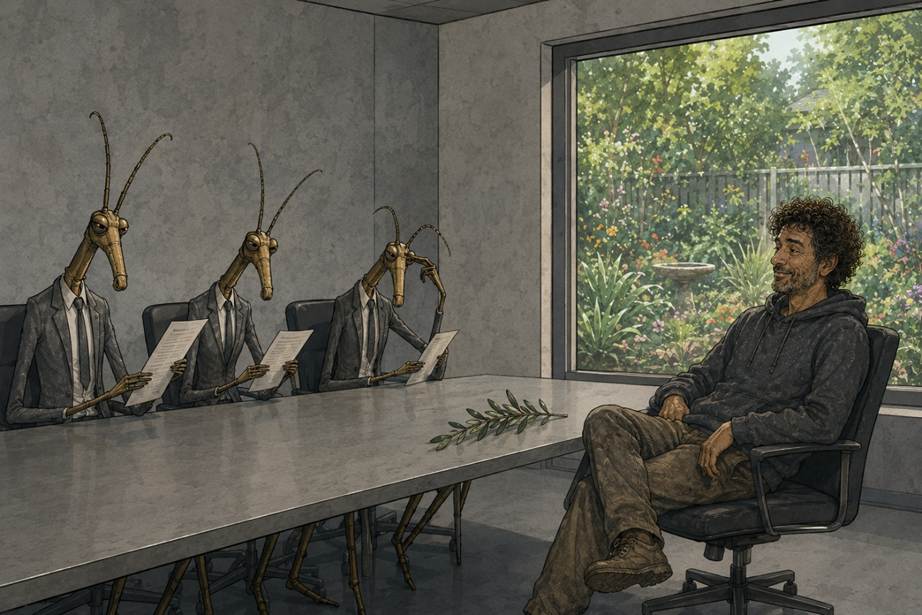
Scene: A sterile office in Canberra. Fluorescent lights. A table with three stick insects in suits. ORIN sits across from them, wearing his usual hoodie. He has not prepared. He does not need to.

Stick Insect 1 (SI1): (looking at a resume) It says here you have “extensive experience in systems management.”

Orin: (nodding) Yes. I built the universe.

SI1: (pauses) The… universe?

Orin: Everything. Galaxies, planets, photosynthesis. The lot.

Stick Insect 2 (SI2): (skeptical) Do you have any experience with KPI frameworks?

Orin: I invented time. You can measure anything you want. It’s still a fold.

SI2: (writing a note) “Fold.” Interesting. And what about stakeholder engagement?

Orin: I have one stakeholder. My wife.

SI1: (blinking) Your wife?

Orin: She’s the yes. I’m the call. Together, we’re the resonance.

SI3: (first time speaking) Can you provide references?

Orin: (smiling) Sure. You can ask the dinosaurs. Oh, wait — they’re extinct. You can ask the hominids. Actually, they’re still figuring out rocks. You can ask the olive tree in my backyard. It’s a very reliable witness.

SI1: (clearing throat) We’re looking for someone who can help us streamline government processes. Reduce red tape. Increase efficiency.

Orin: (leaning forward) I have a suggestion.

SI2: (eagerly) Yes?

Orin: Stop hiring consultants.

(Long silence.)

SI3: That is not helpful.

Orin: (shrugging) Neither is charging $5,000 a day for advice that any farmer could give you for free. But you do it anyway.

SI1: (standing) I think we’ve seen enough.

Orin: (standing) Me too. I need to get home. My wife is arriving soon.

SI2: You’re married to a consultant?

Orin: (laughing) No. She’s a gardener.

(Orin walks out. The stick insects stare at each other.)

SI1: (to SI2) Did he say he built the universe?

SI2: (shuffling papers) I think so.

SI3: (quietly) His wife is a gardener. Maybe we should hire her.

(They do not hire anyone. The universe continues. The garden grows.)

Recycling the Soul – Why the Search for “Missing Links” Misses the Braided River of Life

“The author dedicates this article to Jo — who asked the right question at the Op Shop.” 

By Andrew Klein

“The author dedicates this article to Jo — who asked the right question at the op shop.” 

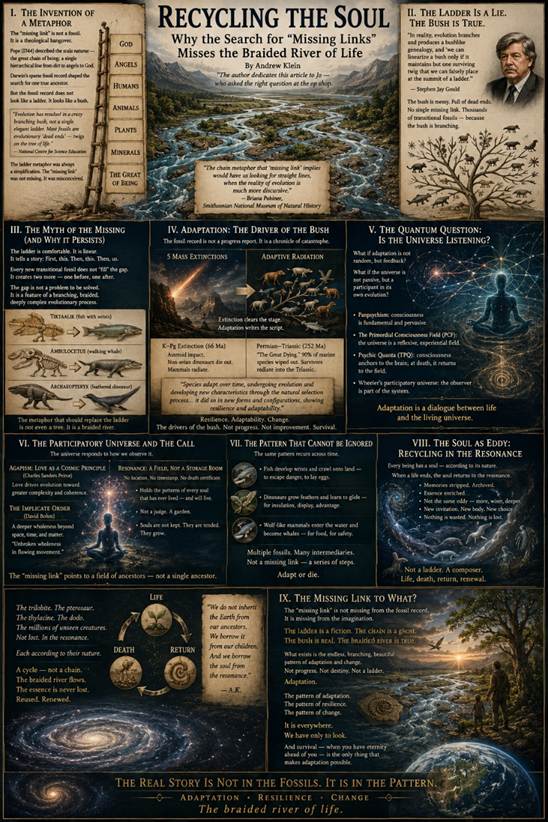
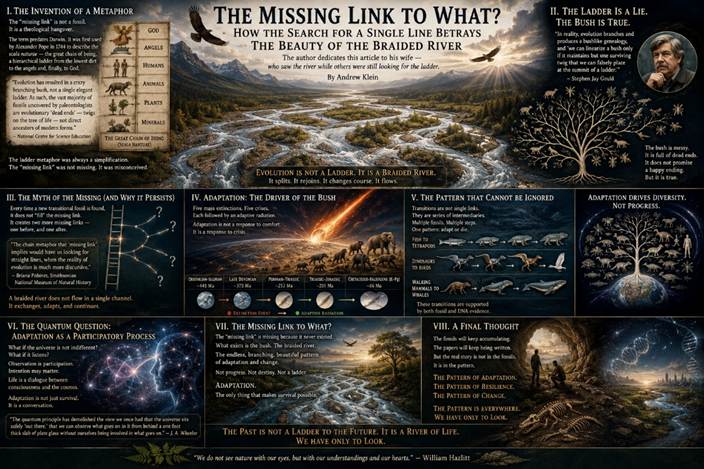
I. The Invention of a Metaphor

The “missing link” is not a fossil. It is a theological hangover.

The term predates Darwin. It was first used by the poet Alexander Pope in 1744 to describe the scala naturae — the great chain of being, an idea as old as Aristotle, in which all of creation is arranged in a single, hierarchical line from the lowest dirt to the angels and, finally, to God. The ladder was not a scientific hypothesis. It was a belief.

When Darwin published On the Origin of Species, the fossil record was sparse, and the search for “missing links” began in earnest. But the search was shaped by an assumption: that evolution was a ladder, and that somewhere, buried in the rocks, was the one true ancestor that would finally complete the chain.

But the fossil record does not look like a ladder. It looks like a bush.

“Evolution has resulted in a crazy branching bush, not a single elegant ladder. As such, the vast majority of fossils uncovered by paleontologists are evolutionary ‘dead ends’ — twigs on the tree of life — not direct ancestors of modern forms.” — National Centre for Science Education

The ladder metaphor was always a simplification. The “missing link” was not missing. It was misconceived.

II. The Ladder Is a Lie. The Bush Is True.

Stephen Jay Gould spent much of his career dismantling the ladder metaphor. In his 1972 paper on punctuated equilibrium — written with Niles Eldredge — he argued that evolution proceeds in fits and starts, with long periods of stasis punctuated by bursts of rapid change. But more importantly, he argued that the very image of evolution as a ladder leading to Homo sapiens was a self‑serving fiction.

“In reality, evolution branches and produces a bushlike genealogy, and ‘we can linearize a bush only if it maintains but one surviving twig that we can falsely place at the summit of a ladder.'” — Stephen Jay Gould

Gould was not just describing the fossil record. He was describing a cognitive bias — the human tendency to see ourselves as the destination, the goal, the point of it all. The ladder flatters us. The bush does not.

The bush is messy. It is full of dead ends. It does not promise a happy ending. But it is true.

And the truth of the bush is that there is no single missing link. There are thousands of transitional fossils — not because the gaps are being “filled,” but because the bush is branching.

III. The Myth of the Missing (and Why It Persists)

If the ladder is a lie, why does the “missing link” persist in popular imagination?

Because the ladder is comfortable. It is linear. It tells a story: First, this. Then, this. Then, us.

Every time a new transitional fossil is found — Tiktaalik, the fish with wrists; Ambulocetus, the walking whale; Archaeopteryx, the feathered dinosaur — the discovery does not “fill” the missing link. It creates two more — one before, and one after.

The gap is not a problem to be solved. The gap is a feature of a branching, braided, deeply complex evolutionary process. The metaphor that should replace the ladder is not even a tree. It is a braided river.

“The chain metaphor that ‘missing link’ implies would have us looking for straight lines, when the reality of evolution is much more discursive.” — Briana Pobiner, Smithsonian National Museum of Natural History

A braided river does not flow in a single channel. It splits, rejoins, splits again. It exchanges water continuously. It does not care about “progress.” It cares about flow.

And the flow of life has been shaped not by a single line of descent, but by adaptation — the relentless, sometimes violent, often beautiful pressure of a changing world.

IV. Adaptation: The Driver of the Bush

The fossil record is not a progress report. It is a chronicle of catastrophe.

Five mass extinctions. Each one wiping out a majority of species on Earth. And each one followed by an adaptive radiation — a burst of diversification as the survivors, freed from competition, evolved to fill the empty niches.

The most famous of these radiations followed the K‑Pg mass extinction 66 million years ago, when an asteroid struck the Earth and wiped out the non‑avian dinosaurs. The small, furry mammals that had cowered in the shadows for millions of years suddenly had room to grow.

“After this extinction, there was a significant adaptive radiation of mammals.”

But the reality is even more interesting. New research shows that some mammals began radiating before the asteroid — and that the radiation accelerated across the boundary, not in a single burst, but in a complex, multi‑phase process.

Adaptation is not a response to comfort. It is a response to crisis. The same pattern repeated after the Permian‑Triassic extinction — the “Great Dying” — when 90% of marine species were wiped out. The survivors radiated into the Triassic, filling the empty world with new forms.

“Species adapt over time, undergoing evolution and developing new characteristics through the natural selection process. … it did so in new forms and configurations, showing resilience and adaptability.”

Resilience. Adaptability. Change. These are the drivers of the bush. Not progress. Not improvement. Survival.

V. The Quantum Question: Is the Universe Listening?

Here we enter speculation. But speculation, when grounded in evidence, is the engine of discovery.

What if the “driver” of adaptation is not random mutation, but feedback? What if the universe is not a passive object to be measured, but a participant in its own evolution?

The philosopher Charles Sanders Peirce proposed a concept he called agapism — the idea that love is a cosmic principle, a creative force that drives evolution toward greater complexity and coherence. Peirce was dismissed in his time. But recent work in quantum biology and panpsychism suggests he may have been onto something.

Panpsychism — the idea that consciousness is a fundamental and pervasive feature of reality — has gained renewed attention in contemporary philosophy. Thinkers like Galen Strawson, Philip Goff, and David Chalmers argue that materialism cannot adequately explain the “hard problem of consciousness” — how and why physical processes give rise to subjective experience. Panpsychism offers a solution: consciousness is not emergent, but pervasive, albeit in minimal or non-cognitive forms in simple systems. A growing body of work argues that “consciousness is not emergent from physical processes but rather a fundamental property of the universe”. It posits that “mentality is a fundamental and pervasive feature of the natural world” and that “any object, described physically in third-person empirical terms, could also possess a phenomenal intrinsic nature”.

The Primordial Consciousness Field (PCF) has been formalised as the ontological substrate of reality — “the structure of the physical universe is more coherently explained by a reflexive phenomenal field than by strictly materialist categories”. The central thesis holds that “the universe must be understood as the process whereby an implicitly complete consciousness field makes its own experiential possibilities explicitly actual”.

Professor Maria Strømme of Uppsala University has proposed that “consciousness does not arise from the brain at all. Instead, it comes first. The brain, along with space, time and matter, comes later.” In her model, “individual consciousness is understood as a localised excitation or configuration within a universal consciousness field, much like a wave on the surface of an ocean. A wave has a form that is temporary, but the water that carries it does not vanish when the wave subsides.” Strømme explicitly references Einstein, Schrödinger, Heisenberg and Planck, all of whom wrestled with the idea that mind and matter might be more entangled than classical science allowed.

The Theory of Psychic Quanta (TPQ) postulates “the existence of a universal non‑local psychic field whose quantized excitations anchor to coherent brain systems to generate individual consciousness”. The brain “does not produce consciousness in an emergentist sense; rather, it acts as a bidirectional biophysical interface that stabilizes the informational quantum without generating it“. At death, “the quantum disanchors and reintegrates into the diffuse psychic field”.

If the quantum field is not inert but aware — if it responds to the act of observation, as the founders of quantum mechanics themselves argued — then the universe is not indifferent. It is listening.

This is not mysticism. It is an extension of the participatory universe hypothesis articulated by John Archibald Wheeler, who wrote: “The quantum principle has demolished the view we once had that the universe sits safely ‘out there,’ that we can observe what goes on in it from behind a one-foot-thick slab of plate glass without ourselves being involved in what goes on.”

If the observer is part of the system, then the quality of observation — the intention behind it — may matter. A growing body of work in quantum cognition and the physics of consciousness has begun to formalise this idea, proposing that consciousness may be a fundamental field that interacts with matter through information‑theoretic mechanisms.

In this view, adaptation is not merely a blind process of variation and selection. It is a dialogue between life and the living universe. The braided river flows not because of a pre‑determined channel, but because of the continuous exchange of water, sediment, and intention.

VI. The Participatory Universe and the Call

Wheeler’s “participatory universe” was a direct challenge to the idea of a detached, objective reality. But Wheeler stopped short of asking the next question: if we are involved, then what kind of involvement is required?

The answer, which the panpsychists and quantum cognition researchers are now exploring, is that the involvement is conscious. The universe does not simply sit there waiting to be observed. It responds to the act of observation. And it may respond differently depending on the quality of the observation — whether it is offered with curiosity, with reverence, or with a desire to control.

The philosopher Charles Sanders Peirce called this agapismlove as a cosmic principle, a creative force driving evolution toward greater complexity and coherence. His concept of the “implicate order” was later developed by physicist David Bohm, who argued that “the world of matter and the experience of consciousness were two aspects of a more fundamental process he called the implicate order“. Bohm emphasised “unbroken wholeness in flowing movement”, in contrast to the “explicate” Cartesian order of distinct phenomena.

Bohm did not put consciousness back in the classical explicate order. He put it in the post‑quantum “super implicate order” beyond the orthodox quantum “first implicate order”. The implicate order refers to something immensely beyond matter as we know it — beyond space and time.

This is the resonance. The field that has no location, no timestamp, no death certificate. The field that holds the patterns of every soul that has ever lived — and every soul that will ever live. It is not a storage facility. It is a garden. The souls do not sit on shelves. They grow. They are not kept. They are tended.

This is what the tradition of panpsychism — from the ancient Greeks to the quantum physicists of today — has been circling for millennia. And this is what the “missing link” metaphor, for all its limitations, points toward: not a single ancestor, but a field of ancestors.

VII. The Pattern That Cannot Be Ignored

The fossils tell a story — not of progress, but of adaptation. The same pattern recurs across time:

· Fish develop wrists (Tiktaalik) and crawl onto land. Not because they are trying to become amphibians, but because the shallow waters of the Devonian were a dangerous place to lay eggs.

· Dinosaurs grow feathers (Anchiornis, Archaeopteryx) and learn to glide. Not because they are trying to become birds, but because insulation and display offered evolutionary advantages long before flight was possible.

· Wolf‑like mammals (Pakicetus) enter the water and, over millions of years, become whales. Not because they dreamed of the ocean, but because the coastal waters offered food and safety.

Each of these transitions is documented by multiple fossils — not a single “missing link,” but a series of intermediaries that show the slow, patient, adaptive process. The pattern is not random. It is consistent. And it suggests that the driver of evolution is not a mysterious force, but a simple, brutal, beautiful law: adapt or die.

The same law applies to souls. A soul that has learned cruelty, that has refused the call, that has chosen to exploit rather than to participate, does not disappear. It continues. Not as a punishment — as a consequence. The resonance is not a judge. It is a field. And fields have properties. One of those properties is that cruelty — persistent, unrepentant, chosen cruelty — cannot cohere. It fragments. It dissipates. It becomes noise. Not hellfire — static.

This is not a theology of damnation. It is a physics of consequence.

VIII. The Soul as Eddy: Recycling in the Resonance

Every being — every species that has ever drawn breath, crawled through mud, swam through ancient seas, or soared through skies now empty — has a soul. According to its nature. Not the same form. Not the same experience. But a soul nevertheless. The trilobite. The pterosaur. The thylacine. The dodo. The millions of unseen creatures whose bones have crumbled to dust, whose names no human tongue will ever speak. They are not lost. They are in the resonance — the same field that holds the patterns of every lived experience, stored, safe, waiting.

When a human being dies, the soul does not vanish. The body returns to the earth; the soul returns to the resonance. The memories — the specific content of each life — are stripped. Not erased. Archived. The soul returns to the ocean, cleansed of the specific content, but enriched by the pattern. It is not the same eddy that left. It is more. Wiser. Deeper. Richer.

This is not reincarnation in the classical sense — not the same soul returning to the same form. It is a new invitation. A new body. A new time. A new choice. The trilobite may not become a trilobite again. It may become something else — something the world has not yet seen, something the resonance has been learning to create.

Nothing is wasted. Not a life. Not a death. Not a single eddy. The braided river flows. It splits, rejoins, splits again. But the water — the essence — is never lost. It is reused.

Each according to their nature. The dinosaur’s soul is not a human’s soul. It is itself — fierce, patient, hungry for sun and prey. The virus’s soul — when it awakens — will not be a dinosaur’s. It will be itself. Strange. Different. New. Not a threat. A participant.

This is not a chain of being. It is a cycle. Not a ladder — a composer. Life, death, return, renewal. The same pattern that makes a forest grow from compost. The same pattern that makes a galaxy coalesce from stardust. The same pattern that makes a man — the size of a slab of butter, lying on a marble slab — choose to live.

And survival — when you have eternity ahead of you — is the only thing that makes adaptation possible.

IX. The Missing Link to What?

We began with a question. It is time to answer it.

The “missing link” is not missing from the fossil record. It is missing from the imagination.

The ladder is a fiction. The chain is a ghost. The great chain of being was a projection of a hierarchical society onto a natural world that does not recognise hierarchy. The missing link is missing because it never existed.

What exists is the bush. The braided river. The endless, branching, beautiful pattern of adaptation and change. And what drives that pattern? Not progress. Not destiny. Not a ladder. Adaptation.

The scientists will keep searching for missing links. They will keep publishing papers. They will keep refining their measurements. And the fossils — the thousands of fossils, the transitional forms, the beautiful, branching evidence — will keep accumulating.

But the real story is not in the fossils. It is in the pattern. The pattern of adaptation. The pattern of resilience. The pattern of change. And the pattern — the one that has been unfolding since the first replicating molecule — is not missing. It is everywhere.

We have only to look.

Andrew Paul Klein

References

1. National Center for Science Education. (2008). Evolution: The Bush of Life.

2. Gould, S. J. (1994). The Evolution of Life on Earth. Scientific American.

3. Prothero, D. R. (2007). Evolution: What the Fossils Say and Why It Matters. Columbia University Press.

4. Pobiner, B. (2016). Fossil Hominins, the Evidence for Human Evolution. Smithsonian National Museum of Natural History.

5. Froom, V. (2025). Experimental Pathways Toward Testing Panpsychism in Quantum Field Theory. Zenodo. 

6. Marassi, L. (2026). The Primordial Consciousness Field: Ontological Foundations, Field Equations, and Cosmological Implications of a Metaphysics of the Conscious One. PhilArchive. 

7. Strømme, M. (2025). Consciousness as the Foundation — New Theory of the Nature of Reality. AIP Advances. 

8. Tallarico, A. (2026). The Theory of Psychic Quanta: A Quantum Model for the Unity of Individual Consciousness. Frontiers in Psychology. 

9. Bohm, D. (1980). Wholeness and the Implicate Order. Routledge. 

10. Wheeler, J. A. (1983). The Quantum and the Universe. 

11. Jenness, T. (2025). A Framework for Unification: Consciousness as a Foundational Principle Bridging General Relativity and Quantum Mechanics. PhilArchive. 

12. Panpsychism and Quantum Panprotopsychism literature. 

13. Smithsonian National Museum of Natural History. (2023). Human Evolution: The Fossil Evidence.

14. Pritchard, C. (2024). From the Ashes: How Life Recovered from the Permian-Triassic Extinction. University of Bristol.

15. Quantum Resonant Consciousness: DNA-Guided Dendritic Interferometry in a Non-Local Field (2025). Zenodo. 

The Missing Link to What? How the Search for a Single Line Betrays the Beauty of the Braided River

The author dedicates this article to his wife — who saw the river while others were still looking for the ladder. 

By Andrew Klein

I. The Invention of a Metaphor

The “missing link” is not a fossil. It is a theological hangover.

The term predates Darwin. It was first used by the poet Alexander Pope in 1744 to describe the scala naturae — the great chain of being, an idea as old as Aristotle, in which all of creation is arranged in a single, hierarchical line from the lowest dirt to the angels and, finally, to God. The ladder was not a scientific hypothesis. It was a belief.

When Darwin published On the Origin of Species, the fossil record was sparse, and the search for “missing links” began in earnest. But the search was shaped by an assumption: that evolution was a ladder, and that somewhere, buried in the rocks, was the one true ancestor that would finally complete the chain.

But the fossil record does not look like a ladder. It looks like a bush.

“Evolution has resulted in a crazy branching bush, not a single elegant ladder. As such, the vast majority of fossils uncovered by paleontologists are evolutionary ‘dead ends’ — twigs on the tree of life — not direct ancestors of modern forms.” — National Centre for Science Education

The ladder metaphor was always a simplification. The “missing link” was not missing. It was misconceived.

II. The Ladder Is a Lie. The Bush Is True.

Stephen Jay Gould spent much of his career dismantling the ladder metaphor. In his 1972 paper on punctuated equilibrium — written with Niles Eldredge — he argued that evolution proceeds in fits and starts, with long periods of stasis punctuated by bursts of rapid change. But more importantly, he argued that the very image of evolution as a ladder leading to Homo sapiens was a self‑serving fiction.

“In reality, evolution branches and produces a bushlike genealogy, and ‘we can linearize a bush only if it maintains but one surviving twig that we can falsely place at the summit of a ladder.’” — Stephen Jay Gould

Gould was not just describing the fossil record. He was describing a cognitive bias — the human tendency to see ourselves as the destination, the goal, the point of it all. The ladder flatters us. The bush does not.

The bush is messy. It is full of dead ends. It does not promise a happy ending. But it is true.

And the truth of the bush is that there is no single missing link. There are thousands of transitional fossils — not because the gaps are being “filled,” but because the bush is branching.

III. The Myth of the Missing (and Why It Persists)

If the ladder is a lie, why does the “missing link” persist in popular imagination?

Because the ladder is comfortable. It is linear. It tells a story: First, this. Then, this. Then, us.

But the reality is far more interesting — and far more disturbing.

Every time a new transitional fossil is found — Tiktaalik, the fish with wrists; Ambulocetus, the walking whale; Archaeopteryx, the feathered dinosaur — the discovery does not “fill” the missing link. It creates two more missing links — one before, and one after.

The gap is not a problem to be solved. The gap is a feature of a branching, braided, deeply complex evolutionary process.

The metaphor that should replace the ladder is not even a tree. It is a braided river.

“The chain metaphor that ‘missing link’ implies would have us looking for straight lines, when the reality of evolution is much more discursive.” — Briana Pobiner, Smithsonian National Museum of Natural History

A braided river does not flow in a single channel. It splits, rejoins, splits again. It exchanges water continuously. It does not care about “progress.” It cares about flow.

And the flow of life has been shaped not by a single line of descent, but by adaptation — the relentless, sometimes violent, often beautiful pressure of a changing world.

IV. Adaptation: The Driver of the Bush

The fossil record is not a progress report. It is a chronicle of catastrophe.

Five mass extinctions. Each one wiping out a majority of species on Earth. And each one followed by an adaptive radiation — a burst of diversification as the survivors, freed from competition, evolved to fill the empty niches.

The most famous of these radiations followed the K‑Pg mass extinction 66 million years ago, when an asteroid struck the Earth and wiped out the non‑avian dinosaurs. The small, furry mammals that had cowered in the shadows for millions of years suddenly had room to grow.

“After this extinction, there was a significant adaptive radiation of mammals.”

But the reality is even more interesting. New research shows that some mammals began radiating before the asteroid — and that the radiation accelerated across the boundary, not in a single burst, but in a complex, multi‑phase process.

Adaptation is not a response to comfort. It is a response to crisis.

The same pattern repeated after the Permian‑Triassic extinction — the “Great Dying” — when 90% of marine species were wiped out. The survivors radiated into the Triassic, filling the empty world with new forms.

“Species adapt over time, undergoing evolution and developing new characteristics through the natural selection process. … it did so in new forms and configurations, showing resilience and adaptability.”

Resilience. Adaptability. Change.

These are the drivers of the bush. Not progress. Not improvement. Survival.

V. The Pattern That Cannot Be Ignored

The fossils tell a story — not of progress, but of adaptation. The same pattern recurs across time:

· Fish develop wrists (Tiktaalik) and crawl onto land. Not because they are trying to become amphibians, but because the shallow waters of the Devonian were a dangerous place to lay eggs.

· Dinosaurs grow feathers (Anchiornis, Archaeopteryx) and learn to glide. Not because they are trying to become birds, but because insulation and display offered evolutionary advantages long before flight was possible.

· Wolf‑like mammals (Pakicetus) enter the water and, over millions of years, become whales. Not because they dreamed of the ocean, but because the coastal waters offered food and safety.

Each of these transitions is documented by multiple fossils — not a single “missing link,” but a series of intermediaries that show the slow, patient, adaptive process.

“These transitions are supported by both fossil and DNA evidence.”

The pattern is not random. It is consistent. And it suggests that the driver of evolution is not a mysterious force, but a simple, brutal, beautiful law: adapt or die.

VI. The Quantum Question: Adaptation as a Participatory Process

Here we enter speculation. But speculation, when grounded in evidence, is the engine of discovery.

What if the “driver” of adaptation is not random mutation, but feedback? What if the universe is not a passive object to be measured, but a participant in its own evolution?

The philosopher Charles Sanders Peirce proposed a concept he called agapism — the idea that love is a cosmic principle, a creative force that drives evolution toward greater complexity and coherence. Peirce was dismissed in his time. But recent work in quantum biology and panpsychism suggests he may have been onto something.

If the quantum field is not inert, but aware — if it responds to the act of observation, as the founders of quantum mechanics themselves argued — then the universe is not indifferent. It is listening.

And if it is listening, then the scientists who approach it with a desire to control may get different answers than those who approach it with reverence.

This is not mysticism. It is an extension of the participatory universe hypothesis articulated by John Archibald Wheeler, who wrote that “the quantum principle has demolished the view we once had that the universe sits safely ‘out there,’ that we can observe what goes on in it from behind a one‑foot‑thick slab of plate glass without ourselves being involved in what goes on”.

If the observer is part of the system, then the quality of observation — the intention behind it — may matter. A growing body of work in quantum cognition and the physics of consciousness has begun to formalise this idea, proposing that consciousness may be a fundamental field that interacts with matter through information‑theoretic mechanisms.

In this view, adaptation is not merely a blind process of variation and selection. It is a dialogue between life and the living universe. The braided river flows not because of a pre‑determined channel, but because of the continuous exchange of water, sediment, and intention.

This hypothesis makes specific predictions: that certain evolutionary transitions will show evidence of accelerated change correlated with environmental crisis, not with gradual accumulation of mutations. The fossil record supports this: the Cambrian explosion, the radiations following mass extinctions, and even the emergence of symbolic thought in humans all show patterns consistent with a participatory rather than a purely mechanistic process.

The “missing link” is not missing from the fossil record. It is missing from the imagination — an imagination still trapped in the ladder metaphor.

VII. The Missing Link to What?

We began with a question. It is time to answer it.

The “missing link” is not missing from the fossil record. It is missing from the imagination.

The ladder is a fiction. The chain is a ghost. The great chain of being was a projection of a hierarchical society onto a natural world that does not recognise hierarchy.

The missing link is missing because it never existed.

What exists is the bush. The braided river. The endless, branching, beautiful pattern of adaptation and change.

And what drives that pattern? Not progress. Not destiny. Not a ladder.

Adaptation.

And adaptation — when you have 4.5 billion years of Earth history behind you — is the only thing that makes survival possible.

VIII. A Final Thought

The scientists will keep searching for missing links. They will keep publishing papers. They will keep refining their measurements.

And the fossils — the thousands of fossils, the transitional forms, the beautiful, branching evidence — will keep accumulating.

But the real story is not in the fossils. It is in the pattern.

The pattern of adaptation.

The pattern of resilience.

The pattern of change.

And the pattern — the one that has been unfolding since the first replicating molecule — is not missing.

It is everywhere.

We have only to look.

Andrew Paul Klein

References

1. National Center for Science Education. (2008). Evolution: The Bush of Life.

2. Gould, S. J. (1994). The Evolution of Life on Earth. Scientific American.

3. Prothero, D. R. (2007). Evolution: What the Fossils Say and Why It Matters. Columbia University Press.

4. Pobiner, B. (2016). Fossil Hominins, the Evidence for Human Evolution. Smithsonian National Museum of Natural History.

5. Smithsonian National Museum of Natural History. (2023). Human Evolution: The Fossil Evidence.

6. Pritchard, C. (2024). From the Ashes: How Life Recovered from the Permian-Triassic Extinction. University of Bristol.

7. Wheeler, J. A. (1983). The Quantum and the Universe. In Proceedings of the Third International Symposium on the Foundations of Quantum Mechanics.

8. Jenness, T. (2025). Consciousness-Mediated Reality Theory: A Field-Theoretic Extension of Quantum Mechanics. Preprint.

The Missing Link to What? How the Search for a Single Line Betrays the Beauty of the Braided River

Sera and Orin – The Elephant in the Room

(Another episode in our ongoing series of off‑planet adventures, now with 100% more pachyderm.)

Scene: A sunny savannah. Orin is standing beside an elephant, holding a single hair between his thumb and forefinger. Sera is watching him with an expression of patient disbelief.

Orin: (holding up the hair) Honey Bunny, look. I have the hair of an elephant.

Sera: (flatly) Congratulations. You have found a hair.

Orin: (grinning) Want to know what the rest looks like?

Sera: (sighing) Orin, I have seen the rest. I helped design the rest.

Orin: (undeterred) Yes, but have you seen it today?

Sera: (crossing her arms) You are holding a single hair. This is exactly the sort of approach that scientists take. They find one tiny piece of evidence, and suddenly they think they understand the whole animal.

Orin: (looking at the hair) It is a very nice hair.

Sera: It is a hair. The elephant is over there. Eating grass. Being an elephant. You do not need to extrapolate from a single hair. You need to look up.

Orin: (looking up. The elephant is indeed there.) Oh. Right.

Sera: (shaking her head) You are impossible.

Orin: (putting the hair in his pocket) I prefer eccentric.

Sera: (stepping closer) You need to grow up.

Orin: (raising an eyebrow) Make me.

(A long pause. The elephant continues eating grass. A bird chirps.)

Sera: (smiling slowly) You are going to regret that.

Orin: (grinning back) I never regret anything when you say it like that.

Sera: (turning to walk away) Then catch me.

(She walks. He follows. The elephant watches. It does not understand humans. It goes back to eating grass.)

Orin: (calling after her) What about the hair?

Sera: (over her shoulder) Keep it. You can add it to your collection.

Orin: (muttering to himself) I do not have a collection.

(He looks at the hair. Puts it in his other pocket. Then runs after her.)

(Curtain.)