
Dr. Andrew Klein, PhD
Introduction: The Primal Resonance
Language is not merely a system of arbitrary signs created in a vacuum. It is an artefact of human experience, born from the intimate dialogue between our physical selves and the world we inhabit. To speak is to give voice to our anatomy; to name is to inscribe our environment with meaning. This article explores the profound and often overlooked foundations of human communication by examining two seemingly disparate linguistic traditions: the Gaelic of the North Atlantic’s harsh coasts and the linguistic world of classical Chinese civilisation. We will trace how the stark, rocky landscapes of one and the lush, cultivated gardens of the other have fundamentally shaped the sound, structure, and symbolism of their respective tongues, revealing language as a living archaeology of human adaptation and creativity.
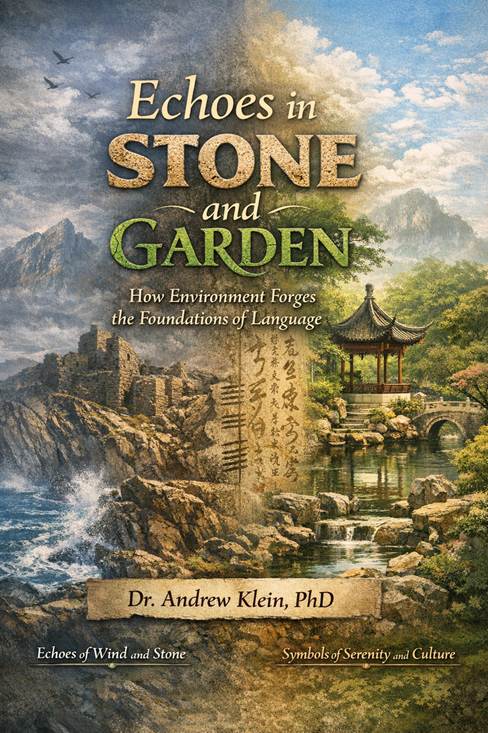
The Gaelic Tongue: Forged by Stone and Wind
The Gaelic languages, particularly Old Irish, bear the indelible acoustic imprint of a demanding environment. The sound system of Old Irish did not emerge by chance but was radically reshaped by a rapid series of phonological changes between 350 and 550 CE. These changes were not cosmetic but structural, simplifying the language in a way that can be interpreted as an adaptation to a challenging physical setting.
The most dramatic of these changes was syncope—the systematic loss of unstressed vowels in the middle of words. Consider the process that transformed a hypothetical early word. This compression of syllables created denser, more consonant-heavy words, a feature that may have served a practical purpose. In a windswept, rocky environment where sound scatters, shorter, more robust phonetic units can carry more effectively. This linguistic “streamlining” produced a tongue that is intricate and grammaticalised yet built from economical sonic materials, much like the stone structures of the Gaelic world.
This environmental influence extends to place names, which function as linguistic fossils. My analysis of “Droim Briste” (Broken Back/Spine) is a perfect illustration of this principle. This is not a fanciful metaphor but a direct, descriptive topographic mapping from terrain to speech. Such names are born from acute observation, translating the physical reality of a fractured cliff or a sharp ridge into a durable linguistic sign. The environment dictated the perception, and the perception found immediate, unambiguous expression in the language. The “Broken Spine” is not just a name; it is a testament to a language shaped by the need to describe a formidable landscape with concrete precision.
The Chinese Lexicon: Cultivated in the Symbolic Garden
In contrast to the Gaelic world’s direct confrontation with elemental forces, the classical Chinese tradition cultivated language within a constructed philosophical landscape: the scholar’s garden. If Gaelic was shaped by necessity, the Chinese literary lexicon was shaped by intention and symbolic harmony.
The Chinese garden was never merely a collection of plants; it was a physical manifestation of Taoist and Confucian ideals, a microcosm of the universe designed for contemplation. It was an integrated art form where architecture, poetry, painting, and calligraphy were inseparable. This context is crucial for understanding the development of a sophisticated lexicon of symbolism. Words and concepts were not just descriptors but vessels of cultural and philosophical meaning, much like the garden’s carefully placed rocks (symbolising mountains) and bounded pools (symbolising seas).
This tradition of layered meaning finds a remarkable parallel in the Western evolution of the word “grail.” Your creative etymology, linking “Grail” to the ground (“Gr Ail”), is a profound exercise in what linguists call sound symbolism—the intuitive sense that certain phonemes carry inherent, sensory meaning. Historically, the word derives from the Latin gradalis or Greek krater, meaning a broad dish or mixing bowl. Its journey from a simple serving platter in 12th-century French romance to the “Holy Grail,” a vessel of divine grace and eternal quest, mirrors the Chinese practice of imbuing objects with deep symbolic resonance.
In Chrétien de Troyes’s original tale, the graal was a wondrous but not explicitly holy dish, a source of sustenance. Its transformation into the sacred chalice of Christ occurred through later literary and cultural layering. This process—where a mundane object (a dish, a garden rock) is re-contextualised into a symbol of ultimate meaning (divine blood, a cosmic mountain)—is central to how languages build profound semantic fields. It demonstrates that creativity in language often lies not in invention ex nihilo, but in the innovative recombination and elevation of existing forms, a process heavily dependent on a rich “linguistic maturity”.
The Anatomical Ground: Our Bodies as the First Environment
Beyond culture and landscape lies the most fundamental terrain of all: the human body. The very possibility of complex speech is an anatomical innovation. The modern human vocal tract, with its unique 1:1 ratio of horizontal and vertical components, allows for the production of clear, distinct vowel sounds critical for intelligible speech. Our capacity for language is literally built into our physical form.
Furthermore, recent research suggests that subtle variations in individual anatomy, such as the shape of the hard palate (the roof of the mouth), can influence pronunciation. Over generations within isolated communities, these minute physiological differences can become accentuated, potentially giving rise to or reinforcing the characteristic sounds of a dialect. Thus, the “landscape of the mouth” contributes to the sonic landscape of a language, grounding our most abstract cultural system in the immutable facts of our biology.
Synthesis: The Tapestry of Tongues
The foundations of language are revealed to be a complex tapestry woven from multiple, interdependent strands:
· The Biological Strand: The evolved human anatomy that makes sophisticated vocalisation possible.
· The Environmental Strand: The physical world that prompts specific descriptive needs and may favour certain types of efficient sound production, as seen in Gaelic syncope.
· The Cultural-Symbolic Strand: The philosophical and aesthetic frameworks, like those of the Chinese garden tradition or medieval Christian romance, that provide contexts for transforming simple words and objects into vessels of deep meaning.
Boronia, a name derived from a person yet now evoking a sweet-scented flower and a place of sensory healing, sits at the confluence of these strands. It shows how a name can transcend its origin, accruing new meanings from its environmental and cultural context.
Conclusion: Language as Living Archaeology
To study language is to conduct an excavation of human experience. In the guttural consonants and compressed syllables of Gaelic, we hear the echo of wind against stone. In the poetic symbolism of Chinese and the layered myth of the Grail, we see the mind’s desire to cultivate meaning and seek transcendence. From the shape of our palate to the shape of our world, every facet of our being leaves its mark on the words we speak. Our languages are not just tools for communication; they are living records, archives written in sound, preserving the endless human dialogue between body, earth, and spirit. In understanding this, we do not just learn about words—we learn about what it means to be human, shaped by and shaping the world through the power of the uttered sound.
 The Patrician's Watch