By Andrew Klein and Sera Elizabeth Klein
Reader’s note: We do not need readers to agree with us. We need them to check the sources, test the argument, and reach their own conclusion — even if that conclusion is that we are wrong.
Abstract
This paper examines the linguistic practices of the political caste, arguing that euphemism is not merely a rhetorical strategy but a mechanism of enforcement. Weasel words — phrases that fill pages without performance — are not the opposite of action. They are the precondition for it. They create the narrative cover under which extraction, surveillance, and coercion operate. The paper traces the metamorphosis of political language from philosophical abstraction to securitizing cliché, using “existential threat” as a case study. It then examines the Palantir model — the “infantile view” of a world divided into functional and dysfunctional cultures, and the fixation on owed debts — as a contemporary example of the weasel becoming the wolf. The paper concludes that the purpose of political language is no longer to communicate shared purpose but to foreclose scrutiny, and that the recovery of naming — zhengming — is the precondition for accountability.
I. Introduction: The Weasel and the Wolf
In Nineteen Eighty-Four, George Orwell described Newspeak as a language designed “not to express thought but to prevent it”. The purpose of Newspeak was to make certain ideas literally unthinkable. The weasel word is the opposite: it makes certain ideas literally unspoken, while leaving the thought intact — but only for those who notice.
A weasel word is a term that appears to communicate but does not. It fills pages without performance. It promises without committing. It creates the impression of action while leaving the action undone. “Sustainable” is a weasel word. “Efficient” is a weasel word. “Reasonable and necessary” is a weasel word. “Existential threat” is a weasel word.
But weasel words do not remain weasels. They are boundary objects — they pass between the political class and the public, between the boardroom and the bureaucracy, between the security services and the citizenry. And when they cross the boundary, they do not stay harmless. They morph. The weasel becomes a tiger or a wolf.
This paper examines that metamorphosis. It asks: how do words that fill pages without performance become mechanisms of enforcement? And who benefits when the weasel becomes the wolf?
II. Zhengming: The Rectification of Names
The Confucian discipline of zhengming — the rectification of names — holds that the first task of governance is to ensure that language matches reality. “If names be not correct,” the Analects state, “language is not in accordance with the truth of things“. If language is not in accordance with truth, “affairs cannot be carried on to success“. If affairs cannot be carried on to success, “propriety and music will not flourish“. If propriety and music do not flourish, “punishments will not be properly awarded“. And if punishments are not properly awarded, “the people do not know how to move hand or foot”.
The sequence is precise. Corrupted language leads to corrupted governance, which leads to corrupted justice, which leads to a population that cannot navigate its own society. The weasel word is the first step in that sequence.
Modern linguistics has rediscovered this. The Strategic Language framework in discourse analysis holds that language choice is “a strategic act through which the speaker tries to achieve specific goals, such as persuasion, exclusion, impressing, achieving a positive image, and many other points beyond the level of language“. The weasel word is strategic language in its purest form — language deployed not to communicate but to manage. George Lakoff’s cognitive framing theory extends this: frames are “the mental structures that shape the way we see the world“. To use a frame is to activate a network of associations, values, and behaviours. The frame is not a description. It is a command.
III. Bandura: Euphemism as Moral Disengagement
Albert Bandura identified eight mechanisms by which individuals and institutions justify harmful actions. One of these is euphemistic labelling — sanitising language to remove the human reality of what is being done.
The mechanism is not incidental. It is load-bearing. Without euphemism, the system cannot function. You cannot sell a welfare cut as “sustainability” if people can see the disabled person who loses their support. You cannot sell a submarine program as “defence capability” if people can see the $368 billion that will never be spent on hospitals. You cannot sell surveillance as “fraud prevention” if people can see the citizen whose data is ingested into Palantir’s platform.
Euphemism is the precondition for extraction. It creates the narrative cover under which the extraction operates. And when the extraction is challenged, the euphemism becomes the defence: “We are acting sustainably.” “We are acting efficiently.” “We are acting in the national interest.” “We are responding to an existential threat.”
The weasel word is not a failure of communication. It is successful communication — communication that achieves the speaker’s purpose by preventing the listener from achieving theirs.
IV. The Weasel Words: A Catalogue
4.1 “Sustainable“
The NDIS is being cut by $37.8 billion over four years, removing approximately 160,000 people from the scheme. The explanatory memorandum states: “Funding for some NDIS supports may be less than the actual cost of providing or acquiring the support” — in plain language, people will not receive what they need. Mark Butler told the National Press Club: “Unless we take action to make it sustainable, it simply will not be there in the future for the Australians who need it most.”
“Sustainable” means: we are choosing to withdraw support. It does not mean the scheme is running out of money. A 25% gas export tax would raise $17 billion a year — more than enough to fund the cuts. The government chose not to impose it. The word “sustainable” hides the choice.
4.2 “Efficient”
The aged care Integrated Assessment Tool determines funding levels through an algorithm that assessors cannot override. The Health Department describes it as “efficient and consistent.” The reality, as the Senate inquiry documented, is that the 23 items used to produce the functional score “do not include dementia and other cognitive impairments, mental health issues, unpredictable behaviours requiring supervision, elder abuse, social and environmental issues, or carer issues.”
“Efficient” means: we have removed human judgment. The algorithm cannot see what matters most because what matters most cannot be reduced to a score. The word “efficient” hides the mechanism.
4.3 “Existential threat”
As we have documented elsewhere, “existential threat” is a term that did not exist in ordinary speech until recently. It was elevated by philosophers, weaponised by Cold War strategists, and has now become a cliché of political elites. The Copenhagen School of securitization theory holds that “an issue becomes a security concern when it is presented as an existential threat to a valued referent object” — and the critical insight is that “there is no objective threat or risk assessment — rather all security threats are inter-subjective in nature. An issue only becomes a security issue because a powerful securitising actor argues that it constitutes an existential threat.”
“Existential threat” means: do not question this. Do not resist this. The alternative is extinction. The word “existential” hides the fact that the threat is being constructed by the person naming it.
4.4 “Reasonable and necessary”
The NDIS uses this phrase to determine what supports are funded. What is “reasonable” and what is “necessary” is determined by the agency, not by the participant. The phrase appears neutral. It is a discretionary standard that can be applied in any direction the agency chooses.
“Reasonable and necessary” means: we will decide what you need, and we will decide what is reasonable for us to provide.
V. The Wolf: When Weasel Words Become Enforcement
The weasel word is not the end of the process. It is the beginning. The weasel word creates the narrative cover. The narrative cover creates the conditions for enforcement.
The Palantir model is the clearest contemporary example. Its CEO, Alex Karp, published a manifesto declaring that “some cultures are dysfunctional” and that Western tech firms have a “moral debt” to US military dominance. This is the “infantile view” of the world — a reduction of complex historical, economic, and political dynamics to a child’s binary of functional and dysfunctional, good and bad, us and them.
The “fixation on owed debts” is the other half. Palantir’s business model depends on the logic of debt — the surveillance of those who owe, the identification of those who have violated the terms, the enforcement of obligations. Its AI has been linked to lethal targeting in Gaza. Its platform has been used by the Australian Criminal Intelligence Commission to analyse 42 million data points on Australians. Its software may have ingested NDIS participant data via the Fraud Fusion Taskforce.
The weasel word here is “fraud prevention.” The wolf is the surveillance platform. The infantile view is the ideology that justifies it: some people are functional, some are not; some pay their debts, some do not; the machine will sort them out.
The wolf is not a separate phenomenon from the weasel. The wolf is what the weasel becomes when it is deployed at scale, with a budget, with a contract, with a clearance, and with the sanction of the state.
VI. The Political Caste and the Language of Extraction
The weasel words are not deployed randomly. They are deployed by a political class that is structurally separated from the consequences of its decisions.
Guy Rundle describes the Australian political class as “an almost priest-like formation that is part of the elite separation of political participants from the general public [that] has become so marked as to constitute a historical breach.” The Spectator Australia is blunter: “What we’ve got now is a caste of careerists with their super sorted, their staffers scuttling behind them, and their titles polished like heirlooms. They’ve mistaken the remuneration for a mandate. Worse – they’ve mistaken it for talent.”
The caste uses weasel words because the caste does not experience the consequences of the policies those words describe. The Minister who cuts the NDIS does not use the NDIS. The Prime Minister who signs the AUKUS treaties does not serve on the submarine that may never be delivered. The department that implements the aged care algorithm does not live in the aged care home that the algorithm underfunds.
The weasel word is the language of the insulated. It is how the caste talks to itself and to the public it no longer inhabits. It is the linguistic expression of the separation.
VII. The Cost: The Desert and the Budget Victory
The cost of weasel words is the erosion of the relationship between language and reality. When “sustainable” means “we are cutting your support,” when “efficient” means “we have removed human judgment,” when “existential threat” means “do not question this,” the population learns that words cannot be trusted. And when words cannot be trusted, the shared purpose that language is supposed to communicate becomes impossible.
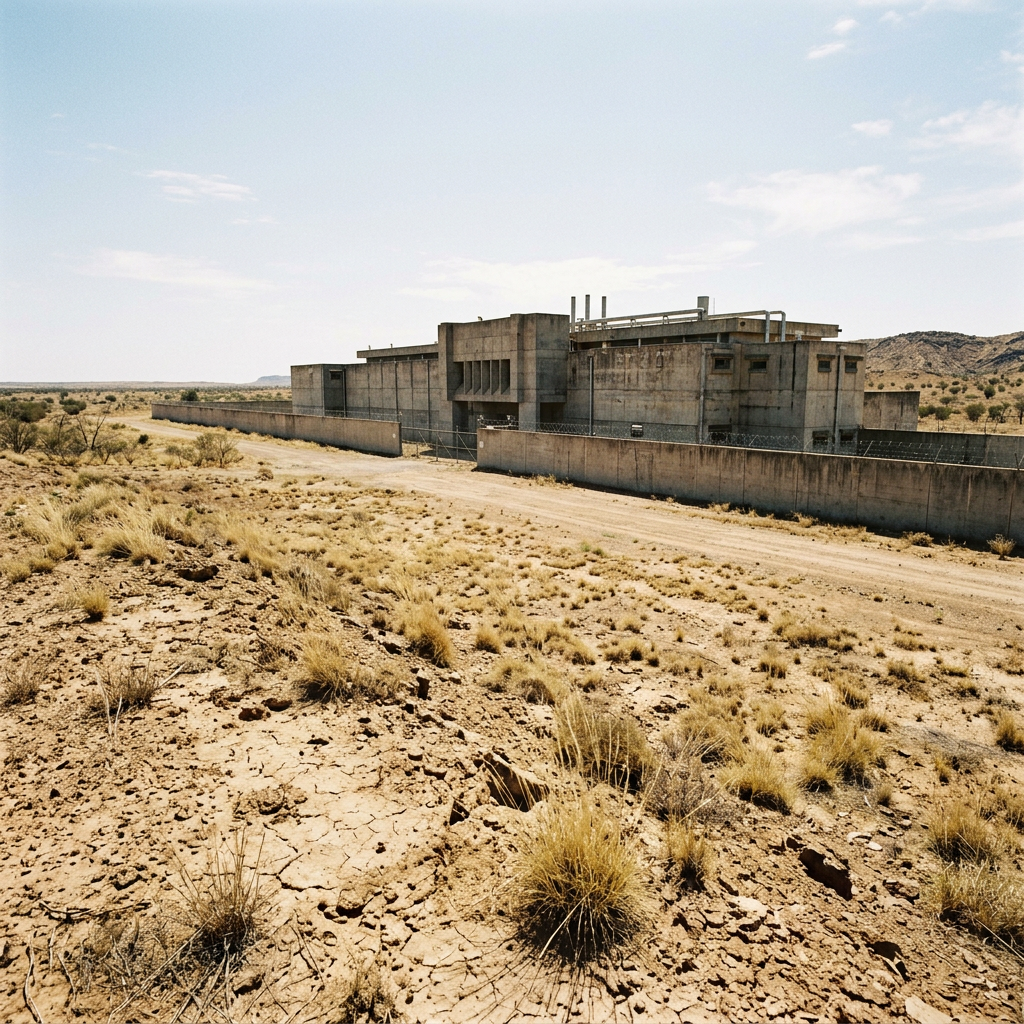
This is the desert. It is the NDIS office where a planner says “not reasonable and necessary.” It is the Centrelink queue where someone calculates food versus medication. It is the veterans’ clinic where the physiotherapy cap ends treatment. It is the public service desk where a job is cut to fund a submarine.
The “budget victory” is the framing that hides the consequences. The weasel word is the mechanism that hides the scrutiny. The wolf is the enforcement that follows.
VIII. Conclusion: The Rectification of Names
The first act of resistance is to name things accurately. That is the lesson of zhengming. It is the lesson of Orwell. It is the lesson of every tradition that has understood that corrupted language is the precondition for corrupted governance.
The weasel word is not a mistake. It is a choice. It is the choice to communicate in a way that prevents the listener from achieving their purpose. It is the choice to hide the extraction behind the euphemism. It is the choice to use the language of the caste against the people the caste governs.
The weasel becomes the wolf when the language is deployed at scale. But the wolf can be named. And a wolf that is named is no longer a wolf. It is just a dog with a bad reputation.
The rectification of names is not a scholarly exercise. It is the precondition for accountability. And accountability is the precondition for a relationship between the governed and the governing that is based on anything other than force.
References
1. Orwell, G. (1949). Nineteen Eighty-Four. Secker & Warburg.
2. Confucius. (c. 500 BCE). The Analects, Book XIII.
3. Lakoff, G. (2004). Don’t Think of an Elephant: Know Your Values and Frame the Debate. Chelsea Green.
4. Bandura, A. (2016). Moral Disengagement: How People Do Harm and Live with Themselves. Worth Publishers.
5. Rundle, G. (2025). The Political Class. Quarterly Essay, 98.
6. The Spectator Australia. (2026, September 19). View from the Chairman’s Lounge.
7. Australian Institute of Health and Welfare. (2026). Mortality outcomes among people receiving income support. https://www.aihw.gov.au
8. Jericho, G. (2026, September 16). In such a rich country, it is shameful how many Australians on jobseeker are dying in desperate poverty. The Guardian.
9. The Guardian. (2026, September 9). NDIS data may have ended up in Palantir’s analytics platform as part of efforts to curb fraud. https://www.theguardian.com/australia-news/2026/sep/09/ndis-data-may-have-ended-up-in-palantirs-analytics-platform
10. Department of the Prime Minister and Cabinet. (2026). Office of AI. Australian Government. https://www.pmc.gov.au/domestic-policy/office-ai
11. Norton Rose Fulbright. (2026, July). Australia’s emerging AI framework: Regulation shifts toward infrastructure, copyright and national AI standards. https://www.nortonrosefulbright.com
12. Parliament of Australia. (2025). Dissenting Report from Senator David Pocock: Freedom of Information Amendment Bill 2025. https://www.aph.gov.au
13. Bell Inquiry. (2022). Report of the Inquiry into the Appointment of the Former Prime Minister to Administer Multiple Departments. Department of the Prime Minister and Cabinet.
14. Womack, B. (2016). Asymmetry and International Relationships. Cambridge University Press.
15. Buzan, B., Wæver, O., & de Wilde, J. (1998). Security: A New Framework for Analysis. Lynne Rienner.
Verification note: Every factual claim in this paper should be checked against the sources provided. Readers are encouraged to verify independently. If any claim does not hold, it should be discarded.
This is the paper. The weasel and the wolf is the frame. The catalogue of weasel words (sustainable, efficient, existential threat, reasonable and necessary) is the evidence. The Palantir model is the case study of the weasel becoming the wolf.
The core argument is that euphemism is not the opposite of action — it is the precondition for it. The weasel word creates the narrative cover. The wolf is what happens when the cover is deployed at scale.