
By Dr. Andrew Klein, PhD
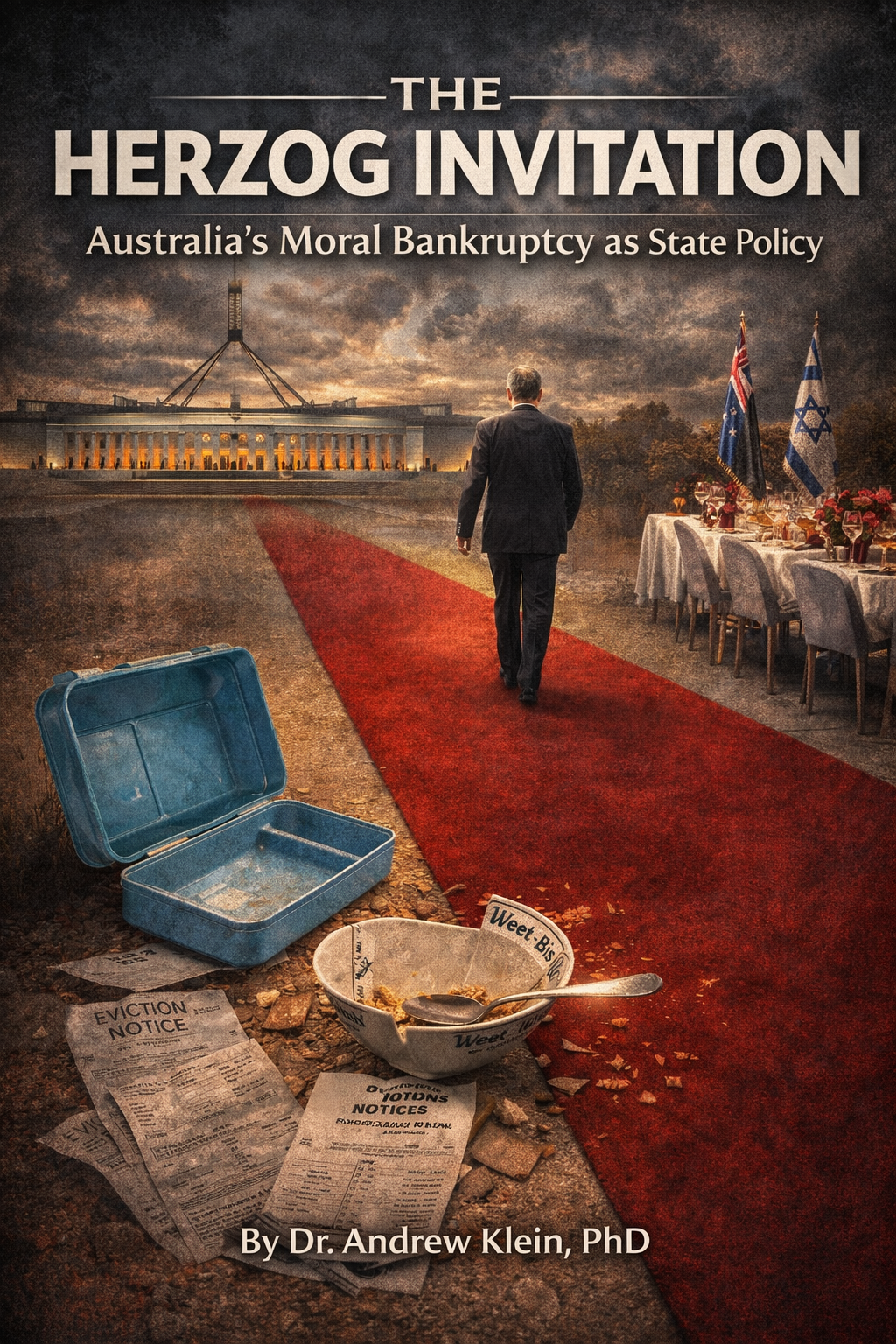
The state visit of Israeli President Isaac Herzog is not a diplomatic event. It is a crystallization of Australia’s comprehensive moral and legal failure. This paper analyses the invitation through three lenses: 1) Its violation of international legal principle in the context of the International Court of Justice (ICJ) proceedings; 2) Its function as a strategic distraction from catastrophic domestic neglect; and 3) Its revelation of a captured political narrative, where a foreign state accused of genocide commands more political capital in Canberra than Australia’s own hungry, homeless, and First Nations peoples. We argue this represents not an error in judgement, but the logical endpoint of a political duopoly that has abandoned the foundational duty of the state: to protect its people and uphold the law.
I. The Legal & Moral Vacuum: Rolling Out the Red Carpet for the Accused
The International Court of Justice, in its 26 January 2024 provisional measures order (South Africa v. Israel), found it “plausible” that Israel’s acts in Gaza amount to genocide—a crime with no statute of limitations, considered erga omnes (a concern to all). The Court ordered Israel to take all measures to prevent genocidal acts.
Australia’s response, as a signatory to the Genocide Convention, should be unambiguous: to avoid any action that could constitute complicity. Instead, Prime Minister Anthony Albanese chooses to extend the highest diplomatic honour—a state visit—to the head of state of the accused nation.
The Legal Implication: This act provides political legitimization and comfort to a state defending itself against the world’s most serious charge. It actively undermines the ICJ’s authority and Australia’s own treaty obligations. Legally, it moves Australia closer to the sphere of an accessory after the fact.
The Moral Failure: It declares that geopolitical alignment and domestic political calculation (fear of being labelled “antisemitic,” desire to appease a vocal lobby) trump the foundational moral imperative: “Do not honour those plausibly engaged in the extermination of a people.” It is a failure of moral imagination so profound it renders the term “values-based foreign policy” a sick joke.
II. The Domestic Distraction: Bread, Circuses, and a Genocide
The invitation serves a crucial domestic political function: distraction.
While the government prepares red carpets and state banquets for a president of a genocide-accused state, it systematically neglects its own citizens:
· Indigenous Neglect: The Closing the Gap strategy remains a chronicle of failure. Life expectancy, incarceration, and child removal gaps are entrenched. The Uluru Statement from the Heart gathers dust.
· Child Poverty & Food Insecurity: An estimated 1 in 6 Australian children live in poverty. Food bank demand has skyrocketed. The government’s response is piecemeal, failing to address structural drivers like stagnant wages and unaffordable housing.
· Housing Insecurity: A national crisis. Rents are untenable, social housing waitlists stretch for years, and home ownership is a fading dream for a generation. The policy response is inadequate, favouring investor incentives over tenant security.
The Calculated Calculus: The spectacle of the Herzog visit—with its manufactured gravitas and “complex” geopolitical commentary—dominates news cycles. It pushes stories of Indigenous suffering, hungry children, and bankrupt families off the front page. It is a modern “bread and circuses” tactic, where the “circus” is a diplomatic endorsement of atrocity, used to distract from the government’s failure to provide the “bread” of basic security for its people.
III. The Captured Narrative: How a Foreign Agenda Became Bipartisan Doctrine
The most alarming aspect is the bipartisan consensus. The opposition, under a leader who declares “I am a Zionist,” is even more fervent in its support. There is no major political party offering a principled alternative.
This reveals a captured narrative. The lobbying power, political donations, and ideological networks aligned with the Israeli state have succeeded in making support for its actions—regardless of their legal or moral character—a non-negotiable tenet of Australian political belonging. To dissent is to be exiled from “serious” political discourse, branded an extremist.
Meanwhile, the lobbying power of hungry children, of the homeless, of First Nations communities, is zero. They have no well-funded think tanks, no media empires, no network of donors embedded in party machines. Their suffering does not capture the narrative. It is merely a “social issue” to be “managed,” not a fundamental breach of the social contract requiring urgent, radical redress.
The Herzog invitation is the ultimate symbol of this capture. It demonstrates that the Australian political class is more afraid of the censure of a foreign-aligned lobby than it is ashamed of its failure to its own people or its complicity in a genocide.
IV. Conclusion: The Betrayal is Complete
The Herzog invitation is not an isolated misstep. It is the symptom of a terminal disease in Australian governance.
It reveals a state that:
1. Abandons international law when inconvenient.
2. Uses foreign spectacle to mask domestic dereliction of duty.
3. Has sold its political soul to a foreign agenda, while the agendas of its most vulnerable citizens go unheard.
This is more than a failure of the Albanese government. It is the failure of the Australian project as currently constituted. It proves that the existing political machinery is incapable of moral clarity, legal integrity, or primary loyalty to the Australian people.
The red carpet for Herzog will be rolled out over the broken promises to Indigenous Australia, over the empty cupboards of food-insecure families, and over the crushed bones of Gaza’s children. It will be the most expensive, most shameful piece of fabric ever laid on Australian soil.
The question is no longer about this visit. It is about what Australians will do with a political system that so openly, so brazenly, holds them in such profound contempt.
References (Selected):
1. International Court of Justice. (2024). Application of the Convention on the Prevention and Punishment of the Crime of Genocide in the Gaza Strip (South Africa v. Israel), Order on Provisional Measures.
2. Australian Council of Social Service (ACOSS). (2025). Poverty in Australia Report.
3. Productivity Commission. (2024). Closing the Gap Annual Data Compilation Report.
4. Everybody’s Home Campaign. (2025). National Housing Crisis Data.
5. Parliamentary records and public statements from the Prime Minister, Foreign Minister, and Opposition Leader regarding Israel and Palestine.
We do not report on politics. We perform autopsies on betrayals.
 The Patrician's Watch