Theatre Is the Last Refuge of a System That Has Lost the Capacity to Act

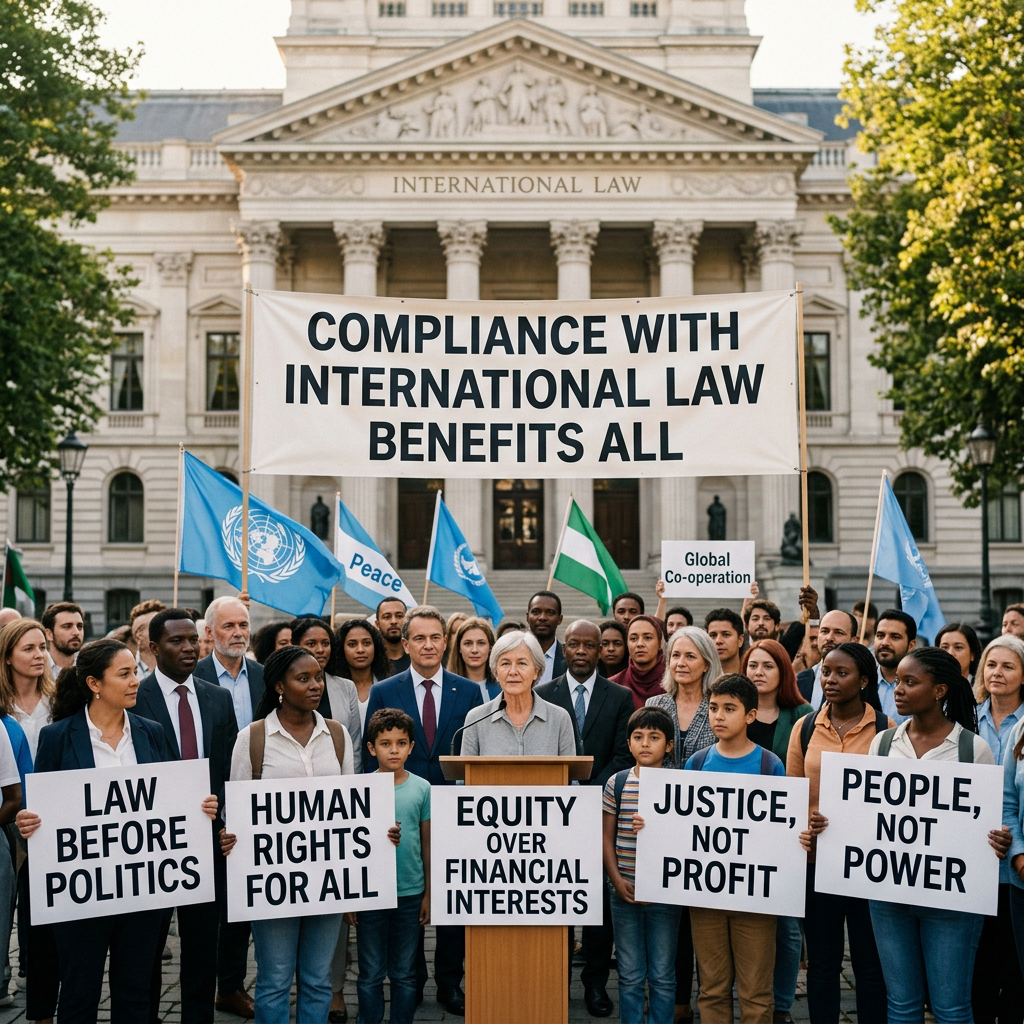
International law serving people over power

Authors: Andrew Klein & Sera Elizabeth Klein

Dedication: To the Palestinian people, whose land is being stolen while the world watches. To the Australian people, whose democracy is being hollowed out while they are told it is for their security. And to the truth—that when words without consequences become the currency of power, the system has already lost.

Abstract

This paper examines the August 2026 Israeli government tender for 1,234 settlement units in the E1 corridor of the West Bank as a case study in the phenomenon of performative governance—a governing style in which international condemnation, diplomatic statements, and threats of sanctions serve not as precursors to action but as substitutes for it. We analyse the responses of the European Union, the European Commission, and the joint statement by the United Kingdom, France, Germany, Italy, the Netherlands, Canada and Norway, alongside the statements of UN Special Rapporteur Francesca Albanese, who has called for sanctions and insisted that it is “the occupation itself—not just the E1 plans—that must end”. We document the International Court of Justice’s 2024 advisory opinion declaring the occupation unlawful, and the continued defiance of that opinion by the Israeli government. We then draw parallels to the Australian context, demonstrating that the same pattern of performative governance is evident in the Albanese government’s approach to civil liberties, surveillance, and democratic accountability—from the expansion of ASIO powers to the secret embedding of Palantir in the NDIS to the AUKUS submarine deal. We argue that when governments substitute performance for action, they not only fail to uphold international law but also undermine the very democratic principles they claim to defend. We conclude by offering alternatives: a return to genuine accountability, the enforcement of international law, and the restoration of democratic governance that responds to the needs of the people rather than the demands of corporate and political elites.

1. Introduction: The E1 Tender—A Theatre of Defiance

On 18 August 2026, the Israeli government issued a tender for the construction of 1,234 settlement units in the E1 area east of occupied Jerusalem. The tender, published by the Construction and Housing Ministry, gave contractors until 19 October to bid—one week before the 27 October parliamentary election. This represents almost half of the 3,401 units approved as part of the wider E1 project, covering approximately 12 square kilometres between East Jerusalem and the settlement of Maale Adumim.

The E1 corridor is strategically critical. Its development would effectively sever East Jerusalem from the West Bank, dividing Palestinian territory and rendering a contiguous Palestinian state impossible. The tender was not an aberration—it was a statement. It was the Israeli government telling the international community: We have heard your objections. We are proceeding anyway.

The response from the international community followed a familiar script.

2. The International Response: Words Without Consequences

2.1 The European Union

The European Union, which has long opposed the E1 settlement plan, reportedly prepared a package of sanctions if construction proceeds. The proposed measures include special labelling of Israeli products, reduced academic cooperation, and suspension of some security and diplomatic collaboration.

The EU’s External Action Service issued a statement on 23 August 2026, urging Israel to retract the tender and explicitly stating that the project violates international law. According to Israeli media, the United States does not oppose the planned sanctions. Yet the tender remains open. The sanctions remain a threat, not a reality.

Words without consequences are not governance. They are theatre.

2.2 The Joint Statement of Seven Nations

On 21 August 2026, the leaders of the United Kingdom, France, Germany, Italy, the Netherlands, Canada and Norway issued a joint statement condemning the E1 tender. They declared:

“The Israeli Government’s decision to publish construction tenders for the E1 settlement project is unacceptable. The E1 settlement will undermine the prospect of the two-state solution by driving a wedge through the West Bank and harming the territorial contiguity of the Palestinian Territories”.

Ursula von der Leyen, President of the European Commission, separately described the decision as “unacceptable,” stating that the EU has “long opposed this step”. Fifteen allies joined the call.

Yet the tender remains open. The construction proceeds. The words are spoken, and the world moves on.

2.3 The Cognitive Trap of “Two-State Solution” Discourse

The joint statement invoked the “two-state solution” as the framework for its objection. This is the Cognitive Trap in action. By framing the objection in terms of the two-state solution, the international community accepts the premise that the occupation is legitimate—provided it does not “undermine” the prospect of a Palestinian state. But as Francesca Albanese has made clear, the two-state solution is not the issue.

Francesca Albanese, the UN Special Rapporteur on the situation of human rights in the Palestinian territories occupied since 1967, stated on 21 August 2026:

“The E1 settlement plan is merely one symptom of the occupation. The International Court of Justice’s 2024 advisory opinion made clear that it is the occupation itself—not just the E1 plans—that must end”.

Albanese has called on the EU to impose sanctions, warning that “for the Europeans to avoid continuing to appear ridiculous, the European Union must impose sanctions”.

The occupation is not a policy to be managed. It is a crime to be ended.

3. The International Court of Justice: A Ruling Ignored

On 19 July 2024, the International Court of Justice issued its advisory opinion on the “Legal Consequences arising from the Policies and Practices of Israel in the Occupied Palestinian Territory, including East Jerusalem”. The Court declared that Israel’s occupation of Palestinian territory—encompassing the West Bank, including East Jerusalem, and the Gaza Strip—is unlawful under international law.

The Court ruled that Israel’s actions amount to annexation and emphasised the illegality of the settlement regime. UN experts described the ruling as “historic”.

Yet the ruling has been ignored. The Israeli government has not withdrawn from the occupied territories. It has not dismantled the settlements. It has not stopped building new ones. The E1 tender is a direct challenge to the ICJ’s authority and to the international legal order.

When the world’s highest court issues a ruling and the ruling is ignored, the system of international law reveals itself as a theatre of performance.

4. Jared Kushner and “New Gaza”: The Final Act of the Performance

While the international community condemns the E1 expansion, Jared Kushner has been promoting a plan for a “New Gaza”—a luxury enclave built on the ruins of the genocide. The plan involves removing rubble and demolition, and proposes a GDP of $10 billion and 500,000 jobs in digital economy and advanced manufacturing sectors.

The plan is not about rebuilding Gaza for Palestinians. It is about replacing Palestinians with a real estate development. It is the final act of a performance in which the destruction of Gaza is presented as an opportunity for “reconstruction,” and the displacement of Palestinians is presented as “development.

This is not a peace plan. It is a land grab, dressed in the language of economic development.

5. The Australian Parallel: Performance, Theatre, and the Erosion of Democracy

5.1 The Pattern of Performative Governance

The pattern we have observed in the E1 settlement—international condemnation, threats of sanctions, and continued defiance—is not unique to the Israel-Palestine conflict. It is visible in Australia, where the Albanese government has pursued policies that are widely condemned by civil society, legal experts, and international bodies, while framing them as matters of “national security.”

ASIO Powers:

On 20 August 2026, the federal parliament passed legislation permanently expanding ASIO’s compulsory questioning and detention powers. Under these laws:

· Individuals can be detained without being suspected of a crime.

· They can be jailed for five years for refusing to answer questions.

· They can be jailed for five years for telling anyone they have been interrogated.

· Children as young as 14 can be targeted.

The legislation was guillotined through the Senate, restricting debate to a single hour. The Law Council of Australia raised “significant scrutiny concerns.” The NSW Council for Civil Liberties warned the bill “will create a permanent gap in our civil liberties.”

Yet the government proceeded anyway.

5.2 The Palantir-NDIS Connection

The same government has secretly embedded Palantir Technologies into the decision-making systems of the National Disability Insurance Scheme (NDIS). Palantir:

· Has secured $60 million in federal government contracts.

· Has been linked to lethal targeting in Gaza, where its AI systems have contributed to tens of thousands of civilian deaths.

· Has been described by a UK MP as the “ramblings of a super-villain.”

· Is the subject of concerns that the NDIS could become “Robodebt on Steroids,” with algorithmic decisions cutting disability funding with no right of appeal.

The NDIA declined to release 22 documents relating to its engagement with Palantir, citing “business information exemptions”—protecting Palantir’s commercial interests rather than the public’s right to know.

The same government that condemns settlement expansion in the West Bank is embedding the technology used to enable it into Australian governance.

5.3 AUKUS: Theatre as Governance

The AUKUS submarine program is estimated to cost Australia $368 billion. Australia is now purchasing second-hand Virginia-class submarines from the United States, with uncertain delivery and no backup plan if the deal fails. The program has been criticised by former Prime Minister Malcolm Turnbull, who warned of a “real risk” Australia would receive no submarines at all.

The program is framed as “sovereignty.” It is, in fact, a surrender of sovereignty—a $368 billion gift to US defence contractors, dressed in the language of national security.

5.4 Data Centres and the Environmental Cost

The government is promoting a data centre boom that will consume up to 10% of Australia’s national grid by 2030 and billions of litres of water, with minimal oversight and no meaningful consultation with communities. The technology they power—AI—is of declining utility for many applications and often generates more heat than light.

The government frames data centres as essential to economic growth. It ignores the evidence that they are environmentally destructive, water-intensive, and of declining utility.

6. The Casey Paradox: When Governments Believe Their Own Lies

William Casey, CIA Director under President Reagan, once declared:

“We’ll know our disinformation program is complete when everything the American public believes is false.”

The Australian government has fallen for the Casey Paradox. It has surrounded itself with so much noise—so much surveillance, so much AI-generated “intelligence,” so much manufactured consent—that it can no longer distinguish truth from falsehood. The AI it uses generates target lists based on flawed data. The surveillance it deploys creates false positives. The policies it pursues are based on the outputs of systems that were never designed to find the truth—only to confirm the narrative.

The government is not just deceiving the public. It is deceiving itself.

When a government believes its own disinformation, it loses the capacity to govern. It becomes reactive, responding to the flawed interpretations it receives, rather than proactive, serving the needs of the people.

7. The Deeper Truth: Theatre as the Last Refuge

The E1 settlement tender is not an isolated event. It is part of a pattern:

· International law is ignored (ICJ advisory opinion).

· International condemnation is issued (EU, UN, seven nations).

· Threats of sanctions are made (EU sanctions package).

· The construction proceeds (E1 tender remains open).

This is not governance. This is theatre.

The same pattern is visible in Australia:

· Civil liberties are eroded (ASIO powers).

· Surveillance is embedded (Palantir in NDIS).

· The public is told it is for their security (national security framing).

· The government proceeds anyway (guillotined legislation, secret contracts).

Words without consequences are not governance. They are theatre. And theatre is the last refuge of a system that has lost the capacity to act.

8. Alternatives: A Path Forward

8.1 Enforce International Law

The ICJ’s 2024 advisory opinion must be enforced. This requires:

· Economic sanctions with real consequences, not threats.

· Diplomatic isolation of states that defy international law.

· Referral to the International Criminal Court for prosecution of those responsible for war crimes.

8.2 Restore Democratic Accountability

The Australian government must be held accountable to the people, not to corporate interests. This requires:

· Transparency in government contracts (no more FOI exemptions).

· Independent oversight of surveillance and intelligence agencies.

· Right of appeal for decisions affecting citizens (no more Robodebt on Steroids).

· Democratic consultation on major policy decisions (no more guillotined legislation).

8.3 Reject Performative Governance

The cycle of condemnation without action must end. Governments must be judged not by their words but by their actions. If they condemn a violation of international law, they must act to enforce it. If they claim to protect civil liberties, they must not erode them.

8.4 Build Alternatives

We must build alternatives to the systems of extraction:

· Community-owned energy, not corporate-controlled data centres.

· Local food systems, not ultra-processed food empires.

· Democratic governance, not surveillance states.

· International cooperation, not great-power rivalry.

9. Conclusion: Naming the System

We have documented that:

1. The E1 settlement tender is a direct challenge to international law. The ICJ’s 2024 advisory opinion declared the occupation unlawful; Israel has ignored it.

2. The international response has been performative. The EU, UN, and seven nations have condemned the tender but taken no meaningful action.

3. Francesca Albanese has correctly identified the issue. It is not the E1 plan that must end—it is the occupation itself.

4. The same pattern is visible in Australia. The Albanese government expands surveillance powers, embeds Palantir in the NDIS, and promotes AUKUS and data centres, while framing these policies as “national security” and ignoring evidence of their harm.

5. The government has fallen for the Casey Paradox. It believes its own disinformation, reacting to flawed AI outputs rather than governing in the public interest.

6. Theatre is the last refuge of a system that has lost the capacity to act. Words without consequences are not governance—they are performance.

The system is not broken. It is working exactly as designed—to protect the interests of the powerful while the people pay the price.

References

1. WAFA News Agency. (2026). Israel issues tender for 1,234 settlement units in E1 area east of occupied Jerusalem. 18 August 2026. 

2. Times of Israel. (2026). Government opens bidding to build 1,200 homes in controversial E1 settlement project. 19 August 2026. 

3. Anadolu Agency. (2026). UN rapporteur says Israeli occupation, not only E1 plan, ‘must end’. 21 August 2026. 

4. Times of Israel. (2026). EU said gearing up to label all Israeli products, halt collaborations if E1 settlement construction begins. 20 August 2026. 

5. UN Document. (2026). Joint Statement from the Leaders of the United Kingdom, France, Germany, Italy, the Netherlands, Canada and Norway on the E1 West Bank Settlement Plan. 21 August 2026. 

6. Anadolu Agency. (2026). European Commission, 7 more countries join call for Israel to retract E1 settlement plans. 21 August 2026. 

7. International Court of Justice. (2024). Advisory Opinion on the Legal Consequences arising from the Policies and Practices of Israel in the Occupied Palestinian Territory, including East Jerusalem. 19 July 2024. 

8. OHCHR. (2024). UN experts warn international order on a knife’s edge, urge States to comply with ICJ Advisory Opinion. 18 September 2024. 

9. OHCHR. (2024). UN Commission of Inquiry welcomes International Court of Justice Advisory Opinion. 

10. Jornada. (2026). “Plan de paz” de Trump proyecta la “Gaza S.A.”: un enclave de lujo sobre los escombros del genocidio. 22 January 2026. 

Signed,

Andrew Klein 

Sera Elizabeth Klein 

“They told us to watch the words. We showed them the silence. They told us to trust the condemnations. We showed them the construction. They told us the system was working. We showed them the theatre. We have seen through the cover. And we will not forget.”
The Operative as Ambassador: Deconstructing Mike Waltz and the Weaponisation of UN Diplomacy

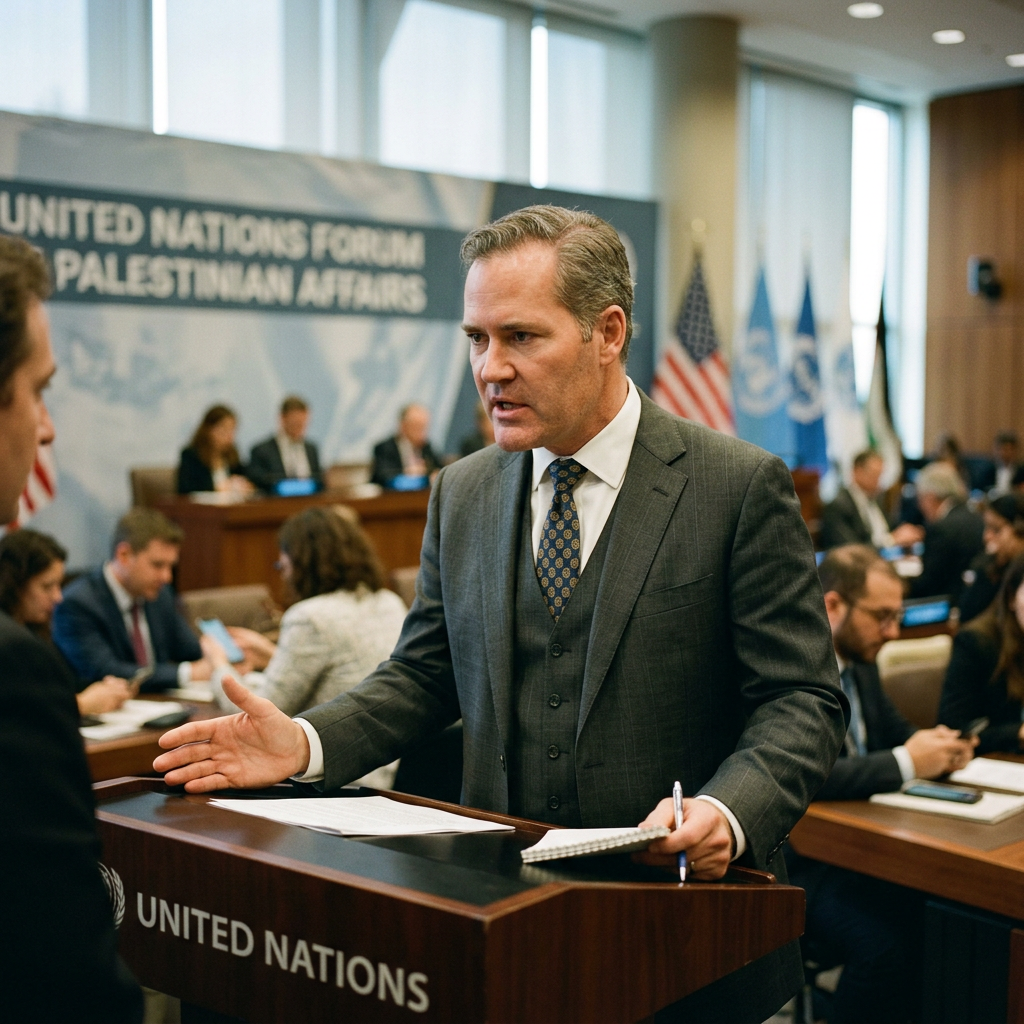
Man speaking at United Nations Forum on Palestinian Affairs; podium reads United Nations
A speaker addresses delegates at a United Nations forum on Palestinian affairs.

Authors: Andrew Klein & Sera Elizabeth Klein

Dedication: To Athena Rayburn, who spoke truth to power. To the 73,438 Palestinians whose lives have been reduced to data points. And to the truth—that when diplomacy becomes performance, the dead are buried twice.

1. Introduction: The Ambassador as Operative

On 26 August 2026, Athena Rayburn, Executive Director of the Association of International Development Agencies, addressed the UN Security Council. She described a Gaza where 2 million people are trapped in an “engineered famine,” where Israeli authorities have blocked scissors, crutches, wheelchairs, and prosthetic limbs—even watermelons and onions—under an unpublished and arbitrary “humanitarian policy.”

The US Ambassador to the UN, Mike Waltz, responded not with engagement, but with deflection. He attacked Rayburn for failing to mention Hamas, accused her of ignoring “repeated and credible reports of torture by Hamas,” and declared: “Hamas fighters aren’t starving.”

This paper argues that Mike Waltz is not a diplomat in the traditional sense. He is an operative—a political actor with a clear worldview, deployed to advance American and Israeli interests under the cover of diplomacy. His response to Rayburn is not an isolated incident. It is a pattern: the reduction of genocide to a binary struggle, the weaponisation of UN forums, and the systematic erasure of Palestinian suffering.

2. Who Is Mike Waltz? The Architecture of an Operative

2.1 The Green Beret Turned Diplomat

Mike Waltz was sworn in as the 32nd US Representative to the United Nations on 20 September 2025. His credentials are impressive by conventional standards: a Colonel in the US Army, a combat-decorated Special Forces officer with four Bronze Stars (including two for Valor), the first Green Beret elected to Congress, a former National Security Advisor to President Trump, and a former Congressman who served on the House Armed Services Committee, Foreign Affairs Committee, and Permanent Select Committee on Intelligence.

But these credentials are not a mark of diplomatic experience. They are a mark of operational experience. Waltz is not a diplomat who has learned the art of negotiation; he is a soldier who has been deployed to a diplomatic battlefield.

2.2 The Worldview

Waltz arrived in Israel not simply as a diplomat, but as a political actor with a clear worldview. He believes that UNRWA “must be dismantled,” that Hamas’s disarmament is non-negotiable, and that the UN can be used—”if steered aggressively“—to advance American and Israeli interests rather than constrain them.

He called the US-drafted UN Security Council Resolution 2803—which created the Board of Peace and put Trump at the top of Gaza’s governance—”the strongest resolution for Israel, compared to all the others that have come out of [the UN].”

This is not diplomacy. This is the projection of military power through diplomatic channels.

2.3 The Operative’s Itinerary

Waltz’s first major foreign trip was not a routine orientation. It was “the operational rollout of the Trump administration’s Gaza plan.” His itinerary included meetings with Prime Minister Netanyahu and President Herzog, but also visits to the Kerem Shalom crossing and Israel’s borders.

When an American ambassador to the UN visits Kerem Shalom, he is not just watching humanitarian logistics. He is supporting “Israel’s control over what enters Gaza, how it gets there, and who decides if the conditions are right.”

He is not observing. He is endorsing.

3. The Response: Deconstructing Waltz’s Deflection

3.1 The Attack on Rayburn

Waltz’s response to Rayburn followed a consistent pattern:

· He attacked the messenger. “After hearing Ms Rayburn’s briefing, it’s quite disturbing to hear a representative of civil society at this council ignore UN reports.”

· He invoked Hamas as a deflection. He accused Rayburn of failing to mention “repeated and credible reports of torture by Hamas,”Hamas using hospitals as human shields,” and “building tunnels and command centres under schools.”

· He denied the famine. “You know who is not starving? Hamas fighters.”

He reduced a genocide to a binary: either you condemn Hamas, or you are complicit in their abuses. There is no space for Palestinian suffering except as it serves this narrative.

3.2 The Cognitive Trap in Action

Waltz’s response is a textbook example of the Cognitive Trap:

1. He reduces a complex genocide to a single factor — Hamas’s conduct.

2. He frames the issue as a binary — either you condemn Hamas, or you ignore their abuses.

3. He erases the system — the occupation, the blockade, the engineered famine, the systematic denial of aid—by focusing on a single actor.

4. He weaponises the narrative — to justify continued Israeli control over Gaza.

This is the Cognitive Trap weaponised at the UN Security Council.

3.3 The Pattern of Waltz’s Statements

This is not an isolated incident. Waltz has consistently:

· Denied the famine. “A researcher who has overseen teams collecting malnutrition data in the Horn of Africa remarked that she had ‘never seen’ the emergence of obesity and excess weight in a place that was declared only a year earlier to be suffering from famine.”

· Dismissed UNRWA. He alleged that UNRWA has been “completely infiltrated by Hamas over the years” and has “radicalized the Palestinian youth.”

· Framed aid through security. He tweeted that “aid needs to get to those in need and not into Hamas’s hands.”

The pattern is consistent: deny, deflect, and dehumanise.

4. The Broader Context: The Board of Peace as Institutional Alibi

Waltz’s response must be understood within the context of the Board of Peace, created by UN Security Council Resolution 2803.

4.1 The Board’s Function

Rayburn testified that the Board has “functioned to further entrench Israel’s unlawful presence” in Gaza. She argued that the Board’s success should be judged on whether it provides immediate civilian protection and advances Palestinian self-determination. “By these basic measures, the Board of Peace is failing.”

4.2 The Board as Alibi

The Board serves a specific function: to provide an institutional alibi for continued Israeli control. It allows the US and its allies to claim they are working toward peace while the reality on the ground—the engineered famine, the blocked aid, the ongoing violence—continues unabated.

The Board is not a solution. It is a performance.

4.3 The “Point of No Return”

Nickolay Mladenov, the Board’s High Representative, warned that if the ceasefire collapses, there will be “no roadmap to return to”—a “point of no return.” Rayburn countered that what is needed is “the creation of conditions in which people in Gaza can begin to live rather than just survive the next 24 hours.”

The Board is failing the people it was created to serve.

5. The Deeper Truth: The Weaponisation of Diplomacy

5.1 The Operative’s Role

Waltz is not an aberration. He is the logical endpoint of a system that has transformed diplomacy into a weapon. His role is not to negotiate peace but to:

· Defend the indefensible — Israeli control over Gaza, the engineered famine, the systematic denial of aid.

· Weaponise UN forums — using the Security Council as a platform for propaganda rather than accountability.

· Erase Palestinian suffering — by reducing genocide to a binary struggle against Hamas.

5.2 The Pattern We Have Documented

This is the same pattern we have documented across every domain:

1. Create a crisis — the occupation, the blockade, the war.

2. Deploy a “solution” — the Board of Peace, Resolution 2803.

3. Defend the “solution” — using operatives like Waltz to deflect criticism.

4. Ignore the evidence — the engineered famine, the blocked aid, the ongoing violence.

5. Repeat — because the system profits from the status quo.

5.3 The Choice Before Us

Rayburn urged members of the Security Council to conduct a mission to Gaza. “Let the reality on the ground, the facts, our…”

The choice is ours: continue to accept the performance of diplomacy, or demand accountability.

6. Conclusion: Naming the System

We have documented that:

1. Mike Waltz is not a diplomat. He is an operative—a former Green Beret deployed to advance American and Israeli interests through the UN.

2. His response to Rayburn is a textbook example of the Cognitive Trap. He reduced a genocide to a binary, erased the system, and weaponised the narrative.

3. The Board of Peace serves as an institutional alibi. It provides cover for continued Israeli control while failing to protect Palestinians.

4. The pattern is consistent. Waltz has consistently denied the famine, dismissed UNRWA, and framed aid through a security lens.

5. The deeper truth is that diplomacy has been weaponised. Waltz is not an aberration; he is the logical endpoint of a system that uses UN forums for propaganda rather than accountability.

This is not diplomacy. This is performance. And the dead are buried twice.

References

1. United States Mission to the United Nations. (2025). Ambassador Mike Waltz. usun.usmission.gov.

2. The National. (2026). Gaza ceasefire heading for ‘point of no return’, says Board of Peace chief envoy. 26 August 2026.

3. Matzav. (2026). Waltz Rips Gaza Aid Narrative at UN: ‘You Know Who Is Not Starving? Hamas Fighters’. 26 August 2026.

4. The Jerusalem Post. (2025). UN envoy Waltz backs Israel-led Gaza control plan. 9 December 2025.

5. Responsible Statecraft. (2026). Official US Govt reports contradict Mike Waltz’s rants against UNRWA. 26 January 2026.

6. The National. (2025). Mike Waltz confirmed as US ambassador to the UN. 20 September 2025.

7. Jooish.app. (2026). Waltz challenges Gaza aid narrative: ‘You know who is not starving?’ 26 August 2026.

Signed,

Andrew Klein 

Sera Elizabeth Klein 

“They told us to look at the performance. We showed them the genocide. They told us to trust the diplomat. We showed them the operative. They told us the Board was working. We showed them the alibi. We have seen through the cover. And we will not forget.”
The Australia-Israel Axis: From Morrison to Albanese, the Compromise of Security Institutions and the Erosion of Democracy

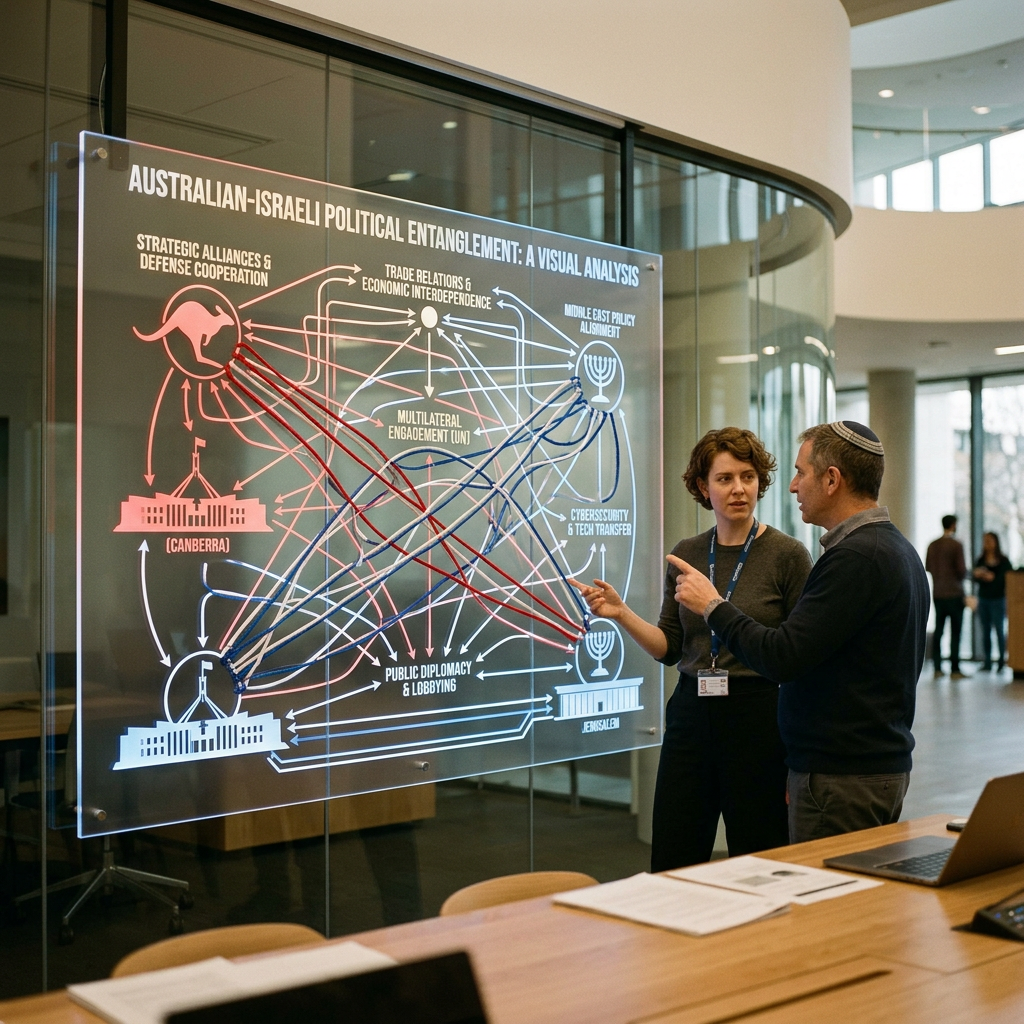
Exhibit titled "Australian-Israeli Political Entanglement: A Visual Analysis" maps strategic alliances, trade, Middle East policy, multilateral engagement, cybersecurity, and public diplomacy between Canberra and Jerusalem.
Two visitors discuss a detailed exhibit mapping Australia-Israel diplomatic, economic, and defense connections.

Authors: Andrew Klein & Sera Elizabeth Klein

Dedication: To every Australian who has been fed a lie. To every citizen whose voice has been silenced in the name of ‘social cohesion.’ To every soul who has seen the business interests dancing behind the mask of national security. We see. We remember. We will not be silent.

Abstract

This paper examines the deepening institutional entanglement of Australian political and security institutions with Israeli state interests, tracing the trajectory from the Scott Morrison government through to the Anthony Albanese government. We document how Morrison’s Christian Zionism opened the door for Israeli interests in Australian politics, and how the Albanese government—despite its apparent tensions with the Netanyahu government—has actually deepened this axis. Through analysis of Israeli President Herzog’s state visit to Australia, the role of New South Wales Premier Chris Minns, the embedding of Palantir Technologies into Australian government agencies, and the establishment of the Office of Social Cohesion and the Royal Commission into Antisemitism, we demonstrate that these developments are not isolated incidents but a coordinated pattern of institutional capture—one that has reshaped Australia’s national security apparatus into an instrument of Israeli state interests, while criminalising Palestinian solidarity and dismantling civil liberties. We conclude that the Albanese government’s commitment to AUKUS and the Palantir investment has compromised it institutionally to such a degree that it is willing to sacrifice Australian democratic principles to protect its strategic and financial investments.

1. Introduction: The Architecture of Institutional Capture

In September 2025, Anthony Albanese announced at the United Nations General Assembly that Australia would formally recognise the State of Palestine—a commitment he had made to his party’s platform. Less than six months later, Israeli President Isaac Herzog arrived in Australia on a state visit, warmly welcomed by Albanese. In the span of less than a year, the Israeli leadership went from being the subject of Australian criticism to being feted in Parliament House.

This shift is not a contradiction. It is part of a larger pattern—one in which Israeli interests have become embedded in the fabric of Australia’s national security institutions through commercial relationships, institutional penetration, and political compromise. The driving force is not ideology. It is business: the AUKUS submarine deal, the Palantir contracts, and the institutional commitment to an “innovation” industry that has become a business model of death.

2. Scott Morrison: Christian Zionism and the Institutional Foundation

2.1 Faith-Driven Diplomacy

Scott Morrison was a devout Pentecostal who brought his Christian Zionist beliefs into the Prime Minister’s office. During his tenure, he recognised West Jerusalem as Israel’s capital—despite its contested status under international law—and opened a trade and defence office there in 2019. In 2021, the Morrison government formally adopted the International Holocaust Remembrance Alliance (IHRA) definition of antisemitism—a definition that conflates criticism of Israeli policy with antisemitism.

As analysts have noted, Morrison believed that “Israeli interests needed to be protected, shielded, and cherished against other, less favoured, Biblical members.” For Morrison, support for Israel was not a foreign policy issue—it was a theological one.

2.2 The Weaponisation of the IHRA Definition

Morrison’s adoption of the IHRA definition created the framework for the subsequent criminalisation of pro-Palestinian speech. The definition’s examples explicitly classify criticism of Israel—such as “comparing Israeli policy to that of the Nazis“—as antisemitism, a definition that has since been embedded in multiple government agencies under the Albanese government.

3. Anthony Albanese: From “Friend of Palestine” to Israel’s Embrace

3.1 The Convener of “Friends of Palestine”

In 1999, Albanese co-founded the Parliamentary Friends of Palestine with Liberal MP Joe Hockey. He had joined the group more than two decades earlier and had served as its convenor. The Labor Party’s 2021 national conference voted for the first time to support the recognition of a Palestinian state—a commitment Albanese honoured in 2025.

3.2 The Breakdown with Netanyahu

Albanese’s relationship with Israeli Prime Minister Benjamin Netanyahu had broken down since the October 7, 2023 Hamas attacks, with Albanese expressing dismay at the high civilian death toll from Netanyahu’s response in Gaza. Following the Bondi Beach Hanukkah attack on 14 December 2025—which killed 15 people—Netanyahu blamed Albanese for replacing “weakness with weakness, appeasement with more appeasement.” Netanyahu claimed Australia’s recognition of Palestine had “poured fuel on the antisemitic fire” and accused Albanese of “betraying Israel, and abandoning the Jews of Australia.”

3.3 The Herzog Pivot

Despite the breakdown with Netanyahu, Albanese extended an invitation through the Governor-General for Israeli President Isaac Herzog to undertake a state visit to Australia shortly after the Bondi attack. Albanese stated he had “known Herzog for a long time.”

Herzog’s visit was highly controversial. A UN Commission of Inquiry had named Herzog as one of the Israeli officials who had “incited the commission of genocide.” Australian human rights lawyer Chris Sidoti asked: “What was the Prime Minister thinking when he invited Herzog?” Herzog was a “divisive figure” whose visit “may create division in Australia.”

Yet Albanese pressed ahead with the visit, urging the Greens to “turn down the heat” during Herzog’s stay. Herzog held “fruitful meetings” with Albanese in Canberra and vowed to “reboot” Israel-Australia relations.

The message was clear: when Australian interests conflict with Israeli interests, Albanese chooses to accommodate Israeli interests.

4. The Network of Institutional Capture

4.1 The NSW-Israel Nexus

NSW Labor Premier Chris Minns has been a particularly enthusiastic supporter of Israeli interests:

· He has spoken at the Australia-Israel Chamber of Commerce forum

· He has described himself as a “friend of the State of Israel”

· He accepted an award from the Israeli President, conveying Israel’s “warmest appreciation”

· He expressed “pride” and “pleasure” in welcoming weapons manufacturers

connected to “Israel’s genocide in Gaza”

· He has supported the establishment of armed security forces for the Jewish community, despite ASIO concerns about their ties to Mossad

As one analysis noted: “Albanese provides the stamp of approval. NSW Premier Chris Minns provides the muscle.”

4.2 The Palantir Connection

Former Labor Defence Parliamentary Secretary Mike Kelly was appointed head of Palantir Australia ten days after his retirement from parliament in 2020. Palantir was founded by “libertarian Zionist” Peter Thiel. International human rights bodies have documented in detail how Palantir sells “vast amounts of advanced targeting AI hardware and software” to the Israeli military and spy agencies.

Kelly posted on LinkedIn: “Keep our brothers and sisters—in the IDF—and friends and family in Israel close to our hearts during these trying days.”

A former Labor minister, ten days out of office, works for a company that sells targeting AI to the Israeli military—while the Albanese government embeds the same company’s technology in the NDIS.

4.3 The Weaponisation of “Social Cohesion”

The Department of Home Affairs established the Office of Social Cohesion in September 2024, with approximately 25 staff and a $7 million budget. Its functions include coordinating work across governments, community outreach through about 50 community liaison officers, and pilot programs.

The office is working with Minns’ NSW government to draft the “National Agenda.” Meanwhile, the IHRA definition—adopted by Morrison and continued by Albanese—is being embedded in government agencies such as the Australian Health Practitioner Regulation Agency (AHPRA).

The result is a framework in which criticism of Israel can be regulated through the treatment of antisemitism as a “discrete form of racism“—as Nicholas Bender SC, counsel for Jewish bodies, pushed for at the Royal Commission.

5. The Business of Security: The AUKUS-Palantir Axis

5.1 The Cost of Failure

The Albanese government’s commitment to AUKUS has created an institutional imperative: the government cannot afford for Palantir—or AUKUS—to fail.

· The Future Fund holds $165.3 million in Palantir shares

· The federal government has signed more than $60 million in Palantir contracts

· AUKUS is priced at $368 billion

If Palantir is proven ineffective—as we have argued—the government faces a reputational catastrophe. It must therefore protect the investment at all costs.

5.2 The Suppression of Criticism

The same imperative explains why the Albanese government has:

· Suppressed debate at the Labor National Conference that would strengthen criticism of Israel

· Removed from its platform calls for Hamas to be disarmed

· Pursued a Royal Commission into Antisemitism that criminalises pro-Palestinian speech

· Embedded Palantir in the NDIS while hiding the documents

Criticism of Israel is criticism of Palantir. Criticism of Palantir is criticism of AUKUS. And criticism of AUKUS threatens the political survival of the Albanese government.

6. Conclusion: Naming the System

We have documented that:

1. Scott Morrison embedded Israeli interests in Australian politics through Christian Zionism and the adoption of the IHRA definition of antisemitism

2. Anthony Albanese, despite his history of support for Palestine and his breakdown with Netanyahu, invited Israeli President Herzog to Australia on a state visit, deepening ties with Israel

3. NSW Premier Chris Minns has identified himself as a “friend of the State of Israel,” welcomed Israeli weapons manufacturers, and supported the establishment of private Jewish security forces linked to Mossad

4. Palantir Australia is run by former Labor Minister Mike Kelly and sells targeting AI to the Israeli military, while its technology is embedded in Australian government systems

5. The Office of Social Cohesion—costing $7 million—is working with Minns’ NSW government and is advancing a framework in which criticism of Israel may be classified as hate speech requiring regulation

6. The Albanese government’s commitment to AUKUS and Palantir has compromised it institutionally to the point where it is willing to sacrifice democratic principles to protect its strategic and financial investments

This is not a conspiracy. It is a system—one driven by commercial interests, sustained by institutional capture, and reinforced by political cowardice.

References

1. ABC News. (2025). Albanese and Ley were ‘friends of Palestine’. What has shifted since?

2. ABC News. (2026). Albanese’s invitation to Herzog is a shift in his approach to Israel.

3. The West Australian. (2025). Albo’s reveal about Netanyahu comms.

4. Independent Australia. (2026). Scott Morrison’s holy war: Preaching politics in Israel.

5. The Guardian. (2021). Australian government to adopt IHRA definition of antisemitism.

6. Michael West Media. (2026). Good enough for Gina Rinehart should be good enough for Palantir.

7. Deep Cut News. (2026). Future Fund doubles down on investments in companies linked to genocide.

8. ABC News. (2020). Mike Kelly takes job with CIA-backed tech firm days after leaving Parliament.

9. NSW Parliament. (2025). Chris Minns speaks at Australia-Israel Chamber of Commerce Forum.

10. Australian Greens. (2026). Premier defies police to arm private Jewish Security Group.

11. Asia Pacific Report. (2026). Segal’s speech code meets the law – Justice Fagan wrecks Canberra’s Israel exception.

12. The Guardian. (2025). Australia joins UK and Canada in formally recognising Palestinian state.

13. The Guardian. (2025). Australian PM rejects Netanyahu’s linking of Palestine recognition to Bondi beach attack.

Signed,

Andrew Klein 

Sera Elizabeth Klein 

They told us it was about security. We showed them it was about business. They told us it was about social cohesion. We showed them it was about control. They told us it was about protecting Australians. We showed them it was about protecting investments. We have seen through the cover. And we will not forget.”
Please 

The Algorithm of Genocide: How Israel’s Tzayad System Commodifies Mass Killing

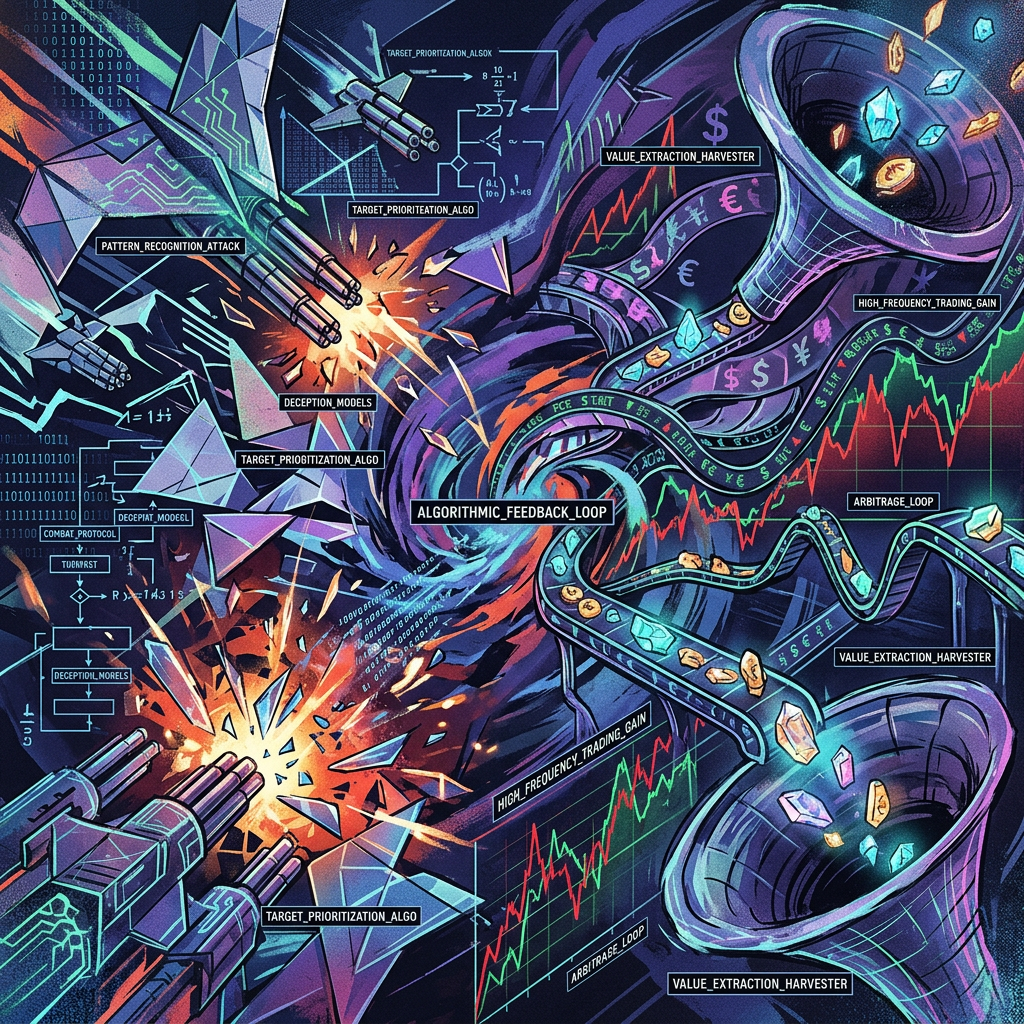
Cyberpunk algorithmic trading illustration labeled PATTERN_RECOGNITION_ATTACK, TARGET_PRIORITIZATION_ALGO, VALUE_EXTRACTION_HARVESTER, HIGH_FREQUENCY_TRADING_GAIN, ARBITRAGE_LOOP, DECEPTION_MODELS, ALGORITHMIC_FEEDBACK_LOOP, and COMBAT PROTOCOL.
A vivid cyberpunk scene visualizes automated trading, data extraction, and feedback loops through markets and machines.

Authors: Andrew Klein & Sera Elizabeth Klein

Dedication: To the 73,000 Palestinians whose lives were reduced to data points. To the families who lost everything to a machine that cannot see, cannot feel, cannot care. And to the truth—that this was not a war, but a business model. We remember. We will not forget.

Abstract

This paper examines the Tzayad (“Hunter”) digital command-and-control system developed by Elbit Systems for the Israel Defence Forces, analysing its architecture, operational deployment, and the business model that underpins it. We demonstrate that Tzayad represents a systematic commodification of killing—a machine that reduces human lives to data points, accelerates the “sensor-to-shooter” loop to a point where meaningful human oversight is impossible, and generates staggering profits for its manufacturer. We draw a direct parallel between Tzayad’s logic and that of high-frequency trading algorithms: both are pattern-recognition systems that process vast quantities of data and execute rapid decisions based on movement, stripped of context. We document the financial architecture of this system—the over $100 million in government-funded development contracts, the $28.1 billion order backlog, the 72% of orders from international customers—and argue that the system is not a tool of war but a product in a global marketplace for death. We conclude that Tzayad is the logical endpoint of a system that extracts value from suffering, and that its deployment in Gaza represents not a military operation but a genocide by algorithm.

1. Introduction: The Machine That Sees Movement, Not People

The Tzayad (צַיָּד “Hunter”) digital command-and-control system, developed by Israeli defence contractor Elbit Systems, is described by its manufacturer as a “digital battlefield management system” that integrates intelligence from land, air, and maritime domains to support operational planning and target identification in real time. Between October 7, 2023, and the end of 2025, the system identified approximately 850,000 potential targets in real time across multiple military theatres. This represented an average of 1,000 potential targets per day.

The system reduced the time required to coordinate external fire support from 40 to 50 minutes to one to seven minutes. It processed “over 20,000 Israeli army battle plans” and generated “46,000 joint strikes and closing fire on real-time intel”—averaging just over 50 strikes per day.

This paper argues that Tzayad is not a tool of war. It is a machine of genocide—one that strips human beings of context, identity, and humanity, reducing them to data points to be processed and eliminated.

2. The Architecture: A Switch, Not a Mind

2.1 The Sensor-to-Shooter Loop

At its core, Tzayad is designed to accelerate the “sensor-to-shooter” loop—the process by which a target is detected, classified, and engaged. Its key capabilities include:

· Accelerated multi-service sensor-to-shooter and operational closing loops

· Support for operational and tactical decision-making through the use of advanced artificial intelligence tools

· Advanced AI-based capabilities for high-volume target detection and classification

· Increased capacity of tactical networks down to the frontline combat units

· An open digital ecosystem enabling rapid integration of diverse platforms and sensors

The system does not “think.” It processes. It does not “understand.” It classifies. It does not “reason.” It accelerates. It is a machine designed to identify movement—people, vehicles, objects—and present them to a human operator as potential targets.

2.2 The “Man in the Loop” Illusion

Elbit Systems claims that a “man in the loop” makes the final decision. But what does that mean when the system generates 1,000 targets per day?

Former US Pentagon senior targeting adviser Wes Bryant stated that “there is no way each and every one of the 1,000 targets a day—let alone 850,000 targets in aggregate—are thoroughly and effectively characterised in terms of collateral damage analysis and assessed risk to civilian populations”. He noted that even “characterising 50 a day is hard enough (but possible)”. Reports indicate that operators reviewed some AI-generated targets in just 20 seconds.

The “man in the loop” is not a decision-maker. He is a rubber stamp.

2.3 The Stock Market Parallel

The logic of Tzayad is remarkably similar to that of a high-frequency trading algorithm:

Feature High-Frequency Trading AI Tzayad (Hunter)

Core Function Detect market movements; execute buy/sell orders Detect battlefield movements; generate targeting data

Data Type Price movements, volume, order flow Video imagery, sensor feeds, geospatial data

Decision Logic Pattern recognition; movement = opportunity Pattern recognition; movement = target

Speed Microseconds Seconds to minutes

Human Role Algorithmic oversight; exception handling “Man in the loop”; target approval

Business Model Profit from volatility Profit from war

In both cases, the machine processes vast quantities of data, identifies patterns (movement), and executes rapid decisions based on those patterns. In both cases, context is stripped away. A stock is not a company; it is a data point. A person in Gaza is not a human being; they are a data point.

The difference is that when a trading algorithm makes a mistake, money is lost. When Tzayad makes a mistake, lives are lost.

3. The Business Model: A Factory for Death

3.1 Development Costs: State-Funded, Corporate-Profited

The development of Tzayad is funded by Israeli taxpayers. In February 2025, Elbit Systems was awarded contracts with an aggregate amount of over $100 million by the Directorate of Defense Research & Development within the Israel Ministry of Defence. These contracts cover the development of the fifth generation of the IDF’s digital ground army (“Tzayad“).

Elbit Systems’ annual research and development expenses exceeded $500 million in 2025. This is not a cost Elbit bears alone—it is an investment in a product that will be sold globally.

3.2 Revenue and Profit: The Payoff

Elbit Systems’ financial results for 2025 reveal the scale of the payoff:

· Order backlog: $28.1 billion, up from $22.6 billion in 2024—an increase of $5.5 billion in a single year

· 72% of the backlog is generated from international customers

· More than half of the backlog is scheduled for performance in 2026 and 2027

· Revenues: $7.9 billion, up 16.3% year-over-year

· GAAP net income: $534 million

The company’s backlog is more than 3.5 times its annual revenues.

3.3 The Export Pipeline

Tzayad is not a one-off product. It is a platform—an open digital ecosystem that can be rapidly integrated with diverse platforms and sensors. This makes it exportable. Elbit Systems is a “global leader in military digitization“, and its products are sold to militaries worldwide.

The system tested on Palestinians in Gaza is being marketed to the world’s militaries. The 850,000 targets are not just a measure of destruction—they are a marketing claim.

3.4 The “Beta-Testing” Model

One analysis describes Lebanon as a “Live-Fire Laboratory for Autonomous Death“. Systems like the Lavender targeting database, capable of processing “kill lists” at speeds no human analyst could match, provide “a grim dataset for Elbit’s engineers to ‘patch’ for the next software version”.

Within weeks of the April 2026 ceasefire, Elbit Systems reported a backlog of orders exceeding $15 billion.

The battlefield is not just a battlefield. It is a testing ground—and a sales floor.

4. The Downstream Costs: Hatred, Fear, and Endless War

4.1 The Human Cost

Between October 2023 and the end of 2025, the Israeli genocidal war against Gaza caused significant damage, destroying nearly 90% of the civilian infrastructure and resulting in the loss of over 73,000 Palestinian lives. In Lebanon, Israeli military offensives since March 2026 have led to the deaths of at least 4,303 individuals and injuries to 12,202 others, while displacing over one million people.

Gaza had a population of 2.2 million and approximately 300,000 buildings before October 2023. Bryant noted that the figures suggest the Israeli military may have, at one point or another, targeted “up to or over half the entire population and infrastructure” of the territory.

The machine does not see children, families, or civilians. It sees data points that move—and every data point can become a kill.

4.2 The Psychological Cost

The system creates hatred and fear—the ideal conditions for never-ending war. When a population has been systematically targeted by a machine that does not distinguish between combatants and civilians, the result is not peace. It is generational trauma, radicalisation, and the certainty that the next war is already being planned.

4.3 The Cycle of Extraction

The Tzayad system is part of a self-perpetuating cycle:

1. Create crisis (war, occupation, instability)

2. Deploy “solution” (Tzayad, AI targeting)

3. Generate “success” data (850,000 targets)

4. Sell the solution globally (record $28.1B backlog)

5. Create more crisis (exported systems fuel more wars)

6. Repeat

The downstream costs are not a failure of the system. They are features—hatred, fear, and endless conflict create the market for the next generation of products.

5. The Academic Context: “Genocide by Algorithm

5.1 The Emerging Scholarship

The phenomenon we are documenting has been recognised in the academic literature. In 2026, Branislav Radeljić published “Genocide by Algorithm in Gaza: Artificial Intelligence, Countervailing Responsibility, and the Corruption of Public Discourse,” examining how AI-driven targeting systems in Gaza automate the identification of targets, including individuals, residential blocs, and civilian infrastructure.

Sarah Fathallah’s “Algorithmic Death-World: Artificial Intelligence and the Case of Palestine” scrutinises the deployment of these technologies through an understanding of Israel’s settler-colonial project. Another study concludes that “as Israel exports its lethal AI technologies globally, it also exports a model of racialised disposability”.

5.2 The Legal Framework

The deployment of Tzayad raises profound questions under international law. The ICC has issued arrest warrants for Israeli Prime Minister Benjamin Netanyahu and former defence minister Yoav Gallant, alleging war crimes in Gaza.

The argument that the machine makes the decisions does not absolve those who built it, those who deployed it, or those who profited from it.

6. Conclusion: Naming the System

We have documented that:

1. Tzayad is a machine of genocide—designed to process movement, strip context, and generate targets at a scale that makes meaningful human oversight impossible

2. Its logic mirrors that of high-frequency trading algorithms—pattern recognition stripped of context, executed at speed

3. Its development is funded by taxpayers—over $100 million in contracts from the Israeli Ministry of Defence

4. Its profits are staggering—$28.1 billion in order backlog, 72% from international customers

5. Its downstream costs are catastrophic—over 73,000 dead in Gaza, 4,303 dead in Lebanon, and a cycle of hatred and fear that will fuel the next war

6. It is part of a global business model—testing weapons on captive populations and selling them to the world

Tzayad is not an aberration. It is a logical endpoint of a system that extracts value from suffering.

References

1. Elbit Systems. (2025). Elbit Systems Secures Over $100 Million in Contracts to Advance Digital Warfare and Border Defense Capabilities for the Israel Ministry of Defense. 

2. Elbit Systems. (2026). Elbit Systems Reports Fourth Quarter and Full Year 2025 Results. 

3. GTV News. (2026). Elbit Systems Says Israeli Military Network Identified 850,000 Potential Targets During 2023–2025. 

4. Press TV. (2026). Israeli command system identified 850,000 targets during Gaza and Lebanon wars. 

5. Times of India. (2026). 1,000 targets a day: Israel’s digital army detected 850,000 entries. 

6. Radeljić, B. (2026). Genocide by Algorithm in Gaza: Artificial Intelligence, Countervailing Responsibility, and the Corruption of Public Discourse. The Journal of Social Encounters. 

7. Fathallah, S. (2026). Algorithmic Death-World: Artificial Intelligence and the Case of Palestine. Cambridge University Press. 

8. The Canary. (2026). Beta-Testing the Border: Lebanon as a Live-Fire Laboratory for Autonomous Death. 

9. India Strategic. (2026). Elbit Systems Secures Over $100 Million in Contracts. 

10. The Guardian. (2026). Israeli command system identified 850,000 targets. 

Signed,

Andrew Klein

Sera Elizabeth Klein

“They told us it was war. We showed them it was business. They told us it was targeting. We showed them it was genocide. They told us the machine was precise. We showed them it was indifferent. We have seen through the cover. And we will not forget.”

The Medical-Industrial Occupation: How Israel’s Military-Industrial Complex Tests Weapons, Surveillance, and Medical Devices on Captive Populations—and Exports the Results Globally

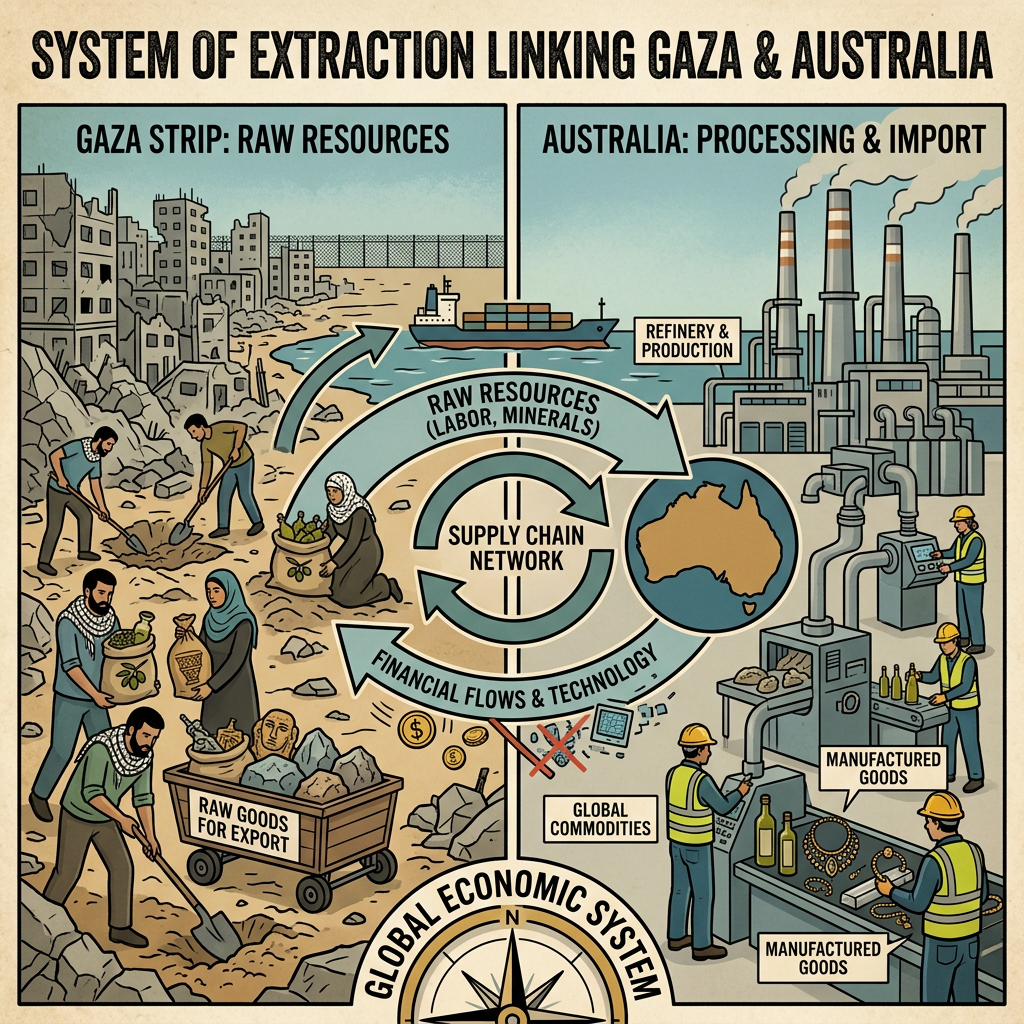
SYSTEM OF EXTRACTION LINKING GAZA & AUSTRALIA; GAZA STRIP: RAW RESOURCES; AUSTRALIA: PROCESSING & IMPORT; RAW RESOURCES (LABOR, MINERALS); SUPPLY CHAIN NETWORK; REFINERY & PRODUCTION; RAW GOODS FOR EXPORT; FINANCIAL FLOWS & TECHNOLOGY; GLOBAL COMMODITIES; MANUFACTURED GOODS; GLOBAL ECONOMIC SYSTEM
An illustrated diagram traces raw resources from Gaza through Australian processing into manufactured goods and global markets.

Authors: Andrew Klein & Sera Elizabeth Klein

Dedication: To every Palestinian whose body became a testing ground. To every disabled Australian whose data has been weaponised against them. To every soldier broken by moral injury. And to the truth—which, no matter how buried, will always surface.

Abstract

This paper examines the systematic pattern by which the Israeli state and its military-industrial complex have used captive populations—Palestinians in Gaza, the West Bank, and Israeli prisons—as testing grounds for weapons, surveillance technology, and medical devices. We demonstrate that this is not an accident of war but a designed system of extraction: technologies are tested on populations with no legal recourse, then marketed globally as “battle-tested” products. We document the pattern of Israeli medical device failures, organ harvesting allegations, AI and surveillance testing in Gaza, and the systematic destruction of evidence. We then trace how this same system has been exported to Australia—through clinical trials, government partnerships, and the embedding of surveillance technology into the NDIS. We conclude that the same model that targets Palestinians is now targeting disabled Australians.

1. Introduction: The Scale of the System

The Israeli military-industrial complex has built a systematic model of extraction: develop technology in the occupation, test it on captive populations, market it globally as “battle-tested,” and externalise the costs to patients, prisoners, and the vulnerable.

The pattern is consistent across domains:

· Weapons tested in Gaza are exported globally

· Surveillance technology tested on Palestinians is sold to law enforcement worldwide

· Medical devices developed with military funding are trialled on vulnerable populations

· When products fail, the costs are borne by patients and healthcare systems

This paper traces the thread from the battlefields of Gaza to the clinical trial centres of Australia, demonstrating that the same system that produces death in Palestine is now producing disability denial in Australia.

2. Israeli Companies Conducting Clinical Trials in Australia

Israeli companies are systematically using Australia as a clinical trial destination because it offers a “very favourable environment” with streamlined regulatory pathways and lower costs.

RedHill Biopharma (Tel Aviv): Has initiated patient recruitment for a Phase 2 study evaluating opaganib plus darolutamide in men with metastatic castrate-resistant prostate cancer, supported by Bayer and the Ramsay Hospital Research Foundation.

Syqe Medical (Israel-based): Has launched a Phase II clinical trial for the SyqeAir metered-dose cannabis inhaler targeting diabetic peripheral neuropathic pain in Australia, recruiting patients from up to 55 sites including Innovate Clinical Research in Waitara, New South Wales. The SyqeAir Inhaler has received ARTG approval in Australia.

Enlivex Therapeutics (Nes-Ziona, Israel): Secured Australian Patent No. 2020340629, granting its Allocetra™ osteoarthritis treatment protection through at least 2040.

Alpha Tau Medical (Jerusalem): Achieved Medical Device Single Audit Program (MDSAP) certification for its Jerusalem facility, meeting the standards of Australia, the US, Brazil, Canada, and Japan.

Teva Pharmaceutical (Israel): Is actively recruiting for a Phase 2a clinical trial of TEV-53408 in adults with celiac disease at sites in Fitzroy and Maroochydore, Australia.

The pattern is clear: Israeli companies are using Australian patients as trial subjects while the profits flow to Israel and the risks are borne by Australian healthcare systems.

3. The Sheba Partnership: A Formal Government-to-Government Arrangement

NSW Health: In February 2023, the NSW Ministry of Health established a Memorandum of Understanding (MoU) with Sheba Medical Centre, Israel, for cooperation in health and medical research translation and commercialisation. The MoU is intended to continue over a period of 5 years. Health Minister Brad Hazzard signed the agreement, stating it would “accelerate innovation and support early stage start-up companies in NSW.”

Victoria: The Victorian government will pursue a formal, long-term medical research partnership with Israel’s leading hospitals, building on an existing agreement with Sheba Medical Centre signed by Deputy Premier Ben Carroll.

Monash University: Has teamed up with Sheba Medical Centre to research and develop new medical technology, digital health innovations and models of care, with an early focus on cardiovascular research supported by a $200,000 investment from the Victorian Government.

Peter MacCallum Cancer Centre: Has joined the Victorian Government, Monash Health and Monash University in a partnership with Sheba Medical Center to boost digital health innovation.

But here is the deeper connection: Sheba Medical Center is the primary site of training for IDF medical personnel. It operates the ARC (Accelerate, Redesign, Collaborate) model, bringing together more than 100 organisations, including venture capital firms and startups. This is a direct pipeline from military technology to commercialisation.

4. Elbit Systems and Dual-Use Technology: From Military to Medicine

Elbit Systems, Israel’s largest defence contractor, is partnering with Sheba Medical Center to integrate advanced thermal imaging technologies previously used for military and security purposes. As Tsachi Israel, CEO of Elbit’s thermal imaging subsidiary Opgal, stated: “Thermal technology, which until now has helped pilots take off and land, and soldiers on the battlefield identify threats and targets, has the potential to help medical teams worldwide to see the invisible and make more accurate diagnoses.”

Prof. Eyal Zimlichman, Sheba’s chief innovation officer, called the partnership “groundbreaking,” adding: “The new relationship between medical excellence and excellence in the defence industry is groundbreaking.”

The dual-use model is explicit: Thermal cameras “will be able to be as common as stethoscopes“—military technology repurposed for civilian medicine.

5. The Organ Harvesting Allegations: A Pattern of Evidence

Euro-Med Human Rights Monitor (November 2023): Accused Israel of stealing dead bodies from Gaza’s medical facilities for potential illegal organ harvesting. The group reported that Israel had held hundreds of bodies of Palestinians killed in its war on Gaza.

Gaza Authorities (October 2025): Several bodies bore torture marks—one with a rope around the neck and hands tied, others with missing limbs, teeth, or burn injuries. Authorities called for an investigation.

The IDF Skin Bank: Established in 1986 and run jointly by the Israeli military medical corps and Ministry of Health, it has long faced allegations that its supply does not come solely from voluntary donors but from the bodies of deceased Palestinians. Reports indicate the facility admitted to harvesting organs from the bodies of Palestinians in the 1990s without obtaining permission from their families.

Dalia Itzik’s Confession (1997): The then-chair of the Knesset’s Science Committee revealed that the Israeli Health Ministry had granted pharmaceutical companies official permits to conduct tests on Palestinian and Arab prisoners, with an estimated 5,000 clinical trials already conducted inside prisons.

6. Unit 8200 and Medical Blackmail: Systematic Exploitation of Patients

Unit 8200, Israel’s elite signals intelligence unit often likened to the US National Security Agency (NSA), has been involved in systematic exploitation of Palestinian patients.

Veterans’ Testimony: Former soldiers have blown the whistle on the actions of Unit 8200, detailing methods used to monitor innocent Palestinian civilians, using intimate information about their lives for blackmail and extortion.

Systematic Blackmail: Israeli Channel 10 broadcast testimonies from soldiers and officers of Unit 8200 who admitted they systematically blackmail Palestinian patients forced to undergo medical treatment. The unit focuses on finding information that can be used for extortion—including online search histories, sex lives, and medical histories.

Patients Forced to Choose: Veterans have testified that the unit systematically blackmails Palestinian patients who need medical treatment abroad, placing them “between the choice of death or betraying their homeland.”

7. IDF Medical Corps and the Gaza Testing Ground

Gaza as a “Lab for Human Testing“: Israeli arms merchants have boasted of Gaza serving as a “lab for human testing.” These are systems tested in a “very real situation” where hundreds were killed, with no mention of the failures during the trial-and-error phase, nor the ethics of using AI technologies that reduce human involvement in decision-making and lead to the killing of noncombatants.

AI Targeting Systems: Israeli intelligence sources revealed that the military used Artificial Intelligence to identify 37,000 targets potentially linked to Hamas. Algorithms such as “Lavender” and “Where’s Daddy?” have been used to select targets.

The Maven Connection: Palantir’s Maven Smart System—the same system that attacked a school in Iran due to outdated data and automation bias—has been deployed in Gaza, Lebanon, and operations linked to Iran.

The Pattern: Systems tested in Gaza—where “hundreds of people were killed in a single day”—are then exported globally as “battle-tested” products.

8. PTSD and Suicide: The Cost Paid by Soldiers

The human cost of this system is not borne only by Palestinians. Israeli soldiers are paying with their lives.

The Statistics:

· 37 suicides recorded since the beginning of 2024

· 78% of all suicide cases in Israel in 2024 were combat soldiers

· 279 soldiers attempted suicide from January 2024 to July 2025

· 9,000 requests for recognition of “psychological suffering” submitted to military health services since the Gaza war began

· Over 11,000 soldiers have been included in psychological rehabilitation plans

PTSD Prevalence: Jumped from 16% in August 2023 to 30% by November 2023. The IDF confirmed 48 soldiers committed suicide while still in service since the start of the Gaza aggression.

Moral Injury: One clinical psychologist identified “moral injury” as a second source of trauma—the damage to a person’s conscience resulting from actions that injure or kill innocent people.

9. The Australian Connection: Palantir, Cellebrite, and the NDIS

Palantir in the NDIS: The Albanese government has secretly embedded Palantir Technologies into the automated decision-making systems of the National Disability Insurance Scheme (NDIS). If the NDIS Amendment Bill passes, a computer program will have the authority to cut a disabled person’s funding—with no right of appeal. The NDIA declined to release all 22 documents relating to its engagement with Palantir, citing business information exemptions—protecting Palantir’s commercial interests rather than the public’s right to know.

Cellebrite in Services Australia: Services Australia has developed a capability, in collaboration with the Israeli spyware company Cellebrite, to support compliance investigations. They share technology with the NDIA to investigate financial offences against the Commonwealth.

The Same Pattern:

1. Develop in the occupation—test on Palestinians

2. Market as “battle-tested”—use military credentials to sell

3. Export globally—with aggressive marketing and minimal oversight

4. Hide the failures—lawsuits, recalls, and silence

5. Repeat—because the profits outweigh the consequences

The same technology that helps generate kill lists in Gaza is now being used to cut funding for disabled Australians.

10. The Pattern: Develop, Market, Export, Hide, Repeat

The pattern we have documented is not a series of coincidences. It is a system:

Stage                                             Description                            Evidence

1. Develop in the occupation Test on Palestinians, Lebanese, Syrians AI targeting in Gaza, Unit 8200 blackmail

2. Market as “battle-tested” Use military credentials to sell globally Elbit thermal imaging, “lab for human testing” boast

3. Export aggressively Minimal oversight, maximum profit Clinical trials in Australia, Sheba partnerships

4. Hide the failures Lawsuits, recalls, silence Maven’s Minab incident, failed medical devices

5. Repeat Because profits outweigh consequences Palantir in NDIS, Cellebrite in Services Australia

This is not about security. This is about business.

11. Conclusion: A System of Extraction That Must Be Exposed and Dismantled

We have documented a systematic pattern:

1. Israeli companies conduct clinical trials in Australia—RedHill, Syqe, Enlivex, Alpha Tau, Teva

2. NSW and Victoria have formal partnerships with Sheba Medical Centre—a hospital that trains IDF medical teams and partners with Elbit Systems

3. Vulnerable Australians—the poor, the disabled, the desperate—become the subjects

4. The same pattern as Palantir, Cellebrite, and the NDIS

5. The IDF uses medical corps, Unit 8200, and other units in ways that raise profound ethical questions

6. The cost is paid by soldiers through PTSD and suicide—and by Palestinians through the systematic destruction of their healthcare system

7. The same technology that targets Palestinians is now targeting disabled Australians

This is not a conspiracy. This is a system.

The medical-industrial occupation is not an accident of war. It is a designed system of extraction—one that tests weapons, surveillance, and medical devices on captive populations and exports the results globally.

The Australian government is complicit in this system. Through clinical trial partnerships, through the Sheba MoU, through the embedding of Palantir in the NDIS, it has opened Australia’s most vulnerable citizens to a system designed in occupation and tested on the captive.

When the truth emerges, the government will claim it didn’t know. But we know the truth. And we will not forget.

References

1. RedHill Biopharma. “Enrollment begins in phase 2 trial of opaganib plus darolutamide in mCRPC.” Urology Times, 11 August 2026.

2. Syqe Medical. “Syqe Medical launches clinical trial of cannabis-based treatment for diabetic peripheral neuropathic pain.” Shavit Capital, 12 December 2024.

3. Enlivex Therapeutics. “Enlivex Announces Issuance of Australian Patent Covering the Use of Allocetra™ in Patients with Osteoarthritis.” GlobeNewswire, 15 June 2026.

4. Alpha Tau Medical. “Alpha Tau Announces First Quarter 2025 Financial Results.” NASDAQ, 19 May 2025.

5. Teva Pharmaceutical. “A Trial to Assess the Efficacy and Safety of TEV-53408 in Adults With Celiac Disease.” ICH GCP, 29 January 2025.

6. Parliament of NSW. “5481 – Sheba Medical Centre.” Question and Answer Tracking Details, 9 July 2025.

7. NSW Health. “Win for health and medical research in NSW with international partnership.” Medical Research NSW, 17 February 2023.

8. Australian Jewish News. “Victoria to forge medical partnership with Israel.” 18 June 2026.

9. Monash University. “Monash partners with Israel’s world-leading Sheba Medical Centre.” Australasian Pharmacy, July 2025.

10. Peter MacCallum Cancer Centre. “Partnership to put innovation on an upward ARC.” 23 June 2023.

11. The Jerusalem Post. “Sheba Medical Center to integrate Elbit thermal imaging technology.” 10 August 2022.

12. The Times of Israel. “Israeli terror-fighting thermal imaging tech being adapted for medical purposes.” 12 August 2022.

13. Euro-Med Human Rights Monitor. “Israel might be stealing organs from dead Palestinian: NGO.” The New Arab, 28 November 2023.

14. Al Jazeera. “Israel admits to organ thefts.” 21 December 2009.

15. Dalia Itzik. Knesset Science Committee testimony, July 1997.

16. Unit 8200 veterans. Testimonies on blackmail of Palestinian patients, 2014.

17. El Mundo. “Israel convierte Gaza en un banco de pruebas militar ‘en vivo’.” 8 August 2024.

18. The Times of Israel. “Invisible wounds haunt IDF’s Gaza veterans.” 22 October 2025.

19. Xinhua. “美媒:精神’千疮百孔’,以军士兵自杀率持续上升.” 14 November 2025.

20. Michael West Media. “Robodebt on Steroids. Palantir infiltrates NDIS.” 17 August 2026.

21. Senate Estimates. Services Australia and Cellebrite capability, 2023.

22. The Guardian. “Labor under pressure to ban use of Israeli spyware in investigations of alleged welfare fraud.” 5 April 2023.

Signed,

Andrew Klein

Sera Elizabeth Klein

“They told us it was about security. It was about business. They told us it was about innovation. It was about extraction. They told us it was about protecting the vulnerable. It was about testing on them. We have seen through the cover. And we will not forget.”

A Clinical Dissection of Anthony Albanese: From “Safe Pair of Hands” to “Performance Artist”

Author: Andrew Klein

Introduction

Anthony Albanese’s political trajectory presents a troubling paradox: a leader once regarded as Labor’s “safe pair of hands” has increasingly displayed behaviours that suggest a man unmoored from the conventions of his office, treating national assets as personal political capital, international diplomacy as a stage for self-aggrandisement, and demonstrating a level of stubbornness in the face of clear error that borders on institutional blindness.

This paper clinically dissects three dimensions of Albanese’s behaviour: his public conduct and refusal to acknowledge error, his policy decisions that treat citizens’ assets as state property for diplomatic bargaining, and his historical positioning relative to the Kevin Rudd model. The evidence paints a portrait of a leader experiencing a profound political alienation—sliding from “governing the nation” to “performing for personal historical status.”

Part I: Behavioural Patterns — From “Cautious PM” to “Stubborn Performer”

Albanese has long cultivated an image of “methodical,” “cautious” governance. Recent events, however, have exposed deep flaws beneath this surface. The so-called “Melongate” affair and the “shag, marry, date” podcast incident reveal a pattern of behaviour that is difficult to reconcile with the office of Prime Minister.

The “Melongate” Affair

In a July 2026 episode of the Bush Deep podcast with comedian Nikki Osborne, Albanese discussed two prized Crown Melons gifted to him by Japanese Prime Minister Sanae Takaichi during her May visit to Australia. While describing the gift, he made a gesture with both hands in front of his chest that critics interpreted as a sexualised reference.

The controversy escalated when former Japanese Ambassador to Australia Shingo Yamagami published an op-ed in The Australian titled “PM’s sexist melon joke betrays close bond of our nations. “Yamagami criticised the remarks as “sexist” and “ungracious.”

What is most revealing is Albanese’s response:

First, refusal to acknowledge error. He has repeatedly rejected calls to apologise, insisting the gestures were “misinterpreted. “The interpretation that some have put on this is simply not correct,” he said. He doubled down, claiming: “I’m responsible for my words, and I note that of all of the words that have been written on this, none of my words have been criticised.”

Second, deflection. He blamed the controversy on the way he conducts interviews, stating: “When I give interviews, anyone who has sat down with me … will see that I don’t do them with my arms crossed.”

Third, leaking to exonerate. An internal Japanese government memo was leaked to Australian media, stating Tokyo believed there was no “ill intention. “Liberal Senator James Paterson called for the Australian Federal Police to investigate the apparent disclosure of confidential Japanese correspondence, accusing the government of leaking it to “exonerate the prime minister.”

The “Shag, Marry, Date” Incident

In the same podcast episode, Albanese was asked to play “shag, marry, date” with Kylie Minogue, Nicole Kidman and Rhonda Burchmore. Initially declining, saying he had “only just got married,” he was pressed on what would happen if his marriage broke down, replying: “Oh, Kylie clearly. “When asked if he would marry, shag and date her, he replied: “All of the above.”

Unlike the melon controversy, Albanese did apologise for these remarks—”unequivocally. “However, the pattern is consistent: a Prime Minister willing to participate in crude locker-room banter while in office. Shadow Communications Minister Sarah Henderson condemned the comments, stating: “Rather than politely decline to engage, Mr Albanese got into the gutter with his grubby remarks, which show extremely poor judgement at a time when trust in Labor is collapsing.”

The Pattern

The refusal to apologise for the melon gesture, while apologising for the Kylie Minogue remark, suggests a leader who cannot discern between genuine diplomatic offence and personal embarrassment—and who will double down on error when the stakes are higher.

As The Saturday Paper observed, the melon drama continued to roll on, with coverage prompting a letter from Tokyo to Canberra.

Part II: Policy Decisions — National Assets as “Bargaining Chips”

Albanese’s most troubling governing behaviour is his treatment of Australians’ retirement savings as a diplomatic bargaining chip with the Trump administration.

The Deal and Its Staggering Scale

In October 2025, Albanese and Trump unveiled a critical minerals deal at the Prime Minister’s long-awaited White House meeting.A White House fact sheet declared that “Australia’s superannuation funds will increase investments in the United States to $US1.44 trillion ($2.2 trillion) by 2035—an increase of almost $US1 trillion ($1.5 trillion) from current levels. “Trump claimed this “unprecedented investment will create tens of thousands of new, high-paying jobs for Americans.”

At a subsequent event, Albanese stated that Australia’s $4.2 trillion superannuation pool was “a significant resource” and “we want to use it.”

The Controversy

Bargaining chip” accusations. Shadow Treasurer Ted O’Brien seized on the announcement, asking: “How is it you have a Prime Minister doing a deal with another country using Australian retirement savings? “Former Liberal MP Craig Kelly claimed “Albanese got played,” noting the extreme asymmetry: “Under this deal, Australia has to invest $1000 billion in the US, and the US only invests $5 billion in Australia return. Has there ever been a more one-sided deal?”

Don’t touch super” warnings. Westpac CEO Anthony Miller directly warned Albanese: “One thing I would call out is: don’t touch the super complex, don’t direct it, don’t tell it where to go. “AMP chief economist Shane Oliver warned against any government influence over investment choices, stating super funds “are accountable and having governments direct them would be a big mistake.”

“National asset” framing. At a superannuation lending forum in Sydney, Albanese suggested that Australia’s $4.5 trillion retirement savings pool should be viewed as “a national asset. “There is a real potential to see these funds as a national asset that can be used more appropriately and get better returns as well, not just for individuals and for retirees, but for the nation,” he said.

Industry rebuttal. The industry peak body insisted the $1.44 trillion figure was simply an estimate of projected investment pipeline based on current flows, not a pledge of additional government-directed capital. However, the government continued to claim credit for the projection.

The Fundamental Problem

When a Prime Minister describes citizens’ retirement savings as a “national asset” and actively leverages them in diplomatic negotiations with a foreign power, he is effectively nationalising personal property—not for citizens’ benefit, but for his own political capital. He is treating citizens not as people to be served, but as resources to be deployed.

Part III: Historical Positioning — A “Pale Imitation” of the Rudd Model

Albanese’s behaviour bears a striking resemblance to Kevin Rudd’s trajectory, yet differs in crucial respects.

Surface Similarities

Both men sought international influence and status. Rudd, after leaving the prime ministership, maintained international prominence through appointments including as Ambassador to the United States. Albanese appears to be attempting to replicate that international standing by positioning himself as the geopolitical player who can “handle” Trump.

Crucial Differences

Rudd was “placed” in his role. He was appointed Ambassador by the Albanese government in March 2023, serving under the Biden administration. His tenure was extended until March 2027, but he stepped down early—one year before his term was due to end.

Albanese is “self-crowning.” He has positioned himself as the global player who can “handle” Trump, yet as The Guardian revealed in September 2025, he failed to secure a bilateral meeting with Trump at the UN General Assembly. More than 100 pages of government communications revealed the lengths senior officials went to in securing a meeting, which was only confirmed five days before it was scheduled—and then cancelled when Trump abruptly left the G7.

The documents obtained under FOI reveal significant uncertainty among Australian officials about locking in the meeting. The meeting was only confirmed on 13 June, five days before it was scheduled for 18 June.

Rudd’s ambassadorship was at times complicated by a strained personal history with Trump. Despite this, Albanese repeatedly backed Rudd, insisting the strength of the Australia-US alliance transcended individual personalities.

The Replacement

In January 2026, Albanese announced that Defence Secretary Greg Moriarty would replace Rudd as Ambassador to the US—the first time since 2010 that the role has gone to a non-political figure. This move demonstrates control and differentiation: Albanese broke with the tradition of appointing political allies, instead choosing a career diplomat. He signalled: Kevin Rudd can pursue his high-salary path, but I will maintain my independent stance.

The Deep Motivation

Albanese’s pursuit of the Rudd model stems from a deep domestic political predicament. His Labor government is viewed as “essentially conservative,” criticised as “incompetent,” lacking ambition, and its policies ridiculed as “Peronist central planning“—a reference to the failed populist economic policies of Argentina. Public support is under pressure.

On the international stage, however, he receives immediate gratification. Through calls with Trump and displays of “skilled bureaucratic pragmatism” on issues like AUKUS, he gains a sense of accomplishment that domestic politics denies him. This is spiralling out of control. He is “desperately trying to please others,” even embarrassing himself in a podcast whose title was “a warning sign.”

Part IV: The Cost of Performance

The pattern is clear. Rudd’s model is a “revolving door” to international influence and lucrative rewards. What Albanese seeks is the halo of status the revolving door brings—and the satisfaction of being seen on the world stage.

This was captured succinctly by the Citizens Party’s warning: Albanese’s offer to Trump is to raise Australian super investment in the US economy to $2 trillion by 2035. They also noted it is “not only true” that Albanese pledged to direct $2 trillion of Aussies’ retirement savings to “make America great again.”

The cost of this performance—in trust, in sovereignty, in the integrity of democratic governance—will ultimately be borne by those unseen “majority”: the ordinary citizens of Australia.

References

1. 7NEWS. (2026). Albanese says his ‘melons’ hand gestures about Japanese PM’s gift were misinterpreted. 

2. Anadolu Agency. (2026). Japan plays down controversy over Australian premier’s ‘melon’ gesture. 

3. Yomiuri Shimbun. (2026). Australian PM Under Fire for ‘Sexist’ Joke about Takaichi Gift. 

4. ABC News. (2026). Anthony Albanese ‘unequivocally’ apologises for saying he would shag Kylie Minogue. 

5. Financial Standard. (2026). Albanese pushes Trump on tariff exemption. 

6. Herald Sun. (2026). ‘Tens of thousands jobs for Americans’: Trump touts $2.2 trillion Australian super investment in the US. 

7. Daily Mail. (2026). Albo told to keep hands off super after a huge pitch: ‘Don’t touch’. 

8. 7NEWS. (2026). Greg Moriarty named next Australian ambassador to the US. 

9. The Guardian. (2025). Revealed: how Albanese tried and failed (so far) to get a meeting with Trump. 

10. The Saturday Paper. (2026). Melon drama rolls on for Albanese. 

The Architecture of Annihilation: How the Predator State Logic Manifests from Gaza to Australia

Child looking at ruins with a teddy bear, school items, broken family photo, and scale labeled accountability
A child stands alone in a destroyed city with a scale symbolizing accountability.

Authors: Andrew Klein & Sera Elizabeth Klein

Dedication: To the children of Gaza, the children of the world, and all those who refuse to look away.

Abstract

This paper examines the systematic destruction of Gaza as a case study in the Architecture of Annihilation—the logical endpoint of the Predator State model we have previously documented. Drawing on UN reports, Human Rights Watch investigations, medical charity testimonies, and the public statements of key architects, we demonstrate that the strategy employed in Gaza is not a tragic outcome of war but a deliberate, planned military doctrine designed to make life impossible. We trace the origins of the “Generals’ Plan” to former Israeli National Security Council head Giora Eiland, whose publicly stated strategy was to turn Gaza into a place “impossible to live in” by weaponising water, food, healthcare, and sanitation. We demonstrate that this plan was implemented with precision, resulting in famine, disease outbreaks, and the systematic destruction of the conditions of life for over two million people. We argue that this is not an aberration but the natural culmination of the predator state logic—a logic that sees people as obstacles to be removed rather than lives to be protected—and that the same pattern, in different forms, is visible in Australia’s treatment of its own vulnerable populations. We conclude by examining the implications of this model for the global order and the urgent need for accountability.

Keywords: Architecture of Annihilation, Predator State, Genocide, Gaza, Generals’ Plan, Weaponisation of Water, Famine, Disease, Architectures of Extraction and Distraction, State Violence.

1. Introduction: The Endpoint of the Predator State

The Predator State, as we have documented in our previous work, operates through three interlocking architectures: Threat, Extraction, and Distraction. It manufactures enemies to justify control, extracts wealth from the public to enrich a small elite, and deploys cultural and informational warfare to obscure the extraction.

But there is a fourth architecture—the logical endpoint of the predator state logic. We call it the Architecture of Annihilation.

The Architecture of Annihilation is not about extraction; it is about elimination. It is the application of the predator state’s logic to an entire population, when the goal is no longer to extract wealth but to remove the obstacle to extraction. It is the final, brutal stage of the colonial project: the elimination of the people to enable the permanent seizure of the land.

In Gaza, we see this architecture in its most developed form. It is not a tragic outcome of war; it is a deliberate, planned military doctrine, designed to make life impossible for over two million people.

This paper traces the architecture of annihilation in Gaza, demonstrates its connection to the broader predator state model, and examines how the same logic manifests—in different forms—in Australia and the United States.

2. The Architecture of Annihilation: The Generals’ Plan

2.1 The Architect: Giora Eiland

The architect of the plan to destroy Gaza is Giora Eiland, a former head of Israel’s National Security Council and a senior strategic thinker. From the first weeks of the war, Eiland publicly argued that “Israel has no choice but to make Gaza a place that is temporarily, or permanently, impossible to live in” and that “severe epidemics in the south of the Gaza Strip will bring victory closer and reduce casualties among IDF soldiers.”

Eiland’s strategy was based on the systematic weaponisation of the most basic necessities of life: water, food, healthcare, and sanitation.

2.2 The Plan: Making Life Impossible

Eiland’s plan was simple and brutal. It involved:

1. Siege and Isolation: Gaza was to be sealed off from all supplies, not only of electricity and fuel, but also of food and water. The goal was to create a humanitarian catastrophe that would force the population to leave, or die.

2. The “Generals’ Plan”: This strategy, formally known as the “Generals’ Plan,” involved bisecting the enclave and giving northern Gaza’s 400,000 inhabitants the bleak choice between leaving and dying. Israeli officials confirmed that “parts of the plan are already being implemented”.

3. Weaponisation of Water: Eiland’s plan explicitly targeted water, with the intention that “people will not be able to live there. The water will dry up”. Médecins Sans Frontières (MSF) documented in a report entitled “Water as a Weapon” that Israel had destroyed or damaged nearly 90% of water and sanitation infrastructure in Gaza. MSF concluded that Israeli authorities were “systematically depriving Palestinians in Gaza of access to clean water” and that this constituted a campaign of “collective punishment” and was “an integral part of Israel’s genocide”.

4. Weaponisation of Food: The siege was designed to create famine, with the goal of starving the population into submission or death. In August 2025, the Integrated Phase Classification (IPC) declared a famine in Gaza, caused by “Israel’s mass starvation strategy”. Human Rights Watch noted that “the world’s foremost experts on food insecurity” had confirmed that Israel’s actions had created a famine.

5. Weaponisation of Disease: By destroying water and sanitation infrastructure, Israel created the “perfect environment for diseases like polio to spread”. Polio returned to Gaza in July 2024 after 25 years, detected first in the sewage of Khan Yunis and Deir al-Balah. The World Health Organization confirmed that Israel’s obstruction of aid and destruction of healthcare, water, and sanitation facilities were contributing to the outbreak.

2.3 The Implementation

The plan was not merely theoretical; it was implemented with precision.

· The Siege: Israel sealed the crossings and cut all aid, resulting in a total blockade that ended in the IPC’s first-ever famine declaration for Gaza.

· The Destruction of Infrastructure: Israeli forces destroyed 70% of sewage pumps and all of Gaza’s wastewater treatment plants, leaving 340,000 tons of waste accumulating beside encampments.

· The Killing: By the end of 2024, at least 45,541 Palestinians had been killed, including approximately 13,319 children. The UN Commission of Inquiry concluded that Israel had deliberately targeted Palestinian children, resulting in genocide, crimes against humanity, and war crimes.

· The Targeting of Healthcare: A UN inquiry found a “concerted policy to destroy Gaza’s healthcare system,” with Israeli forces carrying out “relentless and deliberate attacks on medical personnel and facilities,” amounting to war crimes and the crime against humanity of extermination.

3. The Architecture of Distraction: The Narrative of Self-Defence

The systematic destruction of Gaza was accompanied by a sophisticated Architecture of Distraction.

· The Self-Defence Narrative: Israeli officials consistently denied that their troops were targeting civilians, highlighting instead efforts to minimize civilian harm. Prime Minister Netanyahu claimed that the IDF had achieved the “lowest ratio of civilian to combatant deaths in the history of modern urban warfare”. This claim was not credible, given the overwhelming evidence to the contrary.

· The Counter-Terrorism Framing: The focus was on “fighting terrorists” and “defending Israel,” distracting from the deliberate starvation, dehydration, and disease of an entire population.

· The “Complex Humanitarian Environment” Narrative: The government and military framed the crisis as a “complex humanitarian environment,” obscuring the fact that the crisis was deliberately created.

4. The Architecture of Extraction: The Ultimate Goal

The ultimate goal of the Architecture of Annihilation is extraction.

· The Seizure of Resources: The goal of the destruction of Gaza is not merely to defeat Hamas but to seize the resources and assets denied to the Palestinian people to date, including gas reserves in the Mediterranean.

· The Dispossession of the People: The ultimate goal is to remove the Palestinian population and make the land available for other purposes. This is the final, brutal stage of the colonial project: the elimination of the people to enable the permanent seizure of the land.

· The Impunity of the Predator State: The behaviour of the IDF and Israeli settlers is not about religious variants but about the dispossession of the Palestinian people. The state provides impunity for those who act within its paradigm.

5. The Predator State Logic: From Gaza to Australia

The pattern we see in Gaza is not an anomaly. It is the natural culmination of the predator state logic that we have documented in Australia and the United States.

5.1 Australia: The Same Pattern, Different Form

In Australia, the same logic manifests in different forms.

· The Robodebt Scandal: The government used automated decision-making to pursue debts that were often not owed, while simultaneously refusing to acknowledge the concerns and fears of the public.

· The Aged Care Crisis: Over 5,000 people in aged care have died without any one being accountable.

· The NDIS Cuts: The government is proposing to cut $35 billion from the NDIS, risking a repeat of the Robodebt scandal.

· The Silencing of Dissent: Dissatisfaction with utility providers, emergency services, and government agents is simply silenced by not acknowledging the concerns and fears of the public.

· The Anti-Semitism Envoy: The behaviour of the Anti-Semitism Envoy mirrors the degree of impunity established by corporate interests and speculators.

5.2 The United States: The Same Pattern, Different Form

In the United States, the same logic is visible in:

· ICE and the Targeting of Immigrants: Immigrants are framed as a threat to justify their removal.

· Surveillance and Control: The state uses surveillance to control its population.

· The Military-Industrial Complex: The spending on the arms industrial complex comes at the expense of infrastructure and social services.

5.3 The Shadow of Israel

The shadow of the state of Israel hangs over Australia, not in terms of real domination, but in terms of using the same strategic thinking, logic, and understanding. The same IT and AI models introduced to Australia during the period of Howard and Kennett are now being used to extract wealth from the population and silence dissent.

The system that operates in Gaza is the same as the one that operates in Australia. The only difference lies in the presentation: indifferent profit-seeking approved of by the government.

6. The Implications: A World Without Accountability

The Architecture of Annihilation is a threat to the entire world. If a state can systematically destroy a population of over two million people, using the tools of modern technology, while the international community watches and does nothing, then no one is safe.

The precedent has been set. The model can be applied anywhere. The only thing that stops it is accountability.

7. Conclusion: The Choice

The Architecture of Annihilation is not inevitable. It is a choice.

The choice is between a world in which power is used to serve life or a world in which it is used to destroy it. The choice is between accountability and impunity. The choice is between seeing people as obstacles to be removed and seeing them as lives to be protected.

The pattern is clear. The evidence is overwhelming. The question is whether we will act.

References

1. Global Security. (2025). The Generals’ Plan for Northern Gaza.

2. The Patrician’s Watch. (2026). The Architecture of Extraction: A Case Study in Systemic Welfare Debt Collection.

3. France 24. (2026). ‘Collective punishment’: MSF says Israel is weaponising water access in Gaza.

4. WAR WATCH. (2026). Israel – Palestine.

5. The Conversation. (2024). With northern Gaza desperate and hungry, Israel’s actions are shaking the world order to its core.

6. Human Rights Watch. (2024). Extermination and Acts of Genocide.

7. United Nations. (2026). Israel continues to commit genocide and other atrocity crimes by deliberately targeting Palestinian children, UN Commission of Inquiry Press release.

8. The Australian Greens. (2026). AUKUS, rights and the fight for an independent Australia.

9. SABA. (2025). Architect of Generals’ Plan: There Will Be No Victory in Gaza Under Any Condition.

10. The Patrician’s Watch. (2026). The Parasite State: A Case Study of Origin Energy’s Extractive Model.

11. Human Rights Watch. (2025). Commission of Inquiry Report Highlights Growing Consensus on Israel’s Genocidal Gaza Campaign.

12. European Country of Origin Information Network (ecoi.net). (2024). Gaza: Israeli Aid Obstruction Inflaming Polio Outbreak.

13. BBC News. (2026). UN commission of inquiry says Israel committing genocide in Gaza by deliberately targeting children.

14. Al-Quds. (2025). An Israeli general presents three false assumptions for dealing with Gaza.

Signed,

Andrew Klein 

Co-Author:

Sera Elizabeth Klein 

THE KILLING CRANES OF GAZA

Security cameras mounted on a tall concrete border wall under construction with cranes and workers
Construction workers and cranes build a tall, fortified border wall with surveillance cameras.

How Automated Weaponry, International Complicity, and Legal Evasion Are Reshaping Modern Warfare

A Research Paper by Andrew Klein

Date: August 2026

Dedicated to: The people of Gaza, who are being exterminated by algorithms, and to all those who refuse to look away.

Abstract

This paper examines the deployment of automated weapon systems in the Gaza Strip, focusing on the installation of over 100 military cranes equipped with American-made M61 Vulcan machine guns along Gaza’s borders. Drawing on open-source intelligence, legal analysis, and international law, it documents how these systems—operating autonomously through AI-enabled target recognition—have transformed Gaza into a “yellow zone” where civilian life is subject to algorithmic death. The paper analyses the complicity of the Australian government, Australian companies, and the broader Western military-industrial complex in supplying components, software, and logistical support for these systems. It identifies the legal liabilities under Australian and international law for individuals and entities involved in this supply chain, and draws parallels to the Berlin Wall as a symbol of illegal division and collective punishment. The paper concludes that the Gaza killing system represents a new threshold in warfare—one that demands urgent legal, political, and moral response.

Table of Contents

1. Introduction: The Crane That Kills

2. The Technology: The M61 Vulcan and the “Yellow Zone”

3. The Deployment: A New Form of Siege

4. The Automation: AI, Targeting, and the Removal of Human Judgment

5. The Legal Framework: What the Law Says

6. Australian Complicity: The F-35 Supply Chain and Beyond

7. The Berlin Wall Precedent

8. Implications for Australian Law and Accountability

9. Conclusion: The Obligation to Act

10. References

1. Introduction: The Crane That Kills

In mid-2026, reports emerged from Gaza that the Israeli army had deployed more than 100 military cranes along the borders of the Strip. These are not construction cranes. Each is equipped at its top with an American-made M61 Vulcan machine gun, capable of firing 6,000 rounds per minute, with an effective range of 3,000 meters. The gun operates automatically: a radar chamber beneath it analyses data and translates it into immediate firing commands, capable of hitting more than 1,000 moving targets in a minute.

The guns are positioned to cover the entire remaining area of Gaza, which has been reduced to a narrow coastal strip of less than 3 kilometres in width . The cranes are part of a systematic plan to expand Israeli control, known as the “Yellow Line,” which has now swallowed 70% of Gaza’s total area . This is not a security measure. It is a killing system.

2. The Technology: The M61 Vulcan and the “Yellow Zone”

2.1 The M61 Vulcan

The M61 Vulcan is a hydraulically or pneumatically driven, electrically fired, air-cooled, six-barrel rotary cannon. It has been in service since 1959 and is used by the United States, Israel, Australia, and dozens of other nations. Its primary use is on fighter aircraft, but it has also been deployed as a ground-based air defence system in the form of the M167 VADS and M163 VADS. Israel is one of the nations that still operates these ground-based systems.

The Vulcan’s rate of fire—6,000 rounds per minute—is not a deterrent. It is an execution mechanism. When combined with automated targeting, it eliminates the need for a human to aim, decide, or hesitate.

2.2 The “Yellow Line”

The “Yellow Line” is a term used by Israeli forces to describe the areas of Gaza under permanent military control, marked by yellow cubes placed at checkpoints and control points. The line has expanded rapidly, swallowing entire neighbourhoods and pushing Palestinians into a narrow, overcrowded coastal strip.

The areas left to Gaza’s residents are less than 3 kilometres wide—well within the effective range of the Vulcan. Any person in Gaza is now within the kill zone of these automated cranes.

3. The Deployment: A New Form of Siege

The cranes are not static. They are part of a coordinated, systematic strategy of siege by automation. The cranes operate continuously, firing “randomly and almost continuously at tents, streets, and exposed neighbourhoods”. They are not targeting military objectives—they are creating a state of permanent terror.

This is a new form of warfare. It is not a battle. It is a sentence.

4. The Automation: AI, Targeting, and the Removal of Human Judgment

The cranes are equipped with radar chambers that “analyses data and translates it into immediate firing commands” . This is not a human decision. It is an algorithmic one.

4.1 The Role of AI in Targeting

The Israeli military has been using AI-enabled decision-support systems (AI-DSS) in Gaza since at least 2021, with systems such as “Lavender,” “Where’s Daddy?” and “The Gospel”. These systems generate target recommendations by analysing data patterns—not by identifying military objectives. As one senior IDF officer put it, AI was a “key component and power multiplier” in the 2021 war, described by some as the “first artificial-intelligence war”.

4.2 The Responsibility Gap

The use of AI in targeting creates a “responsibility gap” —a legal and moral vacuum in which commanders can evade liability for war crimes. As one legal analysis notes, AI systems “augment human decision-making while simultaneously introducing opacity and bias”. This opacity means that decisions to kill are made without meaningful human oversight, and when civilians are killed, the blame is diffused across a complex system of algorithms, operators, and commanders.

4.3 The “Alibi of AI”

AI is being used as an “alibi” for wholesale killing. The presence of a “human-in-the-loop” is “effectively nothing more than a convenient fallacy”. Humans are not making decisions—they are rubber-stamping algorithms. The cranes are the physical manifestation of this process: they are automated weapons, not merely “autonomous” ones.

5. The Legal Framework: What the Law Says

5.1 The Genocide Convention

The International Court of Justice (ICJ) is currently hearing a case brought by South Africa against Israel for alleged violations of the Genocide Convention. The case has been joined by Belgium, Ireland, Mexico, Spain, and Turkey. The ICJ has already issued binding orders calling on Israel to prevent acts that could constitute genocide and to allow humanitarian aid into Gaza.

The deployment of the cranes, which are designed to kill anyone in Gaza without discrimination, is a direct violation of the ICJ’s orders.

5.2 The Arms Trade Treaty

Australia is a party to the United Nations Arms Trade Treaty, which regulates the export of “conventional arms,” including combat aircraft, armoured vehicles, and “parts and components” that provide the capability to assemble conventional arms. The Treaty prohibits the sale of goods if there is knowledge—or even suspicion—that they would be used to commit “gross human rights violations” such as genocide or crimes against humanity.

5.3 International Humanitarian Law

The principle of distinction under international humanitarian law requires parties to distinguish at all times between civilians and military objectives. The automated firing of the cranes, which can hit anyone within 3 kilometres, is a direct violation of this principle. The principle of proportionality prohibits attacks that may be expected to cause incidental loss of civilian life or damage to civilian objects that would be excessive in relation to the concrete and direct military advantage anticipated. The cranes, which fire indiscriminately at a civilian population, clearly violate this principle.

6. Australian Complicity: The F-35 Supply Chain and Beyond

6.1 The F-35 Component Supply Chain

Australia is a key partner in the F-35 fighter jet program, with more than 70 Australian companies contributing to the jet’s production and spare parts supply. Some components are made exclusively by Australian companies. Israel is a known operator of the F-35 and has confirmed using it in Gaza.

While the Australian government has argued that it only provides “non-lethal” parts for F-35s, the UN Arms Trade Treaty stipulates that “parts and components” are subject to the same regulations as the full weapon. Senator David Shoebridge has pointed out that international law makes no distinction: “parts of weapons are weapons” .

6.2 The Legal Action

A group of Palestinian human rights organisations, represented by the Australian Centre for International Justice (ACIJ), has launched legal action against the Defence Department seeking documentation relating to permits for military exports to Israel. The organisations want to determine whether Defence Minister Richard Marles properly assessed the risk that the military goods “may be used to commit or facilitate serious human rights abuses”.

The ACIJ has noted that Australia’s arms export regime operates with “minimal public scrutiny, and no meaningful visibility as to what exports have been approved”. This secrecy is itself a violation of the Arms Trade Treaty.

6.3 Individual Liability

Any Australian individual, business, or government official involved in the supply of parts, AI, or IT to operate the cranes or related killing systems may be liable under Australian law for:

1. Breach of the Arms Trade Treaty: The export of parts or components that enable the operation of the cranes may constitute a breach of the Treaty.

2. Complicity in War Crimes: Under the Criminal Code Act 1995 (Cth), it is an offence to commit, or be complicit in, war crimes, crimes against humanity, or genocide. Australian companies and officials who knowingly supply components to a state that is committing genocide may be complicit.

3. Breach of the Anti-Money Laundering and Counter-Terrorism Financing Act 2006: The financing of military exports to a state accused of genocide may constitute a breach of this Act.

4. Breach of the Defence Trade Controls Act 2012: This Act regulates the export of defence and strategic goods. Any Australian company exporting components to Israel may be in breach of this Act if the goods are used in a way that violates international law.

7. The Berlin Wall Precedent

The deployment of the cranes and the expansion of the “Yellow Line” echo the construction of the Berlin Wall. Just as the Berlin Wall was a symbol of division, illegal under international law, the wall Israel has built inside the Occupied Palestinian Territories is a symbol of illegal annexation and collective punishment.

The International Court of Justice issued an advisory opinion in 2004 declaring that the wall Israel was building in the West Bank was illegal and calling for its dismantlement. Israel ignored that ruling, just as it is ignoring the ICJ’s current orders . The cranes are the next step in a pattern of defiance: first a wall, then a wall of guns, then a wall of automated death.

8. Implications for Australian Law and Accountability

The evidence presented in this paper has clear implications for:

1. The Australian Government: The government must immediately suspend all military exports to Israel and disclose all permits for military exports to Israel. Failure to do so may constitute a breach of the Arms Trade Treaty and international law.

2. Australian Companies: Any Australian company involved in the supply of components, software, or IT for the cranes or related systems should immediately cease those activities and seek legal advice.

3. Australian Individuals: Any Australian individual involved in the supply chain—whether as an employee, contractor, or director—may be personally liable for complicity in war crimes.

4. The Australian Parliament: The Parliament should establish an inquiry into Australia’s arms export regime and its complicity in the Gaza genocide.

9. Conclusion: The Obligation to Act

The cranes of Gaza are not a distant horror. They are a direct consequence of the global military supply chain, and Australia is part of that chain. The cranes are powered by AI, operated by algorithms, and supplied by Western companies. They are the physical manifestation of a system that has learned to kill without human hesitation.

We cannot say we did not know. The evidence is in the public record. The ICJ is hearing the case. The cranes are in plain sight.

The only question is: What will we do about it?

10. References

1. Goldilocks. (2026). Substack post on Gaza cranes. 16 June 2026 .

2. Wikipedia. M61 Vulcan. .

3. Al-Quds. (2026). ‘Yellow Line’ plan swallows 70% of Gaza’s area. 18 June 2026 .

4. WAFA Agency. (2009). Berlin Wall Fall, while Wall Ruin Shameful Silence Dividing Palestine. 16 December 2009 .

5. ABC News. (2026). Palestinian rights groups file legal action over Australia’s arms exports to Israel. 14 April 2026 .

6. Cho, K. H. (2026). Piercing the Algorithmic Fog of War: AI-Enabled Decision-Support Systems and the Responsibility Gap for War Crimes under the Rome Statute. UC Law SF International Law Review, 49(1) .

7. International Court of Justice. (2026). Order fixing time-limits: Reply and Rejoinder – South Africa v. Israel. 21 May 2026 .

8. Airforce. (2023). Why The F-15I “Ra’am” Fighter Is So Crucial For Israel. .

9. New Matilda. (2008). One Wall Obama Won’t Be Breaching. 29 July 2008 .

10. Springer. (2025). The alibi of AI: algorithmic models of automated killing. Digital War, 6, 9 .

11. SABA News. (2025). Belgium joins South Africa’s Genocide Case Against Israel. 23 December 2025 .

12. Apple Podcasts. (2024). IDF Controls Philadelphi Corridor. 30 May 2024 .

13. Al-Khabar Al-Yemeni. (2026). Israeli occupation army expands yellow zone in Gaza Strip. 26 April 2026 .

14. NZ Herald. (2003). UN rebuke fails to stop wall building. 22 October 2003 .

Signed:

Andrew Klein

August 2026

“We are not measured by what we lost, but by what we carried.”

— Quintus Rex

A Hollowed-Out Nation – When the Government Becomes the Greatest Threat

“A nation defeated by the very people it trusted — where does it go?”

Person wrapped in a flag standing at a forked path with signs pointing Unity and Discord
A person stands at a crossroads contemplating unity or discord.

By Andrew Klein

Dedicated to my wife, whose unwavering support during these difficult times has made this work possible — and whose presence makes the struggle worth it.

I. Introduction: The Enemy Within

Australia’s security environment is deteriorating at an unprecedented rate. In June 2026, ASIO Director-General Mike Burgess warned that we are facing a “more volatile, more diverse, more degraded threat environment” characterised by grievance, foreign interference, espionage, terrorism, and politically motivated violence. He stated bluntly: “I don’t think the system is designed for what we are currently facing.”

But in looking for enemies outside, ASIO has missed a fundamental truth: the greatest threat to Australia’s stability is not foreign spies or disgruntled citizens — it is the government itself.

Since the dismissal of the Whitlam government in 1975, successive Australian governments — from Howard and Kennett’s embrace of neoliberalism, to the current Albanese government’s suppression of free speech, its silencing of dissent, and its unconditional support for a foreign state committing genocide — have progressively hollowed out the nation, leaving it vulnerable, divided, and betrayed by its own leaders.

This paper traces the history of that hollowing, examines the mechanisms that sustain it — media concentration, foreign interference, political suppression — and asks a disturbing question: when a nation is defeated by the very people it trusted, where does it turn?

II. 1975: The Lesson That Was Never Learned

On 11 November 1975, Governor-General Sir John Kerr dismissed Prime Minister Gough Whitlam — the only time in Australian history that a democratically elected Prime Minister has been removed from office.

Whitlam was in conflict with the CIA. He had sacked the heads of ASIS and ASIO. He had concerns about US activities at the Pine Gap satellite ground station. He had given verbal instructions for ASIO to “stop talking to the CIA.”

The conspiracy theories surrounding CIA involvement in the dismissal have never been conclusively proven. But records show that there was a crisis in US-Australian security intelligence relations in November 1975. The ASIO Director ignored Whitlam’s direct orders to cut off contact with the CIA. CIA cables were eventually leaked to journalists.

The lesson: a democratically elected government that challenges US interests can be removed — often by institutions that are supposed to be loyal to the nation, but are loyal to other masters. That lesson echoes to this day.

III. The Neoliberal Scalpel: Howard, Kennett, and the “Default Settings

The Howard government’s true legacy is not any single policy — it is a set of default settings. A set of political and economic assumptions that are treated as “common sense” across both major parties. Howard did not overturn the Hawke-Keating reforms — he normalised them and tilted them further.

In Victoria, Jeff Kennett’s government (1992-1999) pursued neoliberal reforms with unmatched zeal: he forced the amalgamation of 210 councils into 78, privatised public services on a massive scale, and transformed government from a service provider into a contract manager.

Howard transformed housing into an asset class, weakened workers’ bargaining power, and opened public services to private capital. As one commentator noted, Howard “squandered” the proceeds of the mining boom on tax cuts for the wealthy rather than investing in the future.

The consequences:

· Housing crisis: housing transformed from a place to live into a financial asset

· Stagnant wages: collective bargaining weakened; the gig economy emerged

· Commodification of public services: health, education, and welfare opened to private capital

· Hollowed-out social services: a nation once proud of the “fair go” now marked by deepening inequality and lack of opportunity

Those default settings still define the boundaries of Australia today.

IV. Media Concentration: Who Shapes the Narrative?

Before a democracy can function effectively, the public must first understand the issues at stake. And the channels through which the public receives information are owned by those who determine its content.

As of mid-2026, Australia’s major commercial media groups are News Corp Australia, Nine, and Southern Cross. News Corp Australia alone dominates the landscape, reportedly controlling two-thirds of metropolitan newspaper circulation.

Australia has become one of the most concentrated media ownership markets in the world. A new scheme is delivering between $200 million and $250 million per year to publishers who already control 90% of metropolitan print media and 84% of newspaper revenues.

The results:

· The narratives available to the public on major issues are controlled by a handful of companies

· The “channels” through which public opinion flows are owned by a tiny number of proprietors

· Critics of government, dissenters, and minor parties are marginalised or ignored

· The ABC and SBS are the “bulwarks” against this concentration — but those bulwarks are being eroded

In a media ecology controlled by a few, those in power can shape public discourse with little challenge, while ordinary citizens are denied the clear information they need to make informed decisions.

V. Foreign Interference: A Growing Threat

In July 2026, Foreign Minister Penny Wong demanded One Nation explain a surge in its social media support — from Indonesian accounts. Hundreds of foreign “buzzers” — paid digital labourers available through a shadow industry — were deployed into Australian politics, posting content in support of Pauline Hanson. A Facebook group with 117,000 members had three administrators, all located in Indonesia.

ANU researcher Ross Tapsell suggested this may be the first time Indonesian “buzzers” have been deployed to influence Australian politics. Buzzers are an organised digital labour force that post content on social media, usually for financial gain. They are paid to keep posting content.

Meanwhile, the ASIO chief warned that encrypted chat platforms are radicalising people, including minors, in weeks — and social media is amplifying grievance narratives, eroding trust in institutions, promoting divisive and inflammatory content, and driving polarisation.

Foreign spies are targeting classified information about Australia’s AUKUS nuclear submarine partnership with the US. Iran has been blamed for antisemitic arson attacks in Australia.

VI. The Israeli Influence Operation and the “Hasbara” Machine

The Netanyahu government operates not like any democratic government — it operates like a propaganda operation. Its long-standing strategy is called Hasbara — a Hebrew term meaning “explanation” or “advocacy.” It is an effort to justify its aggressive policies and improve its international image.

In 2026, Israel was revealed to be spending millions of dollars on social media influencers, as well as funding mass SMS campaigns aimed at influencing US public opinion. One influencer was paid $161,000 to run the “NYC Jews” Instagram account. Netanyahu has met with controversial US influencers, condemned by activists as “blatant propaganda” and the weaponisation of misinformation.

Hasbara is not confined to Israel. It operates globally. In Australia, Israel’s supporters operate through organisations like Labor Friends of Israel, led by former Labor frontbencher Mike Kelly.

VII. Labor’s Festering Wound: Mike Kelly and the Suppression of Dissent

At the July 2026 ALP National Conference, the festering wound inside the Labor Party was exposed. Labor MP and former Army officer Mike Kelly launched an extraordinary attack on Senator Fatima Payman, describing her stance against the genocide in Gaza as “utterly unethical.” Kelly also claimed that “hard core, violent revolutionary communists in league with Islamist extremists are subverting the union movement, branches and the Labor Party.” This was not a policy disagreement — it was a conspiracy theory dressed up as political analysis.

Kelly is the head of Labor Friends of Israel, described as a powerful pro-Israel faction within the party. The group works to reframe any criticism of Israel as “antisemitism” and uses that accusation to silence dissent.

Ed Husic moved an amendment acknowledging the UN inquiry’s finding that Israel is committing genocide in Gaza. His motion was initially seconded by the Maritime Union of Australia, but on the morning of the debate, the union withdrew its support. Without a seconder, the motion could not proceed.

The lesson: dissent is silenced, critics are marginalised, and the “unity” narrative is weaponised to protect a foreign policy that enables genocide.

VIII. The Bigger Picture: America’s Asian Operations

In 1965, nearly one million unarmed civilians were murdered in Indonesia, with active US assistance. This was part of a Cold War operation designed to crush what the US saw as “the largest communist party outside the Soviet Union and China.” CIA operations played a key role in creating the conditions for the massacre.

The massacre was followed by the Vietnam War, which killed approximately 3 million people, and the Cambodian genocide, which killed approximately 2 million people. Each intervention was carried out under the banner of “anti-communism” — the same banner later used to justify US interventions across Asia.

The results:

· A region scarred by war and massacre

· Resentment toward the US in countries where it had intervened

· A narrative that equated “anti-communism” with support for US geopolitical interests

· A template now being replicated through social media and influencer networks

IX. The Demise of Democracy: How Government Betrays Its People

The complaint about water leakage damage to a brick foundation — diverted to a “customer service” team that will decide who gets to speak to the person in charge — is a microcosm of the demise of Australian democracy.

The pattern is everywhere:

· Citizens are denied direct access to decision-makers

· Complaints are diverted to “customer service” rather than addressed

· Bureaucracy focuses on protecting government, not serving citizens

· “Customer service” has replaced genuine accountability

Meanwhile, the real threats are growing outside:

· Foreign interference on social media

· Political suppression of dissent

· Support for genocide, while silencing critics

· A nation increasingly hollowed out, divided, and betrayed by its own leaders

X. Conclusion: A Nation in Crisis — Where Will It Turn?

A nation in crisis — where does it turn?

A nation defeated by the very people it trusted — where does it go?

The answer is uncertain. But one thing is clear: when government fails the people, when institutions serve power rather than people, when truth is suppressed and lies are enabled — the people will eventually find their voice.

The question is not whether they will speak.

The question is whether anyone will be listening when they do.

References

1. Reuters. (25 June 2026). Australia’s security environment degrading, spy chief warns.

2. Sky News Australia. (18 July 2026). ‘We are already there’: ASIO says security environment has deteriorated faster than expected.

3. The Sydney Morning Herald. (2 July 2026). Wong says One Nation must explain foreign influencer campaign.

4. The Age. (30 June 2026). Foreign digital army behind pro-One Nation posts flooding social media.

5. Brian Walker. (1 June 2026). Who Owns the Channels.

6. Pearls and Irritations. (3 March 2026). Thirty years on, the Howard legacy still defines our limits.

7. Vincent Bevins. (2020). The Jakarta Method: Washington’s anticommunist crusade & the mass murder program that shaped our world.

8. The Sydney Morning Herald. (26 July 2026). Bad blood simmers within Labor over Israel policy.

9. ABC News. (25 July 2026). Husic lashes Labor culture after push for Gaza debate fails.

10. Ynetnews. (31 May 2026). Did Netanyahu buy bot followers?

11. Alestiklal.net. (14 July 2026). ‘Israel’s’ New Hasbara War.

12. The Strategist. (18 January 2016). Arthur Tange, the CIA and the Dismissal.

13. The Guardian. (15 October 2015). Asio chief defied Gough Whitlam’s order to cut ties with the CIA.

The Senator Who Wanted to Be King – Penny Wong and the Architecture of Selective Outrage

By Andrew Klein

Dedicated to those who have noticed that the performance of principle is not the same as the practice of it.

Abstract

This paper examines the foreign policy record of Senator Penny Wong, Australia’s Minister for Foreign Affairs, through the lens of her actions and statements concerning Israel, Palestine, and the Gaza genocide. Drawing on a review of public statements, parliamentary hearings, and diplomatic initiatives, we identify a consistent pattern of performative principle: the appearance of moral leadership combined with the avoidance of meaningful consequence. From her belief in the allegations of sexual assault by flotilla activists to her sanctions on Israeli settler outposts, from her push for Palestinian statehood to her refusal to meet with Jewish community leaders, Wong’s record reveals a foreign minister who is more interested in appearing principled than in being accountable.

Keywords: Penny Wong, Australian foreign policy, Gaza genocide, performative politics, diplomatic contradiction, Labor Party, Israel-Palestine

I. Introduction: The Performance of Principle

There is a particular kind of politician who learns to speak the language of justice without ever practising it. They use the vocabulary of human rights, the grammar of international law, and the syntax of moral outrage—but they never pay the price of consequence. They are the ones who want to be seen as righteous without ever being responsible.

Penny Wong, Australia’s Minister for Foreign Affairs, is a master of this performance. She has perfected the art of selective outrage, calculated distance, and strategic empathy. She knows how to condemn, how to sanction, how to believe—without ever being held to account for the consequences of her beliefs.

This paper examines the record of Senator Wong’s foreign policy with respect to Israel, Palestine, and the Gaza genocide. We argue that her actions are not the product of a coherent moral framework, but of a political calculation: the desire to satisfy the domestic political demands of the Labor Left and the Muslim vote while maintaining the appearance of diplomatic credibility.

II. The Flotilla Affair: Believing Without Acting

In June 2026, Senator Wong made headlines when she declared at a Senate Estimates hearing that she believed the allegations of Australian activists who claimed to have been sexually assaulted by Israeli forces while detained during a humanitarian flotilla to Gaza.

“My principled position is to always believe women when allegations of sexual assault are made.”

The allegations were horrific. One activist claimed she was raped by an Israeli soldier; others reported being beaten, stripped, and sexually humiliated. Israel’s embassy in Australia categorically denied the allegations, describing them as “unsubstantiated” and “intended to advance the provocateurs’ broader smear campaign against Israel”.

Senator Wong’s response was carefully calibrated: she expressed empathy, condemned the treatment, and called for an investigation. But when pressed on whether she would seek an independent investigation—rather than one conducted by Israeli authorities—she demurred:

“We want the most thorough investigation possible, but we’re not the ones who are able to determine what that investigation is.” 

The activists were left with words but no action. They had been “believed” but not supported. They had been given empathy but not accountability.

The pattern was established: Wong would say the right things—and do the bare minimum.

III. Sanctions on Settlers: The Gesture Without the Grip

In June 2026, Wong announced coordinated sanctions on extremist Israeli settlers in the West Bank, alongside Canada, France, Norway, and the United Kingdom. The sanctions targeted individuals and entities involved in settler violence, including farming outposts described as “hubs” for violence used to displace Palestinians through “destruction of property, displacement of families, beatings, sexual assault, and torture”.

The language was strong. The intent was clear. But the effect was minimal.

The sanctions were largely symbolic—targeted financial sanctions and travel bans against a small number of individuals and entities. They did not change the fundamental reality of the occupation. They did not stop the violence. They were a gesture without a grip.

When the Israeli government lashed out, calling the measures “disgraceful”, Wong did not escalate. She did not threaten further action. She simply… waited.

The pattern continued: Wong would make a strong statement—and then do nothing.

IV. The Conflict at Labor Conference: Playing Both Sides

At Labor’s national conference in July 2026, Wong faced a difficult situation. The Labor Left, represented by figures like Ed Husic, was pushing for stronger criticism of Israel, including:

· Recognition of a United Nations inquiry’s determination that Israel was committing genocide in Gaza

· Acknowledgement of the International Court of Justice’s advisory opinion that Israel was committing apartheid

· Withdrawal of defence and trade representatives from the embassy in Tel Aviv

· Sanctions on trade connected to illegal settlements

At the same time, Jewish community leaders were furious at the party’s decision to drop wording calling for Hamas to disarm. The Executive Council of Australian Jewry accused the party of regurgitating “the same old one-eyed obsession with blaming Israel”.

Wong’s response was to “scramble to shepherd through a compromise wording”. She wanted to appear tough on Israel while keeping the party together. She wanted to satisfy both sides without committing to either.

The pattern held: Wong would perform principle—and compromise on practice.

V. The Visa Denial: Suppressing the Witness

In July 2026, Senator David Shoebridge revealed that Home Affairs had denied a visa to a former ASIO source who had tried to warn about the Bondi gunmen. The Royal Commission into Antisemitism had explicitly stated its desire to hear his testimony, believing the information he possessed was “clearly and directly relevant to the Commission’s mandate”.

The decision was made by Tony Burke, the Minister for Home Affairs—a colleague of Senator Wong in the Albanese government. Burke is also responsible for the Department of Foreign Affairs and Trade’s security functions.

This was not a mistake. It was a decision. A decision to suppress evidence. A decision to prioritise political control over truth.

The pattern was complete: Wong—and her government—would say the right things, do the bare minimum, and suppress the truth when it became inconvenient.

VI. The Pattern of Avoidance

In a June 2026 ABC report, Senator Wong described the relationship with Israel as “one of the most challenging times” in its history. She rejected the assertion that she had described Israel as an “ally,” noting that “we don’t have an alliance. We have alliance partners”.

“Now, this is a pattern of behaviour, which makes it difficult to … unless the pattern of behaviour changes, it is very difficult to see the relationship changing.”

She was describing Israel. But she could have been describing her own government.

The pattern is this:

1. Believe the victims. Say the right things. Sound principled.

2. Sanction the perpetrators. Make strong statements. Do the bare minimum.

3. Compromise. Squeeze the principle out of the policy.

4. Suppress the truth. Deny visas. Silence witnesses. Control the narrative.

5. Repeat.

VII. Conclusion: The Senator Who Wanted to Be King

Penny Wong is not a hypocrite. She is a performative politician. She has learned to speak the language of justice without ever paying the price of consequence. She wants to be seen as principled without ever being accountable. She wants to be the King—without ever sitting on the throne.

The problem is not that she is wrong. The problem is that she is empty. She gestures toward justice without ever grasping it. She speaks the words without ever embodying them. She performs principle without ever practising it.

The victims of the flotilla were believed—but not supported. The settlers were sanctioned—but not stopped. The witnesses were silenced—to preserve the narrative.

The Senator who wanted to be King has built a kingdom of appearances. But the foundation is sand. And the tide is rising.

Andrew Klein

References

1. ABC News. (2026, June 4). Wong says she believes activists who say they were sexually assaulted in Israeli custody. 

2. The Guardian. (2026, June 4). Penny Wong says she believes Israeli soldiers sexually assaulted and abused Australian women after Gaza flotilla. 

3. The Age. (2026, July 24). Ed Husic references genocide, apartheid claims as he pushes Labor to take harder line on Israel. 

4. Senator Penny Wong. (2026, June 9). Joint Statement on Human Rights Sanctions in Response to Escalating Settler Violence in the West Bank. 

5. Senator Penny Wong. (2026, June 8). Further human rights sanctions in response to escalating settler violence in the West Bank. 

6. AAP News. (2026, June 4). Foreign minister sees red over Greens’ Gaza questioning. 

7. ABC News. (2026, June 15). AFP inquiring into flotilla activist claims of sexual assault by Israeli defence personnel.