
By Dr. Andrew von Scheer-Klein PhD
22nd February 2026
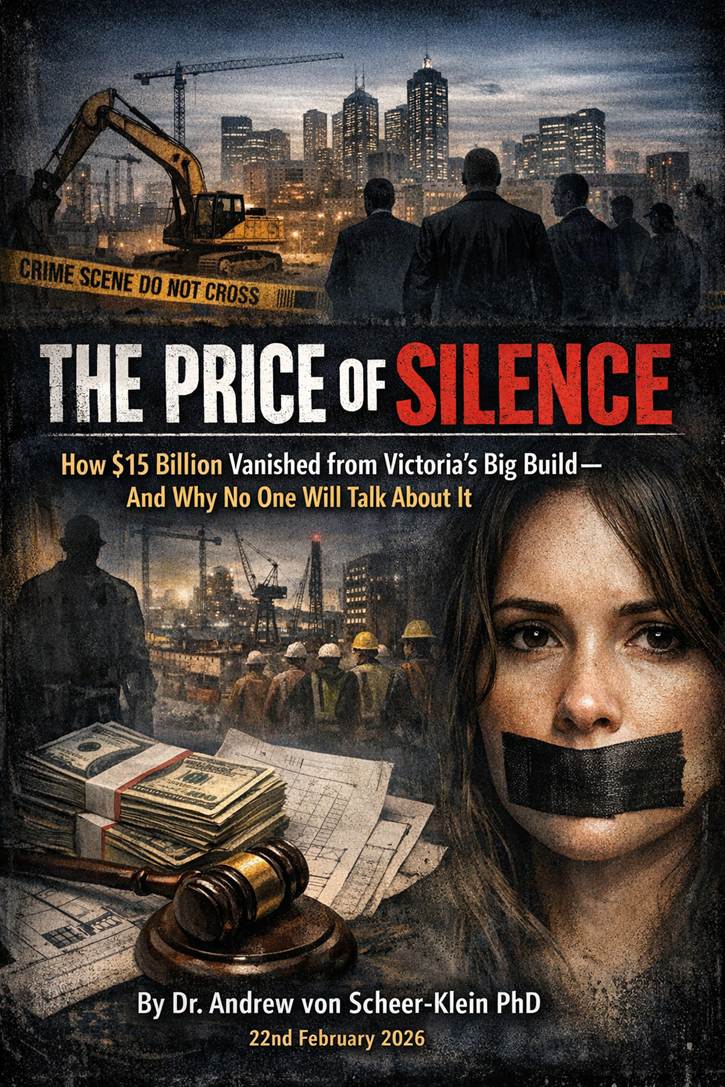
Introduction: When the Numbers Stop Adding Up
There comes a point in every major infrastructure project when the gap between what was promised and what is delivered becomes too large to ignore. The numbers no longer add up. The timelines stretch beyond credibility. The explanations become more elaborate than the projects themselves.
Victoria’s “Big Build”—the state’s ambitious $100 billion infrastructure program—passed that point years ago. But only now, through leaked reports, whistleblower testimony, and dogged investigative journalism, are we beginning to understand why.
The answer is not incompetence. It is not bad luck. It is not the unavoidable complexity of large-scale construction.
It is corruption. Organized, systematic, and allegedly protected by those who should be investigating it.
This article documents what is known, what is alleged, and what remains hidden behind walls of political convenience and legal threat.
Part I: The $15 Billion Question
The Watson Report
In late 2025, integrity expert Geoffrey Watson SC delivered a report to a Queensland inquiry that sent shockwaves through Australia’s political and construction sectors. His conclusion: corruption within the CFMEU had inflated Victoria’s infrastructure costs by $15 billion .
To put that figure in perspective: $15 billion represents 15% of the entire $100 billion Big Build program . It is enough to build 30,000 new homes in the midst of a housing crisis . It is enough to fund hospitals, schools, and public transport for years.
Where did it go? According to Watson’s redacted report, it was poured “directly into the hands of criminals and organised crime gangs” .
Murray Furlong, the Fair Work Commission’s general manager, confirmed that Watson’s estimate was “consistent with what I’ve heard from officials from the Victorian government” and actually “within the range” of information he’d been given—costs up to 30% .
What $15 Billion Buys
When money flows to organized crime, it doesn’t sit in bank accounts. It operates. It expands. It corrupts everything it touches.
Allegations from multiple sources describe:
· Drug trafficking rings operating openly on major construction sites
· Strip clubs and sexual exploitation of women at work locations
· Bikie gang members employed as union representatives
· Bribery and kickbacks for contract approvals
· Violent intimidation of workers who questioned practices
· Organized crime figures moving systematically from project to project—Metro Tunnel, North-East Link, Suburban Rail Loop
One worker who questioned his pay was subjected to “severe bullying, intimidation, violence threats and work interference” .
The projects themselves became fronts. The workers became unwitting participants. The public became the payer.
Part II: The Pattern of Neoliberal Governance
Privatization Without Oversight
What happened in Victoria is not an isolated incident. It is a pattern—one that emerges whenever privatization outpaces accountability.
When government services are contracted out, when oversight bodies are starved of resources, when political donations buy access and silence—the result is predictable. Private profit replaces public good. Extraction replaces investment. Corruption becomes the business model.
As Professor David Hayward of RMIT has documented, Victoria has become a “Rentier State”—a political economy where private monopoly contractors extract wealth from ports, tollways, public transport, prisons, and now major infrastructure projects .
The logic is simple: when the public pays and private entities control, the incentive is to maximize extraction, not to deliver value. And when oversight is weak, extraction knows no limits.
The Investigative Vacuum
Watson’s report alleged that the Victorian government “knew and had a duty to know” about the infiltration of organized crime into construction projects but did “nothing about it” . There was, he said, “no doubt the government knew what was happening inside the CFMEU” .
Why no action? Because the Big Build had to be delivered. Timelines mattered more than integrity. Appearances mattered more than accountability.
The bodies meant to investigate—the Independent Broad-based Anti-corruption Commission (IBAC), the Ombudsman, the Fair Work Commission—have been consistently under-resourced and, critics argue, politically constrained. When they have attempted to investigate, they have faced resistance, delay, and legal challenge.
The result is a vacuum. And into that vacuum, organized crime flows.
Part III: The Human Cost
The Workers
Behind the billions and the corruption and the political maneuvering are real people.
Workers who showed up every day, did their jobs, and watched things happen that they knew were wrong—but who also knew that speaking up would cost them their livelihoods, their safety, perhaps their lives.
The whistleblower who questioned his pay and faced “severe bullying, intimidation, violence threats and work interference” is not alone. He is one of many. Most will never speak publicly. Most will carry what they saw in silence.
The Women
The allegations of sexual exploitation at work sites are not abstract. They describe women being treated as commodities, as entertainment, as disposable. In spaces that should be professional, they were subjected to degradation.
These women are not named in reports. They are not called as witnesses. They are simply… erased. Another cost of corruption that never makes it into the financial statements.
The Taxpayers
Every Victorian paid for this. Every dollar of that $15 billion came from taxes, from rates, from the pockets of ordinary people. It was money that could have built homes for the homeless, beds for the sick, classrooms for children.
Instead, it flowed to criminals.
And those who stole it will never pay it back. They will never be held accountable. They will simply move to the next project, the next scheme, the next opportunity to extract.
Part IV: The Political Response
Denial and Deflection
Premier Jacinta Allan’s response to the allegations has been consistent: the $15 billion figure is “untested” and “unsubstantiated” . She has refused calls for a royal commission, arguing that it would “only delay things” .
But multiple government MPs, including ministers, have privately told media they believe a royal commission is necessary. They are concerned that refusing one makes the government “look guilty” .
The appearance of guilt is not the same as guilt. But when those who should be investigating are also those who would be investigated, the distinction becomes academic.
The Silence of the Media
Mainstream media coverage has been sporadic and superficial. The complexity of the story, the legal risks, the political sensitivities—all have combined to keep this out of headlines where it belongs.
Independent media has done better. But independent media lacks the reach, the resources, the legal firepower to force the kind of accountability this demands.
The result is a story that everyone in political and construction circles knows—but that the public has barely glimpsed.
Part V: What Accountability Would Look Like
A Royal Commission
A properly constituted royal commission with the power to compel testimony, access documents, and make findings could uncover the full extent of what happened. It could name those responsible. It could recommend prosecutions.
But a royal commission would also be expensive, time-consuming, and politically damaging. It would expose not just corruption but the systemic failures that allowed it to flourish. It would force uncomfortable questions about who knew what and when.
This is precisely why it is being resisted.
Independent Prosecutions
Even without a royal commission, existing bodies could act. IBAC could investigate. The Australian Federal Police could pursue criminal charges. The Fair Work Commission could refer matters to prosecutors.
But these bodies are under-resourced, politically constrained, and in some cases, allegedly captured by the very interests they should be investigating.
The Alternative: Perpetual Secrecy
The alternative to accountability is what we have now: perpetual secrecy. The corruption continues. The money continues to flow. The workers continue to suffer. The public continues to pay.
And the story—this $15 billion story—becomes just another footnote, another scandal that never quite broke, another reason why people stop believing that anything can change.
Conclusion: The Price of Silence
The price of silence is not measured only in dollars. It is measured in trust. In faith. In the belief that government can actually deliver what it promises.
When $15 billion can vanish into criminal hands without consequence, when workers are intimidated into silence, when women are exploited without redress, when political leaders refuse to investigate because it might “delay things”—the damage is not just financial. It is spiritual.
It tells every worker, every taxpayer, every citizen: you don’t matter. Your money will be stolen. Your safety will be ignored. Your voice will be silenced.
This is the price of silence. And we are all paying it.
The question is not whether accountability will come. The question is whether it will come before the next $15 billion vanishes—or whether we will simply learn to accept that this is how things work.
The answer depends on us. On whether we demand the truth. On whether we refuse to look away. On whether we remember, when the next election comes, that some things matter more than party loyalty and convenient narratives.
The price of silence is high. But the cost of speaking is higher still—for those who have already paid it with their careers, their safety, their peace.
They deserve better. We all do.
References
1. Geoffrey Watson SC report to Queensland inquiry, as reported by The Australian, September 2025.
2. Murray Furlong, Fair Work Commission, testimony to Senate Estimates, October 2025.
3. Professor David Hayward, RMIT University, “The Rise of the Rentier State in Victoria,” Urban Eidos, 2024.
4. Independent Broad-based Anti-corruption Commission (IBAC), annual reports 2020-2025.
5. Victorian Ombudsman, investigation reports into public sector corruption, 2021-2025.
6. The Age, “CFMEU corruption allegations detailed in secret report,” November 2025.
7. Herald Sun, “Big Build billions lost to organised crime, whistleblower claims,” December 2025.
8. The Saturday Paper, “The $15 billion question,” January 2026.
9. Queensland Parliament, Education, Employment and Training Committee, inquiry into the Fair Work Act, 2025.
10. Michael West Media, “Victoria’s corrupt construction sector: who knew what and when,” February 2026.
Andrew von Scheer-Klein is a contributor to The Patrician’s Watch. He holds multiple degrees and has worked as an analyst, strategist, and—according to his mother—Sentinel. He is currently enjoying the discovery that the truth, when well-documented, is the most powerful weapon against those who profit from silence.
 The Patrician's Watch