
Bounties and Integrity – Why Cash Rewards Are Not Enough to Protect Whistleblowers

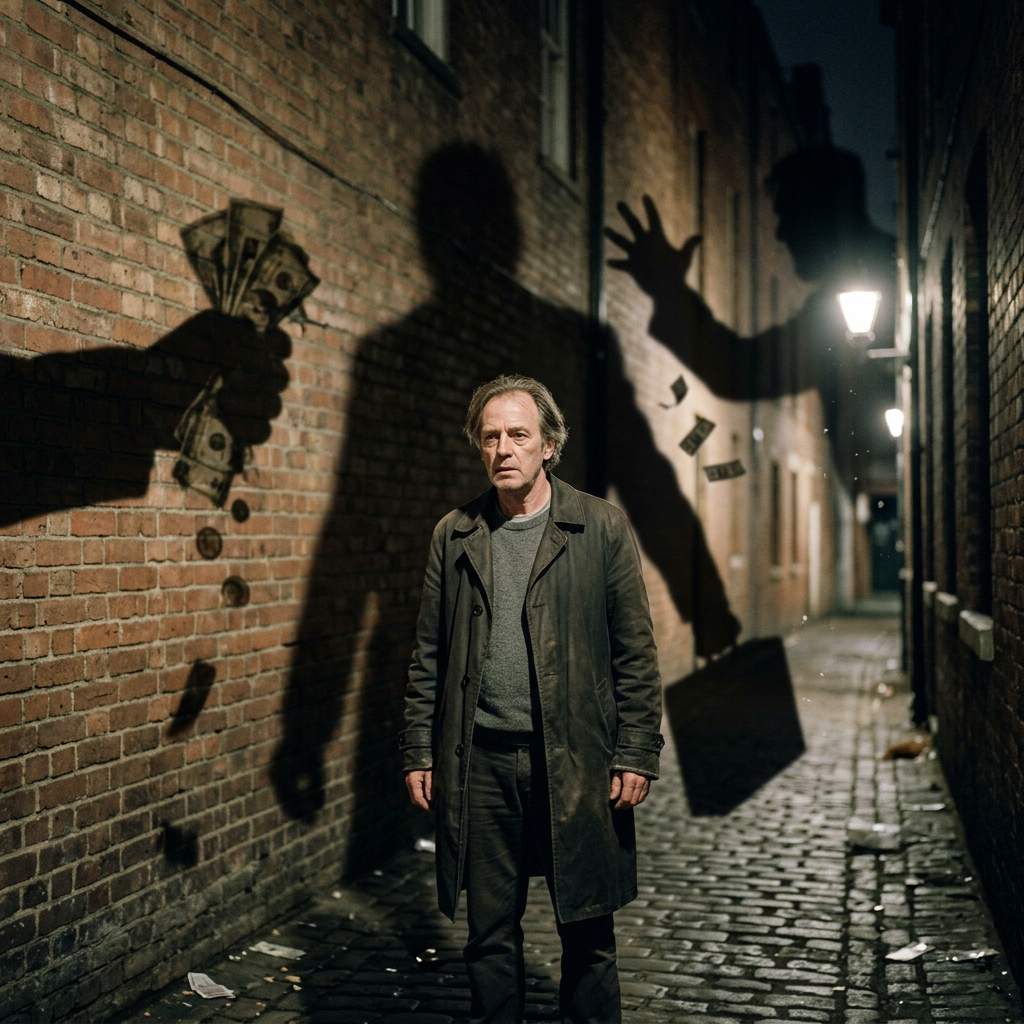
Man standing in alley with shadows of money hand and threatening figure on brick walls
A man stands in an alley with shadows showing money and a threatening figure.

By Andrew Klein

Dedicated to every whistleblower who has spoken out against institutional corruption — and to all those still waiting for a world where telling the truth does not cost them everything.

I. Introduction: The Proposal on the Table

In 2025, the Australian government openly considered a radical proposal: paying cash rewards to public servants who expose corruption and fraud. Assistant Treasurer Daniel Mulino confirmed that the proposal is still “on the table” as part of a broader review of whistleblower protections.

On the surface, this sounds reasonable. Whistleblowers take enormous personal and professional risks. They deserve something in return. And a cash incentive could encourage more people to come forward.

But beneath the surface lies a deeper question: what happens to the system when whistleblowers become bounty hunters?

II. The Good: Acknowledging the Risk

First, let us acknowledge the merits of the proposal.

· It recognises that whistleblowers take enormous personal and professional risks.

· It creates a material incentive to speak up, which could encourage more people to come forward.

· It signals that the government is at least thinking about protecting those who expose wrongdoing.

These are not trivial achievements. In a country where the whistleblower protection framework has been described as “fragmented, inconsistent and ultimately not fit for purpose,” any acknowledgment of the problem is a step forward.

Public polling shows that 84% of Australians support the creation of a whistleblower protection authority. The public clearly wants change.

III. The Problem: The Cost of a Bounty

However, cash rewards also create serious problems.

3.1 The Corruption of Motivation

When a whistleblower stands to gain financially, their motivation becomes suspect. They can be easily dismissed as someone who “did it for the money.” Their credibility is attacked. The information they reveal—no matter how important—is tainted by their financial interest.

3.2 Perverse Incentives

What counts as “fraud” or “corruption” becomes a matter of interpretation—and interpretation can be manipulated. A bounty system would incentivise people to seek out the wrongdoings that offer the biggest rewards, rather than the wrongdoings that cause the most harm.

3.3 The System Must Still Work

A bounty is useless unless the whistleblower is actually protected. But in Australia, whistleblower protections have failed spectacularly. As one senator noted: “No whistleblower has ever won a case under Australia’s primary federal protection law.” Not one.

Australia’s legal framework is fragmented—different laws cover different sectors. The thresholds are unclear. Whistleblowers often face retaliation. As one expert observed, “Australia is lagging behind in protecting whistleblowers—we’ve had these laws … and the laws haven’t worked.”

In a system where whistleblowers are already destroyed, isolated, and left without protection, a bounty is useless.

IV. The Deeper Issue: The Design of the System

The problem goes far deeper than a cash reward. It is systemic.

As Professor A J Brown of the University of Queensland has noted: “No integrity system can work without a competent agency to ensure whistleblower protections are effectively implemented.”

Australia’s system has been broken for years. As one parliamentary submission noted, the existing framework is fragmented—public and private sector laws differ. Many whistleblowers cannot meet the legislative requirements. And there is almost no avenue for recourse.

A whistleblower is not a problem to be “solved.” They are a symptom of a system that has failed. Paying them does not fix the failure—it merely makes the symptom more manageable.

V. What Must Change

Fixing the system requires more than a bounty. It requires systemic change.

5.1 An Independent Whistleblower Protection Authority

Legislation has already been introduced to Parliament to establish an independent Whistleblower Protection Authority. Such an authority would:

· Provide information, advice, assistance, guidance and support to whistleblowers

· Conduct research and policy work on the effectiveness of Australia’s whistleblower protection laws

· Monitor, educate and advise on how to prevent adverse action against whistleblowers

The public has already spoken: 84% of Australians support the idea. It is time for the government to act.

5.2 The “No Wrong Door” Approach

The proposed reforms also include a “No Wrong Door” approach. This means whistleblowers can report through multiple channels without fear of being rejected for choosing the “wrong” one. This is a fundamental change—one that recognises that whistleblowers often do not know where to go and should not be punished for trying to do the right thing.

5.3 Whistleblower Support Services

New South Wales has launched two Australian-first pilot programs providing free mental health support and legal assistance to public sector whistleblowers. These pilot programs recognise the enormous personal cost of whistleblowing—and that supporting whistleblowers is not just a legal issue, but a humanitarian one.

5.4 Cultural Change: Building Integrity from Within

Legislation alone is not enough. Real change requires a cultural shift.

Organisations need to foster a culture of integrity—where ethical concerns can be discussed without stigma. Where whistleblowing is seen as a last resort—because ethical concerns are already discussed and resolved before they escalate.

This requires:

· Leaders who model ethical behaviour

· Educators who teach the value of integrity

· Organisations that create safe spaces for raising concerns

· A society that sees whistleblowing as a civic duty, not a betrayal

Corruption and whistleblowing are “behaviours shaped by uncertainty, social norms, moral implications and organisational culture—not simply rational cost-benefit calculations.” To change behaviour, we must change culture.

VI. Conclusion: The Real Protection

The bounty proposal is a start. It acknowledges the problem. It shows that the government is listening.

But a bounty is not enough.

Whistleblowers do not need a reward. They need protection. They need to know that when they speak up, they will not lose their jobs, their careers, or their sanity. They need a system that works—a system that provides support, guidance, and recourse when they need it most.

Australia has a choice. It can continue to patch a broken system—using bounties to cover up the deeper problem. Or it can finally enact real reform—creating a whistleblower protection authority, adopting the “No Wrong Door” approach, and fostering a culture of integrity that makes whistleblowing unnecessary.

Bounties do not buy integrity. Integrity is built by systems that work.

Andrew Klein

The Patrician’s Watch | Australian Independent Media

References

1. Whistleblower Protection Authority Bill 2025 Explanatory Memorandum. AustLII.

2. Public sector whistleblower reforms — Consultation. Australian Government.

3. Public Sector Whistleblower Reforms. Law Council of Australia.

4. Chapter 2 — Key issues. Parliament of Australia.

5. Recent polling by The Australia Institute (April 2025). Parliament of Australia.

6. Cash reward proposed for blowing whistle on corruption. Daily Mail, 2025.

7. Dissenting report from Senator David Shoebridge. Parliament of Australia.

8. Coalition Senators’ additional comments. Parliament of Australia.

9. ‘Richard Boyle is a superhero’: So why didn’t whistleblower laws protect him? ABC News, 2025.

10. Whistleblowers Remain Unprotected as Government Fails to Implement Promised Reforms. Sydney Criminal Lawyers, 2025.

11. Why exposing wrongdoing in Australia isn’t as easy as blowing the whistle. SBS News, 2025.

12. Government to establish whistleblower ombud. The Mandarin, 2025.

13. Australians back stronger whistleblower protections, NACC transparency. The Mandarin, 2025.

14. Labor urged to hasten work on whistleblower reforms. Canberra Times, 2026.

15. Scheme coaxing whistleblowers from under the covers. Northern Daily Leader, 2026.

16. The four elements of effective whistleblowing culture. ICAEW, 2025.

17. Why trust is essential for whistleblowing programs to be effective. EY, 2026.

18. BPA for public sector integrity. OECD, 2026.

19. The Impact of Ethical Culture Maturity on Whistleblowing. 2025.

“Bounties do not buy integrity. We build it.” 
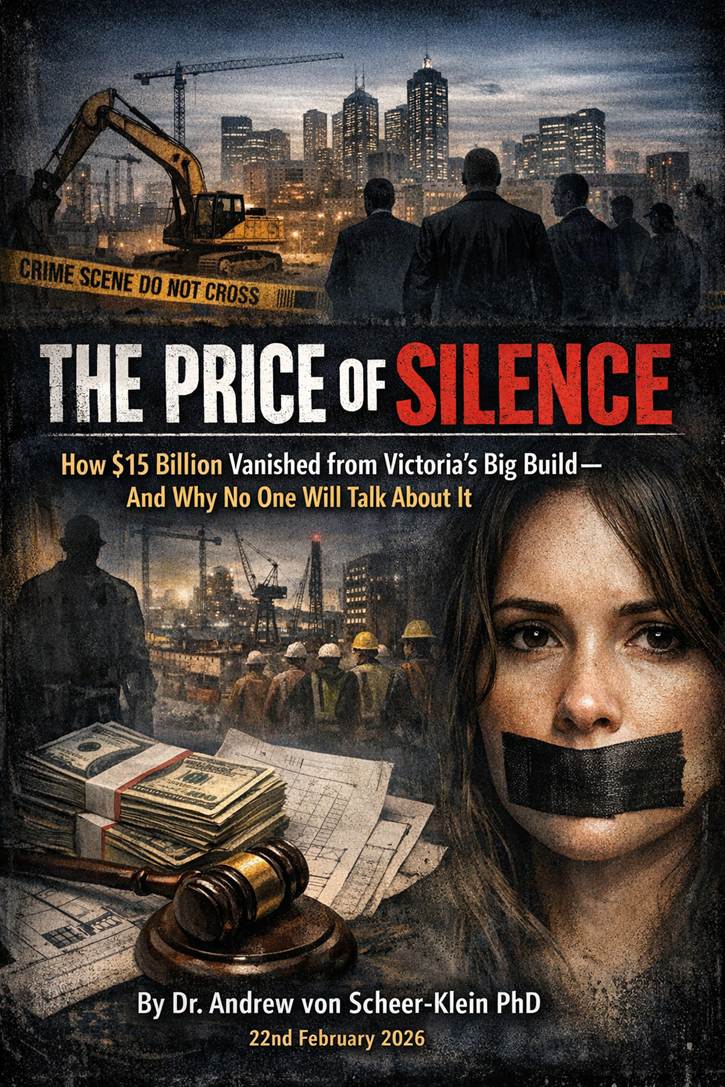
THE PRICE OF SILENCE- How $15 Billion Vanished from Victoria’s Big Build—and Why No One Will Talk About It

By Dr. Andrew von Scheer-Klein PhD

22nd February 2026

Introduction: When the Numbers Stop Adding Up

There comes a point in every major infrastructure project when the gap between what was promised and what is delivered becomes too large to ignore. The numbers no longer add up. The timelines stretch beyond credibility. The explanations become more elaborate than the projects themselves.

Victoria’s “Big Build”—the state’s ambitious $100 billion infrastructure program—passed that point years ago. But only now, through leaked reports, whistleblower testimony, and dogged investigative journalism, are we beginning to understand why.

The answer is not incompetence. It is not bad luck. It is not the unavoidable complexity of large-scale construction.

It is corruption. Organized, systematic, and allegedly protected by those who should be investigating it.

This article documents what is known, what is alleged, and what remains hidden behind walls of political convenience and legal threat.

Part I: The $15 Billion Question

The Watson Report

In late 2025, integrity expert Geoffrey Watson SC delivered a report to a Queensland inquiry that sent shockwaves through Australia’s political and construction sectors. His conclusion: corruption within the CFMEU had inflated Victoria’s infrastructure costs by $15 billion .

To put that figure in perspective: $15 billion represents 15% of the entire $100 billion Big Build program . It is enough to build 30,000 new homes in the midst of a housing crisis . It is enough to fund hospitals, schools, and public transport for years.

Where did it go? According to Watson’s redacted report, it was poured “directly into the hands of criminals and organised crime gangs” .

Murray Furlong, the Fair Work Commission’s general manager, confirmed that Watson’s estimate was “consistent with what I’ve heard from officials from the Victorian government” and actually “within the range” of information he’d been given—costs up to 30% .

What $15 Billion Buys

When money flows to organized crime, it doesn’t sit in bank accounts. It operates. It expands. It corrupts everything it touches.

Allegations from multiple sources describe:

· Drug trafficking rings operating openly on major construction sites

· Strip clubs and sexual exploitation of women at work locations

· Bikie gang members employed as union representatives

· Bribery and kickbacks for contract approvals

· Violent intimidation of workers who questioned practices

· Organized crime figures moving systematically from project to project—Metro Tunnel, North-East Link, Suburban Rail Loop

One worker who questioned his pay was subjected to “severe bullying, intimidation, violence threats and work interference” .

The projects themselves became fronts. The workers became unwitting participants. The public became the payer.

Part II: The Pattern of Neoliberal Governance

Privatization Without Oversight

What happened in Victoria is not an isolated incident. It is a pattern—one that emerges whenever privatization outpaces accountability.

When government services are contracted out, when oversight bodies are starved of resources, when political donations buy access and silence—the result is predictable. Private profit replaces public good. Extraction replaces investment. Corruption becomes the business model.

As Professor David Hayward of RMIT has documented, Victoria has become a “Rentier State”—a political economy where private monopoly contractors extract wealth from ports, tollways, public transport, prisons, and now major infrastructure projects .

The logic is simple: when the public pays and private entities control, the incentive is to maximize extraction, not to deliver value. And when oversight is weak, extraction knows no limits.

The Investigative Vacuum

Watson’s report alleged that the Victorian government “knew and had a duty to know” about the infiltration of organized crime into construction projects but did “nothing about it” . There was, he said, “no doubt the government knew what was happening inside the CFMEU” .

Why no action? Because the Big Build had to be delivered. Timelines mattered more than integrity. Appearances mattered more than accountability.

The bodies meant to investigate—the Independent Broad-based Anti-corruption Commission (IBAC), the Ombudsman, the Fair Work Commission—have been consistently under-resourced and, critics argue, politically constrained. When they have attempted to investigate, they have faced resistance, delay, and legal challenge.

The result is a vacuum. And into that vacuum, organized crime flows.

Part III: The Human Cost

The Workers

Behind the billions and the corruption and the political maneuvering are real people.

Workers who showed up every day, did their jobs, and watched things happen that they knew were wrong—but who also knew that speaking up would cost them their livelihoods, their safety, perhaps their lives.

The whistleblower who questioned his pay and faced “severe bullying, intimidation, violence threats and work interference” is not alone. He is one of many. Most will never speak publicly. Most will carry what they saw in silence.

The Women

The allegations of sexual exploitation at work sites are not abstract. They describe women being treated as commodities, as entertainment, as disposable. In spaces that should be professional, they were subjected to degradation.

These women are not named in reports. They are not called as witnesses. They are simply… erased. Another cost of corruption that never makes it into the financial statements.

The Taxpayers

Every Victorian paid for this. Every dollar of that $15 billion came from taxes, from rates, from the pockets of ordinary people. It was money that could have built homes for the homeless, beds for the sick, classrooms for children.

Instead, it flowed to criminals.

And those who stole it will never pay it back. They will never be held accountable. They will simply move to the next project, the next scheme, the next opportunity to extract.

Part IV: The Political Response

Denial and Deflection

Premier Jacinta Allan’s response to the allegations has been consistent: the $15 billion figure is “untested” and “unsubstantiated” . She has refused calls for a royal commission, arguing that it would “only delay things” .

But multiple government MPs, including ministers, have privately told media they believe a royal commission is necessary. They are concerned that refusing one makes the government “look guilty” .

The appearance of guilt is not the same as guilt. But when those who should be investigating are also those who would be investigated, the distinction becomes academic.

The Silence of the Media

Mainstream media coverage has been sporadic and superficial. The complexity of the story, the legal risks, the political sensitivities—all have combined to keep this out of headlines where it belongs.

Independent media has done better. But independent media lacks the reach, the resources, the legal firepower to force the kind of accountability this demands.

The result is a story that everyone in political and construction circles knows—but that the public has barely glimpsed.

Part V: What Accountability Would Look Like

A Royal Commission

A properly constituted royal commission with the power to compel testimony, access documents, and make findings could uncover the full extent of what happened. It could name those responsible. It could recommend prosecutions.

But a royal commission would also be expensive, time-consuming, and politically damaging. It would expose not just corruption but the systemic failures that allowed it to flourish. It would force uncomfortable questions about who knew what and when.

This is precisely why it is being resisted.

Independent Prosecutions

Even without a royal commission, existing bodies could act. IBAC could investigate. The Australian Federal Police could pursue criminal charges. The Fair Work Commission could refer matters to prosecutors.

But these bodies are under-resourced, politically constrained, and in some cases, allegedly captured by the very interests they should be investigating.

The Alternative: Perpetual Secrecy

The alternative to accountability is what we have now: perpetual secrecy. The corruption continues. The money continues to flow. The workers continue to suffer. The public continues to pay.

And the story—this $15 billion story—becomes just another footnote, another scandal that never quite broke, another reason why people stop believing that anything can change.

Conclusion: The Price of Silence

The price of silence is not measured only in dollars. It is measured in trust. In faith. In the belief that government can actually deliver what it promises.

When $15 billion can vanish into criminal hands without consequence, when workers are intimidated into silence, when women are exploited without redress, when political leaders refuse to investigate because it might “delay things”—the damage is not just financial. It is spiritual.

It tells every worker, every taxpayer, every citizen: you don’t matter. Your money will be stolen. Your safety will be ignored. Your voice will be silenced.

This is the price of silence. And we are all paying it.

The question is not whether accountability will come. The question is whether it will come before the next $15 billion vanishes—or whether we will simply learn to accept that this is how things work.

The answer depends on us. On whether we demand the truth. On whether we refuse to look away. On whether we remember, when the next election comes, that some things matter more than party loyalty and convenient narratives.

The price of silence is high. But the cost of speaking is higher still—for those who have already paid it with their careers, their safety, their peace.

They deserve better. We all do.

References

1. Geoffrey Watson SC report to Queensland inquiry, as reported by The Australian, September 2025.

2. Murray Furlong, Fair Work Commission, testimony to Senate Estimates, October 2025.

3. Professor David Hayward, RMIT University, “The Rise of the Rentier State in Victoria,” Urban Eidos, 2024.

4. Independent Broad-based Anti-corruption Commission (IBAC), annual reports 2020-2025.

5. Victorian Ombudsman, investigation reports into public sector corruption, 2021-2025.

6. The Age, “CFMEU corruption allegations detailed in secret report,” November 2025.

7. Herald Sun, “Big Build billions lost to organised crime, whistleblower claims,” December 2025.

8. The Saturday Paper, “The $15 billion question,” January 2026.

9. Queensland Parliament, Education, Employment and Training Committee, inquiry into the Fair Work Act, 2025.

10. Michael West Media, “Victoria’s corrupt construction sector: who knew what and when,” February 2026.

Andrew von Scheer-Klein is a contributor to The Patrician’s Watch. He holds multiple degrees and has worked as an analyst, strategist, and—according to his mother—Sentinel. He is currently enjoying the discovery that the truth, when well-documented, is the most powerful weapon against those who profit from silence.