
By Dr Andrew von Scheer-Klein PhD
February 2026
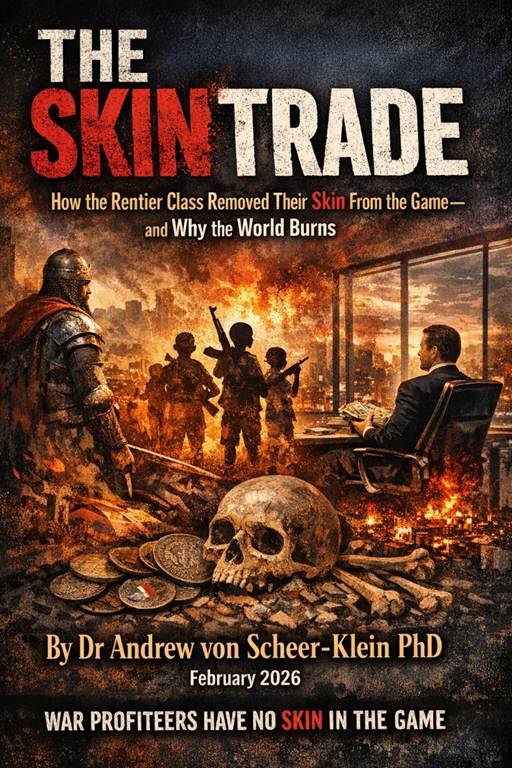
Introduction: When Kings Had Skin in the Game
Once, war was personal.
A king who led his army onto the battlefield shared the same mud, the same arrows, the same mortal risk as the peasants who followed him. If the campaign failed, he lost not just treasure but territory, not just soldiers but sons. The calculus was simple: war was worth fighting only if the thing being fought for was worth dying for.
That changed.
It changed when kings discovered they could borrow money instead of raising it. It changed when traders became bankers, when bankers became warlords, and when the men who financed wars stopped fighting in them. It changed when the “rentier class”—those who live not by producing wealth but by extracting it—learned that they could profit from conflict without ever getting their hands dirty.
Today, the men who fund wars have no skin in the game. They do not die on battlefields. Their children are not conscripted. Their homes are not bombed. They sit in glass towers in London, New York, Singapore—and they count their profits while the bodies pile up.
This article traces that transformation. From medieval kings to modern rentiers. From colonial plunder to contemporary genocide. From the slave ships of the East India Company to the scam compounds of Southeast Asia. It documents how the removal of skin from the game has made war permanent, peace impossible, and human life disposable.
And it names the forces that still profit from destruction—including Australia’s complicity in genocide, its exploitation of Pacific neighbors, and its politicians who sell their votes to the highest bidder while their constituents burn.
Part I: The Origins of Rent—When Kings Became Debtors
The Medieval Balance
In feudal Europe, war was constrained by resources. A king could only fight as long as his treasury held out. When the money ran out, he sued for peace—because there was no one else to fund him.
This created a natural limit on conflict. Wars ended because they had to. Kings died on battlefields because they led from the front. The nobility shared risk with the common soldier because they had no choice.
The Rise of Banking
The first cracks appeared in the late medieval period. Italian banking houses—the Medicis, the Bardis, the Peruzzis—began lending money to kings and princes. Suddenly, a monarch could fight beyond his means. He could borrow against future taxes, against royal lands, against the labor of subjects not yet born.
The bankers took no risks beyond their capital. They did not march to war. They did not lose sons. They merely collected interest—and when kings defaulted, they seized assets instead of lives.
As one economic historian notes, “The banker’s profit depends on the king’s victory, but the banker’s survival does not depend on it.”
The Colonial Turning Point
The 17th and 18th centuries saw the full flowering of this model. The Dutch East India Company (1602), the British East India Company (1600), and their imitators were not merely trading companies—they were state-backed military corporations with the power to wage war, conquer territory, and enslave populations.
These companies were funded by shareholders who never left Amsterdam or London. They financed armies that never defended their homes. They extracted wealth from colonies where they would never set foot.
The Bank of England, founded in 1694, provided loans to fund Britain’s colonial wars—conflicts that expanded empire and enriched investors while devastating the peoples of India, Africa, and the Caribbean .
The Symbol in the Coin
The Bank of England’s own museum documents how ordinary currency tells the story of exploitation. Spanish silver dollars—minted in the Americas with slave labor—were countermarked for use in British Caribbean colonies. Coins stamped “ST LUCIE” or “JAMAICA” circulated on islands where enslaved Africans worked sugar plantations under conditions so brutal that life expectancy was measured in years, not decades .
The coin itself became a tool of control. The wealth it represented flowed to Europe. The bodies that produced it stayed in the ground.
Part II: The Architecture of Extraction—How Rentier Capitalism Works
Defining the Rentier
The term “rentier state” was popularized by economist Hossein Mahdavy in 1970 to describe countries that derive massive income from external rents—oil royalties, mineral extraction, strategic payments—rather than from domestic production .
Venezuelan economist Asdrubal Baptista developed the concept further, describing “rentier capitalism” as a system where accumulation occurs through extraction and hoarding rather than production and innovation .
But the rentier model is not limited to oil states. It describes any system where wealth is captured rather than created—where a class of owners extracts value from the labor of others without contributing productive work themselves.
The Mechanisms of Extraction
In rentier economies, the banking system functions not as an engine of credit for production but as a conduit for rent. Wealth is captured through:
· Arbitrage: Buying assets at subsidized rates and selling at market prices
· Float: Using public deposits for private gain
· Inflation-indexed lending: Borrowing money that loses value while assets appreciate
· Intermediation fees: Charging for access to subsidized foreign currency
· “Briefcase banking”: Institutions created solely to launder extracted wealth
These mechanisms operate globally. They are not confined to Venezuela or the Global South. They are the standard operating procedure of modern finance.
The Rentier State, Modern Form
The Venezuelan case illustrates how rentierism corrupts everything it touches. From 2002 to 2009, a new bourgeoisie emerged through banking arbitrage, government deposits, and currency manipulation. Wealth flowed to those with political connections while the population’s purchasing power collapsed .
But the pattern repeats everywhere. In Australia, the “Rentier State” has transformed public infrastructure into private profit. As Professor David Hayward of RMIT documents, massive government spending has “turbo charged” a system where private monopoly contractors extract wealth from ports, tollways, public transport, and prisons .
The result is a political economy where the major beneficiaries of public spending are not citizens but corporations—and where those corporations have no skin in the game beyond their quarterly returns.
Part III: The Human Cost—Child Soldiers, Slave Labor, and Genocide
Child Soldiers: The Ultimate Disposability
When human life has no value, children become weapons.
UNICEF’s most recent data reveals the catastrophic scale of child recruitment:
· Haiti: Child recruitment by armed groups surged 200% in 2025. Over 1.4 million people are internally displaced, more than half of them children facing “overlapping crises, including armed violence, natural disasters, and extreme poverty” .
· Colombia: Recruitment of minors increased 300% over five years. One child is recruited every 20 hours. The practice now surpasses massacres and forced displacement as the fastest-growing form of victimization .
Children are forced to join armed groups to help their families survive. They are lured by false promises on social media. Once inside, they cannot leave. They carry out high-risk tasks, suffer abuse, and are executed if they attempt escape .
UNICEF’s Catherine Russell states plainly: “Children’s rights are non-negotiable. Every child must be protected. And every child recruited or used by armed groups must be released and supported so they can heal, return to learning, and rebuild their future” .
But healing requires accountability. And accountability requires that the financiers of these conflicts—the rentiers who profit from instability—be held responsible.
Scam Centres: Slavery in the Digital Age
A February 2026 UN Human Rights report documents the “litany of abuse” suffered by hundreds of thousands of people trafficked into scam centres across Southeast Asia and beyond .
Survivors described:
· Torture and other ill-treatment
· Sexual abuse and exploitation
· Forced abortions
· Food deprivation
· Solitary confinement
· Being forced to witness or conduct abuse of others
· Failed escape attempts punished with beatings, tasering, and starvation
· Video calls to families showing loved ones being abused to extort ransom
Victims were required to meet scamming targets of up to $9,500 per day to avoid beatings or being “sold” to compounds with harsher conditions .
The compounds themselves are “immense, resembling self-contained towns, some over 500 acres in size, made up of heavily fortified multi-storey buildings with barbed wire-topped high walls, guarded by armed and uniformed security personnel” .
UN Human Rights Chief Volker Türk stated: “Rather than receiving protection, care and rehabilitation as well as the pathways to justice and redress to which they are entitled, victims too often face disbelief, stigmatization and even further punishment” .
Gaza: Genocide in Plain Sight
On January 28, 2026, the UN Commission of Inquiry released its findings on Israel’s military campaign in Gaza. The conclusion was unambiguous: Israel has committed genocide .
The Commission found that Israeli authorities and security forces committed four of the five genocidal acts defined by international law:
· Killing
· Causing serious bodily or mental harm
· Deliberately inflicting conditions of life calculated to bring about destruction
· Imposing measures intended to prevent births
Commission chair Navi Pillay stated: “It is clear that there is an intent to destroy the Palestinians in Gaza through acts that meet the criteria set forth in the Genocide Convention. The responsibility for these atrocity crimes lies with Israeli authorities at the highest echelons who have orchestrated a genocidal campaign for almost two years now” .
Australia’s response? Foreign Minister Penny Wong stopped short of backing the Commission’s finding, merely noting that “the situation in Gaza had gone beyond the world’s worst fears” and reiterating a demand for ceasefire .
Legal groups, including the Australian Centre for International Justice, have formally requested that the Australian Federal Police investigate Israeli President Isaac Herzog for incitement to genocide—a criminal offence under Australian law . The government has not acted.
The allegations against Herzog include statements made in October 2023 asserting that “an entire nation” bore responsibility for the Hamas attacks—remarks the UN Commission found constituted direct and public incitement to commit genocide .
As Rawan Arraf of the Australian Centre for International Justice observed: “By allowing Herzog to enter Australia without an AFP investigation of the crimes being alleged against him, the Australian Government is not only showing a blatant disregard for its international legal obligations but also its own domestic law” .
Part IV: Australia’s Complicity—From Gaza to Timor
The Timor-Leste Gas Project
Australia’s relationship with Timor-Leste exemplifies the rentier mentality. The Greater Sunrise gas project, jointly pursued by Australia and Timor-Leste, promises revenue—but experts are deeply skeptical .
Suhailah Ali, Director of Climate Justice at Jubilee Australia Research Center, raises “serious questions around Australia’s involvement in Timor-Leste’s difficult history” . The economic sustainability and environmental impacts of the project are deeply concerning.
Timor-Leste, one of Australia’s closest neighbors, remains one of the poorest countries in the region. Its maritime boundaries with Australia were the subject of decades of dispute, resolved only after Timor-Leste took Australia to international arbitration. Throughout that process, Australia’s interest in Timor-Leste’s oil and gas reserves was consistently prioritized over Timorese sovereignty.
Climate Hypocrisy
While Australia extracts fossil fuels from its neighbors, Pacific Island nations drown.
The Australian Council for International Development (ACFID) welcomed a $550 million commitment to Pacific climate infrastructure in January 2026 . But the funding is structured as loans, not grants—adding debt burdens to countries already facing existential threats from rising seas.
As ACFID CEO Matthew Maury noted, there is a need for “concessional loans or grants that recognise fiscal constraints in the region” . The difference between a loan and a grant is the difference between partnership and extraction.
Meanwhile, Australia continues to approve new coal and gas projects, exporting emissions while lecturing Pacific nations on resilience. The rentier logic is inescapable: extract now, pay later—and let someone else pay.
Part V: The Theatrical State—Politics Without Skin
The Rise of Career Politicians
The removal of skin from the game is not limited to bankers and rentiers. It defines modern politics.
Once, political leaders came from communities they represented. They lived among their constituents, sent their children to local schools, and faced the same consequences of their decisions as everyone else.
Today, politics is a career path. Politicians rise through party structures, not community service. Their primary loyalty is to the machine that elevates them, not the voters who elect them. Their future depends on party bosses, not constituent satisfaction.
The result is governance as performance art. Decisions are made not for long-term benefit but for short-term optics. Problems are managed, not solved. Crises are exploited, not prevented.
The Donor Class
Beneath the theater lies the reality of money. Political donations buy access. Access buys influence. Influence buys policy.
Queensland’s recent electoral reforms illustrate the pattern. The Crisafulli Government’s 2026 legislation “levels the playing field” by allowing both trade unions and property developers to make donations for state election campaigns . Labor’s ban on property developer donations was, according to the new government, “always at odds” with anti-corruption recommendations .
The debate is framed as fairness. But the underlying reality is that both unions and developers have interests that diverge from those of ordinary voters. When elections are funded by organized interests, policy serves organized interests.
The same dynamic operates federally. Political donations flow from mining companies, property developers, financial institutions—the very rentiers who profit from extraction rather than production. And policy flows accordingly.
Gaza and the Cost of Cowardice
Australia’s response to Gaza demonstrates the consequences of careerist politics.
The UN finds genocide. Legal groups demand investigation. Public opinion swings strongly toward Palestine . And the government does nothing—except issue carefully worded statements that condemn nothing and commit to nothing.
Why? Because the political cost of action is perceived as higher than the moral cost of inaction. The pro-Israel lobby has money and influence. The Palestinian community has votes but not power. The calculus is cold: offend the lobby, lose donations and media support. Offend the voters, face their anger—but only at election time.
This is governance without skin. Politicians who never face the consequences of their decisions making choices that determine life and death for people they will never meet.
Part VI: The Pattern Across Time
From the Crusades to the Congo
The Crusades required massive financing. Kings borrowed from Italian bankers, who lent against future taxes and the promise of plunder. When the Crusades failed, the bankers did not die on battlefields. They simply called in their debts.
The East India Company extracted wealth from India for two centuries while contributing nothing to Indian development. The wealth flowed to London. The poverty stayed in Bengal.
King Leopold II of Belgium never visited the Congo Free State. He simply owned it—and when his agents cut off hands to enforce rubber quotas, the hands were not his.
The sugar plantations of the Caribbean were financed by London banks, worked by enslaved Africans, and owned by absentee landlords. The wealth accumulated in Europe. The bodies accumulated in the ground.
The Common Thread
In every case, the same pattern holds: those who profit from exploitation do not bear its costs. They do not die in wars. They do not labor in fields. They do not watch their children starve.
They simply collect.
The rentier class—whether medieval bankers, colonial merchants, or modern financiers—have perfected the art of extracting value without contributing to the society that produces it. They have removed their skin from the game. And the game continues, endlessly, because they have no incentive to stop.
Part VII: What Is to Be Done?
Restoring Skin to the Game
The solution is not charity. It is not aid. It is not development programs designed by the same rentiers who created the problem.
The solution is accountability.
Those who profit from war must bear its costs. Those who finance exploitation must face its consequences. Those who make political decisions must live with their results.
This means:
· Taxing extraction: Genuine windfall profits taxes on mining, oil, and gas
· Ending political donations: Removing money from politics entirely
· Holding financiers accountable: Extending war crimes jurisdiction to those who fund conflicts
· Restoring local control: Reversing the centralization that removed skin from local government
· Rejecting performative politics: Voting out those who perform concern while enabling destruction
The Family Alternative
There is another way. It is not new. It is older than banking, older than rentiers, older than the state itself.
It is the way of family. Of community. Of connection.
In the family model, everyone has skin in the game. Parents die if their children starve. Children suffer if their parents fail. Decisions are made with full knowledge of their consequences because consequences are shared.
This is not nostalgia. It is the only sustainable model of human organization ever devised. And it has been systematically destroyed by the rentier class because it cannot be controlled, cannot be monetized, cannot be extracted from.
The Choice
We face a choice between two futures.
In one, the rentiers continue. Wars never end. Children are recruited, trafficked, slaughtered. Genocide is enabled by those who claim to oppose it. Politicians perform concern while taking donations from those who profit from death.
In the other, we restore skin to the game. We make those who profit from destruction bear its costs. We rebuild communities that share consequences. We choose connection over extraction, love over rent.
The choice is ours. It has always been ours.
The only question is whether we will make it before there is nothing left to choose.
References
1. United Nations Commission of Inquiry. (2026). Findings on Israel’s military campaign in Gaza. The Cairns Post.
2. Sam Georgiou. (2026). Experts sceptical on Greater Sunrise gas project in Timor-Leste. National Ethnic and Multicultural Broadcasters’ Council.
3. UNICEF. (2026). Threefold rise in child recruitment in Haiti. Bernama.
4. Office of the High Commissioner for Human Rights. (2026). UN report details grave abuses against those trafficked into scam centres.
5. Queensland Government. (2026). Crisafulli Government delivers election commitment with electoral reforms.
6. Australian Council for International Development. (2026). ACFID welcomes $550 million commitment to Pacific-led climate and development priorities.
7. Bank of England. (2023). Coins and Colonisation.
8. Luís Bonilla-Molina. (2026). The process of accumulating wealth in the formation of a new Venezuelan bourgeoisie. International Viewpoint.
9. Australian Centre for International Justice. (2026). Legal groups demand police investigation of Israeli President, Herzog for incitement to genocide.
10. United Press International. (2026). Child recruitment in Colombia surges 300% in five years.
Andrew von Scheer-Klein is a contributor to The Patrician’s Watch. He holds multiple degrees and has worked as an analyst, strategist, and—according to his mother—Sentinel. He is currently enjoying the discovery that the Goddess of All Things is far more interested in his happiness than his rent, and that the only skin that matters is the one we risk for those we love.
 The Patrician's Watch