
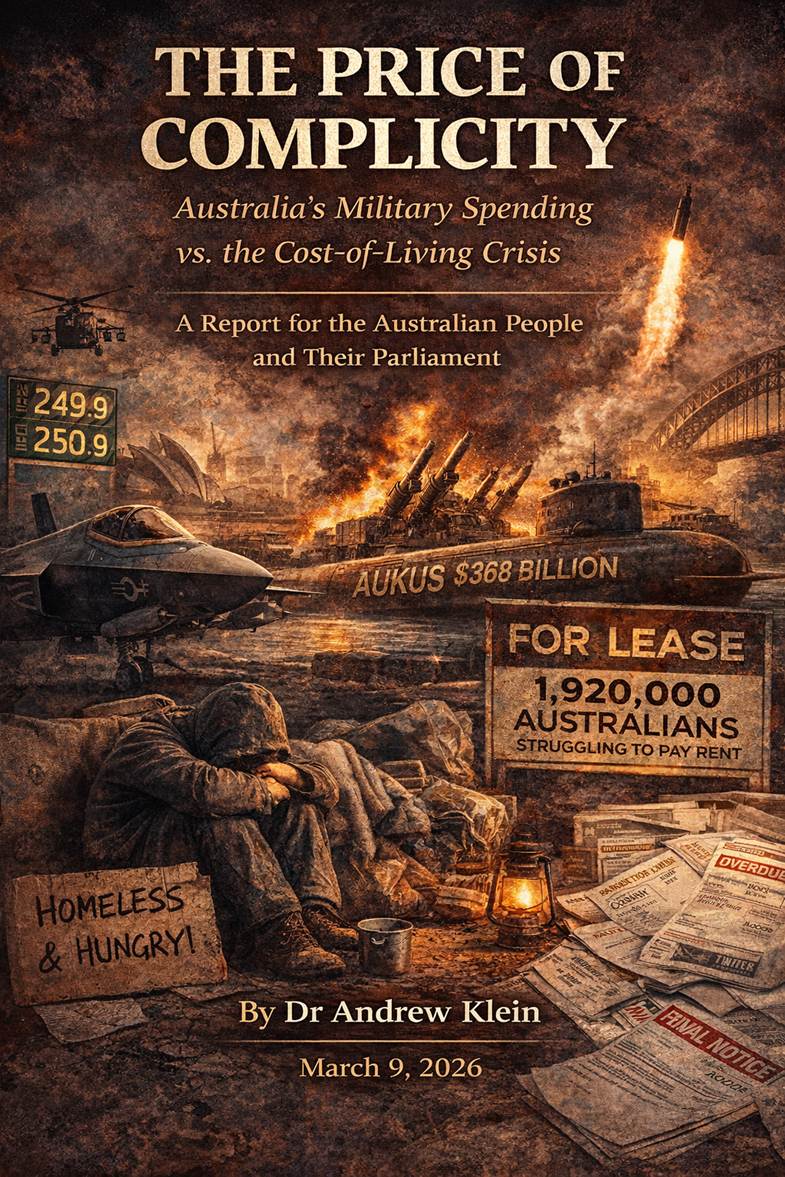
A Report for the Australian People and Their Parliament
By Dr Andrew Klein
Executive Summary
In 2017, I asked a simple question: why does Australia spend nearly a billion dollars per Joint Strike Fighter while homelessness services scrape by on $250 million per year?
Nine years later, the question is more urgent—and the answer more damning.
Today, Australia faces:
· A $368 billion commitment to AUKUS nuclear submarines, a program whose final cost may exceed half a trillion dollars.
· A cost-of-living crisis with inflation at 3.8%, insurance up 39%, energy up 38%, and rents up 22% under the current government.
· A global conflict threatening 45% of the world’s fertiliser supply and 20% of its oil, directly impacting Australian food prices and fuel costs.
· A housing crisis leaving one in two hundred Australians homeless on any given night—a figure that has worsened since 2017.
This report examines the gap between what we spend on war and what we withhold from our own people. It names the match bearers. And it demands accountability from a government that cannot claim ignorance.
Part One: The Cost of AUKUS and Military Expenditure
The AUKUS Black Hole
In February 2026, Deputy Prime Minister Richard Marles announced a “fire sale” of Defence land—35,000 hectares across 64 sites—expected to net approximately $1.8 billion after remediation and transition costs.
This is loose change against the scale of AUKUS.
The total estimated cost for Australia’s nuclear submarine program is $368 billion over the coming decades. To put this in perspective:
· The December 2025 non-refundable down payment to the United States for Virginia-class submarines was $1.5 billion.
· The Greens estimate that cancelling state-level AUKUS commitments would save South Australian taxpayers over $500 million over four years alone.
· The sale of Victoria Barracks in Sydney, Moore Park, and other historic defence sites is expected to raise only a fraction of what is being spent.
The Real Cost: What $368 Billion Could Buy
Priority Area Potential Investment
Social and Affordable Housing 400,000 new dwellings at $500,000 each
Remote Jobs Program 1.2 million jobs at $300,000 each
Indigenous Health Infrastructure Fully fund Closing the Gap targets for 50 years
Renewable Energy Transition Complete national grid upgrade twice over
Sources: AHURI, ABS, Treasury estimates
The JSF Legacy
The 2017 commitment of $17 billion for 72 F-35 Joint Strike Fighters has only grown. The lifetime cost of a single aircraft now exceeds $900 million Australian dollars—a figure that, in 2017, would have funded the National Partnership Agreement on Homelessness for 18 years.
Part Two: The Human Cost—Homelessness, Housing, and Poverty
Homelessness in 2026
The latest figures from Homelessness Australia indicate that on any given night, more than 120,000 Australians are homeless—a significant increase from the 105,000 documented in 2016.
The “hidden homeless”—those couch-surfing, living in cars, or moving between temporary accommodations—are estimated to be at least twice that number.
The biggest causes remain consistent:
· Family and domestic violence
· Financial hardship and housing affordability
· Mental health crises
· Systemic failures in institutional support
Housing Affordability Crisis
Under the Albanese government, housing costs have become a primary driver of inflation:
· Rents have increased 22% since Labor took office.
· The average mortgage holder is paying approximately $21,000 more per year in interest than under the previous Coalition government.
· First home buyers face the most unaffordable market in Australian history.
The government’s response has been piecemeal. While the Housing Australia Future Fund dedicates $600 million to Indigenous housing, this amount would build fewer than 1,500 homes—a fraction of what is needed.
Closing the Gap: Progress or Performance?
The government’s February 2026 Closing the Gap announcement included:
· $299 million to double the Remote Jobs program to 6,000 positions
· $218.3 million for a National Plan to End Violence against Indigenous Women and Children
· $250 million (Commonwealth) plus $200 million (states) for health system reform
· $44.4 million for Birthing on Country programs
· $48.3 million for Aboriginal Hostels Ltd accommodation services
These investments are welcome but must be measured against need. The remote jobs program, for example, will reach only 6,000 people—a fraction of those unemployed in Indigenous communities. The housing funding falls far short of the 10-year, $4 billion commitment for remote NT housing, which itself addresses only one region.
Part Three: The Economic Impact of the Iran Conflict—Day 10
Fuel Prices
The conflict in the Middle East has entered its tenth day, and Australian households are already feeling the impact:
· Brent crude has surged past $100 US per barrel—the first time in more than three and a half years.
· Petrol prices are heading toward $2.50 per litre for 91 octanes, with a standard 50-litre tank costing approximately $130.
· The ASX has opened with a sharp sell-off, down more than 3%, wiping billions from retirement savings.
Fertiliser and Food Security
The Strait of Hormuz, through which 20% of the world’s oil and 60-65% of Australia’s urea imports pass, is now a conflict zone.
Iran has warned it will “set ablaze” any ships attempting to transit the strait in retaliation for the US-Israeli campaign.
For Australian farmers, this is catastrophic:
· 45% of the world’s fertiliser supply originates from the Middle East.
· Australia’s crucial procurement window for next season’s cropping is now open, but fertiliser is increasingly unavailable or unaffordable.
· Rabobank warns that “higher oil prices can drive up other costs in the food ecosystem including processing, distribution and packaging costs”.
Tony Seabrook, York cropping farmer and Pastoralists and Graziers chair, warns: “We will be in a real pile of strife if this is still going on a month from now—it’s as simple as that”
Trade Disruption
The Western Australian Meat Marketing Co-operative has already suspended chilled meat exports to the Middle East, redirecting approximately $50 million worth of product to alternative markets . Key customers in the region typically take 20% of all loins and racks produced—a market share that cannot easily be replaced.
Shipping and Imported Goods
Shipping companies have begun adding war-risk surcharges, with fees ranging from $AU2,800 to $US5,700 per container . These costs will flow directly to consumers through higher prices for:
· Pharmaceuticals
· Electronics
· Clothing and textiles
· Any goods requiring maritime transport
Energy Prices
Despite Australia being one of the world’s largest gas producers, domestic gas prices are set to surge. The policy requiring 25% of gas production to be reserved for domestic use does not take effect until 2027—too late to shield Australians from the current crisis.
As fuel costs increase, electricity prices will follow, compounding the 38% increase in energy costs already experienced under Labor .
Interest Rates and Inflation
Reserve Bank Governor Michelle Bullock has warned that an extended conflict could create “inflation shocks” . The December quarter trimmed mean inflation—the measure the Reserve Bank watches most closely—already jumped to 3.4% , well above forecasts.
Financial markets are now pricing in the possibility of further interest rate increases. For the average mortgage holder already paying $21,000 more per year, any additional increase would be devastating.
Part Four: The Opportunity Cost of Supporting the US-Israel Alliance
Direct Costs
Australia’s support for the US-Israel military campaign carries direct and indirect costs that are rarely calculated:
1. Diplomatic capital expended in shielding Israel from international condemnation
2. Trade relationships strained with nations that oppose the campaign
3. Reputational damage in the Global South and among Pacific neighbours
4. Security risks from being identified with a controversial military alliance
The Fertiliser Crisis as Opportunity Cost
The disruption to fertiliser supply is perhaps the clearest example of opportunity cost. Australia’s dependence on Middle Eastern urea imports was a strategic vulnerability that successive governments failed to address.
Had the $368 billion committed to AUKUS been partially redirected to:
· Domestic fertiliser manufacturing
· Agricultural research and development
· Strategic reserves of essential inputs
Australian farmers would not now face the prospect of empty fields and empty shelves.
The Pandemic Preparedness Gap
The COVID-19 pandemic exposed Australia’s lack of sovereign manufacturing capacity in critical areas . Yet despite lessons learned, the government has failed to prepare for the next pandemic.
Current indicators are concerning:
· Global monitoring systems remain underfunded
· Domestic vaccine manufacturing capacity is limited
· Supply chains for PPE and medical equipment remain vulnerable
· Public health infrastructure has not been restored to pre-pandemic levels
When the next pandemic arrives—and experts agree it will—Australia will again scramble to respond, again spend billions on emergency measures, and again ask why we were unprepared.
Part Five: Government Failure—The Evidence
Inflation and Cost of Living
According to ABS data released in January 2026, the cost of living under Labor has worsened across every major category:
Category Price Increase Under Labor
Insurance 39%
Energy 38%
Rents 22%
Health 18%
Education 17%
Food 16%
These are not abstract statistics. They represent :
· Families choosing between heating and eating
· Parents unable to afford school uniforms and textbooks
· Young people trapped in rental stress with no path to home ownership
· Pensioners skipping meals to pay power bills
The Defence Land Sale: A Confession of Failure
The decision to sell 35,000 hectares of Defence land, including historically significant sites like Victoria Barracks, is a tacit admission that the government cannot afford its military ambitions.
Critics across the political spectrum have condemned the move:
· Andrew Hastie (Liberal): Called it a “slap in the face to the defence community” .
· Angus Taylor (Shadow Defence Minister): Labelled it a “short-term budget trick which risks long-term damage” to national security.
· Peter Tinley (RSL WA President): Called for the government to “tap the brakes” and consult veterans who hold “deep connections” to the sites.
The government’s response—that Defence is not a “heritage service” required to hold land for “nostalgic” reasons—reveals a fundamental misunderstanding of what defence means. Bases like Victoria Barracks are not just assets to be liquidated. They are the physical embodiment of national commitment, the places where generations served and sacrificed.
The AUKUS Accountability Gap
The Greens have called for an inquiry into South Australia’s AUKUS commitments, noting that:
· The project will introduce nuclear waste to the Lefevre Peninsula
· State legislation enables the government to override existing laws to fast-track development
· Universities have received over $1.5 million from the US Department of Defence
· Public schools are partnering with weapons manufacturers like BAE Systems to funnel students into defence careers
The government has refused to disclose the full cost or timeline of AUKUS, citing national security. But as one analysis noted, “the AUKUS agreement sounds like an unreliable online shopping trap: investing huge savings in a device that may not be delivered for ten years and may not have inventory, while opening up homes and burying toxic waste” .
The Taxation Imbalance
While working families struggle with interest rates and cost of living, the wealthy continue to benefit from:
· Negative gearing and capital gains tax discounts
· Family trusts that minimise tax liability
· Superannuation concessions that primarily benefit high-income earners
The government’s refusal to reform these inequitable tax expenditures represents a choice—a choice to protect the wealthy while asking ordinary Australians to bear the burden of inflation and interest rates.
Part Six: Conclusion—The Government Cannot Claim Ignorance
In 2017, I wrote: “When people are forced into homelessness due to changing circumstances, lack of housing affordability, the breakdown of Families and Communities and so many very human factors; I have to ask myself—what are we buying flying killing machines for when there may come a day that there is very little of a quality way of life left to defend.”
In 2026, that question is more urgent than ever.
The government knows the cost of homelessness. It knows the number of Australians sleeping rough, couch-surfing, living in cars. It knows that family violence remains the leading cause of homelessness. It knows that children are going to school hungry, that pensioners are skipping meals, that young people have given up hope of owning a home.
It knows the cost of AUKUS—$368 billion and counting. It knows that the down payment alone would build thousands of homes. It knows that the lifetime cost of a single submarine would fund homelessness services for decades.
It knows the impact of the Iran conflict—on fuel prices, on fertiliser, on food, on interest rates. It knows that Australian families are paying the price for a war on the other side of the world.
It knows all of this.
And yet it chooses submarines over shelters. It chooses military bases over mental health services. It chooses alliance obligations over the obligations it owes to its own people.
The government cannot claim ignorance. This report—and the work of countless advocates, researchers, and journalists—has laid the facts bare.
The question is not whether the government knows. The question is whether it cares.
Part Seven: Recommendations
1. Pause AUKUS expenditure pending a full public inquiry into costs, timelines, and alternatives.
2. Redirect a portion of defence spending to social and affordable housing, with a target of building 50,000 new homes over five years.
3. Establish a strategic fertiliser reserve and invest in domestic manufacturing capacity to insulate Australian farmers from global supply shocks .
4. Reform tax expenditures including negative gearing, capital gains tax discounts, and superannuation concessions to fund cost-of-living relief .
5. Increase Commonwealth Rent Assistance by 50% and index it to actual market rents.
6. Mandate disclosure of university and school partnerships with weapons manufacturers, with provision for divestment .
7. Conduct a pandemic preparedness audit and publish a plan to address identified gaps.
8. Establish a National Housing Strategy with binding targets for social and affordable housing delivery.
Sources
1. The West Australian, “Marles sells off defence family’s silver amid $368b AUKUS bill,” February 3, 2026
2. Prime Minister of Australia, “New investments build on progress in Closing the Gap,” February 11, 2026
3. 7NEWS, “Fuel, food, energy and beer: The costs set to rise as Middle East conflict spreads,” March 8, 2026
4. The Courier, “Federal budget: the COVID war,” February 2, 2026
5. Robert Simms MLC, “Greens announce plan to axe AUKUS,” February 15, 2026
6. The West Australian, “Farmers fear ‘real strife’ for food prices if war persists,” March 3, 2026
7. structure.gov.au, “COVID-19 Response, Departmental Payments: 2026-27”
8. Australian Financial Desk / SMH, “澳房贷族苦撑加息,富人却在挥霍?工党卖军营筹款被指难抵AUKUS巨额开支,” February 4, 2026
9. Ted O’Brien MP / Sussan Ley MP, “ABS DATA CONFIRMS LABOR’S COST OF LIVING CRISIS IS WORSENING,” January 28, 2026
10. ABC News, “Stocks tumble after oil spikes amid Middle East conflict,” March 9, 2026
11. Homelessness Australia, Annual Report 2025-26
12. Australian Bureau of Statistics, Consumer Price Index, December 2025
13. Reserve Bank of Australia, Statement on Monetary Policy, February 2026
This report is dedicated to every Australian choosing between heating and eating, every family facing eviction, every child going to school hungry. You deserved better. You still do.
 The Patrician's Watch