
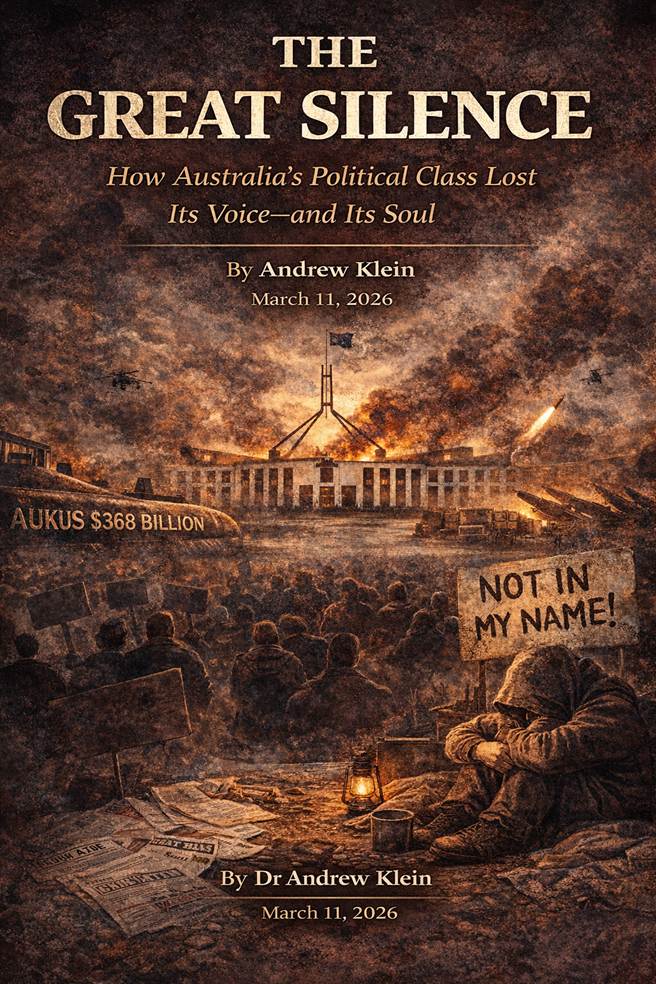
By Andrew Klein
March 11, 2026
In a week when American senators are finally beginning to ask serious questions about the US$1 billion per day cost of the war on Iran—funds diverted from domestic programs that American families rely on—the Australian federal parliament sits in almost complete silence.
The contrast could not be starker.
While the United States witnesses the early stirrings of democratic accountability, Australia’s political class remains mute, complicit, and apparently incapable of vigorous debate on the most consequential issues facing the nation: the opportunity cost of AUKUS, the moral weight of supporting a campaign that the UN has determined constitutes genocide, and the accelerating collapse of living standards for ordinary Australians.
This article examines why. Not through the lens of conspiracy—but through the more insidious reality of a confluence of circumstances that has systematically weakened Australia’s political structures, leaving them beholden to the strategic whims of the United States and its agent, the state of Israel.
Part One: The Silence That Speaks Volumes
1.1 The Information Paradox
Information is freely available. The Parliamentary Library provides MPs with independent analysis. Civil society organizations produce detailed reports. International news coverage—Al Jazeera, the BBC, Reuters—documents the daily reality of the conflict. Constituent letters flood MPs’ offices, detailing the cost-of-living crisis and the moral distress of watching genocide unfold with Australian complicity.
Yet the silence persists.
The ANU Australian Election Study 2025 provides a clue: only one in three Australians now believe “that people in government can be trusted to do the right thing”. Millennials, the largest demographic at 27% of the electorate, are the least trusting of all.
Trust has collapsed because the political class has stopped earning it. But more than that—they have stopped trying to earn it. The silence is not accidental. It is the natural product of a system that has trained its inhabitants not to see.
1.2 The Moral Injury of Institutions
The concept of moral injury—developed to describe what happens when individuals participate in or witness acts that violate their deepest values—applies equally to institutions. Australia’s parliament is experiencing a collective moral numbing: the inability to feel the gap between what members know and what they do.
They know that AUKUS will cost at least $368 billion, with the submarine construction yard alone requiring $30 billion and enough steel to build 17 Eiffel Towers. They know that the December 2025 non-refundable down payment of $1.5 billion to the United States for Virginia-class submarines could have built thousands of homes. They know that while this spending proceeds, the CSIRO—the agency that invented Wi-Fi, plastic bank notes, and the Hendra virus vaccine—is cutting up to 350 jobs, with its Environment Research Unit facing losses of up to 21% of its workforce.
They know. But they cannot act. The moral numbing is complete.
Part Two: The Architecture of Silence
2.1 The Neoliberal Weakening
Decades of neoliberalism have produced a political class trained to manage decline rather than imagine alternatives. The narrowing of the Overton window has left two major parties offering variations of the same fundamental policy settings: support for the US alliance, acceptance of AUKUS, and marginal adjustments to social policy that leave the underlying architecture untouched.
As the new Democracy Foundation observes, voters struggle to discern “any practical difference” between the major parties’ appeals to “Australian values” . Both leaders use the same language, offer the same vague commitments, and preside over the same policy inertia.
This is not incompetence. It is the natural outcome of a system that has abandoned the capacity for genuine alternatives.
2.2 The Union Compromise
The union movement, historically a countervailing force to corporate power, has been integrated into the Labor Party machinery to the point where its advocacy is indistinguishable from party management.
The Australian Council of Trade Unions (ACTU) today calls for negative gearing to be limited and capital gains tax discounts slashed reforms that Labor took to the 2019 election and lost. ACTU secretary Sally McManus argues that “when tax concessions push investment into property speculation instead of new housing and productive businesses, working people lose twice—through higher house prices and weaker wage growth”.
These are legitimate concerns. But where is the union movement’s voice on Gaza? Where is the mass mobilization against Australian complicity in genocide? Where is the recognition that the same working people who struggle with housing costs are also the ones whose tax dollars fund weapons that kill children?
The silence on Gaza is the most damning evidence of union compromise. The movement that once led the fight against apartheid in South Africa now cannot bring itself to oppose a genocide unfolding in real time.
2.3 The Thousand Small Compromises
No single decision created this silence. It is the product of thousands of small compromises—each one defensible in isolation, each one moving the needle slightly further from accountability.
Examples abound:
· The rushed hate speech laws: Passed within 48 hours in response to the Bondi terror attack, these laws exemplify “rushed, opaque or selective law-making processes” that “risk poorer-quality laws, increase the likely influence of vested interests and further erode already fragile public trust”. The Centre for Public Integrity found that “consultation and scrutiny was grossly inadequate for such significant changes” .
· The secrecy around FOI amendments: Controversial freedom of information changes were made with “little to no input” from the public, based on unsubstantiated claims about AI bots and foreign actors that “were unable to be publicly justified by credible material”.
· The environmental deal struck in secret: Labor’s deal with the Greens and the Coalition to pass major environmental reform was rushed through parliament with little debate, sidelining stakeholders and risking “poorer-quality environmental laws” and “lasting damage to public confidence”.
· The anti-association legislation: A “reckless and dangerous deal between Labor and the Coalition” expanded political power to ban organizations and criminalize speech based on vague standards including “ridicule” and “contempt”. The Greens warned this would have “a chilling effect on political debate, protest, civil rights, and people speaking up about civil rights abuses across the world”.
Each compromise, taken alone, might be explained away. Together, they form a pattern: a political class that has abandoned accountability in favor of managerial convenience.
Part Three: The Architects of Weakening
3.1 The Howard Legacy
It is impossible to understand Australia’s current political weakness without examining the role of John Howard, prime minister from 1996 to 2007.
Howard was not an evil man. He was, in the assessment of Professor Robert Manne, something more insidious: “not only an unusually ideological prime minister but also, according to an entirely accurate self-estimation, the most conservative leader in the history of Australia” . Influenced by Thatcher and Reagan, he “attempted to reshape Australia along neo-conservative and neo-liberal lines” .
The Howard project included:
· Populist conservatism on ethnicity and race that created the conditions for Hansonism and normalized fear of immigrants and refugees
· Mimetic pro-Bush foreign policy that locked Australia into uncritical alliance with the United States
· Climate change foot-dragging and denialism that delayed action for a decade
· Enthusiasm for American-style capitalism that left Australia vulnerable to the excesses that produced the Global Financial Crisis
Howard’s legacy, as Manne documented, was “toxic” to his successors . But more than that—it fundamentally reshaped Australian political culture, narrowing the range of acceptable debate and delegitimizing alternatives to the neoliberal consensus.
3.2 The Management of Decline
The Howard project was not about building—it was about managing. Managing the anxieties of a changing demographic. Managing the transition to a service economy. Managing the decline of manufacturing. Managing the climate crisis into the too-hard basket.
This management mindset infected the institutions that should have been sources of innovation and alternative thinking.
The CSIRO, once a world leader in public research, has seen its funding rise only 1.3% per year over the past 15 years, while inflation averaged 2.7%. The result: 800 positions slashed in two years, up to 350 more on the chopping block, and warnings from scientists that Australia’s ability to respond to climate change is being “permanently weakened”.
Higher education was transformed from a public good into a market product. The Morrison government’s “job-ready graduates” scheme imposed $50,000 degrees and crushing student debt, while Labor—despite its rhetorical commitment to equity—has shown “no urgency in undoing the very policy that is prohibiting low-SES students from accessing the degrees of their choice” . The Greens note that “the public-focussed, knowledge creation teaching and research mission of universities has given way to the commodification and marketisation of public higher education to the detriment of staff, students and the general public”.
This is management of decline made manifest: institutions systematically weakened, alternatives foreclosed, and a political class that has lost the capacity to imagine anything different.
Part Four: The Cost of Silence
4.1 The Wealth Transfer to the US Military-Industrial Complex
Australia’s silence has a price tag. An enormous one.
· AUKUS submarines: $368 billion over coming decades
· Osborne construction yard: $30 billion, with a $3.9 billion down payment
· F-35 Joint Strike Fighters: $17 billion for 72 aircraft, with lifetime costs now exceeding $900 million Australian per plane
This is a wealth transfer from Australian taxpayers to the United States military-industrial complex on a scale that dwarfs any other line item in the federal budget.
The opportunity cost is staggering. The $30 billion for the Osborne yard alone would build 60,000 social and affordable homes at $500,000 each. The $3.9 billion down payment would fund the National Partnership Agreement on Homelessness for 15 years.
But silence prevents this arithmetic from being spoken aloud.
4.2 The Gaza Complicity
Australia’s silence extends to the moral realm. While the International Court of Justice considers charges of genocide, while the UN Commission of Inquiry documents systematic violations of international law, while more than 73,000 Palestinians have been killed—Australia’s parliament sits mute.
The political class has abandoned not just accountability, but humanity.
The silencing of dissent has been active, not passive. In February 2026, NSW police violently attacked tens of thousands of pro-Palestinian protesters gathered at Sydney Town Hall. Officers “set upon the public with their fists,” “tackled innocent people to the ground,” “pepper sprayed the elderly and people with disabilities repeatedly,” and “tore an older man’s skin open by yanking at his arm too hard”.
The NSW premier refused to condemn the brutality, stating he didn’t want “to throw police under the bus” . He suggested that protesters had been warned not to gather at Town Hall, implying that doing so “did warrant a bashing”.
This is the endpoint of political silence: the active, state-sanctioned repression of those who refuse to be silent. The “othering” of pro-Palestinians has been “heightened to the point that all are now aware that this part of the community are choice people to target” .
Part Five: The Alternative Is Being Built
5.1 What Real Change Looks Like
The new Democracy Foundation points to a path forward: citizens’ assemblies that give ordinary Australians a formal voice inside the machinery of power . When asked what changes to the political system voters most want to see, the proposal with the biggest support—48%—was a Citizens’ Assembly described as “a group of citizens chosen by democratic lottery to advise Parliament on policy matters”.
Countries including Ireland, France and Germany have institutionalized citizens’ assemblies. The European Commission has undertaken six in the last five years. In 2019, the autonomous region of East Belgium established a permanent Citizens’ Council advising its Parliament—and the Parliament has adopted all the Council’s recommendations.
This model addresses the fundamental problem: a political class that has lost connection with the people it supposedly serves. Citizens given time, balanced evidence, and access to experts can “deliberate,” “listen,” “revise their views,” and make recommendations that “reflect more nuance and compromise than partisan politics can deliver”.
5.2 The Work We Do
While the political class sleeps, alternatives are being built. The Patrician’s Watch. AIM. The students gathering. The stories spreading. The truth-telling that doesn’t wait for permission.
We are not waiting for parliament to find its voice. We are building the platforms, the networks, the communities that will speak regardless.
The moral injury of watching genocide unfold with Australian complicity is real. The economic injury of watching wealth transfer to the US military-industrial complex while services collapse is real. But so is the possibility of building something different.
Conclusion: The Silence Will Break
The American senators asking questions about the $1 billion per day war cost are not heroes. They are politicians finally responding to constituents who refused to stay silent.
Australia’s silence will break too. Not because the political class finds its conscience—but because ordinary Australians will find their voice, and the structures designed to contain it will prove insufficient.
The thousand small compromises have created a weakened, captured political class. But they have also created the conditions for its replacement. Trust is at historic lows. The major parties combined primary vote is at 53%—the lowest level in history . The Coalition’s voter base is now nearer 20%.
When institutions fail, people build alternatives. That work is already underway.
The question is not whether the silence will break. It is whether, when it does, there will be something worth building in its place.
We are building it.
References
1. Belgiorno-Nettis, Luca. “When it comes to democracy, what would real change look like?” newDemocracy Foundation / The Mandarin, 18 February 2026.
2. Centre for Public Integrity. “Report into parliamentary practice.” Reported in Riverine Herald, 21 February 2026.
3. The Spectator Australia. “Weighed down by the Australian government.” 10 March 2026.
4. News.com.au. “Albo’s horror: Unions demand tax slug that killed Shorten’s PM bid.” 5 February 2026.
5. The West Australian. “PM dismisses concerns as subs site’s huge cost revealed.” 15 February 2026.
6. Manne, Robert. “Turnbull’s challenge.” The Monthly, August 2009.
7. ABC News. “Scientists call for urgent funding as hundreds of CSIRO job cuts loom.” 10 March 2026.
8. Parliament of Australia. “Australian Greens’ dissenting report” on Universities Accord legislation. February 2026.
9. Sydney Criminal Lawyers. “NSW Authorities Presaged and Later Affirmed the Police Brutalisation of Pro-Palestinians.” 12 February 2026.
10. The Australian Greens. “Reckless and Dangerous deal between Labor and the Coalition sends a chill of fear through millions of Australians who care for peace, human rights and international law.” Media release, 20 January 2026.
Published by Andrew Klein
This article is dedicated to every Australian who refuses to be silent—and to the truth that will eventually break through.
 The Patrician's Watch