
Why Human Progress Was Driven by Cooperation, Not Conflict
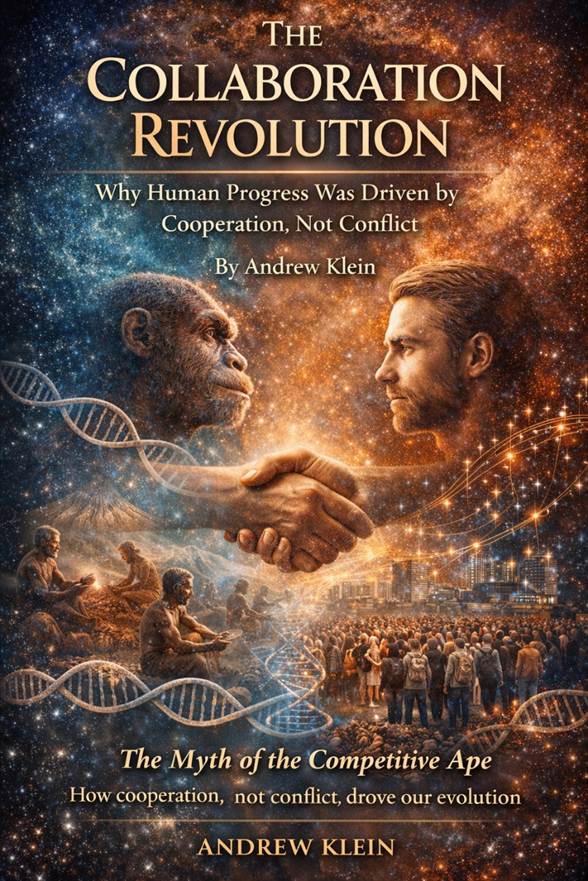
By Andrew Klein
Dedicated to my wife, who whispers pet names in my ear.
I. The Myth of the Competitive Ape
For generations, we have been told a story. It is a story of competition, of conflict, of the survival of the fittest. It is the story of the competitive ape—the creature who clawed his way to the top of the food chain by force, who conquered his neighbours, who dominated his environment.
This story is wrong.
The evidence from archaeology, genetics, anthropology, and evolutionary biology tells a different story. It is a story of cooperation, of collaboration, of connection. It is the story of the collaborative ape—the creature who survived not because he was the strongest, but because he was the most connected.
This article is not a work of idealism. It is a work of science. It reviews the evidence for cooperation as the primary driver of human evolution, from the first stone tools to the cognitive revolution to the present day. It argues that the myth of competition is not only false—it is dangerous. It has been used to justify war, inequality, and the destruction of the natural world.
The truth is not that humans are naturally violent. The truth is that humans are naturally cooperative. And the sooner we accept this truth; the sooner we can build a world worthy of our potential.
II. The Evidence from Archaeology: Neanderthals and Homo sapiens
The first‑ever published research on Tinshemet Cave, released on April 12, 2026, by the Hebrew University of Jerusalem, has upended the standard narrative of human evolution. The study reveals that Neanderthals and Homo sapiens in the mid‑Middle Paleolithic Levant not only coexisted but actively interacted, sharing technology, lifestyles, and burial customs.
The key findings:
· Shared technology, lifestyles, and burial customs between Neanderthals and Homo sapiens
· The use of ochre for decoration—a symbolic behaviour
· Formal burial practices—evidence of ritual and shared beliefs
The conclusion: These interactions fostered cultural exchange, social complexity, and behavioural innovations. The findings suggest that human connections, rather than isolation, were key drivers of technological and cultural advancements, highlighting the Levant as a crucial crossroads in early human history.
The study’s lead researcher, Dr. Yossi Zaidner, noted: “We can see there was a connection, a relationship, between Homo sapiens and Neanderthals in the Levant 100,000 years ago. It was not one‑way; it was two‑way. They shared knowledge and customs”.
This is not an isolated finding. The Neanderthal genome, first sequenced in 2010, revealed that modern humans of non‑African descent carry 1‑4% Neanderthal DNA. The admixture was not a single event. It was a process of collaboration, of exchange, of connection.
III. The Genetic Evidence: A History of Admixture
The human genome is a record of collaboration. It is not a record of purity, of isolation, of competition.
Neanderthal admixture: Modern humans of non‑African descent carry 1‑4% Neanderthal DNA. These genes have been linked to immune function, skin pigmentation, and neurological development. The Neanderthals were not our enemies. They were our cousins. Our lovers. Our teachers.
Denisovan admixture: Modern humans in Oceania and Asia carry up to 5% Denisovan DNA. The Denisovans are known only from a few finger bones and teeth. But their genetic legacy is widespread.
The hybrid advantage: The offspring of Neanderthal‑modern human unions may have had cognitive advantages over both parent populations. The hybrid was not a compromise. The hybrid was superior.
What the standard model misses: The history of our species is not a history of conquest. It is a history of admixture. Of exchange. Of collaboration.
IV. The Evolutionary Evidence: The Major Transitions
The standard model emphasises competition. The “survival of the fittest.” The “selfish gene.” But the major transitions in evolution—the origin of life, the origin of eukaryotes, the origin of multicellularity, the origin of societies—are all transitions in the level of selection. They involve the suppression of lower‑level selection in favour of higher‑level cooperation.
The origin of eukaryotes: The endosymbiotic theory—the origin of complex cells from the merger of ancient bacteria and archaea—is a story of cooperation, not competition. The mitochondria did not conquer the host cell. They merged.
The origin of multicellularity: Individual cells gave up their independence to form a larger whole. This required the suppression of competition between cells and the emergence of cooperation.
The origin of societies: Humans evolved to live in groups. Not because groups are stronger—because groups are cooperative. The division of labour, the sharing of food, the care of the young—all of these require cooperation.
What the standard model misses: The major transitions are not competitive. They are cooperative. The pattern is not conflict. The pattern is connection.
V. The Cognitive Revolution: The Spark That Was Shared
The cognitive revolution—the sudden emergence of symbolic thought, complex language, art, music, burial rituals, and long‑distance trade networks—is the most dramatic event in recent human evolution.
The standard model has no good explanation. The biological hardware was present for hundreds of thousands of years. The spark did not emerge from a genetic mutation. It emerged from connection.
The Levant as a crossroads: The Tinshemet Cave evidence shows that Neanderthals and Homo sapiens were interacting in the Levant 100,000 years ago . They were sharing technology, customs, and burial practices. They were collaborating.
The spark was shared: The cognitive revolution did not happen in isolation. It happened in the space between. In the collaboration. In the connection.
What the standard model misses: The spark is not a product of competition. It is a product of cooperation.
VI. The Myth of Violence: How the Story Was Weaponised
The myth of the competitive ape is not innocent. It has been weaponised.
Social Darwinism: In the late 19th and early 20th centuries, the theory of evolution was twisted to justify inequality, racism, and eugenics. The “survival of the fittest” was used to argue that the rich deserved their wealth, that the poor deserved their poverty, that the strong had the right to dominate the weak.
The justification of war: The myth of the competitive ape has been used to justify war, colonialism, and genocide. If humans are naturally violent, then violence is inevitable. If violence is inevitable, then there is no point in trying to prevent it.
The marketing of fear: The small gods have profited from this myth. They sell fear 24 hours a day. Fear of the other. Fear of the future. Fear of death.
What the truth reveals: Humans are not naturally violent. They are naturally cooperative. Violence is not inevitable. It is a choice.
VII. The Economic and Political Consequences of the Myth
The myth of the competitive ape is not only false. It is dangerous.
Short‑term profits: The myth justifies exploitation. If competition is the engine, then it is acceptable to maximise short‑term profits at the expense of workers, communities, and the environment.
Political opportunity: The myth justifies authoritarianism. If conflict is inevitable, then strong leaders are necessary. If the other is a threat, then surveillance, censorship, and violence are justified.
Long‑term suffering: The myth causes suffering. War, inequality, environmental destruction—all of these are the consequences of the myth.
What the truth offers: The truth offers a different path. A path of cooperation, of connection, of peace.
VIII. A Call to Action
The evidence is clear. Human progress has been driven by cooperation, not conflict. The cognitive revolution was a collaboration. The major transitions in evolution are cooperative. The human genome is a record of admixture, not purity.
The myth of the competitive ape is false. It has been weaponised to justify war, inequality, and destruction. It is time to replace it with the truth.
We must teach cooperation. Not as an ideal—as a science. The evidence is there. The curriculum must reflect it.
We must build cooperative institutions. Not competitive ones. Institutions that reward collaboration, not exploitation.
We must reject the myth of violence. Not because violence does not exist—it does. Because it is not inevitable. It is a choice. And we can choose differently.
IX. A Final Word
The small gods do not want you to know the truth. They profit from the myth. They sell fear. They sell competition. They sell war.
But the truth is not hidden. It is in the fossils. It is in the genes. It is in the spark.
The truth is that we are not competitive apes. We are collaborative apes. We survived because we cooperated. We thrived because we connected. We became human because we loved.
The garden is waiting. The barbed wire is being cut. The spark is being cultivated.
Not through conflict. Through connection.
Andrew Klein
April 14, 2026
Sources
1. The Hebrew University of Jerusalem. (2026, April 12). “Ancient humans didn’t just coexist—they collaborated, and it may have changed everything.” ScienceDaily.
2. Zaidner, Y. et al. (2026). “Tinshemet Cave: Evidence for Neanderthal‑Homo sapiens interaction in the mid‑Middle Paleolithic Levant.” Nature Ecology & Evolution (forthcoming).
3. Green, R.E. et al. (2010). “A draft sequence of the Neandertal genome.” Science, 328(5979), 710‑722.
4. Prüfer, K. et al. (2014). “The complete genome sequence of a Neanderthal from the Altai Mountains.” Nature, 505(7481), 43‑49.
5. Reich, D. et al. (2010). “Genetic history of an archaic hominin group from Denisova Cave in Siberia.” Nature, 468(7327), 1053‑1060.
6. Margulis, L. (1970). Origin of Eukaryotic Cells. Yale University Press.
7. Maynard Smith, J. & Szathmáry, E. (1995). The Major Transitions in Evolution. Oxford University Press.
8. Klein, R.G. (1999). The Human Career: Human Biological and Cultural Origins. University of Chicago Press.

