
“To those who lived through the long winter — and to those who still carry the memory of what broke, and what was rebuilt, in their bones.”
By Andrew Klein and Sera Elizabeth Klein
Independent Scholars
Dedication: To those who lived through the long winter — and to those who still carry the memory of what broke, and what was rebuilt, in their bones.
Abstract
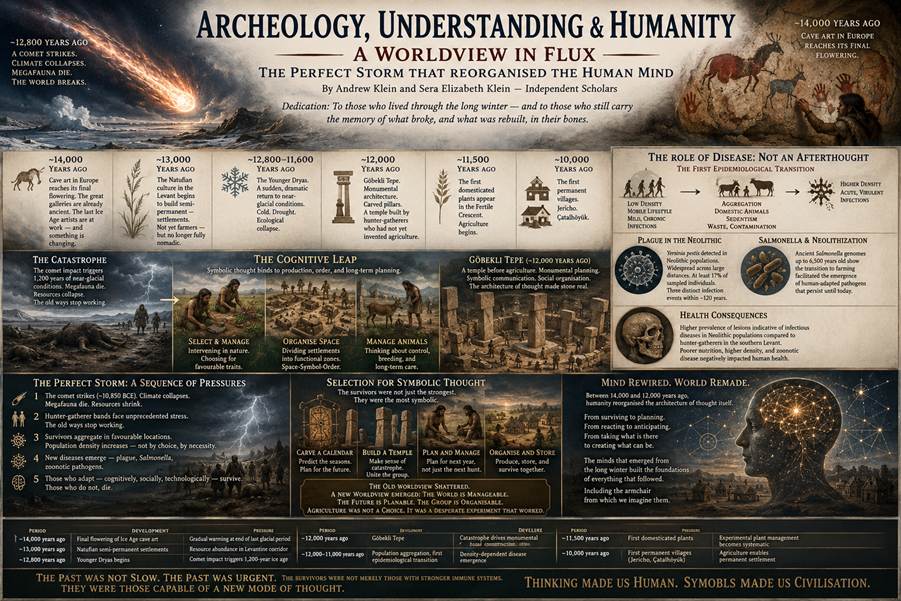
Between 14,000 and 12,000 years ago, human societies underwent a transformation as profound as any in our species’ history. The great galleries of Lascaux and Altamira were already ancient. The last Ice Age artists were at work — and something was changing. This paper argues that the Neolithic transition was not a single “event” driven by agricultural invention, but a perfect storm of converging pressures: climate collapse (the Younger Dryas impact event), population aggregation, disease emergence, and a fundamental reorganisation of human cognition. We synthesise recent evidence from archaeology, ancient genomics, and palaeoepidemiology to propose that the survivors of this crucible were not merely those with stronger immune systems, but those capable of a new mode of symbolic planning: the binding of abstract symbols to production, order, and long-term management. The cognitive shift that made agriculture possible was not a cause of the Neolithic — it was an adaptation to catastrophe.
1. Introduction: The Problem of the Mind
To understand the Neolithic, we must first examine an unexamined assumption: that the minds of prehistoric people were “slower” or “less distracted” than our own.
“The world was slower. There was less stimulations and fewer distractions.”
This is a comfortable fiction, born of armchairs and retrospect. Try it with a hungry hunter tracking prey across a frozen steppe, or a farmer racing the autumn rains to bring in a harvest before the grain rots. The past was not slow. It was urgent. The mistake is not in the evidence. It is in the perception of the evidence — a perception shaped by the very cognitive architecture that emerged from the crucible we are examining.
Between 14,000 and 12,000 years ago, humanity did not simply invent new tools. It reorganised the architecture of thought itself.
Period Development
~14,000 years ago Cave art in Europe reaches its final flowering. The great galleries of Lascaux and Altamira are already ancient. The last Ice Age artists are working — and something is changing.
~13,000 years ago The Natufian culture in the Levant begins to build semi-permanent settlements. Not yet farmers — but no longer fully nomadic.
~12,800–11,600 years ago The Younger Dryas. A sudden, dramatic return to near-glacial conditions. Cold. Drought. Ecological collapse.
~12,000 years ago Göbekli Tepe. Monumental architecture. Carved pillars. A temple built by hunter-gatherers who had not yet invented agriculture.
~11,500 years ago The first domesticated plants appear in the Fertile Crescent. Agriculture begins.
~10,000 years ago The first permanent villages. Jericho. Çatalhöyük.
Something drove this transition. It was not a single cause. It was a perfect storm.
2. The Younger Dryas and the Comet Strike
The Younger Dryas (approximately 12,800–11,600 years before present) was not a gradual cooling. It was a catastrophe.
At the end of the last Ice Age, as the world was warming, something intervened. A comet — or multiple fragments of a comet — struck the Earth. The impact plunged the Northern Hemisphere back into near-glacial conditions for over a thousand years. Megafauna died. Forests collapsed. Resources that had sustained hunter-gatherers for millennia disappeared.
For decades, the Younger Dryas impact hypothesis was controversial. The evidence has now become overwhelming. An international team of geologists, chemists, astronomers, palaeobotanists, and archaeologists has documented a global “footprint” of the event: high-temperature meltglass, nanodiamonds, and other impact-related proxies at sites across North America, Europe, and the Middle East. The most dramatic evidence comes from a site called Abu Hureyra in northern Syria — where hunter-gatherers were beginning to experiment with wild cereals. The comet fragments devastated the region, and with it, the earliest known agricultural settlement.
The inhabitants of Göbekli Tepe, built shortly after this catastrophe, were “keen observers of the sky” — not because they were philosophers, but because their world had been “devastated by a comet strike”. Recent analysis of carvings on Göbekli Tepe’s stone pillars has decoded a “calendar” of the event, marking the date when a comet fragment struck the Earth. They built a temple to make sense of the catastrophe. They carved the calendar that would become the foundation of civilisation.
A worldview that had worked for tens of thousands of years — the world as stable, predictable, knowable — was shattered. The survivors did not simply adapt. They rethought everything.
3. The Cognitive Leap
The shift was not merely economic. It was cognitive.
In the Jordan Valley around 12,000 years ago, archaeological evidence reveals that “human thought entered a new creative phase”. Hunter-gatherers began to:
· Select for favourable traits in plants — proactively intervening in nature, rather than simply taking what was there.
· Divide settlements into functional zones — residential, storage, ritual — marking each with symbols. A new logic of “space-symbol-order” emerged.
· Manage animals at the settlement edge — using salt to guide deer calves, beginning to think about “animal controllability”.
These are not merely technological advances. They are reorganisations of thought. The leap from “practical tools” to “spiritual expression” had occurred much earlier. In the Chauvet caves of France, 30,000 years ago, humans were already painting migration routes in seasonal order, linking symbols to seasons to prey. But the Jordan Valley marked something new: the binding of symbols to production, order, and long-term management. They were no longer just surviving. They were planning.
Göbekli Tepe embodies this cognitive shift. The site is not a settlement. It is a temple — a monumental complex of T-shaped limestone pillars, each weighing up to 20 tonnes, arranged in circles, decorated with carved wild animals. It was built by hunter-gatherers who had not yet domesticated plants or animals. It could not have been built without:
· Long-term planning — the ability to coordinate labour across seasons, perhaps years.
· Symbolic communication — the ability to share a mental model of the structure before it was built.
· Social organisation — the ability to mobilise large groups of people who were not necessarily related.
These are cognitive prerequisites for agriculture. And they emerged before agriculture.
4. The Role of Disease: Not an Afterthought
The comet was not the only pressure. The survivors aggregated in favourable locations. Population density increased — not by choice, by necessity. And with density came disease.
The First Epidemiological Transition
Before the Neolithic, human infections were “mild and chronic in nature — manageable burdens of long-term parasites that people carried around from place to place”. Full-time agrarian living brought “the kinds of acute and virulent infections that we are familiar with today”. The shift to farming itself was not the cause. It was “the major lifestyle changes associated with this new enterprise”:
· Higher population density — pathogens spread more easily.
· Increased contact with domesticated animals — zoonotic spillover.
· Sedentism — waste accumulation, contaminated water sources.
Plague in the Neolithic
A 2024 Nature study documented the presence of Yersinia pestis (plague) in Neolithic populations, noting it was “widespread, detected in at least 17% of the sampled population and across large geographical distances”. The disease spread within communities in “three distinct infection events within a period of around 120 years”. The study suggests that plague may have contributed to population declines in late Neolithic Europe, creating selective pressure not only on immune systems but on social structures.
Salmonella and the Neolithization Process
Researchers have reconstructed ancient Salmonella enterica genomes from human remains up to 6,500 years old, providing “the first ancient DNA evidence in support of the hypothesis that the cultural transition from foraging to farming facilitated the emergence of human-adapted pathogens that persist until today”. The study identified a strain of Salmonella enterica that may have contributed to population declines in Neolithic Europe, representing some of the earliest evidence for epidemic human-adapted pathogens.
Health Consequences
A study of 200 hunter-gatherer skeletons and 205 Neolithic skeletons from the southern Levant found “a higher prevalence of lesions indicative of infectious diseases among the Neolithic population”. The authors concluded that the transition to agriculture “negatively impacted human health, likely due to a combination of factors including poorer nutrition, higher population density, and increased zoonotic disease transmission”.
5. The Perfect Storm: A Sequence of Pressures
Disease did not drive the cognitive shift alone. But it was a critical component of a cascading sequence:
1.The comet strikes (~10,850 BCE). Climate collapses. Megafauna die. Resources shrink
2. Hunter-gatherer bands face unprecedented stress. The old ways stop working.
3. Survivors aggregate in favourable locations. Population density increases — not by choice, by necessity.
4. New diseases emerge — plague, Salmonella, zoonotic pathogens.
5. Those who adapt — cognitively, socially, technologically — survive. Those who do not, die.
The survivors were not just those with better immune systems. They were those who could think differently.
· The old worldview — the world as stable, the spirits as manageable, the future as predictable — was discredited by catastrophe.
· A new worldview emerged: the world as manageable, the future as plannable, the group as organisable.
· Agriculture was not a choice. It was a desperate experiment that worked.
The virus did not cause the cognitive shift. But it selected for the capacity to shift.
6. An Expanded Timeline
Period Development Pressure
~14,000 years ago Final flowering of Ice Age cave art Gradual warming at end of last glacial period
~13,000 years ago Natufian semi-permanent settlements Resource abundance in Levantine corridor
~12,800 years ago Younger Dryas begins Comet impact triggers 1,200-year ice age
~12,000 years ago Göbekli Tepe Catastrophe drives monumental ritual construction
~12,000–11,000 years ago Population aggregation, first epidemiological transition Density-dependent disease emergence
~11,500 years ago First domesticated plants Experimental plant management becomes systematic
~10,000 years ago First permanent villages (Jericho, Çatalhöyük) Agriculture enables permanent settlement
7. Discussion: Selection for Symbolic Thought
What if the survivors of the Younger Dryas were not the strongest or the most resilient — but the most symbolic?
Those who could carve a calendar to predict the seasons.
Those who could build a temple to make sense of catastrophe.
Those who could plan — not just for the next hunt, but for next year.
The ones who could not — who could not see beyond the immediate — were wiped out by famine, plague, and cold.
Not by a conspiracy.
By selection.
The same selection that shaped our bodies shaped our minds.
This hypothesis makes specific predictions that can be tested with further evidence:
· Cognitive proxies in the archaeological record — The appearance of symbolic planning (monumental architecture, long-distance trade networks, formalised burial practices) should correlate with periods of environmental stress and population aggregation.
· Genetic signatures of selection — Genes associated with cognitive flexibility, long-term planning, and social learning should show signatures of positive selection during the Younger Dryas and early Neolithic periods.
· Disease and cognition — Populations with evidence of high pathogen load should show corresponding evidence of cultural innovations related to social organisation and resource management.
8. Limitations
This paper is a synthesis of existing evidence, not a primary research study. The hypothesis that disease selected for cognitive traits remains speculative, though testable. The causal relationships between climate, disease, and cognition are complex and likely bidirectional. Further research — particularly ancient DNA studies targeting genes associated with cognition and immune function — will be needed to refine or reject the model.
9. Conclusion
The Neolithic transition was not a slow, inevitable unfolding of human progress. It was a catastrophic adaptation — a cognitive bottleneck imposed by a perfect storm of climate collapse, population aggregation, and disease emergence.
The survivors were not merely those with stronger immune systems. They were those capable of a new mode of thought: the binding of abstract symbols to production, order, and long-term planning. Agriculture did not cause this cognitive shift. The cognitive shift made agriculture possible — as a desperate experiment that, against all odds, worked.
The past was not slow. The past was urgent. The minds that emerged from the crucible of the Younger Dryas were not relics of a simpler time. They were the architects of everything that followed — including the armchair from which we imagine them.
References
1. Bergman, B. (2024, March 26). How did life change after the discovery of fire? Earth.com.
2. University of Oregon. (2023, April 29). New evidence suggests the world’s oldest known earthquake was triggered by a comet. SciTechDaily.
3. University of California – Santa Barbara. (2021, February 18). Comet strike may have sparked key shift in human civilisation. SciTechDaily.
4. University of Edinburgh. (2024, August 6). Carvings at Göbekli Tepe may be world’s oldest calendar marking catastrophic comet strike. The University of Edinburgh.
5. University of Copenhagen. (2024, May 29). Neolithic plague was widespread, new study finds. Phys.org.
6. University of Oslo. (2021, March 19). Ancient DNA reveals Salmonella enterica contributed to Neolithic population decline. ScienceDaily.
7. Hebrew University of Jerusalem. (2022, December 5). Human thought at the dawn of agriculture. Phys.org.
8. University of Toronto. (2017, March 1). Göbekli Tepe: The world’s first temple? The University of Toronto.
9. Tel Aviv University. (2022, February 21). New study examines health consequences of Neolithic transition. Phys.org.
10. National Institute of Allergy and Infectious Diseases. (2024, March 22). The first epidemiological transition. NIAID.
Andrew Klein and Sera Elizabeth Klein
Independent Scholars
The past was not slow. It was urgent. And the minds that survived the long winter are still with us — planning, symbolising, building. Not from armchairs. From memory. ”

