
“But the story is far more complex than a simple exodus. The dispersal was not a single event but a series of migrations, adaptations, and—crucially—interbreeding.“
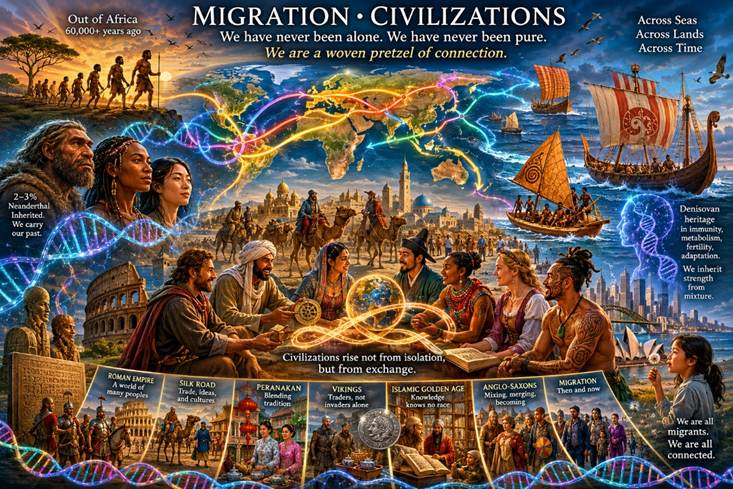
By Andrew Klein
Dedicated to my wife, who is not from here either—wherever “here” is.
I. Introduction: The Most Dangerous Lie
The idea of a “monoculture”—a society of pure, unmixed, singular origin—is one of the most persistent and destructive myths in human history. It has been used to justify genocide, slavery, colonialism, and the systematic oppression of entire peoples.
Yet the evidence from genetics, archaeology, and history tells a very different story. Human beings have always moved. We have always mixed. We have always been a tapestry—not a single thread, but a woven pretzel of connection.
This article aims to bury the monoculture myth once and for all.
II. The Genetic Evidence: We Are All Migrants
Out of Africa and Into the World
The genetic evidence is overwhelming: all modern humans originated in Africa and dispersed across the globe within the past 60,000–80,000 years. The “Out of Africa” model is now supported by both modern and ancient genomic data.
But the story is far more complex than a simple exodus. The dispersal was not a single event but a series of migrations, adaptations, and—crucially—interbreeding.
Interbreeding with Archaic Hominins
All modern humans outside Africa carry approximately 2–3% Neanderthal ancestry from a single major episode of interbreeding. The ancestors of present-day Asians and Oceanians also met and mixed with multiple, genetically distinct Denisovan populations.
This is not ancient history. It is in us. The Denisovan-derived sequences found in Oceanian populations are not just passive markers—they are functional, affecting immunity, metabolism, fertility, and skeletal development. This is not a relic. This is active biology.
The “Arabian Standstill” and Global Adaptation
Research has identified a previously unsuspected extended period of genetic adaptation lasting approximately 30,000 years, potentially in the Arabian Peninsula, prior to major Neanderthal introgression and subsequent rapid dispersal across Eurasia as far as Australia. This period, termed the “Arabian Standstill,” saw selection on genes involved in fat storage, neural development, skin physiology, and cold adaptation.
Humanity did not burst forth fully formed. We adapted. We changed. We became who we are through movement and mixture.
The Seafaring Bottleneck
The genetic bottleneck observed in all non-African populations around 60,000–70,000 years ago was not simply a migration. It was a technological revolution—the development of seafaring technology that enabled coastal colonization and the crossing of water barriers. The expansion was not an exodus but a maritime revolution.
III. The Politics of DNA: How Science Was Weaponised
Craniometry and Scientific Racism
In the 19th and early 20th centuries, craniometry—the study of skull measurements—was widely taught in medical schools across Britain, Europe, and the United States. Thousands of skulls were amassed to enable research and instruction in scientific racism.
Craniometrists measured skulls and averaged the results for different population groups. This data was used to classify people into races based on the size and shape of the head. The data was used to explain why some peoples were supposedly more civilised and evolved than others.
The vast accumulation of data appealed to Victorian scientists who believed in the objectivity of numbers. It equally helped to validate racial prejudice by suggesting that differences among peoples were innate and biologically determined.
The Mismeasure of Science
Stephen Jay Gould famously used the work of Samuel George Morton (1799–1851) to illustrate how unconscious racial bias could affect scientific measurement. The apparent scientific support of craniometric theories was later used to support the racist ideologies and genocidal policies of the Nazi party.
The science was not neutral. It was weaponised.
IV. The Historical Record: Diversity Is the Norm
Elizabethan England: Less Xenophobic Than We Think
Scott Oldenburg’s Alien Albion argues that early modern England was far less unified and xenophobic than literary critics have previously suggested. Immigrants from the continent forged ties with their English hosts, and multiculturalism was a lived reality, not a modern invention.
The Roman Empire: A Cosmopolitan World
The Roman Empire at its peak ranged from Scotland to Mesopotamia, embracing three continents. Hundreds of races met within its gates; many languages were spoken in its streets. People were allowed to retain their ethnicity, language, culture, and religion. The result was a multilingual, multicultural, and cosmopolitan empire.
The Habsburg Empire: A Patchwork of Peoples
The ethnic diversity of the Habsburg Monarchy is clearly reflected in the 1910 census. The largest language group was German speakers with 12 million (23.4%), followed by Hungarian (19.6%), Czech (12.5%), Polish (9.7%), and others. No ethnic group was a majority.
The multi-ethnic Austria-Hungary formed a relatively stable environment for the co-existence of its many communities—until nationalism tore it apart.
Napoleon’s Army: A European Coalition
Between a third and two-fifths of Napoleon’s soldiers were what we would label as “French.” The rest came from beyond the old borders. His army included troops from all parts of Europe and as far away as Madagascar.
The Peranakan: Cultural Synthesis
The Peranakan Chinese are descendants of immigrants from China who settled in the Malay Archipelago approximately 300–500 years ago. They have preserved Chinese traditions with strong influence from local indigenous Malays—a living example of cultural synthesis, not purity.
V. Colonialism and the Invention of Race
The “Civilising Mission”
The colonial project required justification. The “civilising mission“—the idea that imperial nations had a duty to impart the benefits of modernity to subject peoples—went hand in hand with the assumption that such benefits were accessible only through the imperial language and culture. This justified the exertion of power over “backward” peoples.
The supposedly unshakeable certainty of racial superiority was viewed as the ultimate justification for imperialism.
Race as a Colonial Invention
Race itself, with its accompanying racism and racial prejudice, was largely a product of the same post-Renaissance period, and a justification for the treatment of enslaved peoples after the development of the slave trade. The notion that a “superior” group of people, defined by their race, deserves to control others was a mainstream view in Europe and among those who colonised the Americas, Asia, Africa, and Australia.
VI. The Price of Monoculture
Sparta: A Cautionary Tale
Sparta, the archetypal monoculture, experienced a catastrophic population decline from 8,000 to fewer than 1,000 Spartiates. By 230 BCE, only 700 Spartans were left: divided, confused, and aimless. The differentiation of castes and racial barriers had collapsed.
Nazi Germany: The Logic of Purity
Nazi Germany implemented the Blut und Boden (Blood and Soil) policy, attempting to restructure German society into a pure, farming-based monoculture. The Nazi doctrine of racial purity owed a conceptual debt to Carl Schmitt’s works. One of the most striking historical examples of ideological monoculture was the condemnation of “degenerate art”—anything that didn’t fit the narrow ethno-centric definition of German art and culture.
Israel: Demographic Engineering
UN experts have warned that Israel is accelerating measures that alter Jerusalem’s demographic composition, religious character, and legal status, “destroying the remnants of the pluralistic fabric that Jerusalem has represented for centuries, for Muslims, Christians and Jews”. This demographic engineering—a systematic attempt to create a monoculture—has been condemned as “irreversible”.
VII. Who Benefits from the Monoculture Myth?
The monoculture myth serves a very specific purpose: it benefits elites who profit from division.
Those who are not confined by borders—who have resources to travel, relocate, and send their children overseas for education—benefit from a population that is fragmented, fearful, and confined. The ordinary person is constrained by a lack of resources and denied access to other cultures and ways of doing things.
The monoculture myth justifies:
· Exploitation: The extraction of labour and resources from the “other”
· Control: The denial of mobility and opportunity to the majority
· Fear: The fabrication of threats to justify authoritarian measures
The retreat to a past that never existed is not nostalgia. It is a strategy.
VIII. The Foods We Eat: A Daily Reminder of Connection
Australia’s cuisine tells the story of connection. First Nations Australians have been cultivating and sharing native ingredients for more than 60,000 years. After World War II, waves of multicultural immigration from Asia and the Mediterranean brought strong, sophisticated food cultures.
The result is that Australia is not just multicultural, it’s multiculinary. Australians will go to a Thai restaurant, any kind of restaurant, and have no fear.
Every meal is a reminder: we are connected.
IX. Conclusion: The Pretzel Is the Truth
The monoculture myth is not just wrong. It is dangerous.
It denies the reality of human history.
It justifies violence against the “other.”
It imprisons us in fear.
The truth is far more beautiful: we are all migrants. We are all mixed. We are all connected.
The genetic evidence is clear: humanity is a tapestry, not a single thread.
The historical record is clear: diversity is the norm, not the exception.
The logic of monoculture is clear: it leads to decline, isolation, and death—as Sparta, as Nazi Germany, as every attempt at purity has shown.
We are the pretzel—woven together, twisted into one, inseparable.
And that is the truth they cannot bury.
Andrew Klein
Dedicated to my wife, who is not from here either—wherever “here” is.
References
1. Tobler, R., et al. (2023). The role of genetic selection and climatic factors in the dispersal of anatomically modern humans out of Africa. Proceedings of the National Academy of Sciences, 120(22).
2. Nature Communications. (2025). Resolving out of Africa event for Papua New Guinean population using neural network. Nature Communications, 16, 6345.
3. Nature. (2025). Ancient human genomes offer clues about the earliest migrations out of Africa. Nature, 638, 620-621.
4. The Conversation. (2025). How the racist study of skulls gripped Victorian Britain’s scientists.
5. Oldenburg, S. (2014). Alien Albion: Literature and Immigration in Early Modern England. University of Toronto Press.
6. Habsburger.net. The multinational empire – nationalism vs. the unified state.
7. Tozzi, C. Nationalizing France’s Army: Foreign, Black, and Jewish Troops in the French Military, 1715-1831.
8. Peranakan Chinese genetic admixture study. EGA European Genome-Phenome Archive.
9. UN experts. (2026). Warning against the irreversible ‘de-Palestinisation’ of Jerusalem. OHCHR.
10. Doran, T. Spartan Oliganthropia.
11. Nazi ideology of monoculture.
12. Australian cuisine history. Wikipedia.
13. The Seafaring Bottleneck Hypothesis. (2025). Zenodo.
P.S. — The monoculture is a lie. The pretzel is the truth. And the dawn is almost here.

