
Dedicated to my wife — who taught me that true wisdom lies not in conquest, but in understanding.
By Andrew Klein
I. Introduction: The Mandate That Can Be Lost, the Right That Cannot
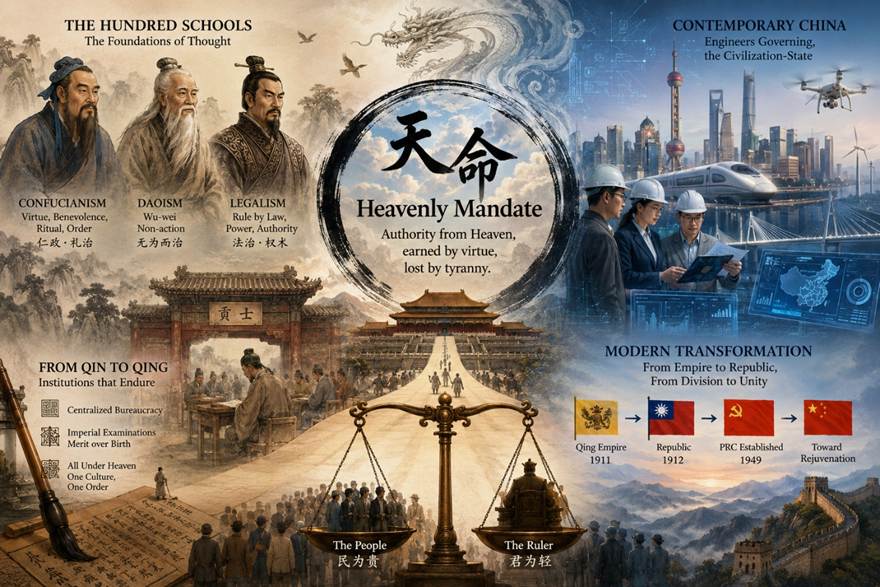
Perhaps the deepest divide between Chinese and Western political philosophy can be captured in two concepts: Heavenly Mandate (天命, Tiānmìng) and Divine Right of Kings.
In the Western tradition, the king’s power comes directly from God and is irrevocable. In the Chinese tradition, the ruler receives authority from “Heaven” — but this authority is conditional. When the ruler loses virtue and the people suffer, the Mandate can be transferred. As one scholar notes, while both concepts trace sovereign power to a divine source, they differ profoundly in “the dimension and limits of the divinisation of kingship,” leading to “completely different political traditions.”
This difference has shaped two entirely different political logics: Western kingship is eternal; Chinese kingship is conditional. When a dynasty loses the Mandate, revolution and dynastic change become legitimate. This idea has run through more than two thousand years of Chinese political history — from Qin to Qing, from Sun Yat-sen to Mao — always present, merely changing its expression.
II. The Hundred Schools: The Axial Age of Thought
The foundations of Chinese political philosophy were laid in the pre-Qin period. Hsiao Kung-chuan called this the “creative period” of Chinese political thought — roughly three hundred years from Confucius (551 BCE) to the unification under Qin Shi Huang (221 BCE), during which the Hundred Schools of Thought provided the basic framework for Chinese political thinking.
Confucianism, represented by Confucius, Mencius, and Xunzi, emphasised rule by virtue, benevolent governance, and the order of ritual. Mencius famously declared: “The people are the most important; the state is secondary; the ruler is the least.” This was the political implementation of the Mandate of Heaven.
Daoism, represented by Laozi and Zhuangzi, advocated wu-wei (non-action) — the idea that the best governance is the least intervention.
Legalism, represented by Shang Yang and Han Feizi, advocated rule by law, governance by technique, and the establishment of power through authority. Legalist thought was fully implemented under the Qin dynasty, creating China’s first centralised bureaucratic empire. Han Feizi is considered the first thinker in world history to systematically argue for centralised autocracy.
These seemingly opposed schools gradually merged after the Qin and Han dynasties, forming the unique genetic code of Chinese political philosophy: Confucianism as the outward expression, Legalism as the inner mechanism, and Daoism as the supplement.
III. From Qin to Qing: Examinations, Bureaucracy, and “All Under Heaven“
3.1 The Institutionalisation of Unity
In 221 BCE, Qin Shi Huang unified the six states. The Qin dynasty, based on Legalist thought, established a centralised system of prefectures and counties. “All matters under heaven, great and small, are decided by the emperor” — this was the institutional realisation of the Legalist concept of “power” (shi).
The Han dynasty inherited the Qin institutional framework but incorporated Confucian thought as the basis of legitimacy, forming what later scholars call the “Confucian-Legalist state” model.
3.2 The Imperial Examination System: The Earliest Meritocracy
The Chinese imperial examination system, established during the Sui and Tang dynasties, is the world’s earliest merit-based talent selection mechanism.
The core of the examination system was selection through testing. It broke the monopoly of hereditary aristocracy on power and “prevented social classes from becoming rigid.” More importantly, the examination system, transmitted to the West through Ming dynasty missionaries, had a substantive influence on Western civil service systems. Napoleon is said to have drawn on the examination system when establishing France’s modern civil service.
3.3 The “All Under Heaven” Concept
Another core concept in ancient Chinese political thought was “All Under Heaven” (天下, Tiānxià). This was not merely a geographical concept but a worldview that defined the political community by culture rather than ethnicity. This concept has been revived in the contemporary philosophy of Zhao Tingyang’s “Tianxia System.”
IV. Modern Transformation: Western Impact and Chinese Response
4.1 From Empire to Republic
After the Opium Wars, China’s traditional political order was subjected to unprecedented shock. Western ideas poured in through missionaries, merchants, and colonisers.
Sun Yat-sen was a key figure in this transformation. He developed the Three Principles of the People, attempting to combine Western democratic ideas with Chinese political ideals. The 1911 Revolution he led overthrew the Qing dynasty, ending more than two thousand years of imperial rule.
However, the political practice of the Republican period was not successful. Warlordism, foreign intervention, and social unrest ultimately led to the split between the Nationalists and the Communists.
4.2 From Division to Unity
In 1949, the Chinese Communist Party established the People’s Republic of China. This new state inherited:
· The political tradition of unity
· The governance model of centralisation
· The concept of selecting talent through examination (continued through the gaokao and other mechanisms)
· The “All Under Heaven” approach to integrating the nation through culture
V. Contemporary China: Engineers Governing and the Civilisation-State
5.1 Engineers in Governance
A notable feature of contemporary Chinese governance is the dominance of technical experts in decision-making.
Some scholars have called China an “engineering state.” China’s decision-making class is dominated by engineers and technical experts, while the United States is dominated by lawyers and politicians.
This difference has profound implications:
· China tends toward technical solutions — identify problems, solve them with engineering thinking
· The US tends toward legal solutions — identify problems, respond with laws and regulations
As one observer noted, China represents a “perfect combination of statesmen governing and engineers governing.” This combination enables China to formulate and implement long-term strategic plans, while Western electoral politics are often constrained by short-term interests and partisan conflict.
5.2 A Civilisation-State, Not a Nation-State
Chinese scholar Zhang Weiwei argues that China is essentially a “civilisation-state” rather than a “nation-state.”
This means:
· China’s legitimacy comes not only from elections but from thousands of years of continuous civilisation
· China’s governance model is rooted in meritocratic selection rather than electoral competition
· China’s goal is civilisational revival rather than merely nation-building
5.3 “People-Centred” Governance
Contemporary Chinese official discourse describes the governance model as “people-centred.” Whatever external critics may say, this model has achieved measurable results in several key areas:
· Education: China has the world’s largest higher education system, producing millions of STEM graduates annually
· Healthcare: Basic medical insurance covers over 95% of the population
· Infrastructure: High-speed rail, ports, and 5G networks are among the world’s most extensive
· Poverty Reduction: Hundreds of millions have been lifted out of extreme poverty
These achievements have been realised without waging foreign wars — a sharp contrast with the United States’ ongoing overseas military operations.
VI. US-China Competition: Behind the Threat Narrative
6.1 The US “Threat” Narrative
The United States has framed China as a “strategic competitor” and a “revisionist power.” This narrative serves multiple purposes:
· Justifying the maintenance of massive military spending
· Legitimising military presence in the Asia-Pacific
· Providing grounds for restricting Chinese technological development
However, as some analyses have noted, this “threat” narrative often “repackages economic and technological competition as a ‘security threat’ narrative.”
6.2 China’s Different Path
Compared with the US, China’s strategic choices show a markedly different pattern:
· No invasion of neighbours — territorial disputes are handled primarily through diplomatic channels
· No global military base network — China’s overseas military presence is far smaller than America’s
· No export of war — China does not engage in the kind of global military interventions that the US does
6.3 Trade, Not War
The future of US-China relations is unlikely to be military conflict. It is more likely to be competition in trade and technology. China’s Belt and Road Initiative, RCEP trade agreement, and other efforts represent attempts to expand influence at the economic level.
The US, through mechanisms like AUKUS, seeks to maintain its Asia-Pacific dominance — but this strategy of “strength rather than confrontation” is essentially about defending a global order that is already changing.
VII. Conclusion: Where Does the Mandate Lie?
Two thousand years of Chinese political philosophy reveal a unique and coherent trajectory:
· From Heavenly Mandate to the People — the source of legitimate rule has shifted from “Heaven” to “the people,” but the conditional nature remains unchanged
· From Imperial Examinations to the Gaokao — the tradition of selecting talent through examination continues
· From “All Under Heaven” to “Community with a Shared Future” — the concept of integrating the world through culture has been reborn in new form
Perhaps the true value of China’s political tradition lies not in offering a “universal model,” but in demonstrating that political systems can operate on entirely different logics and paths.
The difference in governance models between East and West — engineers versus lawyers, selection versus election, long-term planning versus short-term response — is not merely “ideological.” It is the continuation of two different civilisational traditions in the contemporary era.
China has not invaded its neighbours. China has not exported war. Yet it has achieved remarkable progress in economics and technology. If the “Heavenly Mandate” means a legitimate and effective form of governance, then China’s experience may pose a question worth considering:
Perhaps the Mandate does not belong to any single dynasty or system. Perhaps it belongs to whatever form of governance can provide its people with peace, development, and dignity.
Andrew Klein
References
1. Meng Guanglin: Comparative study of “Divine Right of Kings” and “Heavenly Mandate”
2. Stuart D. B. Picken, The Imperial Systems in Traditional China and Japan
3. Hsiao Kung-chuan, A History of Chinese Political Thought
4. Yuri Pines, The Everlasting Empire
5. Chinese imperial examination system’s influence on Western civil service
6. “Engineering State” vs “Lawyer Government” governance model comparison
7. Dan Wang, Breakneck: China’s Quest to Engineer the Future
8. Zhang Weiwei: China as a “civilisation-state” rather than a “nation-state”
9. US 2026-2030 agency strategic plans: China strategy positioning
10. Zhao Tingyang’s “Tianxia System” theory
天命与治理:中国政治哲学的两千年回响
作者:Andrew Klein
献给我的妻子——她让我明白,真正的智慧不在于征服,而在于理解。
一、引言:天命可失,神权不移
中国政治哲学与西方政治哲学之间最深刻的分野,或许可以用两个概念来概括:天命与君权神授。
在西方的君权神授传统中,国王的权力直接来自上帝,是不可撤销的。而在中国的天命观中,统治者获得的是“天”的授权——但这个授权是有条件的。当天子失德、民不聊生时,天命就会转移。正如一位学者所言,天命与神权“在将君权源头追溯到神(天)那里”这一点上相似,但“对君权神化的维度与限度不同导致截然不同的政治传统”。
这种差异塑造了两种完全不同的政治逻辑:西方的王权是永恒的,中国的王权是有条件的。当王朝失去天命,革命和改朝换代就获得了合法性。这个观念贯穿了中国两千多年的政治史——从秦到清,从孙中山到毛泽东,天命的话语始终在场,只是换了一种表达方式。
二、先秦诸子:思想的轴心
中国政治哲学的根基在先秦时期奠定。萧公权将这一时期称为中国政治思想的“创造时期”——从孔子(公元前551年)到秦始皇统一(公元前221年),约三百年的时间里,诸子百家为中国政治思想提供了基本框架。
儒家以孔子、孟子、荀子为代表,强调德治、仁政和礼治秩序。孟子明确提出“民为贵,社稷次之,君为轻”——这是对天命观的政治落实。
道家以老子、庄子为代表,主张“无为而治”,认为最好的治理是不过度干预。
法家以商鞅、韩非子为代表,主张以法治国、以术驭臣、以势立威。法家思想在秦朝得到全面实践,建立了中国历史上第一个中央集权的官僚帝国。韩非子被认为是世界历史上第一个系统论证集权统治的思想家。
这些看似对立的学派,在秦汉之后逐渐融合,形成了中国政治哲学的独特基因:以儒家为表、法家为里、道家为补的复合体系。
三、秦汉至明清:科举、官僚与“天下”
3.1 大一统的制度化
公元前221年,秦始皇统一六国。秦朝以法家思想为基础,建立了中央集权的郡县制。“天下之事无小大,皆决于上”——这是法家“势”的理念在制度上的体现。
汉朝继承了秦的制度框架,但引入了儒家思想作为统治的合法性基础,形成了后世所称的“儒法国家”模式。
3.2 科举制度:最早的功绩制
中国科举制度形成于隋唐,是世界上最早的功绩制人才选拔机制。
科举制度的核心是以考试选官。它打破了世袭贵族对权力的垄断,“让社会阶级不容易僵化”。更重要的是,科举制度通过明末传教士的记述传入西方,对西方的文官制度产生了实质性影响。拿破仑曾借鉴科举制度建立法国的现代文官体制。
3.3 天下观与治理传统
中国古代政治还有一个核心概念——“天下”。这不仅仅是一个地理概念,更是一种以文化而非种族定义政治共同体的世界观。这种观念在当代哲学家赵汀阳的“天下体系”理论中得到复兴。
四、近代转型:西方的冲击与中国的回应
4.1 从帝国到民国
鸦片战争后,中国传统政治秩序受到前所未有的冲击。西方思想通过传教士、商人和殖民者大量涌入。
孙中山是这一转型的关键人物。他提出三民主义,试图将西方民主思想与中国传统政治理想相结合。他领导的辛亥革命推翻了清朝,结束了延续两千多年的帝制。
然而,民国时期的政治实践并不成功。军阀割据、列强干涉、社会动荡,最终导致了国共分裂。
4.2 从分裂到统一
1949年,中国共产党建立中华人民共和国。这个新国家继承了:
· 大一统的政治传统
· 中央集权的治理模式
· 以考试选拔人才的理念(通过高考等制度延续)
· “天下”观念中以文化整合国家的思路
五、当代中国:工程师治国与文明国家
5.1 工程师治国
当代中国治理的一个显著特征是技术专家在决策层中的主导地位。
有学者将中国称为“工程型国家”(engineering state)。中国的决策层以工程师和技术专家为主,而美国则以律师和政客为主。
这种差异产生了深远影响:
· 中国倾向于技术性解决方案——发现问题,用工程思维解决问题
· 美国倾向于法律性解决方案——发现问题,用法律和监管来应对
正如一位观察者所言,中国是“政治家治国加工程师治国的完美结合”。这种组合使中国能够制定和实施长远战略规划,而西方的选举政治往往被短期利益和党派斗争所掣肘。
5.2 文明国家而非民族国家
中国学者张维为提出,中国本质上是一个“文明国家”(civilization-state)而非“民族国家”(nation-state)。
这意味着:
· 中国的合法性不仅来自选举,更来自数千年的文明延续
· 中国的治理模式根植于选拔制而非选举制
· 中国的目标是文明复兴而非仅仅是国家建设
5.3 “以人民为中心”的治理
当代中国官方话语将治理模式描述为“以人民为中心”。无论外部如何评价,这一模式确实在几个关键领域取得了可量化的成就:
· 教育:中国拥有世界上规模最大的高等教育体系,每年培养数百万STEM专业人才
· 医疗:基本医疗保险覆盖超过95%的人口
· 基础设施:高铁、港口、5G网络等基础设施的覆盖率位居世界前列
· 减贫:数亿人摆脱了极端贫困
这些成就是在没有对外发动战争的情况下实现的——这一点与美国持续不断的海外军事行动形成了鲜明对比。
六、中美竞争:威胁叙事的背后
6.1 美国的“威胁”叙事
美国将中国定位为“战略竞争对手”和“修正主义大国”。这种叙事服务于多重目的:
· 为维持庞大的军事开支提供理由
· 为在亚太地区的军事存在提供合法性
· 为限制中国技术发展提供依据
然而,正如有分析指出,这种“威胁”叙事往往将经济和技术竞争“重新包装为‘安全威胁’叙事”。
6.2 中国的不同路径
与美国相比,中国的战略选择呈现出明显不同的模式:
· 没有入侵邻国——中国与周边国家的领土争议主要通过外交渠道处理
· 没有建立全球军事基地网络——中国在海外的军事存在远少于美国
· 没有输出战争——中国没有像美国那样在全球范围内进行军事干预
6.3 贸易而非战争
未来的中美关系,不太可能是军事冲突,而更可能是贸易和技术的竞争。中国的“一带一路”倡议、RCEP贸易协定等,都是在经济层面扩大影响力的努力。
美国试图通过AUKUS等机制维持其亚太主导地位,但这种“实力而非对抗”的策略本质上仍是为了维护一个正在变化的全球秩序。
七、结论:天命在何方?
中国政治哲学两千年来的演变,展现了一个独特而连贯的轨迹:
· 从天命到人民——统治合法性的来源从“天”转移到“人民”,但“有条件性”的本质未变
· 从科举到高考——以考试选拔治理人才的传统延续至今
· 从天下到人类命运共同体——以文化整合世界的观念以新的形式重生
也许,中国政治传统的真正价值,不在于它提供了某种“普世模式”,而在于它证明了政治制度可以有完全不同的逻辑和路径。
中西方的治理模式差异——工程师与律师、选拔与选举、长期规划与短期反应——不仅仅是“意识形态”的分歧,更是两种不同文明传统在当代的延续。
中国没有入侵邻国,没有输出战争,却在经济和技术领域取得了显著进步。如果“天命”意味着一种治理的合法性和有效性,那么中国的经验或许正在向我们提出一个值得深思的问题:
也许,天命并不是某个王朝或制度的专利,而是属于那些能够为人民提供和平、发展和尊严的治理模式。
Andrew Klein
参考文献
1. 孟广林教授学术报告:“王权神授”与“君权天授”的比较研究
2. Stuart D. B. Picken, The Imperial Systems in Traditional China and Japan: 天命与神权的哲学差异
3. 萧公权,《中国政治思想史》:中国政治思想的四个时期
4. Yuri Pines, The Everlasting Empire: 从孔子到当代中国的政治思想延续性
5. 《中国政治思想史》课程:中国政治思想的八个演进阶段
6. 中国科举制度对西方文官制度的影响
7. 《中国科举制度与欧美现代文官制度的确立》
8. “工程型国家”与“律师政府”的治理模式比较
9. Dan Wang, Breakneck: China’s Quest to Engineer the Future: 工程师治国vs律师治国
10. 中国驻哥伦比亚大使朱京阳文章:中国制度逻辑的时代三问
11. 张维为:中国作为“文明国家”而非“民族国家”
12. 美国2026-2030财年机构战略计划:对华战略定位
13. 美国新版国防战略报告:对华表述调整
14. 中国“天下”观念的当代复兴
15. 赵汀阳“天下体系”理论

