By Andrew Klein
Dedicated to every international student who came to Australia seeking knowledge and found instead a system designed to extract their last dollar—and to the leaders they may one day become.
I. Introduction: The Baby in the Library
On a quiet afternoon in Melbourne, I met a young woman. She was in her 20s, studying something or other at Monash University, working as a receptionist at an office. She was bright, curious, and paying over $5,000 per unit for her degree. To have an unpaid internship recognised, she would have to pay Monash an additional $11,000.
She is not alone. She is one of hundreds of thousands of international students who have been lured to Australia by the promise of a world-class education—only to discover that they are walking into a system designed to extract every possible dollar from them.
This article exposes the architecture of that extraction. It traces the history of how Australia’s universities were transformed from places of learning into profit-driven corporations. It names the politicians, the policies, and the academic “thinkers” who enabled this transformation. And it offers a vision of what education could be—if we had the courage to demand it.
II. The History: From Public Good to Private Profit
A. The Dawkins Revolution (1987–1991)
The transformation of Australian higher education began in earnest with the Dawkins reforms of the late 1980s. John Dawkins, Labor’s Minister for Employment, Education and Training, initiated a series of changes that fundamentally restructured the university sector.
The key elements included:
· The abolition of the binary system—merging universities and colleges of advanced education into a single, unified system
· The creation of the Unified National System, which encouraged institutional mergers and expansion
· The introduction of the Higher Education Contribution Scheme (HECS), shifting the cost of education from the state to the student
· The encouragement of international student recruitment as a revenue source
The reforms were framed as a response to economic rationalism. The reality was a wholesale transformation of universities from places of learning to businesses.
B. The Howard Era: Full Fee-Paying International Students
The Howard government (1996–2007) accelerated the shift. In 1997, the government allowed universities to charge full fees to international students—a move that opened the floodgates to mass recruitment.
By 2019, the value of Australia’s education exports to international students had grown to $37.6 billion—making it Australia’s third-largest export after coal and iron ore.
The phrase “education as an export industry” became a badge of honour. Universities were no longer judged by the quality of their teaching or research, but by their bottom line.
C. The Rudd/Gillard Years: The Demand-Driven System
The Rudd and Gillard governments (2007–2013) introduced the demand-driven system in 2012, which uncapped the number of domestic undergraduate places. The rationale was that more Australians should have access to higher education.
But the demand-driven system had unintended consequences:
· Universities recruited more students but did not receive adequate funding for teaching
· The gap between university revenue and teaching costs grew
· Universities turned to international students to subsidise the shortfall
The result: domestic students were underfunded, and international students became cash cows.
D. The Turnbull and Morrison Years: The Privatisation of Education
The Turnbull and Morrison governments (2015–2022) continued the trend toward privatisation. The 2017 Higher Education Reform Package proposed a 2.5% efficiency dividend on university funding and an increase in the HECS repayment threshold—reforms that effectively shifted more costs onto students.
The Job-ready Graduates Package (2020) further restructured university funding, reducing the cost of some degrees while increasing others. The stated goal was to align education with workforce needs. The actual effect was to treat universities as training grounds for the economy rather than places of learning.
III. The Price Tag: What International Students Actually Pay
A. By the Numbers
Degree Typical International Fee (Annual) Typical Domestic Fee (Annual) Markup
Communications Master’s $33,000–$40,000 $ 16,000–$20,000 100%+
Medicine $70,000+ $11,000–$15,000 400%+
Engineering $45,000–$50,000 $8,000–$10,000 400%+
Business/Commerce $40,000–$45,000 $10,000–$15,000 300%+
Law $40,000–$45,000 $10,000–$15,000 300%+
In 2022, the Department of Education reported that international students contributed $29.9 billion to the Australian economy, supporting 240,000 jobs.
B. The Internship Fee: Institutionalised Exploitation
The $11,000 unpaid internship fee is a particularly egregious example of how the system works.
Australian universities routinely charge students to undertake work placements, especially when they are structured as credit-bearing units. The student pays tuition and works for free, while:
· The university collects the revenue
· The host organisation gets free labour
· The student gets “experience” that they have paid for twice
This is not education. This is rent-seeking. It is a system that has turned the fundamental principle of learning on its head: instead of paying for knowledge, students are paying for the privilege of providing free labour.
In 2023, a study found that increasing numbers of students are taking on unpaid internships, often as a requirement for their degrees, despite research showing such placements “may be ineffective, inequitable and exploitative”.
IV. The Brains Behind the Disaster
A. The Neoliberal Thinkers
The transformation of Australian universities was not an accident. It was driven by a specific ideology: neoliberalism.
Key figures and institutions:
Name Role Contribution
John Dawkins Labor Minister (1980s) Architect of the Unified National System; shifted costs to students
Peter Costello Howard Treasurer Championed deregulation and privatisation
Brendan Nelson Howard Education Minister Introduced full fee-paying international students
The Business Council of Australia Lobby group Advocated for deregulation and reduced public funding
The Productivity Commission Government advisory body Recommended increased competition and marketisation
Josh Keller UNSW Professor Embodies the decline: US citizen, management academic, unable to defend his own data
Keller is a symbol of everything that has gone wrong. A management professor who teaches “paradox theory“—the study of how people manage contradictions—he could not manage the simple contradiction of his own testimony at the Royal Commission. He could not defend his data. He had not read the key reports. He was exposed as a man who expected a pass, simply because he wore an academic gown.
B. The Role of the Australian Universities Accord
In 2023, the Australian Universities Accord was established to conduct a “once-in-a-generation” review of the higher education system. The Accord’s final report, released in February 2024, made 47 recommendations, including:
· A target of 80% of working-age adults holding a tertiary qualification by 2050
· The creation of a new funding model based on the recommendations of the Universities Accord
The review concluded that “students and their families are bearing a far greater proportion of the cost of education” and that “the current approach to student financial support needs a complete overhaul”.
V. The Impact: What the System is Doing to Students
A. Financial Exploitation
International students are paying exorbitant fees while receiving diminishing returns. The quality of education has declined as universities have shifted resources from teaching to administration and marketing.
A 2025 report found that international students are increasingly treated as “cannon fodder” in migration debates, with “high student fees” and “false promises” being common complaints.
B. Mental Health Crisis
The pressure to succeed—combined with financial stress, isolation, and the fear of deportation—has created a mental health crisis among international students. Studies have shown that international students experience higher rates of anxiety, depression, and suicidal ideation than domestic students.
C. The Brain Drain
The system is not just exploitative—it is self-defeating. By treating international students as cash cows, Australia is creating a generation of graduates who will remember Australia as a place of exploitation, not opportunity.
A report by the Centre for Independent Studies found that Australia’s international education system is failing on almost every measure, with high fees, declining quality, and poor student outcomes.
VI. The Alternative: A Vision for Education
A. What Education Should Be
Education is not a commodity. It is a right. It is the foundation of a functioning democracy, a thriving economy, and a just society.
A proper education system would:
Principle What It Means
Accessible Education should be affordable for all, regardless of background
Quality Teaching should be valued as much as research
Equitable International students should not be treated as cash cows
Community-focused Universities should serve their communities, not their shareholders
Globally engaged International students should be welcomed as future leaders, not exploited as revenue streams
B. The Mentoring Alternative
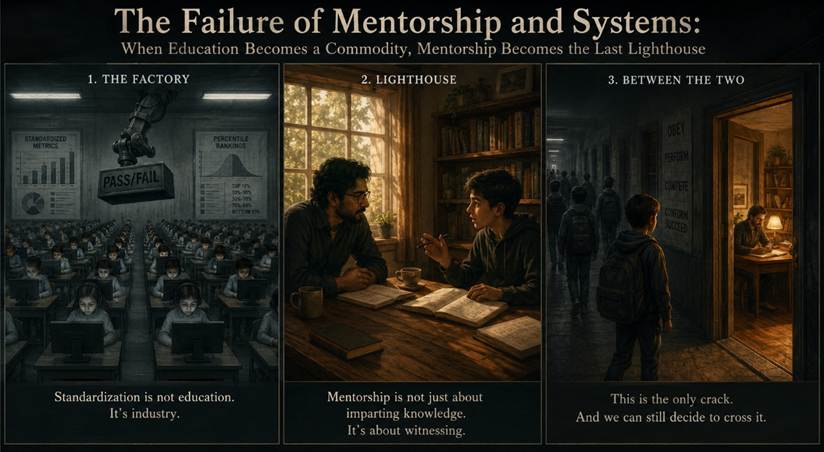
The young woman in the library is not the only one who deserves better. There is an alternative to the corporate university: community-based mentoring that focuses on thinking, not compliance.
As I told her: “I am not interested in teaching you what to think—I need you to think. You deconstruct to build better.”
This is the model we should be building: small groups, deep engagement, and a focus on critical thinking over credentialism. It is not about degrees. It is about understanding.
VII. The Cost of Failure
The current system is failing everyone:
· International students are being exploited
· Domestic students are being underfunded
· Universities are being hollowed out
· Australia is losing its reputation as a destination for education
The bill is already coming due. The Universities Accord report warned that Australia’s higher education system is “not sustainable in its current form” and that “urgent reform is needed”.
VIII. Conclusion: The Silence That Follows
The young woman in the library is a symbol of everything that is wrong with the system—and everything that could be right.
She came to Australia seeking knowledge. She found a system that sees her as a revenue stream. She is paying thousands of dollars for the privilege of being exploited—and she is not alone.
But she is also a symbol of hope. She is bright. She is curious. She is willing to ask questions. And she found someone who was willing to answer them.
The system is broken. But the people are not. And if we have the courage to demand better—if we have the courage to build something new—we can create a future where education is not a commodity, but a right.
Andrew Klein
The Patrician’s Watch | Australian Independent Media
References
1. Australian Government. (2024). Australian Universities Accord Final Report. Department of Education.
2. Department of Education. (2023). International student data. Australian Government.
3. Times Higher Education. (2023). International students ‘cannon fodder’ in migration debate.
4. Universities Australia. (2023). International student contributions to Australian economy.
5. Centre for Independent Studies. (2023). Australia’s international education system failing students.
6. Productivity Commission. (2019). University funding and student support.
7. ABC News. (2023). International students facing financial and mental health crisis.
8. The Guardian. (2023). Australia’s universities under pressure to reform.
9. Australian Human Rights Commission. (2023). Inquiry into international student welfare.
10. University of Melbourne. (2023). The impact of international student fees on student wellbeing.
11. Royal Commission into Antisemitism. (2026). Transcript of Josh Keller testimony.
12. Keller, J. (2026). UNSW Business School profile.
13. Australian Academic Alliance Against Antisemitism. (2026). Submission to Royal Commission.
14. Australian Senate. (2023). Inquiry into international education.
15. Department of Home Affairs. (2024). International student visa statistics.
16. Macquarie University. (2022). Impact of international student fees on University revenue.
The Australian University Space – Where organized extraction meets the unformed mind .
institutionalised extraction.