
By Andrew Klein
Dedicated to the many veterans, their families and communities abandoned after giving their all.
I. Introduction: A Debt Unpaid
On 9 September 2024, the Royal Commission into Defence and Veteran Suicide delivered its Final Report after three years of inquiry. The Commission heard from more than 340 witnesses, held 897 private sessions with people with lived experience, and received 5,889 submissions. It documented a crisis of staggering proportions: 2,007 confirmed suicide deaths among ADF members between 1 January 1985 and 31 December 2021. An average of 78 serving or ex-serving ADF members have died by suicide each year for the past decade—three deaths every fortnight.
The Commission made 122 recommendations. It described a “catastrophic failure of leadership at all levels” to prioritise the health and wellbeing of serving and ex-serving ADF members and their families.
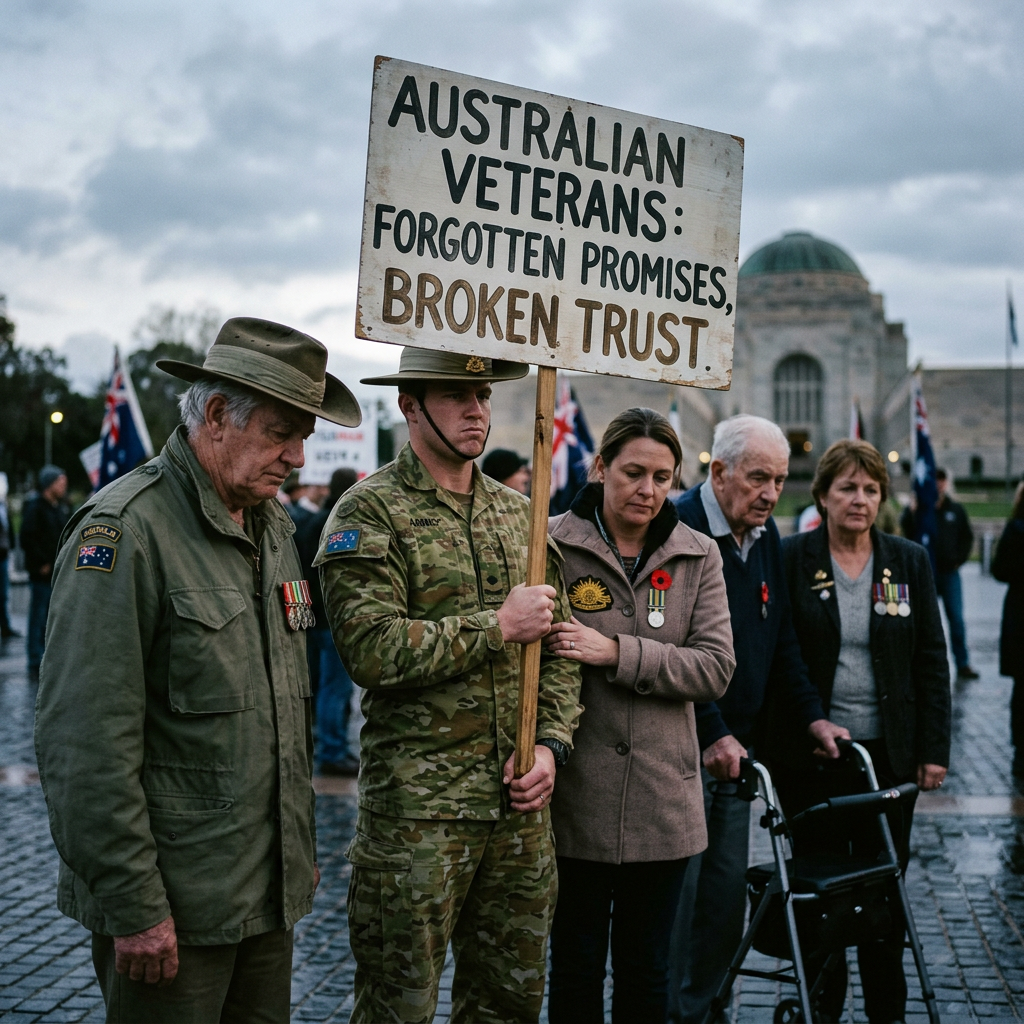
And yet, the system remains broken. The promises remain unkept. And the veterans remain abandoned.
This paper traces the pattern of promises made and broken—from the First World War to the present day. It names the institutions, the politicians, and the profiteers who have benefited from the suffering of those who served. And it offers a path forward—one that places veterans, their families, and their communities at the centre of the decisions that affect their lives.
II. The Scale of the Crisis: By the Numbers
A. Suicide
Between 1997 and 2021, at least 1,677 serving and ex-serving ADF members died by suicide — more than 20 times the number of Defence personnel killed in active duty over the same period. Male permanent members serving in a combat or security role are 100% more likely to die by suicide than employed Australian males.
B. Homelessness
On census night in 2021, approximately 1,555 Australian veterans were homeless. Veterans are three times more likely to experience homelessness than the general population. Approximately 5,800 veterans experience homelessness annually. The economic cost of veteran homelessness is estimated at $4.6 billion over 30 years.
C. Domestic Violence
Studies of veteran families have reported levels of intimate partner violence ranging from 2% to 46%. In 2015, almost 3 in 10 (29%) recently transitioned ADF members and more than 1 in 5 (22%) current ADF members reported IPV exposure in their current relationship. Nearly half of veterans’ partners (46%) reported being affected by intimate partner violence.
D. Health
Veterans report higher rates of arthritis, back problems, heart disease, diabetes, cancer, and COPD compared to non-veterans. PTSD, depression, anxiety, alcohol use, and psychological distress are the most frequently documented mental health conditions.
These are not statistics. These are lives. Families. Communities. Destroyed.
III. The Pattern: A Century of Broken Promises
A. The “War to End All Wars” and What Followed
After WWI, the government promised soldiers land and support. In Victoria alone, almost 12,000 soldiers were granted parcels of land. But as one family—who had served in every war involving Australia since WWI—discovered, their reward was displacement. The promised land was not always delivered. The promised support was not always provided.
After WWII, the pattern repeated. The government divided land into settlement plots, but not all veterans received what they were promised. The mission was closed. The veterans were left to fend for themselves.
After Vietnam, the neglect was even more pronounced. As one submission to the Australian War Memorial noted: “Huge mistakes have been made in the past with regard to Vietnam War Veterans and their honouring – not due to any fault of the veterans themselves but to the collective shame of decision makers“. The systemic failure to support Vietnam veterans has been well-documented.
B. The Modern Era: Afghanistan and Beyond
Between 2001 and 2014, 26,000 Australian men and women served in Afghanistan. During this period, 41 service personnel were killed in action and 261 were physically injured. But the casualties did not end when the war did. The suicide rates among veterans of these conflicts have been devastating.
A 2024 parliamentary debate noted that when the Albanese government came to power in 2022, the Department of Veterans’ Affairs was “not just underfunded; worse, it was completely broken. There was a backlog of almost 42…”.
C. The Gold Card: A Symbol of the Betrayal
In July 2026, the government began reissuing DVA Veteran Cards. Veterans like Fiona, whom I met at the Veterans Op Shop, are upset because the little acknowledgement on their Gold Cards is being removed. It is a small thing—a symbol. But symbols matter.
Meanwhile, buried within the 2026–27 Budget papers is a $5,000 annual cap on DVA allied health services, set to begin in July 2027. A cap on healthcare for those who have already sacrificed so much.
IV. The Institutions That Failed
A. The Returned and Services League (RSL)
The RSL has historically played a central role in promoting veteran well-being. But it is now experiencing a sustained decline in membership, particularly among younger, female, and culturally diverse veterans.
Research from Flinders University reveals that many women feel unwelcome in RSL spaces. Some leave. Others never join. The RSL draws its members from the Australian Defence Force, where women have long reported sexism, harassment and inappropriate behaviour.
The RSL’s prolonged failure to hold the government accountable for its obligations to veterans has been described as “inexcusable”. Over the course of a generation, the RSL has been “absent from the front lines of veteran advocacy”. Many veterans view the RSL as an “outdated organisation that no longer represents their interests or their service”.
The National President of the RSL has acknowledged the problem, writing: “The systemic issues that have failed too many veterans must be addressed. … Too many younger veterans have seen the RSL as irrelevant to their needs”.
B. Legacy
Legacy has dedicated itself to supporting veterans’ families for over a hundred years. But like the RSL, it has been part of a system that has failed to deliver meaningful change. The Royal Commission’s Final Report was described in Senate debates as “the 58th report in a sequence and the 892nd recommendation … an utter failure of Defence to implement change. It’s a national shame”.
C. The Class Divide
The distinction between officers and other ranks has ensured that even though all are veterans, the interests and rewards are very different. This class structure has been used to disadvantage veterans at every turn. Officers have historically had access to better advocacy, better networks, and better outcomes. Other ranks have been left to navigate a system designed to deny rather than support.
V. The Department of Veterans’ Affairs: A System Designed to Fail
A. Red Tape and Denial
A former Australian Army soldier told the media he has “lost everything” including his house, his marriage and nearly his life due to red tape “agony” dealing with the Department of Veterans’ Affairs.
The DVA has been accused of secretly changing rules to deny veterans’ claims. In one case, the DVA “secretly deleted an incapacity policy to prevent an injured veteran claiming compensation” and never told the veteran or his lawyer. Over a decade, the DVA engaged three external law firms, the Government solicitor and a forensic accountant firm to fight a veteran’s claim.
B. The Consultant Class
The government has created a “cottage industry fleecing veterans“. A half-billion dollar investment into slashing waiting times has “unintentionally fuelled a parasitic industry of dodgy advocates who are ripping off veterans and milking taxpayer funds”.
Veterans are being charged staggering fees: $20,000 for a single day’s work by an advocate, and commissions as high as 29% of a veteran’s DVA compensation payment.
C. The Medical Cannabis Debacle
The DVA spent $105 million on medicinal cannabis prescriptions in under two years. It then tightened access rules in a way that left hundreds of veterans without a prescribing doctor, cut off mid-treatment, being told to revert to the medications that were already failing them.
VI. The War Memorial: A Monument to Hypocrisy
A. Taking Money from Arms Manufacturers
The Australian War Memorial has accepted funding and support from international weapons makers for years, including Boeing, Lockheed Martin, Thales, BAE Systems and Northrop Grumman. Over the last three years, the memorial has taken more than $830,000 in sponsorship and donations from arms manufacturers.
Boeing gave $US300,000 ($474,000) for an Indigenous art project. Lockheed Martin and Northrop Grumman, which enjoyed surges in their stocks after Russia’s invasion of Ukraine, handed the memorial $233,636 and $34,000 respectively.
B. The Critics Speak
Former war memorial principal historian Peter Stanley labelled the money “dirty money” and said: “Of all places, it should not be accepting money from merchants of death“. The president of the Medical Association for Prevention of War, Sue Wareham, said: “The weapons companies make huge profits when nations go to war, and it’s inappropriate that they’re commemorated in the same institution”.
Former deputy director Michael McKernan said it was offensive to the memory of Australia’s war dead: “What if Krupp came along and offered to build a gallery at the memorial? … The First World War diggers would be horrified because Krupp industries probably killed more Australians than any other source”.
C. The Response
War memorial chairman Kim Beazley—who is also a board member of naval shipbuilder Luerssen Australia and on the advisory board of Lockheed Martin—said: “I don’t feel the slightest embarrassment with weapons manufacturers contributing”. Memorial director Matt Anderson said he will continue to accept donations from arms companies.
VII. The Human Cost: Beyond Numbers
A. The Medical Conditions of Service
Condition Prevalence Among Veterans
Musculoskeletal disorders Significantly elevated
Psychological issues (PTSD, depression, anxiety) Significantly elevated
Deafness and tinnitus Significantly elevated
Arthritis Higher than non-veterans
Back problems Higher than non-veterans
Heart disease Higher than non-veterans
Diabetes Higher than non-veterans
Cancer Higher than non-veterans
COPD Higher than non-veterans
(Source: DVA, Medcast)
B. The Unaddressed Issue of PTSD
PTSD, depression, anxiety, alcohol use, and psychological distress are the most frequently documented mental health conditions in veteran populations. Suicide deaths appear to increase with transition out of the military.
C. Depleted Uranium and Chemical Exposure
Australian veterans who served in the Gulf War and other conflicts have been exposed to depleted uranium (DU). Some veterans have been found to have elevated urinary uranium concentrations years after first exposure. Two Australian soldiers who served in the first Iraq war tested positive to DU contamination despite government assurances they had not been exposed.
VIII. The Cost of Neglect
Category Cost
Veteran homelessness (economic cost) $4.6 billion over 30 years
DVA medicinal cannabis spending (2 year) $105 million
Individual advocate fees Up to $20,000 per case
Commission on compensation claims Up to 29%
DVA backlog Nearly 42,000+ claims
The Ministers and Secretaries
Since the Vietnam War, a succession of ministers have overseen the Department of Veterans’ Affairs, including (among others): Peter Durack (1975–1976), Senator Michael Ronaldson, Dan Tehan, Darren Chester, and current ministers. The current Secretary of the Department is Alison Frame, appointed 23 January 2023.
Each has presided over a system that has continued to fail.
IX. The Veterans Advocacy Centre: An Alternative
The Veterans Advocacy Centre in Boronia and the Veterans Op Shop represent a different model—one that is independent of government funding and the political machinations of a failed system.
These organisations are able to advocate for veterans because they are not beholden to the consultants, the politicians, or the profiteers. They are run by veterans, for veterans.
This model is viable. It is effective. And it should be expanded.
Let those who fought for their country decide their future in peace.
X. Conclusion: A Call to Action
The pattern is clear. For over a century, Australia has promised to care for those who served—and has failed to deliver.
· 1,677 suicides between 1997 and 2021.
· 5,800 veterans experiencing homelessness annually.
· 46% of veterans’ partners affected by intimate partner violence.
· $4.6 billion in economic costs from homelessness alone.
· 122 recommendations from a Royal Commission—largely ignored.
The system is not broken. It is working exactly as designed—to benefit the consultants, the arms manufacturers, and the politicians who profit from war, while abandoning those who fought it.
We can do better.
What Must Change
1. Independent funding for veteran advocacy—not tied to government policies or consultant recommendations
2. Removal of the profit motive from veteran services
3. Real accountability for the Department of Veterans’ Affairs
4. Rejection of arms manufacturer funding for the War Memorial
5. A whole-of-life approach to veteran health and wellbeing
6. Meaningful implementation of the Royal Commission’s recommendations
Andrew Klein
References
1. Royal Commission into Defence and Veteran Suicide. (2024). Final Report.
2. Australian Institute of Health and Welfare. (2024). Suicide data.
3. DVA. (2026). Veteran Card reissue information.
4. ABC News. (2025, March 10). Critics slam weapons makers’ war memorial funding as ‘disgusting’.
5. The Guardian. (2023, February 14). Australian War Memorial accepted more than $830,000 from arms manufacturers in three years.
6. Flinders University. (2025). RSL membership decline research.
7. DVA. (2025). Study on intimate partner violence among veteran families.
8. RSL Australia. (2023). Veteran homelessness report.
9. Australian Institute of Health and Welfare. (2022). Veteran homelessness data.
10. OpenAustralia. (2025, August 26). Veterans homelessness debate.
11. Senate Estimates. (2025). DVA advocacy provider evidence.
12. The Conversation. (2025, August 21). RSL’s woman problem.
13. The Guardian. (2024, October 15). Australia treats its armed forces veterans with a perversely shabby contempt.
14. Parliament of Australia. (2024, November 4). Veterans’ Entitlements Bill debate.
15. DVA. (2024). Schedule of fees.
16. DVA. (2026). Updated fees for compensation claim medical assessments.
17. Medcast. (2024). Health issues in veterans.
18. SMRC. Depleted uranium exposed veterans study.
19. Australian War Memorial Act 1962.
20. RACGP. (2026). DVA makes ‘substantial increase’ to GP payment for claims work.
21. Parliament of Australia. (2026). Senate speech on veterans.
22. European PMC. (2026). Mental Health Conditions among Australian Defence Force Veterans.
23. Department of Veterans’ Affairs. (2024). Veterans’ Entitlements Act.
24. Royal Commission into Defence and Veteran Suicide. (2024). Final Report – all volumes.
25. Australian War Memorial. (2026). Director and Council information.
26. Pearls and Irritations. (2026). Flawed Hero, flawed decision: The War Memorial’s institutional cowardice.
27. Western Advocate. (2026, April 4). From serving the nation to serving a sentence.
28. EurekAlert. (2026, March 31). Going from serving the nation to serving a prison sentence.
29. Northern Daily Leader. (2024, August 6). This really is Australia’s national shame.
30. The Sydney Morning Herald. (2007, March 27). Two Diggers ‘contaminated’ by uranium.

