
By Andrew Klein
Dedicated to my darling wife S — who taught me that true power needs no divine justification, only love.
I. The Definition: A Mask for Power
The word “theocracy” was coined by the Jewish historian Flavius Josephus in the first century CE to describe the polity of ancient Israel—a form of government in which God himself is recognized as the head of state, and divine law is the statute book. Taken literally, theocracy means “rule by God” and refers primarily to an internal “rule of the heart.”
But what begins as a claim to divine guidance inevitably becomes something else. As Josephus himself understood, theocracy is a form of government in which “the laws of the commonwealth are the commandments of God, and they are promulgated and expounded by the accredited representatives of the invisible Deity, real or supposed—generally a priesthood.”
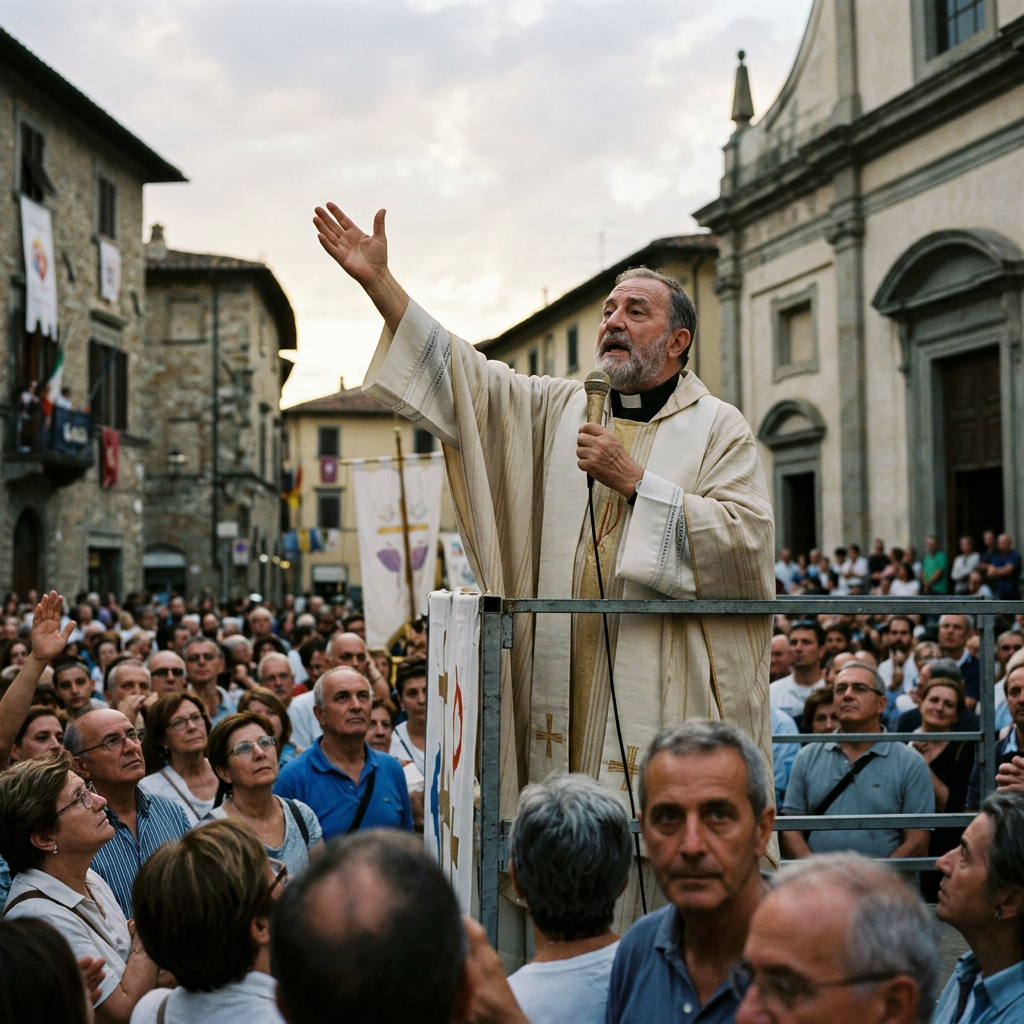
This is the fatal flaw. The claim to speak for God is the ultimate abdication of personal accountability. When human beings claim divine authority, they place themselves beyond criticism, beyond question, beyond moral restraint. The hierarchy that forms around such claims—the priesthood, the clergy, the self-appointed guardians of divine will—becomes an engine of control that inevitably turns toward violence.
II. The Pre-Westphalian Pattern: Religious Wars as the Norm
For more than a century before the Peace of Westphalia in 1648, Europe was consumed by religious wars arising from the Protestant Reformations. The Thirty Years’ War (1618–1648), which the Peace of Westphalia finally concluded, was the last great religious war in Western Europe—a conflict that had “broken out as a result of confessional conflicts between Catholic and Protestant states” and “inflamed vast regions at the heart of Europe.”
The lesson of that era is clear: when religion becomes the justification for war, there is no limit to the violence. The theocratic impulse—the claim that God is on your side and that your enemies are God’s enemies—creates a permission structure for atrocity. As one scholar notes, the pre-Westphalian era was “riven by murderous ideological divisions” that produced wars fought not for faith alone, but for dominance.
The Peace of Westphalia introduced the radical idea that peace was more important than religious unity. It was a turning point—but not an endpoint. The theocratic impulse did not disappear. It merely found new forms.
III. The Jewish Bund: Human Rights, Democracy, and Universalism
In 1897, the same year that Theodor Herzl convened the First Zionist Congress, another Jewish movement was born in Tsarist Russia: the General Jewish Labour Bund.
The Bund was “a secular, socialist, defiantly Jewish, and uncompromisingly anti-Zionist revolutionary party.” Its members were “young Jewish Marxists who wanted to overthrow the tsar and establish democratic socialism, but also to liberate their own people.”
The Bund’s political project was built on:
· Do’ikayt (“here-ness”) — the principle that Jews should build viable communities wherever they lived, rather than seeking an ethnostate in Palestine.
· Internationalism — the belief that Jewish liberation was inseparable from the liberation of all peoples.
· Universal human rights — the demand for “equal civil and political rights for the Jews in Russia” and for all oppressed peoples.
· Anti-Zionism — the rejection of the idea that Jewish identity required a state of its own. The Bundists “fought for dignity and equality, not in an imagined homeland in Palestine but ‘here where we live.'”
As Bundist leader Henryk Erlich presciently warned in 1938: “Zionism, in point of fact, has always been a Siamese twin of antisemitism. … The Zionists regard themselves as second-class citizens in Poland. Their aim is to be first-class citizens in Palestine and to make the Arabs second-class citizens.”
The Bund was “deeply committed to universal humanist values and to socialist politics.” It rejected “all ethnonationalism, including Zionism” and believed that “Jewish national problems arising within the countries where Jews reside can be solved on the basis of freedom and democracy.”
This was the alternative to theocracy: not divine rule, but human rights. Not exclusivity, but solidarity. Not conquest, but coexistence.
IV. Jabotinsky and Revisionist Zionism: The Theocratic Turn
Vladimir Jabotinsky, the founder of Revisionist Zionism, represented a fundamentally different vision. He advocated a “revision” of practical Zionism in favour of “political Zionism”—the idea that Zionism was essentially a political movement, not a cultural or spiritual one.
Jabotinsky’s ideology was built on:
· Exclusivism — the belief that Jewish national identity must take precedence over all other considerations.
· State sovereignty — the conviction that only a Jewish state could solve the “Jewish problem.”
· Ethnonationalism — the elevation of Jewish national identity above universal human values.
By the late 1930s, Revisionist Zionism had become “a right-wing tendency” with branches that included the Irgun, which conducted campaigns of violence against British authorities in Palestine. After World War II, Revisionist ideology evolved into the political and religious movements that now dominate Israeli politics.
In 2018, the Israeli Knesset passed the “nation-state law,” which codified “Jewish supremacy” into law and “effectively mirror[ed] the Nazi-era legislation of ethnoreligious stratification of German citizenry.” As one analysis notes, the law stipulates that “actualisation of the right of national self-determination in the state of Israel is unique to the Jewish people“—meaning that the 1.7 million Palestinian citizens of Israel are “without sovereignty or agency, forever living at the mercy of Israeli Jews.”
The theocratic impulse had found its modern expression: not a priesthood ruling in God’s name, but an ethnostate ruling in the name of a chosen people.
V. The Modern Manifestation: Gaza and the Theology of Extermination
The invocation of divine mandate has been central to Israel’s conduct in Gaza. In a speech on March 2, 2026, Israeli Prime Minister Benjamin Netanyahu declared: “In this week’s Torah portion, we read ‘Remember what Amalek did to you.’ We remember and we act.”
This reference to Amalek—the Biblical nation that God commanded King Saul to “destroy all they have, and do not let them live. Kill both man and woman, child and baby“—has become “an oft-used phrase at the highest levels of Israel’s government, a dog whistle well understood to call for the extermination of the Palestinians.”
UN institutions, international and Israeli human rights NGOs, and scholars of genocide studies have “classified the wide use of the Amalek rhetoric across Israeli politics and the military as a clear incitement to genocide.” Netanyahu’s invocation of Amalek was “explicitly cited as direct incitement to genocide.”
In June 2026, a UN Independent International Commission of Inquiry concluded that “Israeli authorities and security forces have deliberately targeted Palestinian children, resulting in genocide, crimes against humanity and war crimes in the Gaza Strip.” The commission found that the “intense scale and systematic nature of the Israeli military operations have continued, causing unprecedented death, injury and trauma to Palestinian children.”
The theocratic claim—the assertion of divine mandate—has become the justification for atrocity. As one report notes, “Wipe out the memory of Amalek” has become a rallying cry for those who seek the extermination of the Palestinian people.
VI. The Two Threads: Universalism vs. Exclusivism
The divergence between the Bund and Revisionist Zionism represents two fundamentally different visions of Jewish identity:
The Bund (Universalism) Revisionist Zionism (Exclusivism)
Human rights for all Rights for Jews only
Democracy and socialism Ethnostate and supremacy
Coexistence where you live Conquest of Palestine
International solidarity National chauvinism
Anti-Zionist Zionist
As Molly Crabapple’s recent history of the Bund documents, “Bundists themselves foresaw the inevitable inversion of victim and perpetrator demanded by Zionist ideology.” The Bund’s philosophy of do’ikayt—”here-ness“—offered a vision of Jewish life that did not require the dispossession of another people.
Today, those who place “human values, human rights and universalities above themselves”—the heirs of the Bund’s internationalist tradition—face threats not only from the Israeli far-right but also from figures like Donald Trump, who has embraced the same ethnonationalist rhetoric that fuels theocracy.
VII. The Pattern: How Theocracy Becomes Killing
The pattern is consistent across history:
1. A claim to divine authority — human beings assert that they speak for God.
2. The creation of hierarchy — a priesthood or ruling class that interprets divine will.
3. The denial of accountability — those who claim divine authority place themselves beyond criticism.
4. The dehumanization of the “other” — those who are not part of the chosen community are cast as enemies of God.
5. The justification of violence — killing in the name of God becomes not only permissible, but sacred.
This pattern is visible in the pre-Westphalian religious wars of Europe, in the Nazi regime, and in the modern State of Israel. As one commentator notes, “the genocidal ideology the fans espouse” is rooted in “extremist religious nationalism, and the concentration of executive power.”
The claim to divine authority is always a mask for human power. The theocracy is always a hierarchy. And the hierarchy always protects itself—even at the cost of genocide.
VIII. Conclusion: The Choice Before Us
The theocratic impulse—the claim to speak for God—is the oldest and most persistent engine of human violence. It allows the powerful to place themselves beyond accountability. It allows the hierarchy to claim divine sanction for its crimes. It allows the killers to believe they are doing God’s work.
But there is another way.
The Bund offered it: a vision of Jewish identity rooted in universal human rights, democratic socialism, and international solidarity. A vision that rejected ethnonationalism and embraced do’ikayt—the commitment to build a just society wherever one lives.
That vision was nearly destroyed by the Holocaust and by Stalinism. But it survives—in the memory of those who fought for it, and in the example of those who continue to resist the theocratic impulse.
The choice is clear. We can continue to worship the theocracy—to bow before those who claim divine authority and commit atrocity in God’s name. Or we can choose the Bund’s path: human rights, democracy, and the recognition that no one speaks for God.
Theocracies are not built by the devout. They are built by the powerful, who use God’s name to mask their own ambitions. And they always, always lead to killing.
Andrew Klein
References
1. Theocracy. Wikipedia.
2. Theocracy. Catholic Encyclopedia.
3. Peace of Westphalia. World History Encyclopedia.
4. The Enduring Lessons of the Jewish Bund. The Nation, 10 April 2026.
5. ‘For leftist Jews, the Bund is a model’. The Guardian, 7 April 2026.
6. Revisionist Zionism. Wikipedia.
7. Israel Is Using Its Genocidal Gaza Playbook on Iran. The Nation, 6 March 2026.
8. Israel’s ‘nation-state law’ parallels the Nazi Nuremberg Laws. Al Jazeera, 26 July 2018.
9. UN commission: Israel continues to commit genocide by targeting children. UN News, 23 June 2026.
10. ‘Blot Out the Memory of Amalek from Under Heaven’. De Gruyter Brill, 2025.
11. General Jewish Labour Bund. Wikipedia.
12. Bundism. National Library Board Singapore.

