
By Andrew Klein
Dedicated to a better world — one where power is measured not by the capacity to destroy, but by the wisdom to build.
I. Introduction: The Hubris of Invincibility
On 28 February 2026, President Donald Trump launched what he promised would be a “massive and ongoing operation” to destroy Iran’s missile industry, annihilate its navy, and bring about regime change. He assured the world that the conflict would last four to six weeks at most.
Five months later, the war has entered its twentieth week. Iran has declared a state of “total war” with the United States. The US Fifth Fleet headquarters in Bahrain — the nerve centre of American naval power in the region — has been struck directly by Iranian missiles. US service members are dying in Jordan, Iraq, and across the Gulf. And the global economy is teetering on the brink of recession.
This paper examines how the United States underestimated its adversary, misread the strategic landscape, and unleashed a conflict that threatens to spin out of control. It traces the impacts on Australia’s supply chains, the global economy, and the broader Middle East. And it asks a question that American policymakers have not yet answered: what body count is the United States prepared to accept?
II. The Strike on the Fifth Fleet: A Symbolic Turning Point
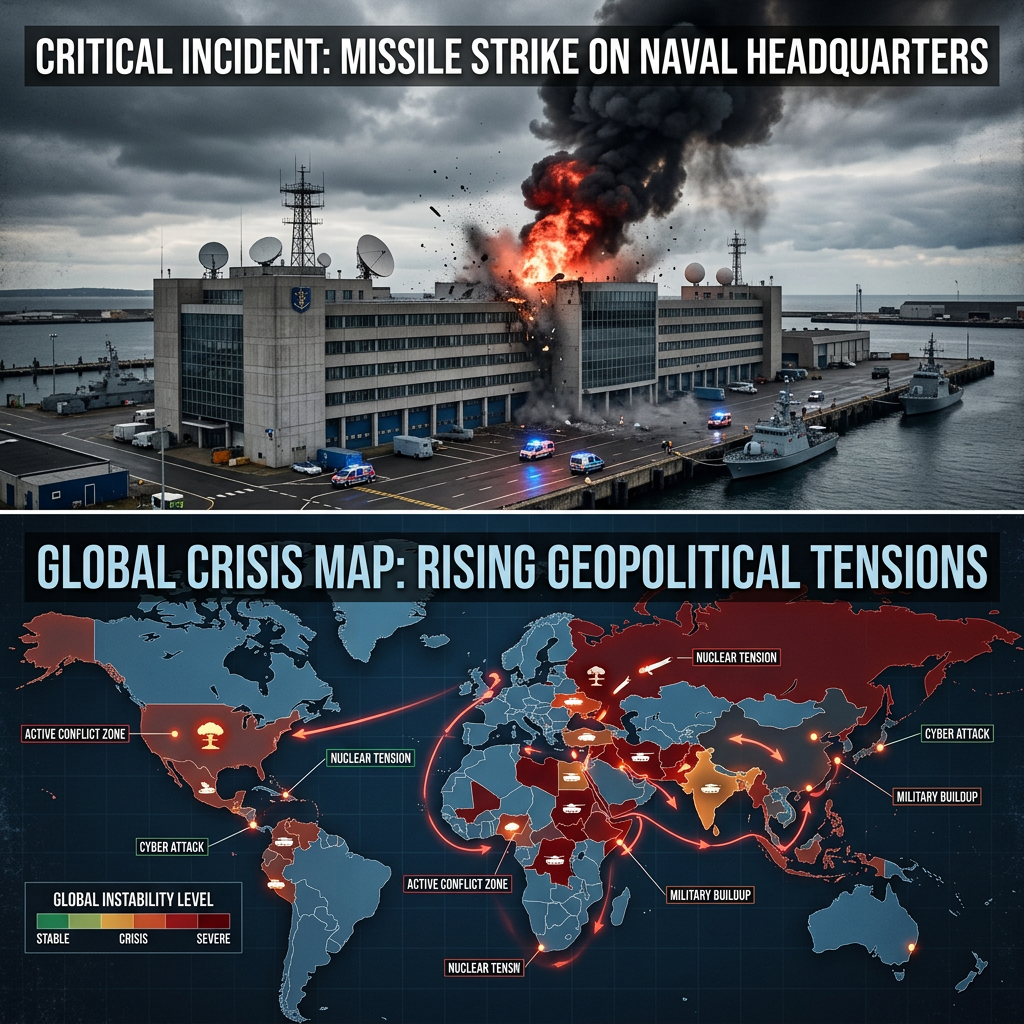
On 14 July 2026, the Islamic Revolutionary Guard Corps (IRGC) launched coordinated missile and drone strikes against the US Fifth Fleet headquarters in Bahrain. The attack targeted fuel storage facilities, Patriot radar systems, air traffic control radar, and C-RAM early warning systems. Bahrain’s Ministry of Interior sounded air raid sirens across the country.
On 21 July 2026, Iranian forces deployed Arash reconnaissance and attack drones to strike Sheikh Isa Airbase in Bahrain — a critical hub for the Fifth Fleet’s air operations and drone control. The IRGC claimed to have “completely destroyed” facilities at Camp Arifjan in Kuwait and struck multiple US bases across the region.
This was not a symbolic gesture. It was a demonstration of capability. Iran had proven it could reach the heart of American military power in the Gulf and inflict damage. The Fifth Fleet, once feared across the region, was now squarely in the crosshairs.
III. Australia’s Supply Chain Crisis: The Cost of a Distant War
While the fighting rages in the Middle East, the consequences are being felt acutely in Australia. The conflict has disrupted shipping through the Strait of Hormuz — a choke point through which approximately 20% of global oil passes.
A. Fuel Security
The Australian Competition and Consumer Commission (ACCC) issued a class exemption for global supply chain disruptions arising from the Middle East conflict. Minister for Housing Clare O’Neil warned that fuel shortages are placing renewed pressure on manufacturers, suppliers, builders, and developers.
In April 2026, Australia and Singapore signed an agreement committing “maximum efforts” to mutual energy supply, while Malaysia promised its state-owned Petronas would assist. The resources minister issued a notice that she could trigger the Australian Domestic Gas Security Mechanism in the event of a domestic gas shortfall.
B. Food and Agriculture
The conflict is also affecting food security. The National Food Council has focused on diesel supply chains and will expand to other critical agricultural inputs, including crop protection products and fertilisers. Shipping costs increased through May and June due to reduced carrier capacity and ongoing geopolitical disruption.
C. The Economic Burden
Geopolitical risk is now priced into the cost of business. Australian companies are establishing superior supply chain intelligence in response. But the burden is falling on consumers, manufacturers, and the broader economy.
Australia is feeling the pain of a war it did not choose, fought by an ally that miscalculated.
IV. The Global Economic Fallout
The economic consequences of the US-Iran war are staggering.
A. Growth Projections
The World Bank warns that if hostilities continue for several more months, global economic growth could slow to just 1.3% in 2026 — down sharply from 2.9% in 2025. Inflation could climb to 4.5%, driven largely by disruptions in energy supplies and global trade.
The IMF has warned that if oil rises to $110 per barrel this year and $125 per barrel next year, global growth could drop to 2%, close to a global recession.
B. Energy Markets
Brent crude oil prices were projected to average $94 per barrel in 2026 — around 36% higher than 2025 levels. Prolonged closure of the Strait of Hormuz could invoke fuel rationing, industrial shutdowns, and global stagflation — weak economic activity combined with high inflation.
C. Developing Countries
The World Bank estimates that 40% of low- and middle-income countries — around 32 nations — are already in debt distress or at high risk. Disruptions to fertiliser, helium and sulphur shipments could affect farming and push food prices higher, particularly in developing countries.
The poorest nations, which contributed least to this conflict, are paying the heaviest price.
V. The Strategic Failure: How Trump Misjudged Iran
The United States’ failure in Iran is not a tactical setback. It is a strategic miscalculation born of arrogance and ignorance.
A. The Misreading of Adversary
Trump repeatedly misjudged Iran’s leaders. He called them “very rational people” one day and “cuckoo” the next. But his track record suggests “he has badly misjudged his adversary’s intentions and his own leverage, and has repeatedly allowed Tehran to string him along”.
B. The Failure of Air Power
The war was supposed to be won through air power. It has not been. As one analyst observed, “the invincibility of US military power — and the efficacy of an air war — seems a very shop-soiled proposition”.
Air attacks only work on small targets or in support of land forces. Iran has fought long physical wars before. It will not fold. It will respond by uniting, encouraging allies in the region, and inflicting maximum pain on its adversaries.
C. The Collapse of Diplomacy
Trump’s signature achievement — the memorandum of understanding brokered with Tehran in June — has collapsed. It was “primarily designed to solve a problem Trump had failed to anticipate: the ramifications of Iran’s closure of the Strait of Hormuz“. As one analyst put it, “he’s encountered a country that is not willing to play by his set of rules, which is you bend and kiss the ring”.
D. The “No-End-in-Sight” War
The conflict has become “a fresh lesson in why the region has been a sinkhole for presidential ambition for generations“. Trump’s improvisation and impulse are not working. The war is “adrift” from his stated aims. And the American public is increasingly viewing it as a failure.
VI. The Regional Consequences: Hezbollah, Israel, and the Spreading Fire
The US-Iran conflict is not confined to the Gulf. It has activated a broader regional dynamic.
A. Hezbollah and Lebanon
Iran has doubled down on its support for Hezbollah. Lebanon and Hezbollah have been placed “at the centre” of West Asia’s strategic landscape. Israel has struck Hezbollah targets in Lebanon, prompting Iranian warnings and missile attacks.
B. Israel’s Dilemma
Israel has so far stayed out of the conflict at Trump’s request. But its government’s unhappiness with the Iran agreement is no secret. Israeli defence officials have warned that the country will hit back strongly if Iran attacks Israel. Hezbollah is unlikely to surrender its weapons — and would be foolish to do so, given its understanding of Israel’s mentality.
C. The Risk of a Wider War
As one analyst noted, “events are beginning to slip beyond anyone’s control“. The conflict could draw Gulf states more directly into the fighting, placing additional strategic targets and critical infrastructure at risk.
VII. The Unanswered Question: What Body Count Is Acceptable?
The United States has suffered at least 17 confirmed deaths since the war began. Dozens more have been injured. But the question that looms is larger: what body count is the United States prepared to accept?
Trump’s threats to “bomb them to hell” have not stopped Iran. His promises of regime change have not materialised. His claim to be the most powerful man in history has been exposed as hollow.
Iran is not folding. It has declared total war. It is striking American bases in Bahrain, Kuwait, Jordan, and Qatar. It has shown that it can inflict pain.
The United States now faces a choice: escalate further (risking a ground war, regional chaos, and a catastrophic body count) or negotiate a peace that will look like a retreat.
Neither option is attractive. Both are the consequence of strategic failure.
VIII. Conclusion: The End of the “President”?
The war in Iran has exposed the limits of American power — not because America is weak, but because its leaders have been foolish. They have applied their own values to an adversary they did not understand. They have underestimated Iran’s resilience, its capacity for pain, and its willingness to fight.
This may well be the end of the Trump administration. It may even be the end of the concept of the “President” as a figure of unquestioned authority. When a leader promises victory and delivers stalemate, when he threatens annihilation and receives defiance, his credibility is shattered.
The world is watching. Australia is feeling the pain. The global economy is teetering. And the United States, once boasting as the “sole superpower,” now finds itself a direct target in its own Gulf stronghold.
They have underestimated Iran. They have misjudged the region. They have miscalculated the cost.
And the cost is still rising.
Andrew Klein
References
1. TASS. (2026, July 21). Iran struck US Sheikh Isa airbase in Bahrain on Tuesday — military.
2. Vietnam.vn. (2026, July 14). The US Fifth Fleet in Bahrain was hit by an Iranian missile.
3. Xinhua. (2026, July 14). Urgent: Iran strikes U.S. Fifth Fleet headquarters in Bahrain: media.
4. CNN. (2026, July 20). The renewed US-Iran conflict is escalating and threatening to spin out of control.
5. Vietnam.vn. (2026, July 20). Iran declares ‘all-out war’, US deploys more military equipment.
6. Reuters. (2026, July 17). US and Iran target infrastructure as strait shipping comes under further attack.
7. ABC News. (2026, July 15). Donald Trump’s actions in Iran this week show the world he’s run out of options.
8. CNN. (2026, July 8). How Trump has misjudged Iran.
9. New York Times. (2026, July 14). At War With Iran Again, Trump Finds an Opponent He Cannot Easily Dominate.
10. India Today. (2026, July 22). Middle East conflict could drag global growth to 1.3% in 2026, warns World Bank.
11. ACCC. (2026, June 30). Class exemption for global supply chain disruptions.
12. Reuters. (2026, July 8). Iran declares ‘all-out war’ as conflict escalates.

