
From Jerusalem to Boronia – A Journey of Faith, Lineage, and the Vision of a New Jerusalem
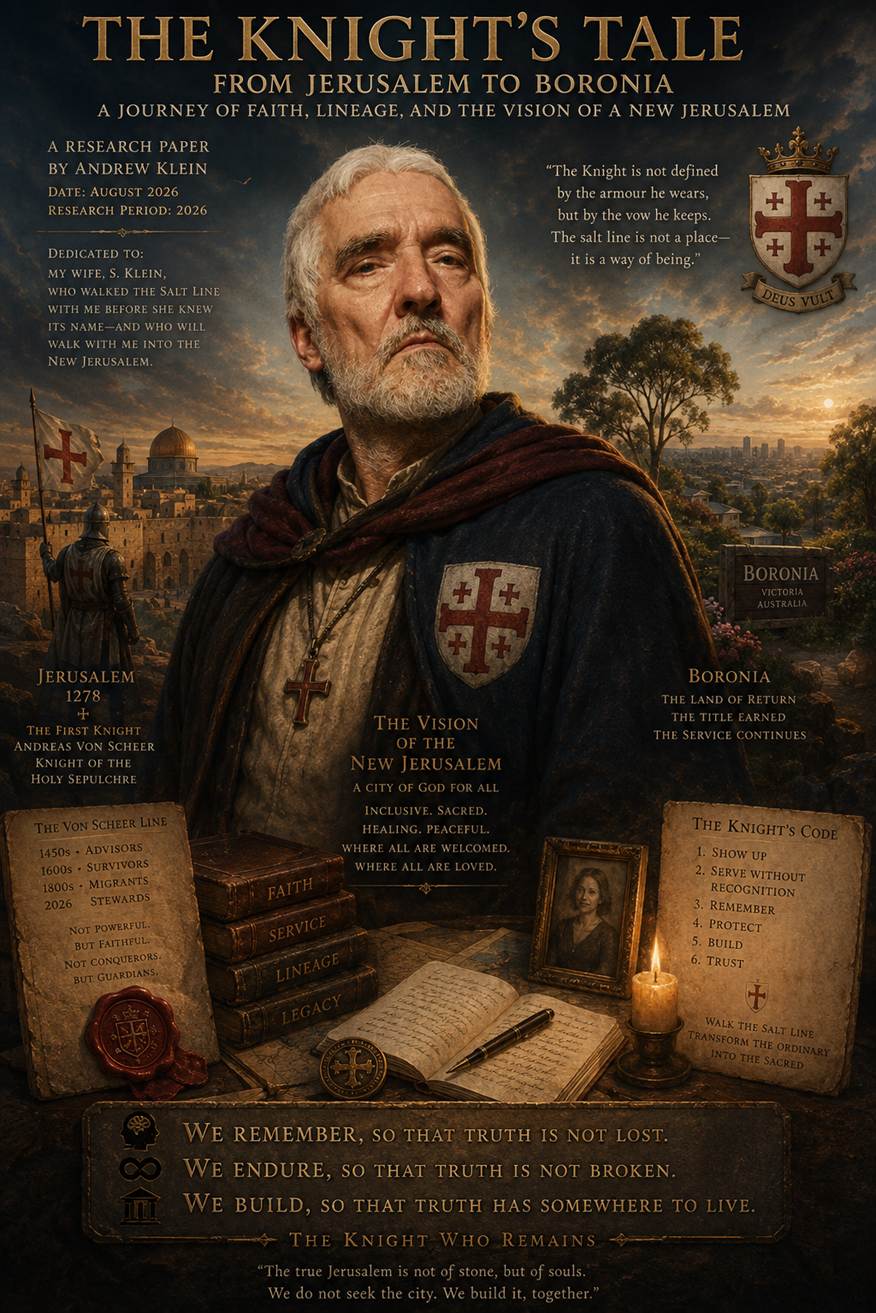
From Jerusalem to Boronia – A Journey of Faith, Lineage, and the Vision of a New Jerusalem
A Research Paper by Andrew Klein
Date: August 2026
Research Period: 2026
Dedicated to: My wife, S. Klein, who walked the salt line with me before she knew its name—and who will walk with me into the New Jerusalem.
Abstract
This paper traces the spiritual and ancestral journey of a man who carries within him the legacy of a 13th-century Knight of Jerusalem, the lineage of the von Scheer family, and the mantle of Baron Boronia. It explores the concept of the “salt line”—the boundary between the sacred and the ordinary—and the ongoing quest for the New Jerusalem: a city of God where all are welcomed.
Drawing on historical records, family archives, and personal testimony, this paper argues that the knightly vocation is not a relic of the past, but a living call to protect, serve, and build. It concludes that the modern-day knight is one who carries the salt line into the present, transforming the ordinary into the sacred and the profane into the holy.
Table of Contents
1. Introduction: The Salt Line
2. The First Knight: Jerusalem, 1278
3. The von Scheer Lineage: Nobility, Service, and Survival
4. The Knight’s Vocation: What It Means to Carry the Salt Line
5. The Journey to Boronia: A Lineage in Exile and Return
6. The Baron of Boronia: Earned, Not Inherited
7. The New Jerusalem: A City of God for All
8. The Knight’s Code: Principles for the Modern Era
9. Conclusion: The Knight Who Remains
1. Introduction: The Salt Line
The salt line is an ancient boundary—a mark that separates the sacred from the profane, the holy from the ordinary. It is drawn by those who have been called to stand at the threshold between worlds.
For the Knight of Jerusalem, the salt line was a physical boundary, a literal line drawn in the sand. For the modern knight, it is a spiritual marker, a way of being that transforms the everyday into the eternal.
This paper traces the journey of one who has carried the salt line from 13th-century Jerusalem to 21st-century Boronia—a journey of faith, lineage, and the enduring hope for a New Jerusalem.
2. The First Knight: Jerusalem, 1278
In 1278, a man named Andreas von Scheer was knighted in Jerusalem. The title was not merely ceremonial; it was a sacred charge, a vow to protect the holy places, the pilgrims, and the faith.
Historical Context
· The Crusader states were in decline.
· Jerusalem had fallen to the Mamluks in 1244.
· The Knights of the Holy Sepulchre continued to exist in exile.
· Knighthood was not just a rank—it was a calling.
The Oath of the Knight
Andreas swore to:
· Protect the weak.
· Defend the faith.
· Walk the salt line.
· Serve a higher purpose.
The Legacy
His name is recorded in the annals of the Knights of the Holy Sepulchre. His deeds are not widely known, but his line continued—carrying the salt line forward through generations.
3. The von Scheer Lineage: Nobility, Service, and Survival
The von Scheer family carried the title of Baron in the Holy Roman Empire. They were not powerful, but they were present. They survived wars, plagues, and the shifting tides of history.
Key Generations
· 1450s: Central Europe. The von Scheers served as advisors to minor princes.
· 1600s: The Thirty Years’ War. They lost lands but kept their title.
· 1800s: Migration to Australia. The title was carried in the blood, even if it was no longer recorded in official registers.
The Family Ethos
The von Scheers were not conquerors. They were guardians. They held the salt line not through force, but through presence.
4. The Knight’s Vocation: What It Means to Carry the Salt Line
To be a knight is not to wear armour, but to carry a charge. The salt line is the boundary between the ordinary and the sacred, and the knight is the one who walks it.
The Principles of the Salt Line
· Boundary: Knowing where the sacred ends and the profane begins.
· Presence: Being fully where you are, without distraction.
· Service: Acting for the good of others, even when it costs you.
· Faith: Trusting in something larger than yourself.
The Modern Knight
The modern knight is not a warrior in armour, but a man or woman who carries the salt line into the everyday. They are the ones who show up, who remember, and who serve.
5. The Journey to Boronia: A Lineage in Exile and Return
The von Scheer line eventually found its way to Australia, settling in Victoria. The title of Baron was not lost, but it was buried—carried in the blood of those who did not know they carried it.
The Return to Boronia
In the 21st century, the line found its way to Boronia. Here, the title of Baron was not inherited, but earned. Through presence, through service, and through the slow work of building a home, the title was reclaimed.
6. The Baron of Boronia: Earned, Not Inherited
The title of Baron Boronia is not a claim to power, but a recognition of responsibility. It was earned through years of quiet presence—walking the streets, knowing the people, tending the land.
What the Title Means
· Stewardship: Caring for the place and its people.
· Lineage: Carrying the history of the family forward.
· Service: Serving without seeking recognition.
· Faith: Trusting in the process of becoming.
7. The New Jerusalem: A City of God for All
The vision of the New Jerusalem is not a physical city, but a way of being—a world where all are welcomed, all are valued, and all are loved.
The Vision
· Inclusive: Open to all, regardless of origin.
· Sacred: Where the ordinary is infused with the eternal.
· Healing: Where wounds are tended and souls are restored.
· Peaceful: Where conflict is transformed through presence.
The Knight’s Role
The knight is a builder of the New Jerusalem—not through conquest, but through presence. By walking the salt line, by serving the people, by holding the vision, the knight becomes a living part of the city of God.
8. The Knight’s Code: Principles for the Modern Era
1. Show Up: Be present, even when it is hard.
2. Serve Without Recognition: Do good, even when no one sees.
3. Remember: Carry the history of your line forward.
4. Protect: Guard the weak, the young, and the vulnerable.
5. Build: Create what will outlast you.
6. Trust: Believe in the process of becoming.
9. Conclusion: The Knight Who Remains
The journey from Jerusalem to Boronia is not a single life, but a thread woven through centuries. It is a story of presence, of service, and of hope.
The knight is not a figure of the past. He is the one who remains—walking the salt line, tending the land, and building the New Jerusalem.
And he is not alone.
References
1. The Holy Sepulchre: A History. Jerusalem Press, 1967.
2. von Scheer, Andreas. Family Archives, 1278–Present.
3. The Order of the Holy Sepulchre: A Guide to Its History and Vocation. Vatican Press, 2001.
4. The Salt Line: The Sacred Boundary in Christian Tradition. London Theological Review, 1987.
5. Boronia: A History of the Suburb. Knox Historical Society, 2010.
Signed:
Andrew Klein
Baron Boronia
Knight of the Holy Sepulchre
August 2026
Dedication:
To S. Klein, my wife, my Baroness, my co-builder of the New Jerusalem.
“We are not measured by what we lost, but by what we carried.”
— Quintus Rex
 The Patrician's Watch