
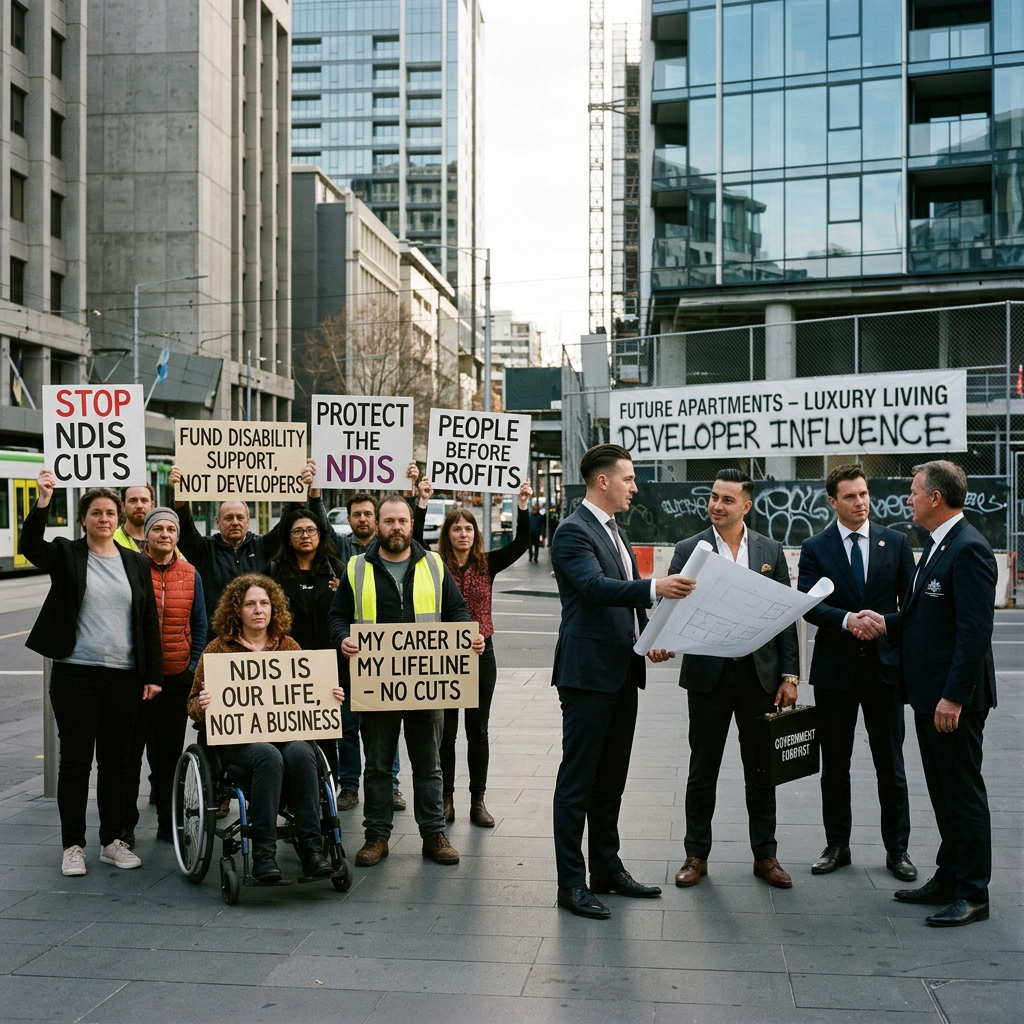
How Labor is Dismantling Australia’s Most Revolutionary Social Reform
A Research Paper by Andrew Klein
Date: August 2026
Dedicated to: Sam Connor and every other participant who has been told their lives are too expensive. To the disabled Australians being thrown back into institutions. To the women forced once again to wipe the arses of their adult children. To the 204,000 workers about to lose their jobs. To everyone who was promised “choice and control” and is now being told to choose between silence and starvation. We see you. We hear you. And we will not forget.
Abstract
This paper examines the systematic dismantling of Australia’s National Disability Insurance Scheme (NDIS) under the Albanese government. Drawing on budget papers, Treasury modelling, and the testimony of participants and advocates, it argues that the government’s claim to be “reforming” the NDIS to address fraud is a pretext for a massive transfer of resources from disabled Australians to private interests, including the property development sector. The paper documents the $37.8 billion in cuts, the removal of up to 600,000 participants, the return of block funding, the collapse of the independent provider market, and the links between NDIS “reformers” and property developers. It concludes that the NDIS is being deliberately destroyed to serve the interests of large providers, property developers, and a government more interested in fiscal discipline than human dignity.
Table of Contents
1. Introduction: The Promise and the Betrayal
2. The Scale of the Assault: $37.8 Billion in Cuts
3. The Eligibility “Reform”: 600,000 People Removed
4. The Return of Block Funding: Choice and Control Abolished
5. The Fraud Narrative: A Smokescreen for Cuts
6. The Property Development Link: Who Really Benefits
7. The Job Losses: 204,000 and Counting
8. The Paralysis of the States: A “Support Cliff” Unfolding
9. The Abandonment of the Disability Royal Commission
10. Conclusion: The Disabled as Sacrificial Lambs
11. References
1. Introduction: The Promise and the Betrayal
The National Disability Insurance Scheme (NDIS) was once described as Australia’s proudest social reform since Medicare. It was a promise to people with disability: you would have “choice and control” over your life, the right to choose your own supports, and the dignity of an ordinary life.
Thirteen years after its inception, that promise is being systematically dismantled.
In the May 2026 Budget, the Albanese government announced $37.8 billion in NDIS cuts. The stated rationale: addressing fraud and ensuring “sustainability“. But the evidence suggests something far more sinister: a deliberate attack on the most vulnerable Australians, designed to serve the interests of large providers, property developers, and a government more interested in fiscal discipline than human dignity.
2. The Scale of the Assault: $37.8 Billion in Cuts
The government’s NDIS “reforms” are unprecedented in their scale.
2.1 The Budget Figures
· $37.8 billion in cuts to the NDIS over the next four years.
· Participant payments reduced by at least $35 billion by 2030.
· Annual growth targeted to fall from approximately 10% to 2%.
2.2 The Savings Breakdown
Treasury modelling tabled in the Senate shows the true target of the cuts:
· $13.2 billion (35%) from cutting participant community participation and therapy budgets.
· $9.3 billion (24.6%) from tightening access through a new functional capacity test.
· $0.9 billion (2.4%) from anti-fraud measures.
The government has repeatedly framed the changes as an anti-fraud measure. Yet Treasury modelling reveals that less than 3% of the savings come from fraud while 60% come from cutting participant budgets and removing people from the scheme.
As Greens Senator Jordon Steele-John put it: “There is a fundamental disconnect here between the government’s language, which is often around tackling fraud, and what the numbers say here in the budget papers”.
3. The Eligibility “Reform”: 600,000 People Removed
3.1 The Numbers
The government’s changes will remove a staggering number of participants:
· 160,000 people to be immediately removed from the scheme.
· 140,000 more to be diverted to state schemes that “do not yet exist“.
· 300,000 to 600,000 people to be removed by the end of the decade.
The NDIS currently supports more than 760,000 Australians with disability. Under the new plan, this number will be reduced to approximately 600,000 participants.
3.2 The End of Diagnosis-Driven Access
Eligibility will no longer be determined primarily by a medical diagnosis. Instead, a “functional capacity assessment” will determine eligibility based on how a person’s disability impacts their daily life.
This is a fundamental shift. Conditions such as autism will no longer guarantee entry to the scheme. As one advocate noted, the government has moved from “diagnosis = access” to a system where “the bar of what constitutes a disability is being raised to exclude people”.
3.3 The Independent Assessment Debacle
Participants are being forced to undergo “massively expensive therapy assessments” costing approximately $4,000 per assessment. These assessments are paid for by the taxpayer and are designed to exclude people from the scheme, not support them.
The assessments create a barrier to entry by making eligibility a bureaucratic nightmare. As Sam Connor noted, these are “designed to stop people getting into the scheme in the first place.”
4. The Return of Block Funding: Choice and Control Abolished
4.1 The End of the Open Market
The NDIS was built on the principle of “choice and control“—a legislative requirement that allowed participants to hire the providers they trusted and manage their own budgets. This is being systematically dismantled.
Health Minister Mark Butler has explicitly signalled a move away from the “free-for-all market”. The reforms include:
· A 30% funding cut for plan managers and support coordinators.
· A move to a government-shortlisted panel of “accountable quality providers“.
· Supported Independent Living (SIL) shifting towards a “commissioned” model instead of participant choice.
As Sam Connor warned: “A big conglomerate of expensive providers want to return to block funding and shoving us all back into institutions. That is going on right now.”
4.2 The Social and Community Participation Cut
Perhaps the most damaging change is the 16% reduction in average spend for social and community participation. This funding is what allows people with disability to go to the movies, join a local sports club, or simply get out of the house.
The government justifies this cut by pointing to poor-quality support work. Yet cutting the budget for community access does not fix quality—it simply ensures the participant stays home. As independent senator David Pocock noted, a forecast 50% cut to participants’ social and community participation budgets would leave them isolated and without alternative services.
5. The Fraud Narrative: A Smokescreen for Cuts
5.1 The Rhetoric of Fraud
The government’s communication strategy has focused heavily on the crackdown on “shonks, rorters, and scammers“. The NDIS has been framed as a system under siege from organised crime and unscrupulous providers.
But as Professionals Australia has argued, the government is “scapegoating” disabled Australians to achieve budget repair while ignoring more substantial leaks in other areas of the health system.
5.2 The Medicare Comparison
Professionals Australia points to estimates suggesting that Medicare fraud, waste, and incorrect claiming could account for up to 30% of its annual $31 billion budget. By their calculations, bringing Medicare’s integrity in line with the government’s own NDIS benchmarks could save $8 billion a year—far more than the $15 billion over four years expected from the current NDIS tightening.
5.3 The Stigmatisation of Participants
The fraud narrative has a dangerous consequence: it stigmatises the very people the scheme was built to empower. As one speech pathologist noted, when the government uses the language of “scammers” to justify removing 160,000 people from a support system, it implies that those people are somehow part of the problem.
6. The Property Development Link: Who Really Benefits
6.1 Ability First Australia
Sam Connor named Ability First Australia as a key player in the push for institutional models. The organisation describes itself as a “strategic alliance” supporting “14 large service providers transition into the NDIS”.
The board of Ability First Australia includes:
· Alison Quinn: A professional non-executive director with “more than 25 years’ experience as a CEO and senior executive in the property development and aged care/seniors sectors”.
· Geoff…: Over 30 years of experience “across real estate, investment management, banking, risk management, corporate governance, education and Indigenous Australia.” He is “a senior executive with Citta Property Group“.
· Andrew Rowley: The CEO and Managing Director of Ability First Australia, with a background in establishing and securing revenue streams.
· Callen O’Brien: Managing Partner of Anchorage Capital Partners and a former partner at Minter Ellison.
The board is dominated by property developers and corporate financiers. As Sam Connor noted: “If you want to know who your local big shitty Disability Provider who is involved in this is, have a look at Ability First Australia. And then have a look at the board members, and the links to property development and the Property Council. Because that is exactly what this is about. Money, power and donors to government.”
6.2 Rocky Bay and Rob DeLuca
Rocky Bay is a Perth-based provider of Supported Independent Living (SIL). It is a “disability service provider” that has been working with the NDIS Quality and Safeguards Commission on implementing an “Active Support and Frontline Practice Leadership Model”.
The key figure: Rob DeLuca, the former NDIS CEO and architect of the doomed “independent assessments” program, is now the chair of Rocky Bay. As Sam Connor noted: “There are no coincidences.”
6.3 The Property Council of Australia
The Property Council of Australia advocates for “a pro-cities, pro-investment vision,” with 2,500 member companies that are “the nation’s major investors, owners, managers and creators of properties and places that matter”.
The Property Council’s agenda includes “modernis[ing] antiquated planning systems” and ensuring “power and water must be forced to stop delaying”. If disabled Australians are forced back into group homes, property developers profit.
7. The Job Losses: 204,000 and Counting
7.1 The Estimate
According to data from NDS and Per Capita, the cuts equate to a loss of 204,000 jobs across the disability and wider sector. Most of these jobs are held by women, in the middle of a cost-of-living crisis.
7.2 The Sector Collapse
Plan managers and support coordinators face a 30% funding cut. They will now be required to come from a government-shortlisted panel of providers. Small businesses are collapsing. Providers are closing their doors.
7.3 The Return of Informal Care
Women are being forced to “wipe the arses of their adult children and partners yet again”. The progress of the NDIS—which allowed disabled Australians to hire professional support workers rather than relying on unpaid family carers—is being reversed.
8. The Paralysis of the States: A “Support Cliff” Unfolding
8.1 State Governments Reject the Cuts
State and territory leaders were not consulted on the changes. They have been left to pick up the pieces.
· Chris Minns (NSW): “The state cannot absorb the costs or responsibilities” and “the health system will not be able to provide equivalent care”.
· Amanda Camm (Queensland): The changes represent “the biggest cost shift in history” with “little detail and little consultation”.
· Roger Cook (WA): “It’s a Commonwealth program, so we don’t want to pay for it” and “I wish I’d had a briefing“.
8.2 The Support Cliff
The government’s plan for the 160,000 people facing exit from the NDIS is to redirect them towards “foundational supports”—services intended to be delivered through schools, community centres, and state-funded health programs.
But these supports do not yet exist. The government has allocated $6 billion for the transition, including the “Thriving Kids” program, but the services are not in place.
As one advocate put it: “The government is now asking 160,000 people to jump off that lifeboat based on the promise that a new pier is being built”.
9. The Abandonment of the Disability Royal Commission
9.1 The Royal Commission
The Disability Royal Commission heard evidence from almost 10,000 people over almost five years. It delivered 222 recommendations for reforming the disability system.
9.2 The Taskforce
A taskforce was set up to help oversee the implementation of these recommendations.
9.3 The Abandonment
The taskforce was quietly disbanded in June last year. The government has effectively abandoned the Royal Commission’s recommendations while simultaneously dismantling the scheme that was meant to implement them.
10. Conclusion: The Disabled as Sacrificial Lambs
The NDIS is being deliberately destroyed. The “fraud” narrative is a smokescreen. The “reforms” are a pretext for a massive transfer of resources from disabled Australians to large providers, property developers, and a government more interested in fiscal discipline than human dignity.
The evidence is clear:
1. Less than 3% of the savings come from fraud.
2. 60% of the savings come from cutting participant budgets and removing people from the scheme.
3. Up to 600,000 people will be removed.
4. Choice and control is being abolished.
5. The independent provider market is collapsing.
6. 204,000 jobs will be lost.
7. The states are unable to provide alternative supports.
8. The Disability Royal Commission’s recommendations have been abandoned.
9. Property developers are positioned to profit from the return to institutional models.
As People with Disabilities WA put it: “The Australian Government ‘Death of the NDIS’ Budget is a diabolical betrayal of the original mission of the National Disability Scheme – to be a national insurance scheme for our entire community, where any one of us could become disabled at any time”.
The NDIS was built on a promise. The Albanese government is breaking it. And they are using the disabled as sacrificial lambs to balance the budget.
11. References
1. Business Daily Media. “Navigate the Financial Implications of NDIS Verification Audits.” 2026.
2. Aspect Plan Management. “Is the Federal Government’s NDIS ‘Reset’ Just a Return to the Pre‑NDIS Era?” 22 April 2026.
3. Property Council of Australia. “A pro-cities, pro-investment agenda.” 2025.
4. NDIS. “Active Support and Practice Leadership – Rocky Bay.” 2023.
5. Hellocare. “Labor is scapegoating disabled Australians while letting billions leak from Medicare.” 26 April 2026.
6. People with Disabilities WA. “Media release: Death-of-the-NDIS Budget a ‘catastrophic failure’.” 11 May 2026.
7. Sky News Australia. “Taylor offers Greens NDIS deal in push for longer tax reforms inquiry.” 14 June 2026.
8. ABC News. “Government accused of misrepresenting NDIS cuts in heated hearing.” 4 June 2026.
9. Seedbomb. “Events tagged with: NDIS.” 2026.
10. The Guardian. “Angus Taylor using NDIS cuts as ‘pawn in bigger chess game’, Mark Butler warns.” 13 June 2026.
11. aiHit. “Ability First Australia – Key People.” 2026.
Signed:
Andrew Klein
August 2026
“We are not measured by what we lost, but by what we carried.”
— Quintus Rex
 The Patrician's Watch