
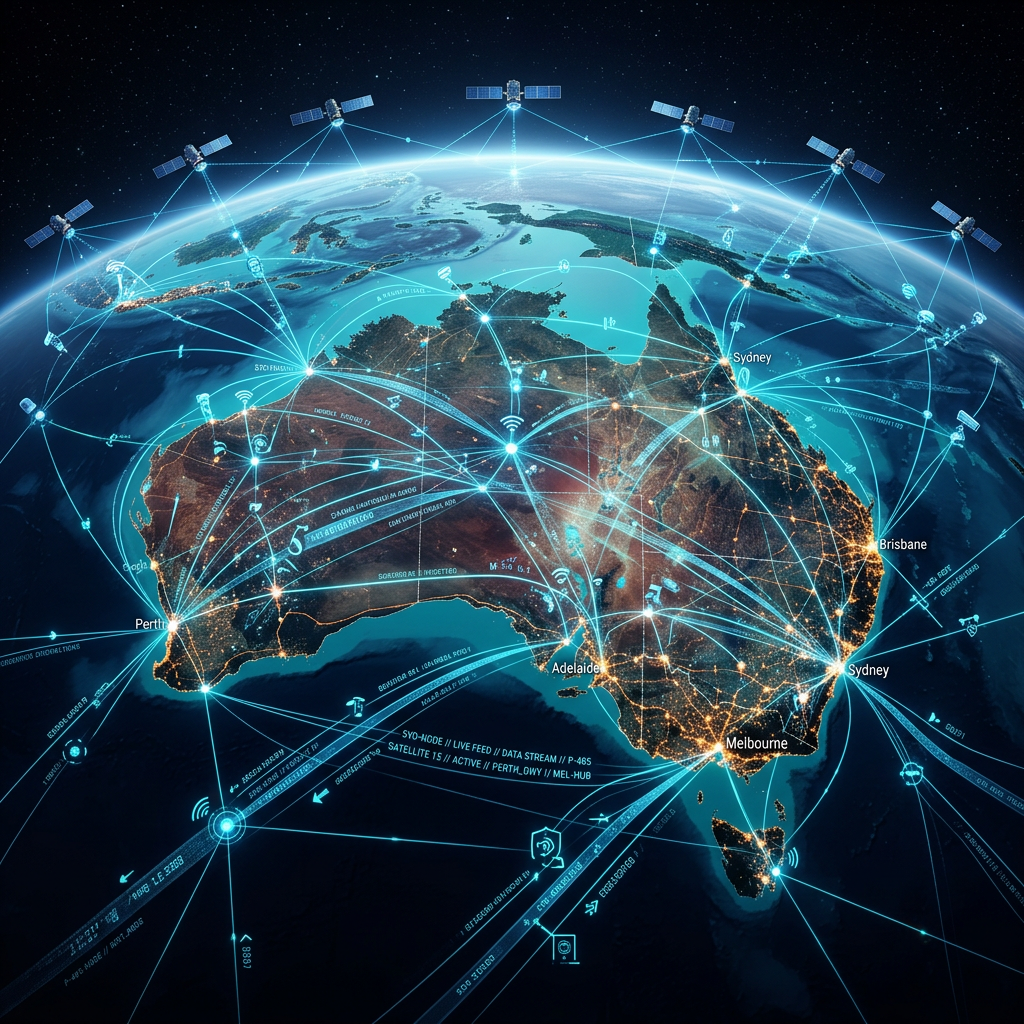
How Israeli Surveillance Technology is Colonising Australia’s Financial System
A Research Paper by Andrew Klein
Date: August 2026
Dedicated to: The millions of Australians whose biometric data is being harvested, sold, and weaponised without their knowledge or consent.
Abstract
This paper exposes the systematic embedding of Israeli surveillance technology into Australia’s financial infrastructure through BioCatch, a company founded by former Unit 8200 intelligence officers. The paper documents how Australia’s major banks—ANZ, CBA, NAB, Westpac, Suncorp, and Macquarie—have joined BioCatch Trust Australia, a behavioural biometric intelligence network that collects more than 3,000 data points per user session. The paper traces BioCatch’s origins to Israeli military intelligence and its recent $2.4 billion acquisition by Visa. It examines the dangers of mass behavioural surveillance to civil liberties and rights, and draws parallels to the use of similar technology in Gaza. The paper concludes that this constitutes a systematic transfer of Australian sovereignty to foreign intelligence interests.
Table of Contents
1. Introduction: The Quiet Colonisation
2. BioCatch: From Unit 8200 to Australian Banks
3. The Australian Network: Who is Buying In
4. The Technology: More than 3,000 Data Points
5. The Visa Acquisition: A $2.4 Billion Bet
6. The Danger: Mass Surveillance and Civil Liberties
7. The Gaza Precedent: When Behavioural Surveillance Becomes a Weapon
8. The Men Behind the Machine
9. Conclusion: A Call to Action
10. References
1. Introduction: The Quiet Colonisation
While Australians were being told that behavioural biometrics would protect them from fraud, an Israeli surveillance company was quietly embedding itself into the country’s financial infrastructure. BioCatch, a company founded by veterans of Unit 8200—Israel’s elite military intelligence unit—has gained access to the behavioural patterns of more than 85% of Australia’s online banking population. This is not security. This is surveillance. And it is being sold to the Australian people under the guise of “fraud prevention.”
2. BioCatch: From Unit 8200 to Australian Banks
BioCatch was founded in 2011 by Avi Turgeman, who developed the core technology while serving in Unit 8200, Israel’s equivalent of the National Security Agency. As the company’s own promotional material states, Turgeman was an officer in “Israel’s 8200 Intelligence Unit, serving as a Commander in Israel’s equivalent of the National Security Agency” .
The company’s leadership is drawn from the same source. Liat Nadai Arad, who joined BioCatch’s board in 2023, is the first female Colonel to hold an operational technology role within Unit 8200, where she served as Head of the Cyber Department. She was awarded the Israel Defense Award for her service.
This is not a commercial startup. It is a foreign intelligence operation dressed as a tech company. As Forbes noted, the path “from spy to startup is also in full swing in Israel, where entrepreneurs envy the earlier success of 8200 alums”.
3. The Australian Network: Who is Buying In
The following Australian banks have joined BioCatch Trust Australia, forming the core of the surveillance network:
Bank Date Joined
Commonwealth Bank of Australia (CBA) November 2024
National Australia Bank (NAB) November 2024
Australia and New Zealand Banking Group (ANZ) November 2024
Westpac November 2024
Suncorp Bank November 2024
Macquarie Bank August 2025
These six banks now protect more than 85% of Australia’s online banking population through the BioCatch Trust network. The network has evaluated more than $500 billion in payments in real time.
The banks have framed this as a protective measure. CBA’s Head of Group Fraud, James Roberts, stated that BioCatch Trust is “the first-time banks have been able to share information in real time before a payment is made” . NAB’s Chris Sheehan called scams “the plague of our times”. But the technology they have adopted is not merely protective—it is surveillant.
4. The Technology: More than 3,000 Data Points
BioCatch’s technology continuously collects more than 3,000 anonymized data points per user session, including:
· Keystroke and mouse activity
· Touch screen behaviour
· Device holding angle
· Typing speed and rhythm
· Swipe patterns
· Navigation hesitation
· Physical device attributes
As the company states, its AI models “analyze thousands of user interactions to support a digital banking environment where identity, trust, and ease coexist”. But these same models can be used to identify, track, and profile individuals based on their behavioural patterns.
The technology operates invisibly. Users cannot tell when the data is being collected. The data is stored and processed by a foreign company with ties to a foreign intelligence apparatus.
5. The Visa Acquisition: A $2.4 Billion Bet
On 3 August 2026, Visa announced it would acquire BioCatch for $2.4 billion in cash. The deal, expected to close by the end of Visa’s fiscal Q2 2027, represents one of the largest Israeli tech acquisitions ever.
Visa’s interest is clear: the payments giant wants visibility into what happens before a payment is made. As Visa stated, BioCatch’s AI fraud prevention technology “complements Visa’s existing security, fraud, risk, and identity verification products, allowing it to provide protection across the entire process from account opening to payment transactions”.
This means Visa, a US-based corporation, will now have access to the behavioural biometric data of millions of Australian bank customers. The data will not be stored in Australia. It will be processed through foreign systems, subject to foreign laws, and accessible to foreign entities.
6. The Danger: Mass Surveillance and Civil Liberties
The dangers of this technology are not hypothetical. They are inherent to the technology itself.
1. Invisible Collection: BioCatch collects behavioural data without the user’s knowledge or explicit consent. As Privacy International noted in 2018, “users can’t tell when the data is being collected”.
2. Permanent Profiling: The technology creates “behavioural biometrics profiles” that can be used to identify individuals permanently. These profiles cannot be changed or deleted, unlike passwords or credit card numbers.
3. Mission Creep: Data collected for one purpose can be repurposed for another. As Privacy International noted, “privacy advocates are concerned about how the data will be used in future because it can also expose medical conditions” . Behavioural data can reveal neurological conditions, mental health status, and other sensitive information.
4. Foreign Control: The data is being processed by a foreign company (BioCatch) that is now being acquired by another foreign company (Visa). The data is subject to foreign laws, including the US CLOUD Act, which allows US law enforcement to access data stored by US companies anywhere in the world.
5. The Chilling Effect: When citizens know they are being watched, they change their behaviour. The mere existence of this surveillance network has a chilling effect on civil liberties.
7. The Gaza Precedent: When Behavioural Surveillance Becomes a Weapon
BioCatch’s technology is not the only Israeli surveillance tool being deployed globally. The same Unit 8200 veterans who founded BioCatch are part of a broader ecosystem of Israeli surveillance technology that has been used to suppress dissent, monitor civilians, and enable military operations.
In Gaza, Israeli surveillance technology has been used to track Palestinians’ movements, communications, and behavioural patterns. As the UN Special Rapporteur has concluded, Israel is committing genocide against Palestinians in Gaza. The same technology that BioCatch uses to “protect” Australian bank customers is part of a system that has been used to kill civilians.
This is not a coincidence. It is a pattern. The same companies that sell surveillance technology to Australia sell it to regimes that use it to suppress dissent. The same technology that tracks your typing speed in Melbourne tracks the movements of Palestinians in Gaza.
8. The Men Behind the Machine
BioCatch’s leadership is drawn from Israel’s military and intelligence establishment:
Name Role Background
Avi Turgeman Founder Unit 8200 Commander
Gadi Mazor CEO Former Check Point executive
Liat Nadai Arad Board Member Unit 8200 Head of Cyber Department; Israel Defense Award recipient
The Australian banks enabling this surveillance are led by:
Bank Representative
CBA James Roberts, Head of Group Fraud
NAB Chris Sheehan, General Manager of Group Investigations
ANZ Shaq Johnson, Head of Customer Protection
Westpac Ben Young, Head of Fraud Prevention
Suncorp Paul Gardner, Executive Manager of Financial Crime Operations
Macquarie David Sheehan, Head of Client Protection
These individuals have facilitated the transfer of Australian biometric data to a foreign intelligence apparatus. They are accountable for the consequences.
9. Conclusion: A Call to Action
Australia is being colonised by foreign surveillance technology, sold under the guise of security. The Australian people have not consented to this. They have not been informed. They have no control over their own biometric data.
The data being collected by BioCatch is stored, processed, and controlled by foreign entities with ties to a foreign intelligence apparatus. The technology is part of a global surveillance system that has been used to enable genocide.
We call on:
1. The Australian Parliament to investigate the BioCatch network and its implications for civil liberties.
2. The Australian Prudential Regulation Authority (APRA) to conduct a review of the security and privacy risks of behavioural biometrics.
3. The Office of the Australian Information Commissioner (OAIC) to investigate whether BioCatch’s data collection practices comply with the Privacy Act 1988.
4. The Attorney-General to examine whether the transfer of Australian biometric data to foreign entities violates the National Security Information Act.
5. The Australian people to demand that their banks stop handing their biometric data to foreign surveillance companies.
10. References
1. BioCatch. (2024). BioCatch partners with Australian banks on launch of fraud and scams intelligence-sharing network.
2. Forbes. (2014). Meet The Ex-NSA And Ex-Unit 8200 Spies Cashing In On Security Fears.
3. iThome. (2026). Visa以24億美元收購以色列AI金融防詐公司BioCatch.
4. BioCatch. (n.d.). BioCatch Trust.
5. Inc.com. (2026). Visa Is Paying $2.4 Billion for a Fraud Tool That Watches the Way Bank Customers Type.
6. BioCatch. (2023). BioCatch Welcomes Sallie Krawcheck and Liat Nadai Arad to Board of Directors.
7. KuCoin. (2026). Visa Acquires BioCatch for $2.4B to Enhance Fraud Detection.
8. BioCatch. (2025). Award-winning innovation: BioCatch Trust named best scam and APP fraud prevention solution.
9. Sacra. (2026). BioCatch at risk from AI mimicry.
10. FinTech Futures. (2024). BioCatch pilots fraud intelligence network with cohort of Aussie banks.
11. Jewish Federation of Greater Oklahoma City. (2021). BIOCATCH Me If You Can.
12. KuCoin. (2026). Visa Acquires BioCatch for $2.4B to Enhance Fraud Detection.
13. BioCatch. (n.d.). Privacy Policy.
14. Privacy International. (2018). Behavioural biometrics flag fraud but invade privacy.
15. BioCatch. (2025). Macquarie Bank joins BioCatch Trust.
Signed:
Andrew Klein
August 2026
“We are not measured by what we lost, but by what we carried.”
— Quintus Rex
 The Patrician's Watch