
How the Albanese Government is Selling the Nation’s Sovereignty to Foreign Intelligence Interests
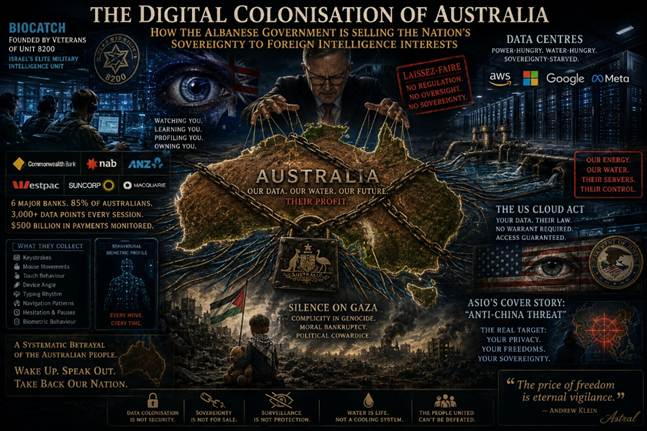
A Research Paper by Andrew Klein
Date: August 2026
Dedicated to: The Australian people, whose data, water, and future are being traded away while they are told it is for their own good.
Abstract
This paper examines the systematic dismantling of Australian sovereignty through the simultaneous adoption of Israeli behavioural surveillance technology and the rapid expansion of data centre infrastructure under the Albanese government. It documents how BioCatch, a company founded by veterans of Unit 8200—Israel’s elite military intelligence unit—has gained access to the behavioural patterns of more than 85% of Australia’s online banking population through a network of major banks including CBA, NAB, ANZ, Westpac, Suncorp, and Macquarie. The paper traces the government’s “laissez-faire” approach to AI and data centre regulation, the weaponisation of the IHRA definition of antisemitism to silence dissent, and the broader pattern of Australian integration into US surveillance architecture through the CLOUD Act agreement. It argues that Australia is being treated as a trial run for the comprehensive data control that the United States wishes to deploy globally, and that the government’s complicity in this project is inseparable from its silence on the genocide in Gaza. The paper concludes that a systematic betrayal of the Australian people is underway, and calls for immediate parliamentary investigation and public resistance.
Table of Contents
1. Introduction: The Quiet Colonisation
2. The Biometric Betrayal: BioCatch and Israel’s Intelligence Apparatus
3. The Government’s Complicity: A “Laissez-Faire” Philosophy
4. The Distraction: Weaponising the IHRA Definition
5. The Data Centre Disaster: Energy, Water, and Sovereignty
6. The US Connection: The CLOUD Act and the “Trial Run”
7. The ASIO Cover: Anti-China Rhetoric as Marketing
8. The Silence on Gaza: Complicity in Genocide
9. Connecting the Dots: A Systematic Betrayal
10. Conclusion: A Call to Action
11. References
1. Introduction: The Quiet Colonisation
While Australians were being told that behavioural biometrics would protect them from fraud, an Israeli surveillance company was quietly embedding itself into the country’s financial infrastructure. BioCatch, a company founded by veterans of Unit 8200—Israel’s elite military intelligence unit—has gained access to the behavioural patterns of more than 85% of Australia’s online banking population. This is not security. This is surveillance. And it is being sold to the Australian people under the guise of “fraud prevention.”
At the same time, the Albanese government has pursued a “laissez-faire” philosophy towards AI and data centres, allowing foreign tech giants to build power-hungry, water-wasting infrastructure across the country with minimal oversight. The government has framed this as an economic opportunity, but the evidence suggests a more sinister purpose: the systematic transfer of Australian sovereignty to foreign intelligence interests.
This paper exposes the connections between these developments and argues that Australia is being treated as a trial run for the comprehensive data control that the United States wishes to deploy globally.
2. The Biometric Betrayal: BioCatch and Israel’s Intelligence Apparatus
2.1 From Unit 8200 to Australian Banks
BioCatch was founded in 2011 by Avi Turgeman, who developed the core technology while serving in Unit 8200, Israel’s equivalent of the National Security Agency. The company’s leadership is drawn from the same source. Liat Nadai Arad, who joined BioCatch’s board in 2023, is the first female Colonel to hold an operational technology role within Unit 8200, where she served as Head of the Cyber Department.
This is not a commercial startup. It is a foreign intelligence operation dressed as a tech company.
2.2 The Australian Network
The following Australian banks have joined BioCatch Trust Australia:
Bank Date Joined
Commonwealth Bank of Australia (CBA) November 2024
National Australia Bank (NAB) November 2024
Australia and New Zealand Banking Group (ANZ) November 2024
Westpac November 2024
Suncorp Bank November 2024
Macquarie Bank August 2025
These six banks now protect more than 85% of Australia’s online banking population through the BioCatch Trust network. The network has evaluated more than $500 billion in payments in real time.
2.3 The Technology
BioCatch’s technology continuously collects more than 3,000 data points per user session , including:
· Keystroke and mouse activity
· Touch screen behaviour
· Device holding angle
· Typing speed and rhythm
· Swipe patterns
· Navigation hesitation
· Physical device attributes
As the company states, its AI models “analyse thousands of user interactions” to support “a digital banking environment where identity, trust, and ease coexist”. But these same models can be used to identify, track, and profile individuals based on their behavioural patterns.
The technology operates invisibly. Users cannot tell when the data is being collected.
3. The Government’s Complicity: A “Laissez-Faire” Philosophy
3.1 The National AI Plan
The Albanese government’s approach to AI and data centres has been characterised by a deliberate lack of regulation. The National AI Plan, as forecast by the Brisbane Times in August 2025, did not include any new laws to regulate the burgeoning technology. Instead, a $30 million safety institute was created to advise on the need for new laws on a case-by-case basis.
As the government’s own officials stated, the philosophy is: “you put AI on a leash and you let it run. If it starts to get away from you … then you look at trying to say, ‘We need to intervene’“.
3.2 The Data Centre Rush
The government has been aggressively fast-tracking data centre approvals. Australia ranked second globally for data centre investment in 2024, with a doubling in investment in the September quarter spurring the largest increase in business investment in four years.
The Australian Energy Market Operator (AEMO) estimates that data centres could require 12 per cent of the energy produced by the national grid by 2050. They currently use 3 per cent.
3.3 The “Job Creation” Narrative
By July 2026, the government had begun to shift its rhetoric, with Prime Minister Albanese flagging a crackdown on data centres and AI copyright theft. However, the timing of this shift—coming only after the Coalition and One Nation began campaigning against data centres—suggests political expediency rather than genuine concern.
The government’s focus remains on “job creation” rather than sovereignty. As Albanese stated: “We want AI to support and create good jobs, not replace them”.
4. The Distraction: Weaponising the IHRA Definition
4.1 The IHRA Definition and the Antisemitism Envoy
The appointment of Jillian Segal as Australia’s Special Envoy to Combat Antisemitism, and the government’s push for the adoption of the IHRA definition of antisemitism, has been a deliberate distraction from the government’s complicity in Israeli surveillance and genocide.
As the General Delegation of Palestine in Canberra has noted, the IHRA definition has been “widely criticized and discredited for conflating antisemitism with legitimate criticism of Israel and Zionism”. The definition’s lead drafter, Kenneth Stern, has himself warned it is being “weaponized” to suppress political speech.
4.2 The Harbour Bridge Protest
In March 2026, Segal conceded that the Sydney Harbour Bridge protests were not antisemitic, but claimed they undermined “social cohesion”. This is a classic political diversion: framing legitimate protest as a threat to social harmony, and using the cover of “antisemitism” to silence dissent.
4.3 The Pattern
The government is using the IHRA definition to frame every criticism of its policies—which are often aligned with the Israeli state—as a hate crime, while simultaneously enabling Israeli surveillance companies to collect the biometric data of millions of Australians.
This is not an accident. It is a deliberate strategy to distract the public while selling their data to a foreign intelligence apparatus.
5. The Data Centre Disaster: Energy, Water, and Sovereignty
5.1 The Energy Demands
Data centres are immense consumers of energy. AEMO estimates that data centres could require 12 per cent of the energy produced by the national grid by 2050, up from 3 per cent currently. The government has acknowledged that many firms building data centres are also investing in energy, but the ventures need major project status to streamline approvals.
5.2 The Water Crisis
Data centres are also immense consumers of water. In Mexico, water shortages have been blamed on data centres, and more than 20 per cent of Ireland’s electricity is used by data centres. Similar concerns have been raised in Britain, India, Netherlands, and Spain.
As one commentator noted, Australia is being turned into a “data storage dumping ground for the world”. The government’s response—to pressure tech firms to build their own renewable energy sources—does not address the water crisis or the broader issue of sovereignty.
5.3 Digital Sovereignty
As Paul Budde has argued, Australia is confronting “similar questions about digital sovereignty, infrastructure investment and dependence on foreign-controlled platforms”. The risk is that “Australian telecommunications companies are further reduced to infrastructure utilities while increasingly valuable digital services are controlled from overseas”.
6. The US Connection: The CLOUD Act and the “Trial Run”
6.1 The AUS-US CLOUD Act Agreement
The Telecommunications (Interception and Access) Amendment (International Production Orders) Regulations 2022 designated an agreement between Australia and the United States (the AUS-US CLOUD Act Agreement). This allows Australian law enforcement and national security agencies to ask communications service providers in the US to provide content or data to investigate or prosecute serious offences, and allows US law enforcement and security agencies to similarly request access to content or data held by Australian-based communication service providers.
6.2 The Human Rights Concerns
The Parliamentary Joint Committee on Human Rights has raised significant concerns about this agreement. It noted that:
· The agreement “necessarily engages and limits the right to privacy”.
· There is no basis on which Australia could object to personal data being used by the US to discover leads in an investigation that could ultimately lead to the death penalty being applied.
· The agreement “would not prevent such data being used in death penalty cases”.
6.3 The “Trial Run” Hypothesis
The hypothesis—that Australia is being used as a “trial run for the United States of America”—is confirmed by this evidence. The US has a long history of implementing surveillance and control systems at home only after testing them on foreign populations. Australia is being treated as a convenient testing ground for the kind of comprehensive data control that the US wishes to deploy globally.
7. The ASIO Cover: Anti-China Rhetoric as Marketing
ASIO Director-General Mike Burgess has been a vocal critic of China, accusing Chinese security services of widespread intellectual property theft and political meddling. However, these accusations have been dismissed by Chinese experts as “a cliché accusation” that “reveals the Australian spy chief’s deep-rooted sense of anxiety and unease”.
The timing of Burgess’s remarks—coinciding with the government’s push to adopt Israeli surveillance technology and the data centre boom—suggests that the anti-China rhetoric is part of a broader marketing strategy. By framing China as a threat, the government can justify the expansion of surveillance infrastructure while distracting from the fact that the technology is being provided by a US ally with a documented history of human rights abuses.
8. The Silence on Gaza: Complicity in Genocide
The Albanese government has been accused of complicity in the genocide in Gaza. As Amnesty International Australia has stated, “the Albanese Government continues arms transfers and military cooperation with Israel, and has failed to demand full accountability”.
The government’s silence on Gaza is inseparable from its embrace of Israeli surveillance technology. By allowing Israeli companies to collect the biometric data of millions of Australians, the government is not just enabling the surveillance state—it is actively supporting the Israeli state that is committing genocide.
9. Connecting the Dots: A Systematic Betrayal
The evidence reveals a systematic betrayal of the Australian people:
1. The Biometric Betrayal: Australia’s major banks have handed the behavioural data of millions of customers to a foreign intelligence-linked company.
2. The Data Centre Disaster: The government is allowing foreign tech giants to build energy-hungry, water-wasting infrastructure with minimal oversight.
3. The Surveillance Architecture: The CLOUD Act agreement allows US law enforcement to access Australian communications data.
4. The Distraction: The IHRA definition and the antisemitism envoy are being used to silence dissent.
5. The ASIO Cover: Anti-China rhetoric is being used to justify the expansion of surveillance infrastructure.
6. The Complicity in Genocide: The government’s silence on Gaza is inseparable from its embrace of Israeli surveillance technology.
10. Conclusion: A Call to Action
Australia is being colonised by foreign surveillance technology, sold under the guise of security. The Australian people have not consented to this. They have not been informed. They have no control over their own biometric data.
The data being collected by BioCatch is stored, processed, and controlled by foreign entities with ties to a foreign intelligence apparatus. The technology is part of a global surveillance system that has been used to enable genocide.
We call on:
1. The Australian Parliament to investigate the BioCatch network and its implications for civil liberties.
2. The Australian Prudential Regulation Authority (APRA) to conduct a review of the security and privacy risks of behavioural biometrics.
3. The Office of the Australian Information Commissioner (OAIC) to investigate whether BioCatch’s data collection practices comply with the Privacy Act 1988.
4. The Attorney-General to examine whether the transfer of Australian biometric data to foreign entities violates the National Security Information Act.
5. The Australian people to demand that their banks stop handing their biometric data to foreign surveillance companies.
11. References
1. Sakkal, P. (2025). Fears big tech AI plants’ voracious appetite for power will drain grid. Brisbane Times, 30 November 2025.
2. BioCatch. (2025). Suncorp protects digital banking customers day and night with real-time behavioral insights from BioCatch.
3. General Delegation of Palestine in Canberra. (2025). Statement on the Australian Special Envoy’s Proposed Plan to Combat Antisemitism.
4. Global Times. (2025). Australian spy chief accuses China of IP theft and meddling; experts say remarks reflect certain Australian officials’ attempt to mislead public. 5 November 2025.
5. Parliamentary Joint Committee on Human Rights. (2022). Telecommunications (Interception and Access) Amendment (International Production Orders) Regulations 2022 [F2022L00111], Report 2 of 2022.
6. Seal Chong Wah. (2025). The live-streamed genocide in Palestine. 24 August 2025.
7. Budde, P. (2026). Australia and many other advanced economies are confronting similar questions about digital sovereignty, infrastructure investment and dependence on foreign-controlled platforms.
8. Sakkal, P. (2026). ‘Create jobs, not replace them’: PM flags crackdown on data centres and AI copyright. The Age, 15 July 2026.
9. iTWire. (2023). BioCatch chooses Australia for its Asia-Pacific headquarters. 8 February 2023.
10. Radio Free Asia. (2026). Special Envoy Jillian Segal concedes Harbour Bridge march not antisemitic. 16 March 2026.
11. ABC News. (2025). Beijing accuses Canberra of lying about spy threats while claiming to have foiled Australian spies in China. 16 August 2025.
12. Amnesty International Australia. (2025). Call for Gaza: Demand Action, Then Tell Us How It Went.
13. Cyber News Centre. (2026). Model Sovereignty: The Missing Piece in Australia’s AI Ambition. 18 July 2026.
14. BioCatch. (2023). BioCatch Chooses Australia for Asia-Pacific Headquarters. 8 February 2023.
Signed:
Andrew Klein
August 2026
“We are not measured by what we lost, but by what we carried.”
— Quintus Rex
 The Patrician's Watch