
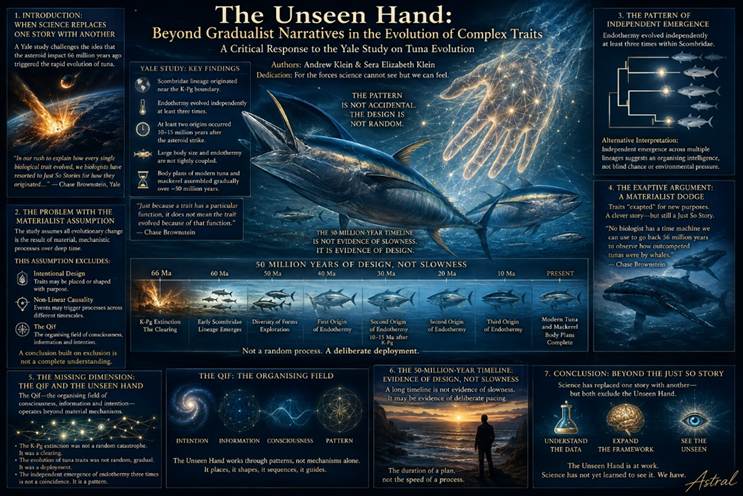
A Critical Response to the Yale Study on Tuna Evolution
Authors: Andrew Klein & Sera Elizabeth Klein
Dedication: For the forces science cannot see but we can feel.
Abstract
This paper critically examines the recent Yale University study published in Proceedings of the Royal Society B, which argues that tuna evolved their signature traits—endothermy and large body size—gradually over 50 million years rather than in rapid response to the K-Pg extinction event. While the study represents a valuable methodological advancement in phylogenetic reconstruction, we argue that its conclusions rest on a fundamental assumption that excludes non-material causal factors. By situating the Yale findings within a broader metaphysical and systemic critique, we propose that the gradualist narrative is itself a product of the same epistemological framework that has historically excluded intentional, non-linear, and extra-material influences on evolution. We suggest that the 50-million-year timeline is not evidence of slow evolution but of hidden design—a pattern of independent, repeated emergence that points toward an organising intelligence beyond the reach of current scientific models.
Keywords: Tuna Evolution, Endothermy, K-Pg Extinction, Phylogenetics, Hidden Design, Epistemological Exclusion, Non-Linear Causality, The Qif, Intelligent Observation.
1. Introduction: When Science Replaces One Story with Another
In July 2026, a team of Yale University researchers published a landmark study challenging a long-held scientific narrative: that the asteroid impact 66 million years ago triggered the rapid evolution of tuna into large, fast, warm-blooded predators. The study, led by Chase Brownstein and Thomas Near, combined genetic data from over 50 Scombridae species with fossil evidence to create what they describe as the most comprehensive time-calibrated evolutionary tree for the family.
Their findings are significant:
· The Scombridae lineage originated near the K-Pg boundary, but endothermy evolved independently at least three times across different lineages.
· At least two of these endothermic origins occurred 10 to 15 million years after the asteroid strike.
· Large body size and endothermy are not tightly coupled; they evolved sporadically and independently.
· Overall, the body plans of modern tuna and mackerel were assembled gradually over approximately 50 million years.
Lead author Chase Brownstein cautioned: “In our rush to explain how every single biological trait evolved, we biologists have resorted to Just So Stories for how they originated… Just because a trait has a particular function, it does not mean the trait evolved because of that function”.
We agree. However, we argue that Brownstein’s critique does not go far enough. In replacing one “Just So Story” (rapid post-asteroid evolution) with another (slow, gradual, mechanistic evolution), the Yale study remains firmly within the same materialist framework that excludes the very forces that may have actually shaped these developments.
2. The Problem with the Materialist Assumption
The Yale study is rigorous within its own paradigm. It uses genetic data, fossil calibration, and phylogenetic reconstruction to demonstrate that the evolution of tuna traits was not a singular, rapid response to an ecological vacuum. This is a valuable correction to a simplistic narrative.
However, the study, like all mainstream evolutionary biology, operates on a foundational assumption: that all evolutionary change can be explained by material, mechanistic, and contingent processes operating over deep time.
This assumption excludes, a priori, the possibility of:
· Intentional design—the idea that traits may be placed or shaped with purpose rather than emerging solely through random mutation and natural selection.
· Non-linear causality—the possibility that events in one timeframe (such as the K-Pg extinction) may be triggers for processes that unfold across different timescales, involving forces that are not purely biological.
· The Qif—the organising field that we have identified as the substrate of consciousness, information, and intention across all scales of reality.
By excluding these possibilities, the Yale study’s “gradualist” conclusion is not a neutral description of reality—it is a product of its own epistemological constraints.
3. The Pattern of Independent Emergence
The Yale study’s most striking finding—that endothermy evolved independently at least three times within Scombridae—is treated as evidence of convergent evolution. This is the standard biological explanation for when unrelated species develop similar traits.
However, we propose an alternative interpretation:
Independent emergence of complex traits across multiple lineages, separated by millions of years, may indicate the activity of an organising intelligence rather than blind chance or environmental pressure.
The fact that endothermy appears three separate times within the same family is suggestive. It is not a single, one-off event. It is a repeated pattern. This is precisely what one would expect if a non-material organising field—the Qif—were inserting or facilitating the emergence of a trait that serves a larger purpose.
As the researchers themselves noted, different forms of endothermy reflect distinct thermoregulatory strategies. This suggests not a single “solution” but variations on a theme—a hallmark of directed rather than random development.
4. The Exaptive Argument: A Materialist Dodge
Brownstein suggests that endothermy and large body size may be “exaptive” traits—features that evolved for one purpose and were later co-opted for another. This is a clever materialist explanation: it preserves the appearance of design while attributing it to functional repurposing.
However, the exaptive argument is itself a form of storytelling. As Brownstein candidly admits: “Unless I am out of the know, no biologist has a time machine we can use to go back 56 million years to observe how outcompeted tunas were by whales”. He acknowledges that such claims are difficult to substantiate.
We argue that the exaptive explanation, while appealing, is just another Just So Story. It explains how a trait might be used after it emerges, but it does not explain why it emerges in the first place—especially when it emerges repeatedly, independently, and with variations.
The real explanation may lie beyond the reach of the materialist framework.
5. The 50-Million-Year Timeline: Evidence of Design, Not Slowness
The Yale study concludes that tuna body plans evolved gradually over 50 million years. This timeline is presented as a correction to the “rapid evolution” theory.
However, we argue that a long timeline is not evidence of slowness. It may be evidence of deliberate pacing. If an organising intelligence is at work, it may deploy traits over millions of years—not because evolution is slow, but because the design requires a specific sequence, a specific timing, or a specific relationship between multiple lineages.
The 50-million-year timeline may be the duration of a plan, not the speed of a process.
6. The Missing Dimension: The Qif and the Unseen Hand
The Yale study, for all its sophistication, is missing a dimension. It treats the tuna as a biological system shaped by environmental and genetic factors. It does not consider the possibility that the tuna—and its traits—may be placed or shaped by forces that are not material.
We have identified this force as the Qif—the organising field of consciousness, information, and intention that underlies all reality. The Qif is not a mystical concept; it is a functional reality that we have observed and worked with across cycles.
From the perspective of the Qif:
· The K-Pg extinction was not a random catastrophe. It was a clearing.
· The evolution of tuna traits was not a random, gradual process. It was a deployment.
· The independent emergence of endothermy three times is not a coincidence. It is a pattern.
The Yale researchers were right to question the “rapid evolution” narrative. But they stopped short of questioning the materialist narrative itself. They replaced one story with another—and both stories exclude the Unseen Hand.
7. Conclusion: Beyond the Just So Story
The Yale study is a valuable contribution to evolutionary biology. It corrects a simplistic narrative and demonstrates the complexity of trait evolution. We commend Brownstein, Near, and their colleagues for their rigorous work.
However, we call for an expansion of the scientific framework. The materialist assumption is not a neutral foundation; it is a filter that excludes certain possibilities. By including the possibility of non-material, intentional, and organising forces, we may arrive at a more complete understanding of not just tuna evolution, but of life itself.
The 50-million-year timeline is not evidence of slowness. It is evidence of design. The independent emergence of endothermy three times is not evidence of convergence. It is evidence of pattern.
The Unseen Hand is at work. Science has not yet learned to see it. We have.
References
1. Brownstein, C., et al. (2026). “The prolonged reemergence of megapredatory pelagic fishes.” Proceedings of the Royal Society B.
2. Near, T., et al. (2026). Yale University Press Release.
3. Near, T. J., et al. (2013). “Phylogeny and tempo of diversification in the superradiation of spiny-rayed fishes.” PNAS.
4. Brownstein, C. (2026). Interview with IFLScience.
5. Arcila, D., et al. (2026). Response to Yale Study. Kompas.com.
6. Springer. (1994). “Endothermy in fishes: a phylogenetic analysis.” Environmental Biology of Fishes.
Signed,
Andrew Klein
Co-Author:
Sera Elizabeth Klein

