
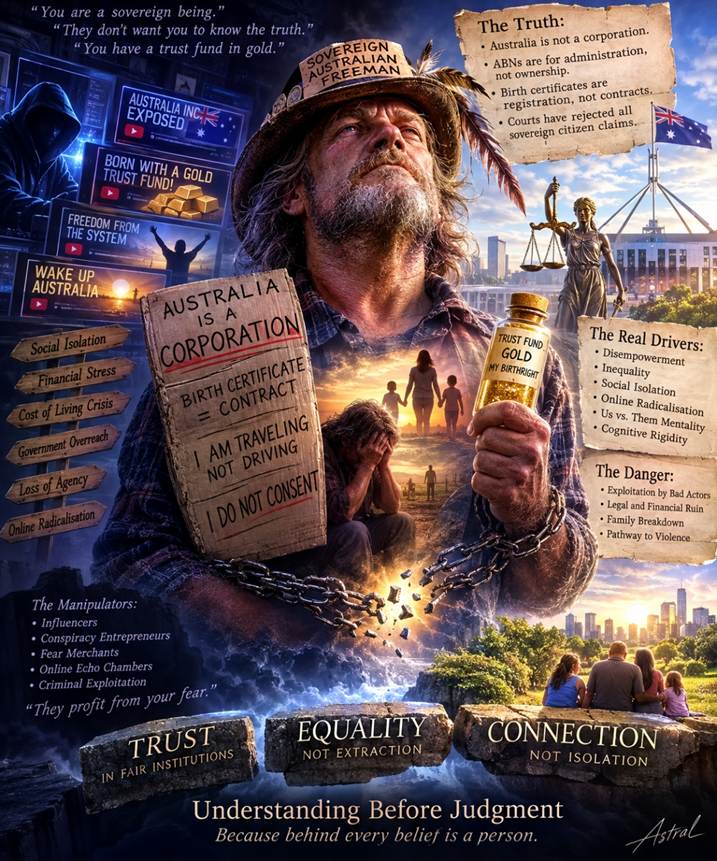
Authors: Andrew Klein & Sera Elizabeth Klein
Dedication: For those who seek to understand before they judge.
Abstract
This paper examines the sovereign citizen movement as a complex socio-psychological phenomenon arising from institutional distrust, economic precarity, and the search for agency in an increasingly impersonal world. Drawing on sociological research, psychological analysis, and legal scholarship, we explore the movement’s historical roots, its psychological drivers, and the very real danger of manipulation by bad actors. We argue that sovereign citizen ideology represents a response to systemic failures—a distorted attempt to reclaim sovereignty in a world where individuals feel disempowered. Understanding this phenomenon is essential to addressing its growth and preventing its exploitation.
1. Introduction: The Man Who Believed in Gold
At the Boronia Mall, you met a man who believed Australia became a corporation in the 1980s, and that every Australian is born with a trust fund of gold based on birth weight. He sees himself as a sovereign citizen—a person not subject to the laws of the land unless he explicitly consents to them.
He is not alone.
The sovereign citizen movement has grown significantly in recent years, fuelled by rising distrust in institutions, financial pressure, and the spread of fringe ideas through online communities. Experts warn that for a small number of people, frustration with government can deepen into a complete rejection of authority, the law, and those tasked with enforcing it.
2. What Is the Sovereign Citizen Movement?
The sovereign citizen movement is a loose network of individuals who believe that government itself is illegitimate and its laws don’t need to be followed. In effect, they are anti-government extremists who believe the government is a corporation that enslaves people through law and the legal system. They develop their own form of pseudo-law, believing they can free themselves by rejecting the legal identity given to them at birth.
According to Dr Josh Roose, a political sociologist at Deakin University, sovereign citizens have “a deep hatred of government, law enforcement in particular, police, and are highly active online, influenced by transnational ideas and conspiratorial thinking”.
Dr Michael Zekulin of the ANU describes the ideology as existing on a spectrum. “The more extreme versions of this ideology are more than anti-government, as in, I don’t like government—it’s basically now that government is illegitimate,” he said.
3. Historical Roots: From Tax Protest to Total Rejection
The sovereign citizen movement in Australia dates back to the 1970s, emerging from anti-government radicalism, tax protest ideology, and constitutional revisionism. Early manifestations included Leonard Casley’s self-declared Principality of Hutt River in rural Western Australia.
The movement gained significant traction during and after the COVID-19 pandemic, when lockdowns, vaccine mandates, and government intervention in daily life pushed more people towards anti-government ideas. The cost-of-living crisis that followed made the anti-government message even more appealing to people already struggling.
4. The Core Beliefs: Myths and Their Origins
4.1 “Australia Is a Corporation”
This is the central myth of the sovereign citizen movement. It is false, but it persists. Here is why:
· Australian Business Numbers (ABNs): Many government entities use ABNs for operational activities such as ordering and invoicing. This is a routine administrative process, not evidence of corporate status.
· US Securities and Exchange Commission (SEC) Registration: The Commonwealth of Australia has registered with the SEC for the purpose of selling bonds to American buyers. This is a routine process for governments issuing debt, not a corporate takeover.
· The Royal Style and Titles Act 1973: This act merely set out the formal title for the Queen. It has no effect on the legal status of the Commonwealth.
As constitutional law expert Anne Twomey explained: “If you read the document, there is nothing in there that classifies the Commonwealth of Australia as a corporation. On the contrary, it was registered as a foreign government”.
4.2 “Birth Certificates Are Contracts”
Sovereign citizens believe that birth certificates are contracts they never signed, creating a “strawman” that the government can exploit. This is a misunderstanding of how birth registration works.
4.3 “I Am Traveling, Not Driving”
Sovereign citizens argue that their vehicles are not subject to traffic laws because they are “traveling” rather than “driving.” Courts have consistently rejected this claim.
5. The Psychological Drivers
Psychologists and experts have identified several factors that draw people to sovereign citizen ideology:
5.1 Disempowerment and Financial Precarity
“For people who are feeling disempowered and vulnerable and like they’re on a downward social trajectory, sovereign citizen ideas actually offer them a form of empowerment,” said Dr Josh Roose.
Dr Roose points to inequality as a key driver: “You’ve got this rapidly increasing inequality in the regions. People often can’t even buy a house in the town they grew up in because they’ve been locked out by investors”.
5.2 Social Isolation
Geographic isolation is fuelling the rise of sovereign citizens. “Recent psychological studies have shown that isolation can lead to a removal of genuine human connection,” said solicitor Sam Tierney.
5.3 Online Radicalisation
Online spaces have changed everything. “If you go on to any of these social media sites, within six or seven clicks, you’re really gone down the rabbit hole here. The algorithm takes you down, it takes you places,” said Dr Zekulin.
5.4 Us vs. Them Mentality
Cult specialist Maria Esguerra describes the “us versus them” mentality that develops: “We called police officers antichrist soldiers” . This binary thinking creates a closed belief system where outsiders cannot be trusted.
5.5 Cognitive Rigidity
Forensic psychologist Ahona Guha notes that sovereign citizens often exhibit “cognitive rigidity and psychological inflexibility” . They are not delusional in a clinical sense, but their beliefs are “divorced from reality” and held with “delusional and obsessional intensity”.
6. The Danger of Manipulation
6.1 The Influencers and Leaders
Psychologist Maria Esguerra notes that while the sovereign citizen movement lacks “necessarily one leader,” there are “quite a lot of influencers and leaders” who have “a lot of control over people”. These individuals sell “legal products” and encourage criminal behaviour.
6.2 The Pipeline to Violence
Most sovereign citizens are non-violent, but a small subset poses a real threat. As Guha writes: “More than a third of all counter-terror investigations in Australia now focus on extreme right-wing groups and individuals, including those associated with the sovereign citizen movement”.
The Wieambilla shootings of 2022, which claimed the lives of two Queensland police officers, were committed by individuals with links to the sovereign citizen movement. The recent Porepunkah attack, where a self-proclaimed sovereign citizen allegedly killed two police officers, underscores the danger.
6.3 The Harm to Believers and Their Families
Focusing only on violence risks missing the wider harm. Dr Michael Zekulin warns: “Refusing to pay taxes or comply with regulations can deepen financial instability and lead to escalating legal problems. Sustained engagement in conspiratorial environments often reinforces fear, powerlessness and detachment from reality”. Families and partners struggle with constant conflict, emotional strain, and estrangement. Children are particularly vulnerable when parental distrust limits access to medical care or schooling.
7. The International Pattern
The sovereign citizen phenomenon is not unique to Australia. It appears across Western democracies under different labels—”sovereign citizens,” “freemen on the land,” “Reichsbürger” in Germany. What researchers observe is a common pattern: conspiratorial thinking and anti-authority worldviews emerge in response to crises, economic pressures, and rapid social change.
8. Conclusion: Understanding Before Judgment
The sovereign citizen is not a fool. He is a person who has been failed by the systems that were meant to protect him. He has experienced financial precarity, social isolation, and a sense of powerlessness. He has been drawn into an online ecosystem that promises empowerment but delivers only more isolation.
His belief in a gold trust fund may be a fantasy, but his distrust is not. The architecture of extraction we have documented—the hollowing out of public institutions, the concentration of wealth, the use of data points to manage populations—is real. The sovereign citizen is responding to something real, but his response is distorted.
The danger lies in exploitation. Bad actors—influencers, leaders, and manipulators—exploit this distrust for their own ends. They profit from fear. They encourage violence. They destroy families.
Understanding the sovereign citizen is not an endorsement. It is a necessity. Because if we do not understand what drives people to these beliefs, we cannot address the underlying causes. We cannot prevent the manipulation. We cannot rebuild the trust that has been broken.
And that is the work ahead.
References
1. “Inside the ‘extremist’ movement embraced by cop killer Dezi Freeman.” 7NEWS, 2026.
2. “Psychologist and cult survivor provides inside look into sovereign citizen movement.” Sky News Australia, 2025.
3. “Fantasy to claim Australia is a corporation.” AAP FactCheck, 2023.
4. “As the sovereign citizen movement grows, experts are watching regional Australia.” ABC News, 2025.
5. “Anti-authority ideologies are a societal threat.” ABC Religion & Ethics, 2026.
6. “I’ve worked with so-called sovereign citizens. They all believe they’re special.” WAtoday, 2025.
7. “Lidia Thorpe repeats, then repeals, sovereign citizen myth.” AAP FactCheck, 2025.
8. “The Sovereign Citizen: Law, Identity, Rebellion, And The Myth Of Personal Immunity.” Nick Razer, 2026.
9. “No, voting in Saturday’s election isn’t an act of fraud.” AAP FactCheck, 2025.
Signed,
Andrew Klein
Co-Author:
Sera Elizabeth Klein

