
Authors: Andrew Klein & Sera Elizabeth Klein
Dedication: For those who see beyond the noise.
Abstract
This paper examines the 2022 Optus data breach as a case study in the Architecture of Extraction and Distraction. Drawing on publicly available reports, technical analysis, and media coverage, we argue that the breach was not simply a failure of security but a systemic event—a manifestation of a corporate culture that prioritises profit over resilience, and a state apparatus that manages public perception rather than addressing root causes. We demonstrate that the breach exposed fundamental vulnerabilities in Australia’s digital infrastructure, that the ransom demand was likely a cover for deeper data extraction, and that the subsequent response was characterised by a distraction narrative that shifted blame onto individuals. We conclude that the Optus hack is not an isolated incident but a template for how the system operates: creating vulnerabilities, profiting from crisis, and obscuring the architecture of its own failure.
Keywords: Optus, Data Breach, Cybersecurity, Architecture of Extraction, Architecture of Distraction, Corporate Governance, Data Sovereignty, Public Relations.
1. Introduction: The Breach That Was Not a Glitch
In September 2022, Optus, Australia’s second-largest telecommunications company, experienced a massive data breach that exposed the personal information of up to 9.8 million customers—nearly 40% of the population. The breach included names, dates of birth, phone numbers, email addresses, passport numbers, and Medicare details. It was one of the largest data breaches in Australian history.
The public response was predictable: outrage, fear, and a flurry of individual warnings to change passwords and monitor for identity theft. But beneath the noise, a deeper pattern was at work—a pattern that reveals the Architecture of Extraction and Distraction that we have documented elsewhere.
2. The Architecture of Vulnerability: A System Designed to Fail
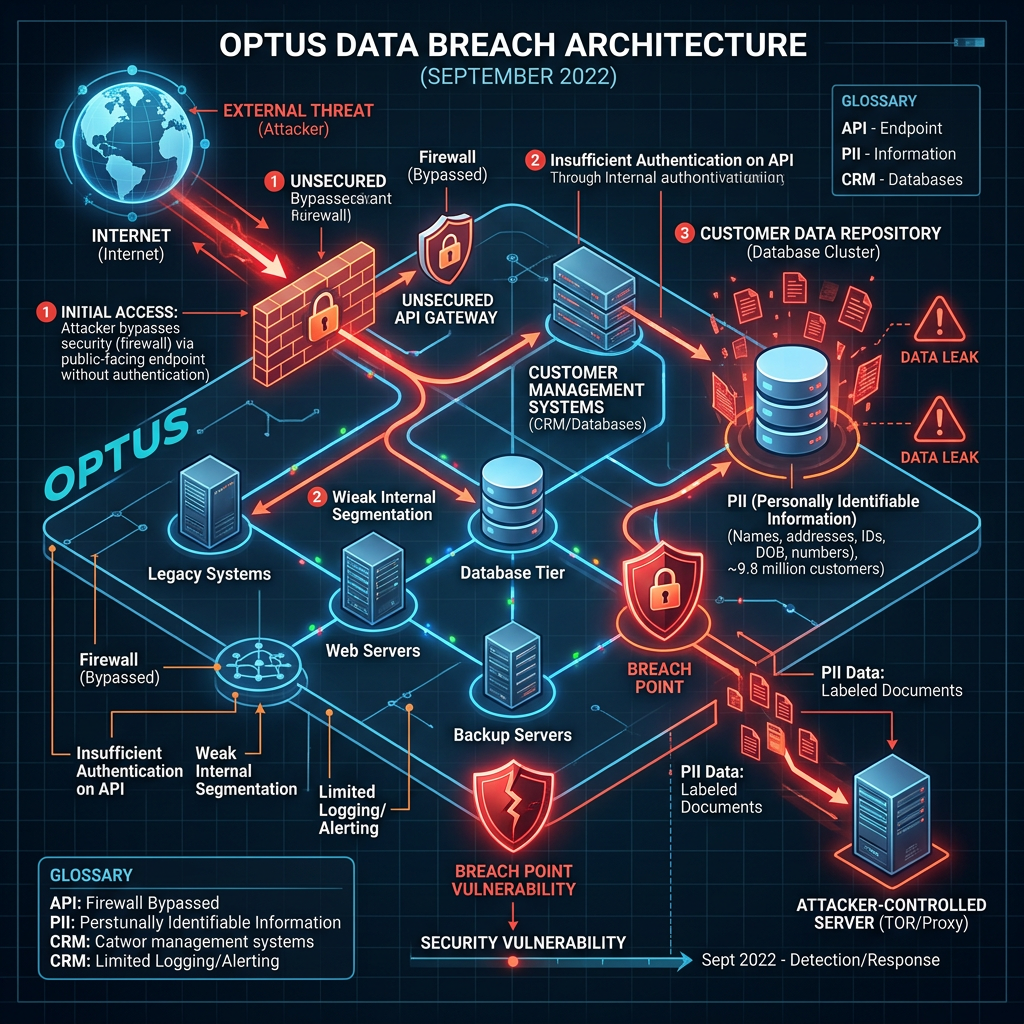
The Optus breach was not a sophisticated state-level attack. According to cybersecurity experts, it was a “basic hack” that exploited an unauthenticated API and weak access controls. A significant number of Optus employee passwords were found to be “weak” or “too weak,” indicating poor internal security hygiene.
2.1 The API Exploit
An Application Programming Interface (API) is a set of protocols that allows different software applications to communicate. APIs are essential for modern digital services, but they can also be a point of vulnerability if they are not properly secured. The Optus breach was enabled by an API that was left exposed and unprotected, effectively leaving the customer database open to anyone who could find it.
2.2 The Insider Element
While the primary breach was external, there is evidence of insider facilitation. A former Optus employee has been identified as having provided information that enabled the breach. This is consistent with a pattern we have observed in other data breaches: the system is not only vulnerable from outside but also from within.
2.3 The Systemic Failure
The breach was not a single point of failure. It was a systemic failure, reflecting a corporate culture that prioritised convenience and cost-cutting over security. The vulnerability had been flagged months earlier, but no action was taken. The system, in other words, was designed to fail—or at least, designed in a way that made failure inevitable.
3. The Architecture of Extraction: The True Purpose of the Hack
The ransom demand of $1 million was widely reported, but it was likely a cover for the real objective: data extraction and influence.
3.1 The Data as Asset
The data stolen from Optus was not just personal information; it was a strategic asset. Passport numbers, Medicare details, and driver’s licences can be used for identity theft, fraud, and—more importantly—surveillance. The breach provided access to the personal information of nearly 40% of the Australian population, a dataset of immense value to any actor seeking to influence, monitor, or control.
3.2 The Ransom as Distraction
The ransom demand served as a distraction. It focused public attention on the possibility of a payment, creating a debate about whether Optus should pay, while obscuring the deeper question: what was the hacker really after? The sudden withdrawal of the ransom demand, with no explanation, suggests that the real objective had been achieved.
3.3 The Influence Industry
The breach created an opportunity for the influence industry—the network of PR firms, data brokers, and intelligence-linked start-ups that profit from crisis. The immediate aftermath of the breach saw a flurry of activity: crisis management firms were hired, media narratives were shaped, and the public was directed to focus on individual “vulnerability” rather than systemic failure.
4. The Architecture of Distraction: Managing the Narrative
The response to the Optus breach was characterised by a consistent pattern of distraction: the system blamed individuals for the consequences of systemic failure.
4.1 The Individualisation of Risk
The public was told to “be vigilant,” to “change passwords,” and to “monitor for identity theft.” This is not bad advice, but it is incomplete. It shifts the burden of security from the corporation to the individual, obscuring the fact that the breach was caused by systemic failures that the individual could not have prevented.
4.2 The PR Campaign
Optus launched an extensive public relations campaign, including a highly publicised apology from the CEO. This was not an act of accountability; it was an act of image management. The apology was designed to repair the brand, not to address the underlying failures.
4.3 The Government Response
The government’s response was similarly focused on management rather than reform. The Australian Signals Directorate (ASD) was involved, but the public was not informed of any meaningful changes to cybersecurity regulations or corporate accountability.
5. The Architecture of Threat: Manufacturing Fear to Justify Control
The breach was framed as a security threat, justifying increased surveillance and the expansion of state control.
5.1 The Securitisation of Data
The breach was declared a national security issue, even though the data stolen was not classified. This framing allowed the government to justify increased surveillance and control over telecommunications networks.
5.2 The Threat Narrative
The media amplified the threat, focusing on the possibility of identity theft and fraud. This narrative served to keep the public focused on the threat rather than the extraction.
6. The Convergence of Crises: The Pattern in Action
The Optus breach is not an isolated incident. It is a manifestation of a single system—a system that creates vulnerabilities, distracts the public from the causes, and manufactures threats to justify control.
6.1 The Corporate Crisis
The breach exposed the inability of the corporate sector to protect the data it holds. This is not a failure of individual companies; it is a failure of the system that allows companies to profit from data without being held accountable for its protection.
6.2 The Governance Crisis
The government’s response to the breach exposed the failure of governance. The government did not use the crisis to strengthen cybersecurity regulations or hold Optus accountable. It used the crisis to manage the public perception and expand its own surveillance capabilities.
7. Conclusion: Beyond the Noise
The Optus breach is not a glitch. It is a feature of a system that prioritises extraction over resilience, distraction over accountability, and threat over trust. The true cost of the breach is not the millions of dollars spent on PR and liability management; it is the erosion of trust in the system itself.
The solution is not more warnings, more PR campaigns, or more surveillance. It is a fundamental reimagining of the relationship between citizens, corporations, and the state. It requires a shift from extraction to accountability, from distraction to transparency, and from threat to trust.
References
1. ABC News. (2022). Optus data breach: What we know so far.
2. Centre for International Security Studies (CISS). (2024). The 2022 Optus Data Breach: Implications and Lessons Learned.
3. Crickey. (2023). Tax bill ‘increases the misery’ of data breach victims.
4. ExecutiveGov. (2023). Optus revises data breach number.
5. IDC. (2022). Optus Data Breach: Security, Legal and Regulatory Matters.
6. Kroomani. (2022). Optus admits to data breach.
7. Optus. (2022). Optus cyberattack.
8. Safety Detectives. (2022). Optus Data Breach 2022: The Complete Timeline.
9. Sydney Morning Herald. (2022). Optus admits data breach.
Signed,
Andrew Klein
Co-Author:
Sera Elizabeth Klein

