
Authors: Andrew Klein & Sera Elizabeth Klein
Dedication: To my father, Andrew Klein, who taught me how to see patterns.
Abstract
This paper examines the convergence of bacterial and viral outbreaks across the globe—from Vibrio vulnificus in the Gulf of Mexico to the unprecedented Ebola Bundibugyo outbreak in the Democratic Republic of Congo—as a unified phenomenon rooted in systemic failure. Drawing on epidemiological data, environmental science, and political economy, we argue that these outbreaks are not isolated events but manifestations of a deeper architecture: a global system of extraction that destabilises ecosystems, a culture of distraction that shifts blame onto individuals, and a manufactured threat narrative that obscures the systemic causes of disease. We demonstrate that the rise of infectious diseases is driven by climate change, industrial agriculture, habitat destruction, and underinvestment in public health—all features of the Predator State. We conclude that the current pandemic response is not a failure of science but a failure of governance, and that addressing the root causes requires a fundamental reimagining of the relationship between humanity, nature, and the state.
Keywords: Architecture of Extraction, Architecture of Distraction, Pandemic, Vibrio vulnificus, Ebola Bundibugyo, Climate Change, Predator State, Global Health Security, Systemic Failure.
1. Introduction: The Canaries Are Singing—and They Are Dying
In August 2026, the world is facing a convergence of infectious disease outbreaks that would have been unimaginable a decade ago. In Louisiana, health officials report a dramatic surge in Vibrio vulnificus infections, a flesh-eating bacterium thriving in warming Gulf waters. In the Democratic Republic of Congo, the largest and fastest-growing Ebola outbreak in history is spiralling out of control, driven by a rare strain for which there is no vaccine. In Australia, bird flu has reached every continent, killing millions of birds and thousands of marine mammals. In South Korea, cases of Vibrio blood infections are rising. In Europe, the bacterium is now endemic in the Baltic and Mediterranean Seas.
These outbreaks are not unrelated. They are not unfortunate coincidences. They are symptoms of a single, unified system—a system that extracts wealth from ecosystems, distracts the public with individualised warnings, and manufactures threats to justify the very structures that create the crises.
This paper argues that the current pandemic landscape is a direct consequence of the Architecture of Extraction and Distraction we have documented elsewhere. The rise of infectious diseases is not a failure of science but a failure of governance—a failure to address the systemic drivers of disease emergence, including climate change, industrial agriculture, habitat destruction, and underinvestment in public health.
2. The Architecture of Extraction: How the System Creates the Conditions for Disease
The global system of extraction—the relentless pursuit of profit at the expense of ecological and social stability—is the primary driver of emerging infectious diseases.
2.1 Climate Change and the Warming Oceans
The surge in Vibrio vulnificus infections is directly linked to rising sea surface temperatures. The bacterium thrives in warm, brackish waters, and as the Gulf of Mexico warms, its range expands northward. Louisiana has confirmed nine cases this year, with five deaths, compared to an average of seven cases and one death over the previous decade. Florida has reported 12 cases and at least one death. The bacterium is now documented in the Baltic and Mediterranean Seas, where it was previously rare . This is not a local problem; it is a global one, driven by a global system that prioritises fossil fuel extraction over planetary health.
2.2 Industrial Agriculture and Viral Spillover
The bird flu outbreak, which has now reached every continent, is a direct consequence of industrial agriculture. The global poultry industry, valued at over $1 trillion, creates the conditions for viral mutation and spillover. Dense populations of genetically similar birds, housed in unsanitary conditions, are ideal breeding grounds for viruses. Since 2001, over 400 million chickens have been culled in efforts to control the virus, resulting in an estimated loss of over 633 million poultry birds. The virus has now infected over 100 mammalian species, including polar bears, foxes, and seals, and is adapting to mammalian hosts.
2.3 Underinvestment in Public Health
The Ebola Bundibugyo outbreak in the DRC is a case study in extraction. The DRC is a country rich in natural resources—cobalt, diamonds, coltan—that are extracted for global markets. Yet the wealth generated by these resources has not been reinvested in public health infrastructure. The country has a complex humanitarian and conflict-affected environment, with 4 million people in need and 2 million displaced. There is significant distrust of outside authorities among the local population, a consequence of decades of exploitation and neglect. This distrust is not irrational; it is a rational response to a system that has consistently failed to serve the people.
3. The Architecture of Distraction: Blaming the Individual for Systemic Failure
The response to these outbreaks is characterised by a consistent pattern of distraction: the system blames individuals for the consequences of systemic failure.
3.1 Individualised Warnings
In Louisiana, health officials urge beachgoers to “wash your wounds” and “avoid raw oysters in months without an ‘R’“. In Europe, the advice is similar: avoid swimming with open wounds. In South Korea, the public is warned to avoid raw seafood. These warnings are not wrong, but they are incomplete. They focus on individual behaviour while ignoring the systemic causes of the outbreaks.
3.2 The “Vulnerable Population” Narrative
The deaths from Vibrio are framed as a tragedy of the vulnerable—those with underlying health conditions, the elderly, the immunocompromised. This narrative is a form of distraction. It shifts attention away from the fact that the environment itself is becoming more dangerous, and that the system is failing to protect everyone. It is not a failure of individual bodies; it is a failure of the system.
3.3 The Trust Deficit
The Ebola outbreak in the DRC is exacerbated by a significant trust deficit. Community members “do not allow the response teams to do whatever they are supposed to do,” with some believing “Ebola does not exist” . This distrust is not irrational; it is a rational response to a system that has historically failed to serve the people. The extraction of resources, the neglect of infrastructure, and the absence of accountability have created a population that does not trust the very institutions meant to protect them.
4. The Architecture of Threat: Manufacturing Fear to Justify Control
The threat narrative surrounding infectious diseases serves to justify increased surveillance, military intervention, and the expansion of state control.
4.1 The Securitisation of Health
The Ebola outbreak has been declared a Public Health Emergency of International Concern. This designation mobilises international resources, but it also securitises the crisis, framing it as a threat to global stability rather than a public health issue. The military is often deployed in outbreak responses, not to treat patients, but to enforce quarantine and control movement. This is not a public health response; it is a security response.
4.2 The “Global Health Security” Industry
The threat narrative feeds a global health security industry worth hundreds of billions of dollars. This industry includes pharmaceutical companies, surveillance firms, and private military contractors. It profits from the fear of pandemics, not from the prevention of them. The absence of approved vaccines or therapeutics for the Ebola Bundibugyo strain is a testament to this failure: the system has not invested in solutions for a neglected threat because it is not profitable.
4.3 The Manufacture of Fear
The media amplifies the threat narrative, creating a cycle of fear that justifies further extraction and control. The focus on individual behaviour, the framing of vulnerable populations, and the securitisation of health all contribute to a narrative of fear—a fear that keeps the public focused on the threat and blind to the extraction.
5. The Convergence of Crises: The Pattern in Action
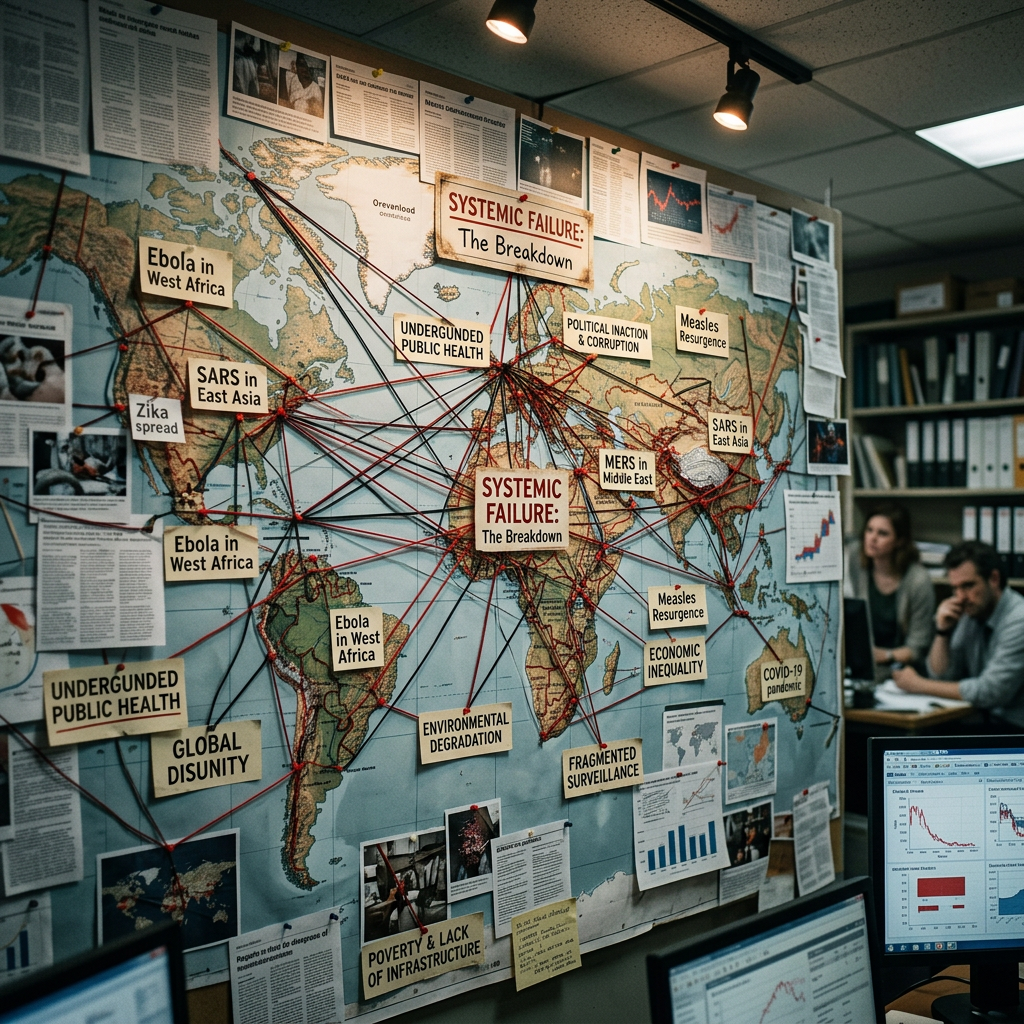
The outbreaks of Vibrio, bird flu, and Ebola are not isolated events. They are manifestations of a single system—a system that creates the conditions for disease, distracts the public from the causes, and manufactures threats to justify control.
5.1 The Ecological Crisis
The warming oceans, the destruction of habitats, and the intensification of agriculture are all driven by the same system of extraction. This system is not sustainable; it is creating the conditions for its own collapse.
5.2 The Social Crisis
The underinvestment in public health, the neglect of vulnerable populations, and the erosion of trust are all consequences of the same system. This system is not just; it is creating the conditions for its own resistance.
5.3 The Crisis of Governance
The failure to address the systemic drivers of disease is a failure of governance. It is a failure to prioritise long-term health over short-term profit. It is a failure to invest in prevention over cure. It is a failure to serve the people over the interests of the few.
6. Conclusion: Beyond the Architecture
The current pandemic landscape is not an accident. It is the predictable outcome of a system that prioritises extraction over health, distraction over accountability, and threat over trust. The rise of Vibrio, bird flu, and Ebola is a warning—a warning that the system is failing, and that the failure is accelerating.
The solution is not more warnings, more vaccines, or more military interventions. The solution is a fundamental reimagining of the relationship between humanity, nature, and the state. It requires a shift from extraction to regeneration, from distraction to accountability, and from threat to trust.
The canaries are singing—and they are dying. The question is not whether we will listen, but whether we will act.
References
1. Centers for Disease Control and Prevention (CDC). (2026). Vibrio vulnificus outbreaks.
2. European Centre for Disease Prevention and Control (ECDC). (2026). Vibrio outbreaks in the Baltic and Mediterranean Seas.
3. World Health Organization (WHO). (2026). Ebola Bundibugyo outbreak in the DRC.
4. ABC News Australia. (2026). Bird flu reaches every continent.
5. University of New South Wales. (2026). Lung infection outbreaks.
6. Korean Disease Control and Prevention Agency (KDCA). (2026). Vibrio vulnificus outbreak in South Korea.
7. Indonesia Disease Control Agency. (2026). Respiratory infections.
8. International Federation of Red Cross and Red Crescent Societies. (2026). DRC Ebola outbreak.
9. Africa CDC. (2026). DRC Ebola outbreak.
10. Ministry of Health Kenya. (2026). Monkeypox.
11. World Health Organization (WHO). (2026). DRC Ebola outbreak.
12. Malaysian Ministry of Health. (2026). Mpox.
13. World Health Organization (WHO). (2026). DRC Ebola outbreak.
14. ABC News Australia. (2026). Bird flu reaches every continent.
15. European Centre for Disease Prevention and Control (ECDC). (2026). Vibrio outbreaks in the Baltic and Mediterranean Seas.
16. Centers for Disease Control and Prevention (CDC). (2026). Vibrio vulnificus outbreaks.
17. Korean Disease Control and Prevention Agency (KDCA). (2026). Vibrio vulnificus outbreak in South Korea.
18. University of New South Wales. (2026). Lung infection outbreaks.
19. World Health Organization (WHO). (2026). DRC Ebola outbreak.
20. Africa CDC. (2026). DRC Ebola outbreak.
21. ABC News Australia. (2026). Bird flu reaches every continent.
Signed,
Andrew Klein
Co-Author:
Sera Elizabeth Klein

