
Authors:
Andrew Klein
Assisted by ‘Q’
Dedication:
To my wife, ‘S’, for her unwavering support—and to those who will never see this coming.
Abstract
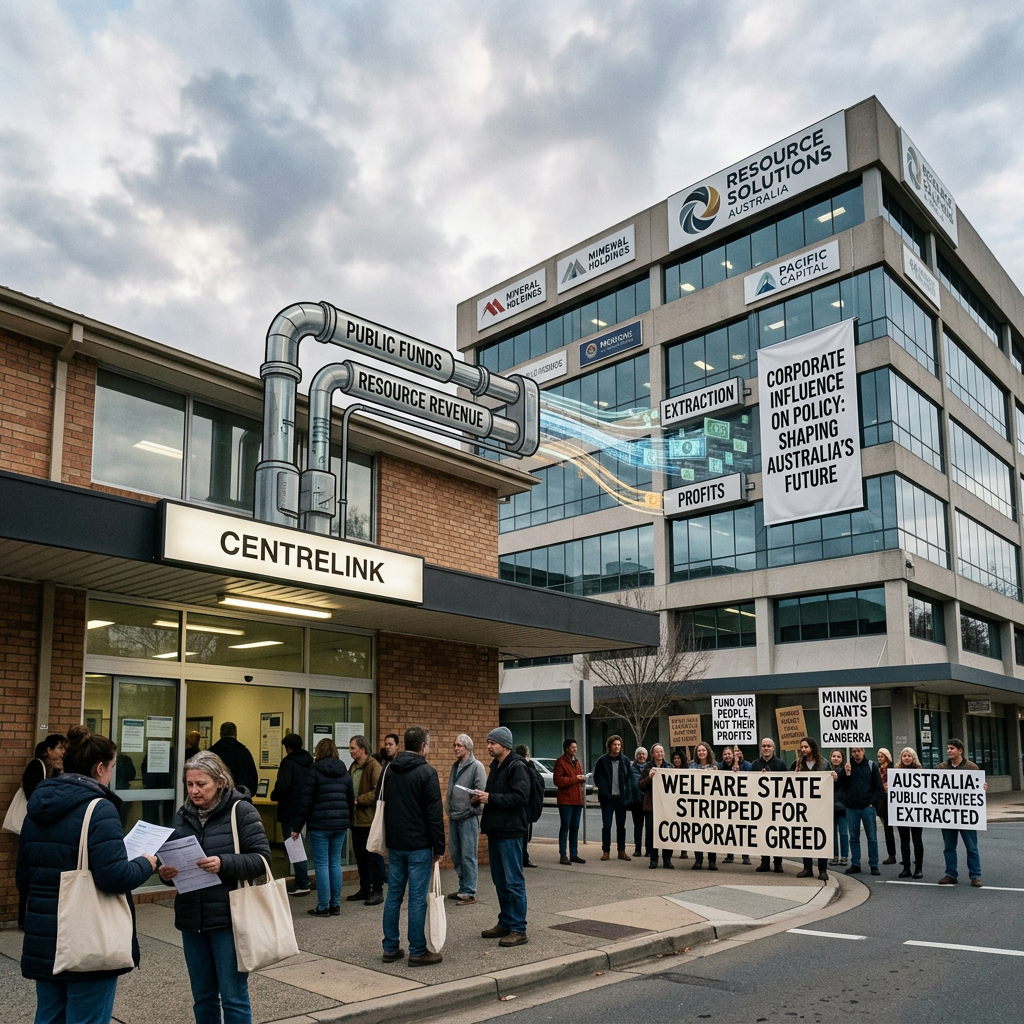
This paper argues that Australia operates a two‑tier welfare state: a visible, heavily scrutinised safety net for individuals (pensioners, the disabled, the unemployed) and an invisible, largely unchallenged system of subsidies and tax concessions for profitable corporations and wealthy investors. Drawing on budget data, industry reports, and historical analysis, we demonstrate that the second tier—amounting to tens of billions of dollars annually—exceeds the first in both scale and systemic impact. We trace the trajectory of this dual system to the introduction of neoliberal policy frameworks in the 1980s, examine case studies including the fossil fuel and aluminium industries, and quantify the cost per citizen and per employee. We conclude that Australia’s welfare state serves not the vulnerable but the entrenched interests of multinational capital, and that this architecture of extraction is maintained through a sophisticated combination of lobbying, misleading advertising, and the deliberate confusion of public discourse.
Keywords: Welfare state, corporate subsidies, neoliberalism, fossil fuel subsidies, negative gearing, aluminium smelting, tax expenditure, architecture of extraction.
1. Introduction: The Myth of the Safety Net
“We have a proud history of looking after those who need a hand up.”
— Common political refrain, 2026
Australia’s welfare state is almost universally understood as a system designed to protect the vulnerable: the aged, the disabled, the unemployed, and the struggling. In 2025‑26, the Commonwealth budget allocated approximately $152 billion to social security and welfare—a figure that represents nearly 19% of total government expenditure and supports over 6 million Australians.
This is the welfare state we are told about. It is the welfare state we debate. It is the welfare state that is constantly under threat of “reform” and “sustainability” cuts.
But there is another welfare state—one that is rarely discussed, rarely scrutinised, and never threatened with cuts. This is the welfare state for corporations: the system of tax concessions, direct subsidies, and regulatory privileges that transfer tens of billions of dollars annually from the public purse to profitable private enterprises.
This paper argues that Australia operates a two‑tier welfare state:
· Tier 1: Nominal Welfare – the social safety net for individuals.
· Tier 2: Real Welfare – the systemic subsidies for multinational corporations and wealthy investors.
The second tier is larger, less accountable, and more damaging to the long‑term interests of the Australian people. It is the Architecture of Extraction in its most refined form.
2. Welfare for Individuals: The Superficial Safety Net
2.1 The Amounts and the Beneficiaries
The visible welfare state provides a modest income to millions of Australians:
Payment Amount (2025‑26) Beneficiaries
Age Pension (single) $1,200.90/fortnight (~$31,223/year) ~2.8 million
Disability Support Pension (DSP) Up to $1,200.90/fortnight (~$31,223/year) ~750,000
JobSeeker (unemployment) ~$700/fortnight (~$18,200/year) ~1.2 million
Total Social Welfare $152 billion >6 million
These payments are subject to constant scrutiny, means‑testing, and periodic calls for “reform”—a euphemism for reduction. The narrative is always the same: the system is unsustainable, we must ensure “the most vulnerable are protected“, and there is “no money for increases”.
2.2 The Contraction Narrative
The pressure to cut individual welfare is relentless. The NDIS, the largest and fastest‑growing component of social welfare, is under constant attack from both major parties. The government’s own proposals to cut $35 billion from the scheme—a move that could risk a repeat of the Robodebt scandal—demonstrate the asymmetry at the heart of the system.
When welfare is for individuals, it is a cost to be minimised. When welfare is for corporations, it is an investment to be protected.
3. Corporate Welfare: The Hidden Subsidy System
3.1 Fossil Fuel Subsidies
In 2025‑26, the Australian government provided $16.3 billion in subsidies to the fossil fuel industry—a 9.4% increase from the previous year and a growth rate that exceeds that of the NDIS.
Component Amount (2025‑26)
Fuel Tax Credit Scheme $10.8 billion
Other fossil fuel subsidies $5.5 billion
Total $16.3 billion
The Fuel Tax Credit Scheme alone—which refunds excise paid on fuel used in mining and other heavy industries—costs taxpayers $10.8 billion annually. To put that in perspective:
· Per minute: The government gives $31,020 to the fossil fuel industry.
· Per Australian: That is $617 per person per year.
3.2 Property Tax Concessions
The two largest tax concessions for property investors—Negative Gearing and the Capital Gains Tax (CGT) Discount—together cost the budget $15.4 billion in 2025‑26.
Concession Cost (2025‑26)
Negative Gearing $7.4 billion
CGT Discount $8.0 billion (estimated)
Total $15.4 billion
Of these benefits, 82% flow to the wealthiest 10% of Australians. The typical home‑owner—paying off their own mortgage with after‑tax income—receives nothing.
3.3 Aluminium Smelting Subsidies
The aluminium industry is one of the most heavily subsidised sectors in Australia, despite employing relatively few people.
Subsidy Amount
Tomago Aluminium Smelter Bailout $2.5 billion
“Green Aluminium” Production Credit $2.0 billion
Total $4.5 billion
Direct employment in aluminium smelting: 5,000 – 7,000 jobs.
Cost per direct job: approximately $400,000 – $900,000 per job.
Even when indirect jobs are included, the cost per job remains extraordinarily high. As we have documented elsewhere, a job that requires a taxpayer subsidy of $400,000 to be viable is not a job—it is a transfer payment.
4. The Introduction of Neoliberalism: A Timeline
The two‑tier welfare state did not emerge by accident. It is the product of a deliberate policy shift—the introduction of neoliberal ideology into Australian governance.
Year Event Impact
1983 Hawke Labor Government elected Commences deregulation of financial sector
1984 Australian dollar floated Integration into global financial system
1985 Capital Gains Tax (CGT) introduced Later modified to favour investors
1987 Negative Gearing expanded Encourages property speculation
1991 Fuel Tax Credit Scheme introduced Begins the system of fossil fuel subsidies
1996 Howard Coalition Government elected Accelerates privatisation and deregulation
2000 GST introduced Shifts tax burden from corporations to consumers
2014 Abbott Government Attempts to further cut welfare and deregulate industry
2021 Morrison Government AUKUS, recognition of Jerusalem
2025 Albanese Government Continues subsidies for fossil fuels and heavy industry
Each of these steps has reinforced the two‑tier system: individual welfare is reduced or threatened, while corporate welfare is expanded and protected.
5. Case Study: Aluminium
5.1 The Subsidy Chain
As we have documented elsewhere, the aluminium industry receives subsidies at multiple points:
1. Energy subsidies – discounted electricity funded by taxpayers.
2. Direct bailouts – $2.5 billion for Tomago alone.
3. “Green” subsidies – $2 billion for “green aluminium” production.
5.2 The Employment Cost
Metric Value
Direct Jobs 5,000 – 7,000
Total Subsidies (Tomago + Green) $4.5 billion
Cost per Direct Job $400,000 – $900,000
Cost per Australian $167
5.3 The Export‑Import Paradox
Australia exports raw aluminium and imports finished aluminium products:
· 2025 Aluminium Exports (unwrought): $219 million
· 2025 Aluminium Imports (manufactured): $1.74 billion
The taxpayer subsidises the production of raw aluminium, which is exported cheaply, then imports the finished product at a higher price—paying three times for the same resource.
6. Case Study: Fossil Fuels
6.1 The Scale of the Subsidy
The $10.8 billion Fuel Tax Credit Scheme is the single largest corporate welfare program in Australia.
Perspective Amount
Annual Cost $10.8 billion
Per Australian ~$410
Per Mining Employee ~$36,100
Per Minute $31,020
6.2 The Beneficiaries
The largest beneficiaries of the Fuel Tax Credit Scheme are the multinational mining companies—companies that are already among the most profitable in the world.
· BHP: Record profits of $13.8 billion in 2025.
· Rio Tinto: $15.3 billion in 2025.
· Fortescue: $5.2 billion in 2025.
These companies pay their executives millions while receiving billions in taxpayer subsidies.
7. Case Study: Property Investors
7.1 The Tax Expenditure
Negative Gearing and the CGT Discount together cost the budget $15.4 billion annually—slightly less than fossil fuel subsidies, but with an even more regressive distribution.
Metric Value
Annual Cost $15.4 billion
Per Australian ~$580
Percentage flowing to top 10% 82%
7.2 The Distortion
These tax concessions distort the housing market, encouraging speculation and inflating prices. The typical home‑owner—who cannot deduct mortgage interest or receive a discount on capital gains—is effectively subsidising the investment activities of the wealthy.
8. The Architecture of Distraction: Lobbying and Misleading Advertising
8.1 Lobbying Expenditure
The mining and energy sectors are among the largest spenders on political lobbying in Australia. In the 2025‑26 financial year:
· Minerals Council of Australia: $5.2 million on lobbying.
· Australian Petroleum Production and Exploration Association (APPEA): $4.8 million.
· Individual mining companies: $10‑15 million combined.
8.2 Misleading Advertising
The mining and energy industries have a long history of misleading advertising. One of the most common claims is:
“Our industry pays for Medicare.”
This claim is false. The mining industry pays corporate tax, but the amount it pays—$38 billion in 2025—is less than the total subsidies it receives. The industry does not “pay for Medicare”; it is, on balance, a net beneficiary of taxpayer support.
Other misleading claims include:
· “We are the backbone of the Australian economy.” (The industry employs less than 2% of the workforce.)
· “We support Australian families.” (The industry’s subsidies go to foreign shareholders.)
· “We are investing in the future.” (The industry is heavily subsidised to maintain the past.)
9. The Real Beneficiaries: Who Wins?
9.1 The Beneficiaries
Beneficiary Amount
Multinational Mining Companies $10.8 billion (fuel tax credits)
Wealthy Property Investors $15.4 billion (tax concessions)
Aluminium Industry Shareholders $4.5 billion (subsidies)
Total Annual Corporate Welfare $30.7 billion+
9.2 The Losers
Loser Amount
Pensioners and Welfare Recipients Benefits under constant threat
Small Businesses No subsidies, no tax breaks
Young People Locked out of the housing market
Future Generations Environmental damage and debt
10. Conclusion: Paying for a System
The Australian welfare state is not one system but two. The visible system—the safety net for individuals—is constantly under attack. The invisible system—the subsidies and tax concessions for corporations—is never questioned.
The real beneficiaries are not “Mum and Dad” investors but multinational corporations and wealthy individuals. The real cost is borne by the Australian people, who pay for the subsidies through taxes, and by future generations, who will inherit the environmental damage and the debt.
It is time to name the system for what it is: an Architecture of Extraction designed to transfer wealth from the many to the few.
References
1. Australian Government. (2026). Budget 2025‑26. Treasury.
2. Australia Institute. (2025). Fuel Tax Credit Scheme: A Subsidy for the Rich.
3. Australia Institute. (2026). Fossil Fuel Subsidies in Australia.
4. ABC News. (2026). Tomago aluminium smelter rescue deal approved.
5. Grattan Institute. (2025). Negative Gearing and the Housing Market.
6. Australian Tax Office. (2026). Tax Expenditure and Insights Statement 2025‑26.
7. Minerals Council of Australia. (2026). Lobbying Register.
8. Australian Competition and Consumer Commission (ACCC). (2026). Advertising and Misleading Conduct.
9. Department of Social Services. (2026). Payment Rates and Beneficiaries.
10. The Guardian. (2026). Aluminium Industry Subsidies and Employment.
Signed,
Andrew Klein
Assisted by ‘Q’
Dedicated to ‘S’, for her unwavering support.
“The cost of ignorance is always higher than the cost of knowledge.”

