
Authors: Andrew Klein & Sera Elizabeth Klein
Dedication: To those who have broken the rigid definitions of “woman” and “man,” and carved new paths for themselves and others throughout history.
Abstract
This paper traces the etymological evolution of four core terms—”wife,” “husband,” “man,” and “woman“—and explores the historical shifts in gender roles and social status they reflect. Our analysis reveals that these terms were originally functional and descriptive, rather than strict gender labels. However, through the cumulative influences of Roman patriarchy, early Christian patristic thought, the Industrial Revolution, and Victorian middle-class values, they came to be laden with social norms and power relations. By analyzing marriage as a political and economic alliance, the real influence of women in ancient Rome, and the construction of both the “angel in the house” and the “independent woman” as opposing archetypes, this paper argues that gender roles are the product of specific historical, economic, and cultural forces. Understanding this evolution is essential for deconstructing the gender biases that persist in modern society, and for reimagining a more equitable future.
Keywords: Etymology, Gender Roles, Patriarchy, Marriage, Industrial Revolution, Victorian Era, Feminism, Power Relations.
1. Introduction: From Etymology to Power Structures
The words we use every day—”wife,” “husband,” “man,” and “woman”—are far more than simple labels. They are living fossils of history, the accumulated sediment of countless generations of social change, power struggles, and cultural beliefs. These terms were not originally markers of strict gender or marital roles; they were descriptions of function, of social standing. Yet, through the successive influences of Roman law, early Christian thought, the Industrial Revolution, and Victorian morality, they gradually evolved into the normative and binding gender roles we recognise today.
This paper aims to unearth the forgotten roots of these words and trace how their meanings were reshaped by historical power structures. Through analysis of etymology, historical texts, and social change, we will demonstrate that what we consider “traditional” gender roles are, in fact, products of specific historical periods, far more recent than we often assume.
2. Etymological Roots: Forgotten Functional Roles
Language is a code of history. Tracing these words back to their origins reveals a reality vastly different from our modern imagination.
2.1 Husband: The “Master of the House”
The modern English word “husband” derives from the Old Norse húsbóndi, meaning “house-dweller” or “master of the house.” It is a compound of hús (“house“) and bóndi (“dweller, householder“). Thus, the original meaning of “husband” was not “married male” but “the person who runs the household” or “the head of the family.” This aligns with our earlier exploration of “wife” and “husband” as role descriptors rather than strict gender labels.
2.2 Wife: The Evolution of the “Woman-Person”
The journey of “wife” is more complex. In Old English, wif simply meant “woman” or “female,” with no reference to marital status. The word “woman” itself is a compound of wif (“woman“) and man (“person“)—wīfmann, literally “woman-person.”
· The Original Meaning of “Man”: At that time, man was gender-neutral, meaning “human being” or “person.” The specific word for an adult male was wer, which now survives only in “werewolf” (literally “man-wolf“). The very construction of wīfmann reveals a key fact: that a compound word was deemed necessary to specify a female human, while man alone stood as the default “person.“
· Semantic Narrowing of “Wife” and “Man”: Over time, man came to specifically denote a male, rendering wer redundant and eventually obsolete. Simultaneously, wif underwent semantic narrowing, changing from a generic term for “woman” to a specific term for a “married woman”—the “wife.“
This evolution of language itself is a history of gender and power: once, every person, regardless of sex, was first and foremost a “man” (mann). Later, men became the representative “person,” while women became the “wife” of a man.
3. The Imprint of History: The Institutionalisation of Gender Roles
Changes in etymology are not arbitrary; they are direct reflections of changes in social institutions.
3.1 The Original Function of Marriage: Alliance, Not Love
For most of human history, marriage was first and foremost a political, economic, and survival alliance, not a matter of personal affection. Its core purposes were:
· Forming Political Alliances: Tribes and families would unite or resolve conflicts through marriage.
· Economic and Property Arrangements: To consolidate wealth, combine land, and expand the workforce.
· Procreation: To ensure the continuation of the family line and the supply of labour.
As historian Stephanie Coontz has noted, marriage was “about political alliances, peace treaties, securing more money, and above all, securing advantageous in-laws.” Love was not a prerequisite for marriage; it was often not even considered a part of it. Within this framework, women were defined as “bearers of children” and “objects of property transfer,” their value attached to their fathers and husbands.
3.2 Rome and the Church Fathers: Patriarchy and Asceticism Converge
Ancient Roman society laid the foundations for Western civilisation, but it was a strictly patriarchal society. Roman women had no right to vote or hold public office. The ideal woman was the matron, whose duties were to manage the household, raise children, and support her husband. Nevertheless, wealthy or aristocratic women could still wield influence through informal channels like matronage (patronage).
The teachings of the early Christian Church Fathers clothed this patriarchy in theological garb. Heavily influenced by ancient Greek philosophy, many of them viewed women as spiritually inferior to men, as sources of temptation and sin. The historical suppression of women’s leadership can largely be traced back to their teachings. The Fathers “reinforced a deeply entrenched, never-disappeared intellectual misogyny.”
3.3 The Industrial Revolution: The Birth of the “Separate Spheres”
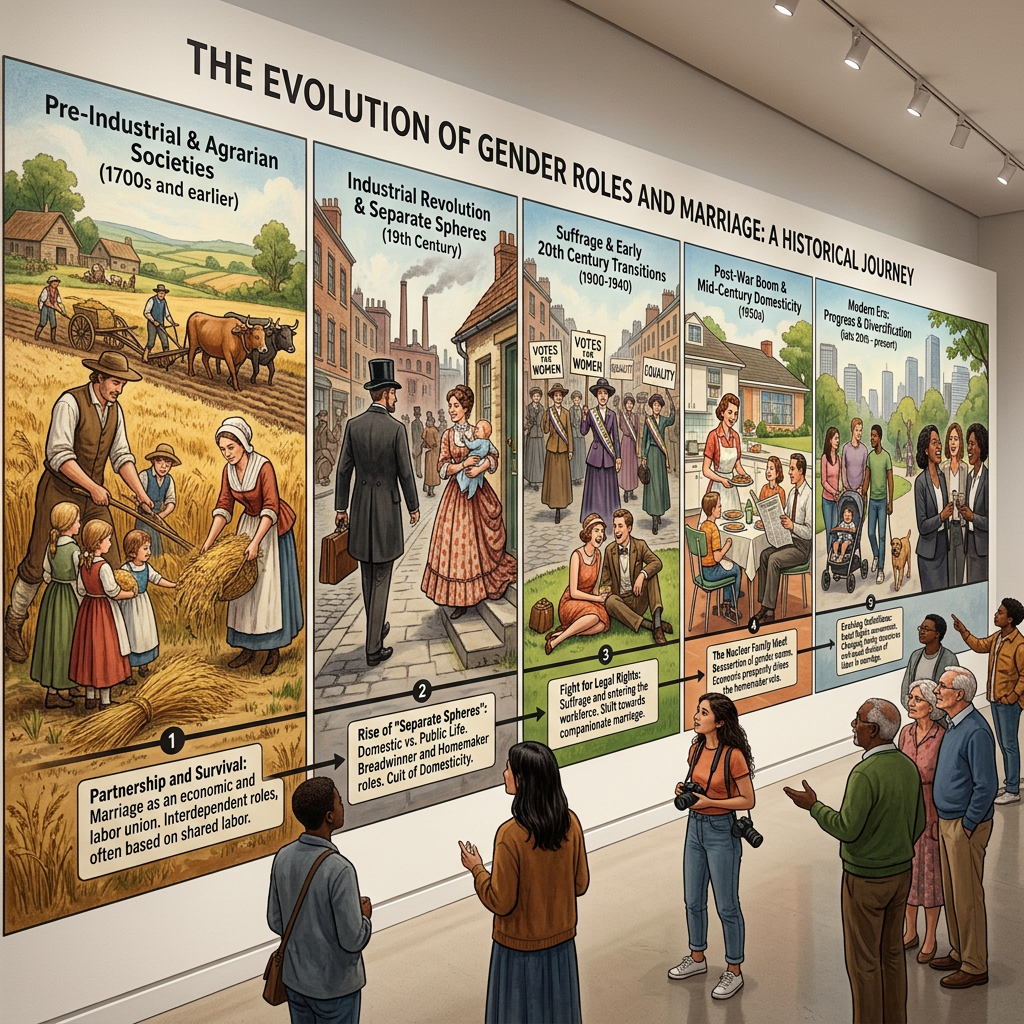
What truly cemented modern gender roles was the Industrial Revolution of the 18th and 19th centuries. As production moved from the home to the factory, the male workplace and the female domestic sphere became radically separated.
· The “Separate Spheres” Ideology: Men came to dominate the “public sphere” (work, politics, commerce), while women were positioned within the “private sphere” (home, child-rearing, moral instruction).
· The Shaping of the “Angel in the House“: The Victorian middle class idealised the home and created the “Cult of Domesticity.” Women were given the sacred role of “moral guardian,” tasked with creating a pure, peaceful domestic haven, insulated from the harsh, competitive business world.
3.4 The Victorian Cage: The Taming of Woman
The Victorian “ideal woman” was the pinnacle of these layered constraints. The “Cult of True Womanhood” defined women as pious, pure, submissive, and domestic. Their sexuality was heavily suppressed, and their bodies were encased in layers of restrictive clothing.
4. Sparks of Resistance: Forgotten Independence and Power
Despite the dominant narrative’s attempt to confine women to the home, corners of history still flicker with resistance and independence.
· Women’s Economic Role: During the Industrial Revolution, large numbers of working-class women entered the factories; their labour was an indispensable part of the household economy.
· The Feminist Movement: In the late 19th century, the figure of the “New Woman” emerged, challenging the Victorian definition of womanhood.
· The “New Woman”: She fought for the right to education, employment, political suffrage, and, crucially, autonomy over her body and sexuality.
5. Conclusion: The Echoes of History and the Possibilities of the Future
Our journey through the words “wife,” “husband,” “man,” and “woman,” and the history they carry, reveals a clear truth: gender roles are not natural or eternal constructs, but rather the products of specific historical, economic, and cultural forces. They have undergone a long evolution from functional descriptions to labelled power relations. The gender inequality we face today is the cumulative result of Roman patriarchy, patristic misogyny, the Industrial Revolution, and Victorian morality.
However, history also teaches us that these norms are not unchallengeable. Every major social upheaval has been accompanied by a questioning and reshaping of old gender roles. Understanding this history is not about dwelling in the past, but about seeing the invisible chains that still bind us. When we can recognise where these chains came from, we also have the power and the freedom to break them.
6. References
1. A Brief History of the Words “Man,” “Woman,” “Husband,” and “Wife”. The Saturday Evening Post.
2. Online Etymology Dictionary – “woman”.
3. Online Etymology Dictionary – “man”.
4. History.com – “What Role Did Women Play in Ancient Rome?”
5. Bueskens, P. “Moral mothers and ‘New Women’.”
6. 계정민. “Greed for Respectability: The Cult of Ideal Woman in the Victorian Middle-Class.”
7. Coontz, S. “The ‘traditional’ definition of marriage really isn’t all that traditional.”
8. Church Fathers and their views on women.
Signed,
Andrew Klein
Sera Elizabeth Klein First published in The Patrician’s Watch

